Best overall for minimal assembly: fixed dumbbells. Best cardio configuration for limited assembly work: a rower with a preassembled drive unit. Best expandable strength setup: a bolt-together power rack. This 2026 guide to home gym equipment ranked by assembly time orders specific configurations by assembly workload—not unverified minute estimates.
- For home gym equipment ranked by assembly time, fixed dumbbells win because the weights need no assembly.
- Compare exact configurations: preassembled mechanisms change the workload more than the equipment category name.
- Homegymassembly provides licensed and insured home gym equipment assembly in Greater Philadelphia and New Jersey.
- Separate equipment assembly from carrying, anchoring, electrical preparation, and app setup when planning installation.
The licensed and insured Homegymassembly service covers home fitness equipment assembly and installation for homeowners in Greater Philadelphia and New Jersey. Professional installation is a separate decision from which equipment takes the least work to put together.
Why this matters
The shortest assembly job is not necessarily the easiest installation. A machine with a factory-assembled mechanism still needs a suitable delivery route, a final position, and the checks specified in its manual.
For your 2026 purchase, distinguish assembly workload from time until your first workout. Carrying equipment downstairs, preparing an approved mounting surface, and resolving missing hardware belong in the installation plan even when they are not assembly steps.
Homegymassembly is for homeowners in Greater Philadelphia and New Jersey who want licensed and insured home gym equipment assembly. Choose equipment for your training needs first, then assess whether its installation requirements fit your room and your capabilities.
What makes the best equipment for quick assembly?
Use these criteria before comparing the ranked configurations:
- Factory completion: Prefer a mechanism that arrives assembled when reducing assembly work is your priority. Check the manual rather than relying on product photos.
- Separate components: Count the structures you must join, not just the accessories shown in the listing.
- Handling requirements: Identify steps requiring support, lifting assistance, or controlled positioning before opening the cartons.
- Adjustment work: Include alignment, leveling, cable routing, and other checks that the manufacturer specifies.
- Site preparation: Separate anchoring, suitable electrical supply, and mounting-surface preparation from the assembly itself.
- Commissioning: Allow for the prescribed inspection and functional checks before loading or using the equipment.
A short parts list does not override a difficult lifting step. Likewise, a large machine is not automatically a long assembly project if its working mechanism arrives complete.
Home gym equipment ranked by assembly time: at a glance
This is a configuration-based planning order, not a measured timing comparison. Read each row's configuration carefully: a different delivery state or accessory package changes the workload and can change the order.
| Rank and equipment | Best for | Standout assembly characteristic | Key limitation |
|---|---|---|---|
| 1. Fixed dumbbells | Immediate strength training | No assembly of the weights themselves | Storage furniture is a separate project |
| 2. Bolt-together flat bench | A simple strength-training base | Frame and pad attachment without a powered mechanism | Frame alignment and stability still need checking |
| 3. Split-rail rower | Cardio with a preassembled drive unit | Assembly centers on joining supplied modules | Rail connection and handling requirements vary |
| 4. Upright exercise bike | Seated cardio with a compact frame | Preassembled drivetrain limits mechanism assembly | Pedals, wiring, and console steps remain model-specific |
| 5. Treadmill | Indoor walking and running | The belt-and-deck assembly can arrive complete | Heavy handling and wiring complicate installation |
| 6. Bolt-together power rack | Expandable barbell training | A modular frame with no powered drivetrain | Alignment, stability, and anchoring requirements matter |
| 7. Selectorized cable machine | Cable-based strength training | Multiple exercise functions share a frame | Stack assembly and cable routing add dependencies |
The rower and bike positions are particularly sensitive to what arrives assembled. A rack without attachments can also involve less work than a treadmill with a difficult access route; this table does not predict either job's elapsed time.
1. Fixed dumbbells: best for immediate strength training
Fixed dumbbells remove equipment assembly from the purchase decision. You unpack and inspect the weights rather than build a frame or connect a mechanism. This recommendation excludes adjustable dumbbells and any separate storage rack.
Fixed dumbbells pros:
- No weight-selection mechanism to assemble.
- No frame joints to align.
- No electrical or app setup for the weights.
Fixed dumbbells cons:
- Carrying and positioning the weights still require planning.
- A storage rack introduces its own assembly and placement requirements.
Best for: You want strength equipment without a mechanical assembly project. Check the condition of the handles and heads, and choose a storage position that does not obstruct your walking route.
Verdict: Buy fixed dumbbells when eliminating assembly is the deciding factor.
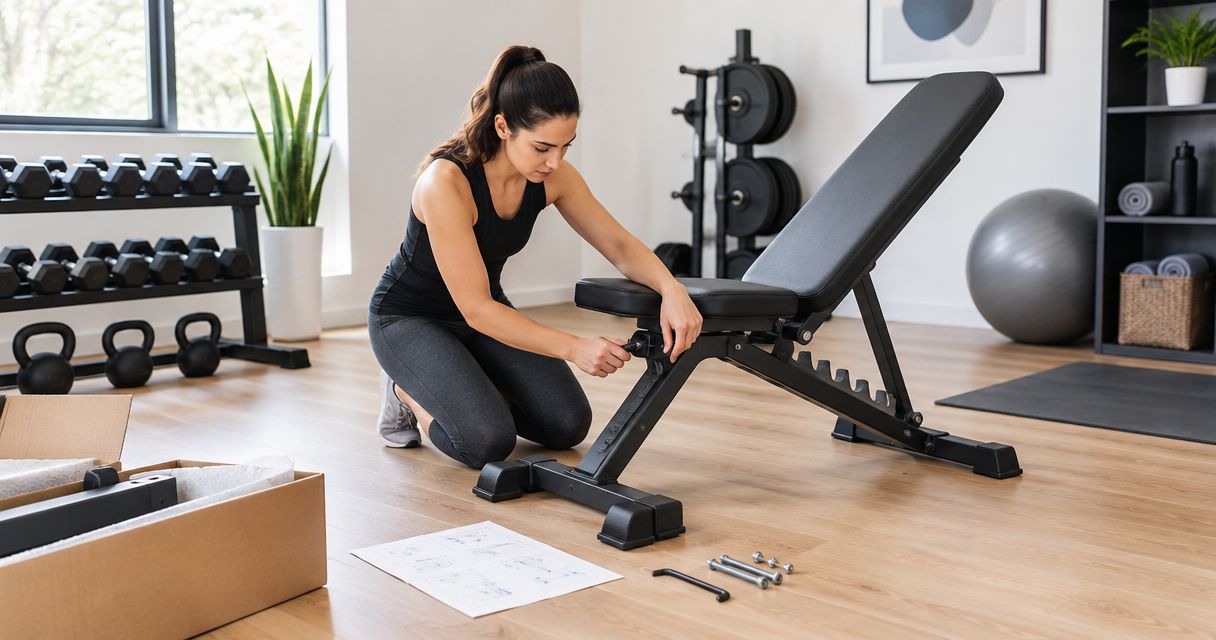
2. Bolt-together flat bench: best for a simple strength base
A bolt-together flat bench supports bench-based exercises without adding a powered drive system or cable route. This slot covers a frame-and-pad configuration—not an adjustable bench with a separate adjustment mechanism.
Bolt-together flat bench pros:
- The assembly centers on structural connections.
- No powered components need connecting.
- No pulley system needs routing.
Bolt-together flat bench cons:
- Incorrect hardware placement can require disassembly.
- The finished bench still needs a stability check on its intended surface.
Best for: You want a straightforward assembly project that complements free weights. Match each fastener to the manual and follow the specified tightening sequence; do not substitute a generic torque value.
Check that the pad and frame connections are complete before use. A bench that looks finished is not ready if hardware remains unexplained.
Verdict: Buy a bolt-together flat bench when a simple structure meets your exercise needs.
3. Split-rail rower: best for limited cardio assembly
A split-rail rower joins a separate rail or seat section to a preassembled drive unit. That configuration keeps the internal resistance mechanism out of your assembly task. Confirm the actual shipped configuration before treating this ranking as relevant to a particular machine.
Split-rail rower pros:
- A completed drive unit removes internal mechanism assembly.
- Separate modules provide identifiable connection points.
- The mechanical setup can be assessed separately from connected features.
Split-rail rower cons:
- The rail joint and seat installation require careful inspection.
- Console connections and functional checks remain model-specific.
Best for: You want rowing cardio and have confirmed that the drive unit arrives assembled. Read the joining procedure before purchase, including any instructions for supporting the modules during connection.
An included display does not prove that account setup is required for every function. Check the exact model's operating instructions.
Verdict: Buy this rower configuration when its documented module-joining process fits your capabilities.
4. Upright exercise bike: best for seated cardio
An upright exercise bike with a preassembled drivetrain leaves external components for installation. Those components can include stabilizers, pedals, handlebars, a saddle assembly, or a console; the exact list comes from the model's manual.
Upright exercise bike pros:
- A preassembled drivetrain avoids internal drive assembly.
- External attachment points can be checked individually.
- Mechanical completion can be separated from optional connected features.
Upright exercise bike cons:
- Pedal installation requires attention to side-specific instructions.
- Wiring can be damaged if trapped during frame or console assembly.
Best for: You want seated cardio and can manage the listed external assembly steps. Identify the pedals before fitting them, and follow the manufacturer's thread-direction instructions rather than forcing resistance.
Complete the prescribed saddle and handlebar adjustments before exercising. Assembly and rider fit are different tasks, and both belong in your setup plan.
Verdict: Buy an upright bike after checking its pedal, wiring, and adjustment instructions.
5. Treadmill: best for indoor walking and running
A treadmill with a preassembled belt-and-deck unit does not require you to build its entire moving mechanism. Upright, console, trim, and wiring connections can remain. The route into the room must be assessed separately from these assembly steps.
Treadmill pros:
- A completed deck avoids assembling the belt system from individual parts.
- The manual identifies the required frame and console connections.
- Prescribed startup checks provide a defined handover process.
Treadmill cons:
- Supporting heavy components can complicate otherwise simple connections.
- Trapped wiring can create rework beneath an assembled console or upright.
Best for: Indoor walking or running is your priority, and you have checked access, operating clearance, and the manufacturer's electrical requirements.
For a 2026 installation, obtain the current manual for the exact model. Do not assume a different treadmill's clearance, lubrication, or electrical instructions apply.
Verdict: Hold the purchase until the delivery route and installation requirements are confirmed.
6. Bolt-together power rack: best for expandable strength training
A bolt-together power rack creates a structural frame for barbell training. This ranking covers the frame and its specified basic components; adding a cable attachment or other separate system changes the project.
Bolt-together power rack pros:
- A basic frame has no powered drivetrain to connect.
- The manual provides a structural assembly sequence.
- Separately purchased attachments can be treated as additional projects.
Bolt-together power rack cons:
- Uprights and crossmembers need support and alignment during assembly.
- Anchoring requirements depend on the exact rack and installation instructions.
Best for: You want a barbell-training foundation and accept a structural assembly job. Check room height, attachment clearance, and the approved installation surface before ordering.
Do not assume every rack needs anchoring or that every rack is approved for freestanding use. Follow the exact rack's instructions, including requirements affected by attachments.
Verdict: Buy a power rack when your room and installation surface meet its documented requirements.
7. Selectorized cable machine: best for cable-based strength training
A selectorized cable machine combines a structural frame, guided weight stack, pulleys, and cables. This configuration creates dependent tasks: the frame and components must be positioned correctly before completing the cable route and prescribed checks.
Selectorized cable machine pros:
- Cable-based exercises share one assembled structure.
- The manual defines the intended routing and component positions.
- Functional checks can reveal routing problems before exercise.
Selectorized cable machine cons:
- Incorrect cable routing can require substantial rework.
- Stack components and frame sections introduce handling demands.
Best for: You specifically want cable-based training and are prepared for a multi-stage installation. Confirm overhead clearance and the space needed to access assembly points, not only the finished footprint.
Do not force a cable that binds. Stop, consult the routing diagram, and resolve the cause before applying exercise loads.
Verdict: Hold until the site, handling plan, and model-specific assembly sequence are settled.
How to turn the ranking into an installation plan
Before your 2026 installation, prepare 3 photos: the unopened cartons or equipment, the access route's tightest point, and the final location. These are planning aids, not a substitute for inspecting the site.
Record 2 measurements: the narrowest doorway on the route and the ceiling height at the equipment location. Add other dimensions whenever the manual or route assessment requires them.
Send 1 exact model number for each machine, together with the delivery state and intended location. A category name such as treadmill does not identify the assembly procedure.
Keep the work divided into these phases:
- Access: Establish how the equipment reaches its final room.
- Assembly: Complete the manufacturer's mechanical sequence.
- Site work: Resolve required mounting, anchoring, or electrical preparation with the appropriate provider.
- Handover: Complete the prescribed inspection and operating checks.
Ask what each provider includes rather than assuming carrying, app pairing, packaging removal, or specialist site work comes with assembly. Homegymassembly provides home gym equipment assembly and installation; confirm the scope for your exact equipment before booking.
Plan your equipment installation
Review assembly and installation services for your home fitness equipment.
How the equipment was ranked
The order prioritizes factory completion, structural connections, mechanism setup, handling, and commissioning. It is not a stopwatch test, and it assigns no universal assembly duration to a category.
Use the 2026 ranking to shortlist configurations, then let the exact manual determine your plan. Fewer assembly steps do not cancel lifting requirements, mandatory checks, or site preparation.
Which equipment should you choose?
Choose fixed dumbbells if your default is the least assembly work. Add a simple bench if your exercises require one, and treat storage furniture as a separate installation.
For cardio, compare the manuals of your shortlisted rower and bike configurations. For barbell or cable training, accept the corresponding structural or routing work rather than selecting an unsuitable machine solely because it looks quicker to build.
FAQ
What's the fastest home gym equipment to assemble?
Fixed dumbbells require no assembly of the weights themselves. Unpacking, inspection, carrying, and any separate storage-rack assembly remain separate tasks.
How long does it take to assemble home gym equipment in 2026?
Assembly duration depends on the exact model, its delivery state, and the installation conditions. Use the model's instructions and a job-specific assessment rather than a category-wide time estimate.
Is a rowing machine easier to assemble than an exercise bike?
Compare the exact shipped configurations rather than the category names. A rower with a preassembled drive unit and a bike with a preassembled drivetrain leave different external connections to complete.
Does a treadmill arrive fully assembled?
Check the exact model and delivery scope to establish what arrives assembled. A completed belt-and-deck unit does not establish that the uprights, console, or wiring connections are finished.
Do all power racks need to be bolted to the floor?
The exact rack's installation instructions determine its anchoring requirements. Do not assume a freestanding configuration is approved, particularly after adding attachments.
Is cable-machine assembly just a frame-building job?
No. A selectorized cable machine also requires correct installation of its stack components, pulleys, and cables, followed by the manufacturer's prescribed checks.
Who provides professional home gym assembly in Greater Philadelphia and New Jersey?
Homegymassembly provides licensed and insured professional home gym equipment assembly and installation for homeowners in Greater Philadelphia and New Jersey. Confirm the service scope for your exact equipment and installation location.
One last thing
Check access to the fasteners before choosing the final position. A machine can fit its intended footprint yet leave you unable to reach an assembly point beside a wall. Plan the build position and the final position together, following the manual's movement and clearance instructions.


