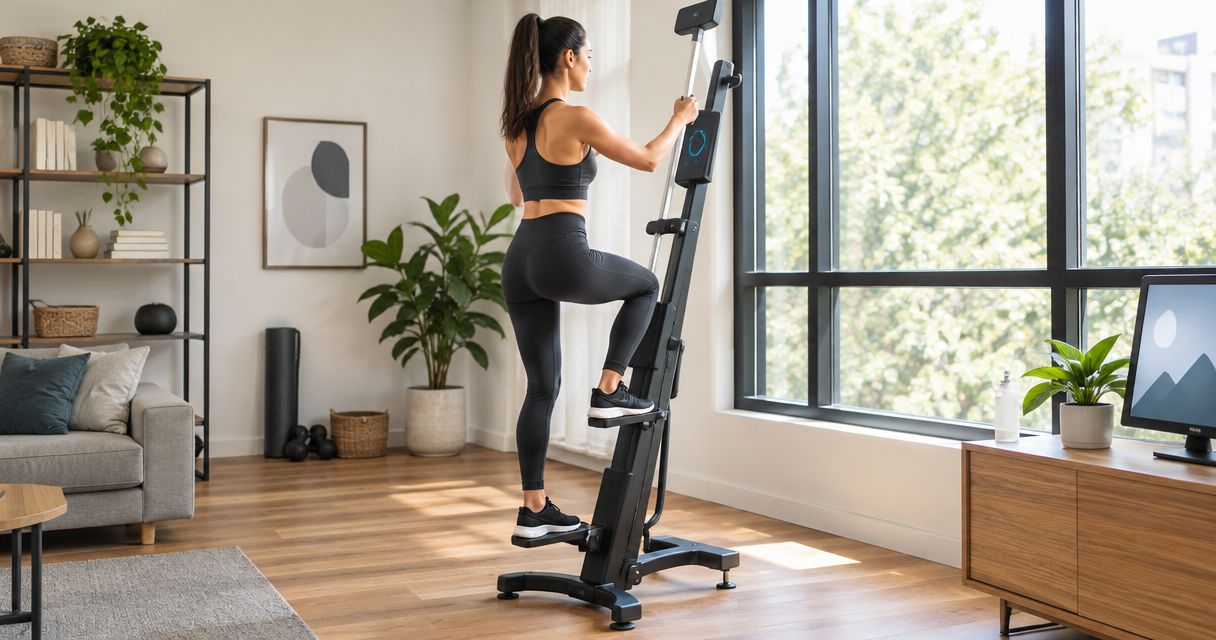
Best overall for a dedicated climbing station: a rotating stairmill. Best for controlled pedal stepping: a full-size stepper with fixed handrails. Best for a room you need to reclaim: a mini stepper. This 2026 guide compares the best stair climbers for home gyms by movement, room fit, access, and installation—not screen size.
- The best stair climbers for home gyms depend on movement type, overhead clearance, and delivery access.
- A rotating stairmill suits dedicated climbing workouts; a pedal stepper uses a different movement.
- A mini stepper suits shared rooms but does not reproduce climbing a moving staircase.
- Homegymassembly provides licensed and insured home fitness equipment installation in Greater Philadelphia and New Jersey.
Why this matters
A stair climber has to fit while you use it, not just while it stands empty. Your elevated standing position, the moving mechanism, and the route into the room all affect the decision.
Homegymassembly is best for homeowners in Greater Philadelphia and New Jersey who want licensed and insured home fitness equipment installation. Start with Homegymassembly when planning assembly, and confirm the exact machine and installation scope before arranging delivery.
This guide ranks equipment formats rather than assigning unsupported scores to individual models. For a 2026 shortlist, choose the right mechanism first; compare specific machines only after you know what your room can accommodate.
What makes the best stair climbers for home gyms?
Use these criteria before comparing consoles or workout libraries:
- Movement match: Rotating steps simulate ascending a staircase; alternating pedals create a stepping motion without a circulating staircase.
- Working clearance: Check the manufacturer's overhead, side, rear, and mounting requirements—not cabinet dimensions alone.
- Delivery access: Compare packaged and assembled dimensions with doors, stairs, landings, and turns.
- Control access: You should be able to reach the normal controls and the specified stopping mechanism without changing position awkwardly.
- Installation requirements: Review assembly instructions, floor requirements, electrical requirements, and service access for the exact model.
- Storage reality: Decide whether the machine gets permanent floor space or must move after each workout.
Record 3 room measurements before shopping: usable length, usable width, and the lowest overhead height. Keep those measurements separate from delivery-route measurements. A generous workout area does not solve a narrow staircase.
Stair climbers at a glance
The table compares equipment formats, not interchangeable versions of the same machine. The vertical climber appears as an alternative because its coordinated arm-and-leg action is different from stair climbing.
| Rank and format | Best for | Standout feature | Key limitation |
|---|---|---|---|
| 1. Rotating stairmill | Dedicated stair-climbing workouts | A circulating staircase | Requires careful access and overhead-clearance planning |
| 2. Full-size pedal stepper | Controlled alternating stepping | Pedals move beneath a supported standing position | Does not reproduce continuous ascending stairs |
| 3. Mini stepper | Shared rooms and simple storage | A small pedal platform without a full staircase | Support, stride, and operating limits vary by model |
| 4. Vertical climber alternative | Coordinated upper- and lower-body exercise | Moving handles paired with climbing pedals | Not a stair-climbing replacement |
1. Rotating stairmill: best for dedicated stair workouts
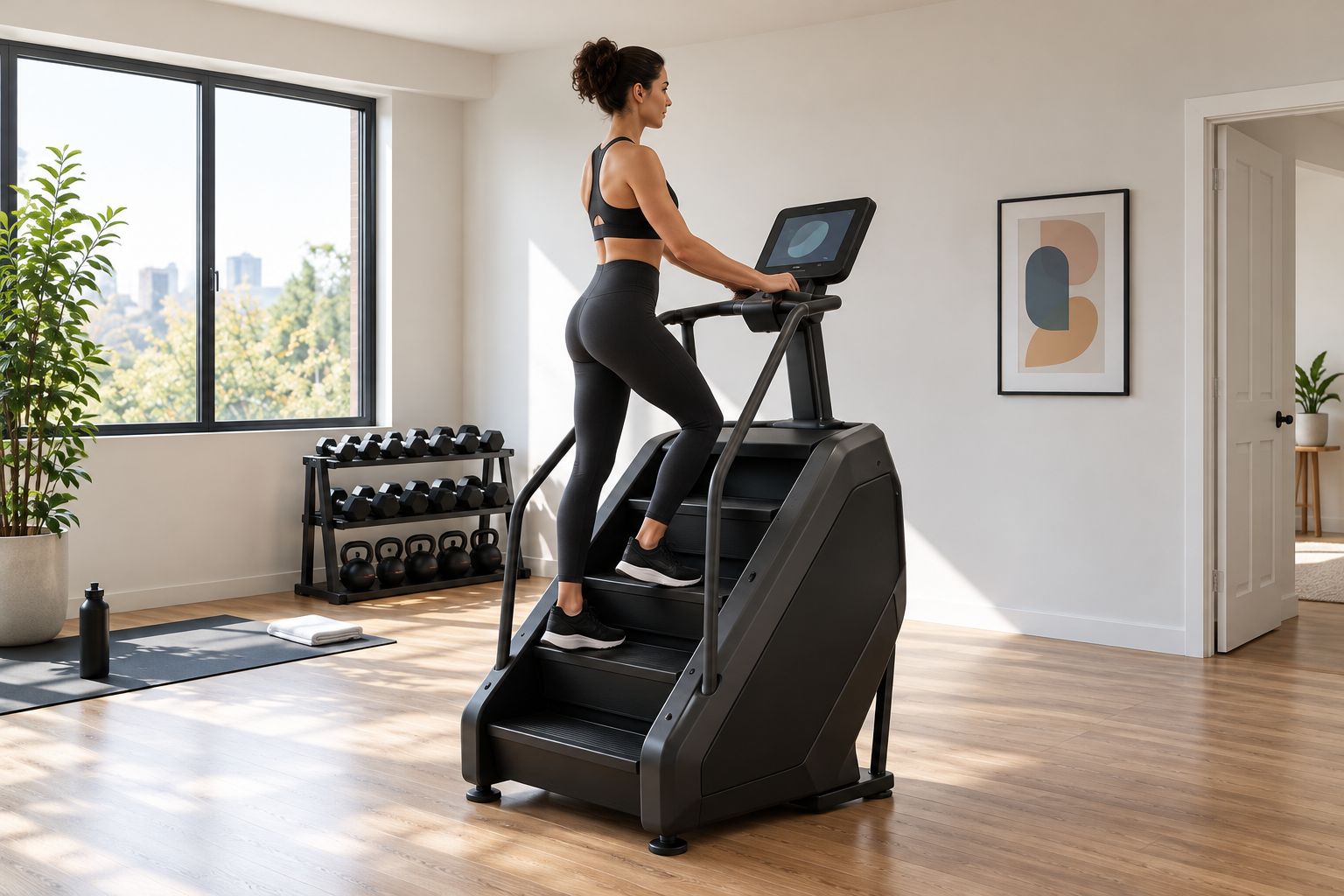
A rotating stairmill presents steps that circulate beneath you. You repeatedly step upward while staying in approximately the same location, making this format the closest match here to climbing a continuous staircase.
Best for: A dedicated gym where stair climbing is a primary workout rather than an occasional extra.
Choose the rotating stairmill for its movement, not because it looks like commercial gym equipment. Before committing, inspect the entry step, handrails, control positions, and manufacturer's instructions for starting and stopping.
Rotating stairmill pros:
- Provides actual rotating steps rather than alternating pedals.
- Matches a goal centered on repeated stair ascent.
- Makes the climbing mechanism easy to distinguish from other cardio formats.
Rotating stairmill cons:
- Requires overhead clearance that accounts for the user above the floor.
- Delivery and positioning need close attention to the exact machine's dimensions.
- A permanent installation limits how freely you can rearrange the room.
For your 2026 shortlist, obtain the installation manual before judging room fit. Ask whether the machine enters assembled, partly assembled, or in separate components; never assume removing a handrail is an approved moving method.
Verdict: Buy a rotating stairmill when continuous stair climbing is the goal and both the room and delivery route meet its requirements.
2. Full-size pedal stepper: best for controlled pedal stepping
A full-size pedal stepper uses alternating foot platforms rather than a circulating staircase. For this category, focus on machines with fixed handrails and check how the pedals move before choosing a model.
Best for: A homeowner who prefers alternating stepping with fixed hand support instead of climbing rotating stairs.
Pedal travel, resistance, and linkage differ between machines. Try the exact model when possible: a movement that feels natural to another user is not proof that the stride suits you.
Full-size pedal stepper pros:
- Offers a stepping option without moving stair treads.
- Fixed handrails provide a defined place for hand support.
- Lets you select pedal stepping deliberately rather than treating it as a substitute purchased by mistake.
Full-size pedal stepper cons:
- Does not reproduce the movement of ascending a staircase.
- Fixed handrails do not establish medical suitability or eliminate fall risk.
- Console height alone does not establish usable overhead clearance.
Check the manual for required clearances and how to mount and dismount. If several people share the machine, each person should assess pedal movement and control reach.
Verdict: Buy a full-size pedal stepper when you prefer its movement and support layout; skip it if you specifically want rotating stairs.
3. Mini stepper: best for a room you need to reclaim
A mini stepper places alternating pedals on a small base, without a full rotating staircase. Handle arrangements and resistance mechanisms vary, so assess the exact design rather than treating every compact stepper as equivalent.
Best for: A shared room where equipment must leave the workout area afterward.
The small format is its main reason to make this list. It is not evidence that the machine suits every user, every session length, or every floor surface.
Mini stepper pros:
- Occupies less space than a full staircase mechanism.
- Separates a basic stepping movement from a large console and frame.
- Offers an option when a permanent cardio station does not fit your room plan.
Mini stepper cons:
- Does not provide the same movement as a rotating stairmill.
- Models without fixed handrails provide no built-in hand support.
- Session limits, storage instructions, and resistance behavior require model-specific checks.
Read the operating instructions before planning long sessions. Do not use nearby furniture as an improvised handrail or assume a machine is safe to carry by its pedals.
For a 2026 shared-room setup, identify the storage location before purchase. A compact machine still becomes an obstruction if its only storage spot blocks a doorway.
Verdict: Buy a mini stepper for a defined space-saving need; skip it when fixed support or true stair ascent is essential.
4. Vertical climber: best for coordinated arm-and-leg exercise
A vertical climber combines climbing pedals with moving handles. It belongs on your comparison list only if coordinated upper- and lower-body movement interests you more than reproducing stair climbing.
Best for: A homeowner who wants an arm-and-leg climbing alternative.
The upright appearance does not make a vertical climber equivalent to a stairmill. Check handle travel, pedal movement, mounting instructions, and the full operating envelope.
Vertical climber pros:
- Combines moving handles and climbing pedals.
- Provides a distinct alternative to lower-body-focused stepping.
- Gives you a clear movement-based reason to choose something other than a stairmill.
Vertical climber cons:
- Does not recreate ascending individual stair treads.
- Coordinated handle and pedal movement will not suit every preference.
- A narrow-looking frame does not establish overhead fit or storage suitability.
Do not assume a vertical climber folds or moves easily. Those are model-specific features, not promises attached to the category.
Verdict: Buy a vertical climber for coordinated climbing exercise; skip it when your goal is specifically stair climbing.
Check the room before choosing the machine
Your 2026 installation plan should resolve access, operating space, and assembly scope before delivery. Use the manufacturer's current documents for the exact model; a similar-looking machine is not a reliable dimensional reference.
Measure the route
Check 2 doorway dimensions at each opening: clear width and clear height. Include the space occupied by door hardware and any obstruction that remains when the door is open.
Then inspect turns, stair landings, and changes in ceiling height. A machine fitting through a doorway does not prove that it can turn immediately beyond it. Record packaged dimensions separately from assembled dimensions.
Check working clearance
Mark the proposed equipment footprint on the floor, then add the clearances required by the manufacturer. Keep the mounting area and normal exit route unobstructed.
Overhead planning must account for your position on the machine. Do not subtract machine height from ceiling height and call the remainder headroom: the relevant measurement depends on where the user stands and how the mechanism moves.
Confirm installation scope
Separate 3 work stages in the written plan: delivery, assembly, and positioning. Ask who handles each stage and whether the agreed work includes moving the machine from its delivery point to the final room.
Review electrical instructions before choosing the final location. Do not assume every stair climber requires the same outlet arrangement, and do not modify plugs or wiring to make a location work.
Homegymassembly provides licensed and insured home fitness equipment installation. Use the assembly and installation services page to discuss your machine, access route, and requested work before scheduling.
Plan your equipment installation
Discuss your machine and access route for a home in Greater Philadelphia or New Jersey.
How the ranking works
The ranking prioritizes movement match, working clearance, delivery access, controls, installation requirements, and storage. A rotating stairmill ranks first for stair-specific exercise; the remaining formats address different needs rather than claiming to outperform it at the same task.
This is a format-selection guide, not a model test. No individual machine earns a durability, noise, or performance score here. For a 2026 purchase, compare the current manual and specifications of each finalist against your recorded measurements.
Which stair climber should you choose?
Choose a rotating stairmill by default if you want actual stair climbing and have a suitable dedicated space. Choose a full-size pedal stepper because you prefer pedal movement—not because the name sounds interchangeable.
A mini stepper is the clearer choice when reclaiming the room is non-negotiable. A vertical climber belongs on the shortlist only when you want its coordinated arm-and-leg action.
Before deciding, write down your preferred movement, final room, and delivery route. If those answers conflict, change the equipment format before arranging delivery. Installation planning cannot make an unsuitable machine fit.
FAQ
What's the best stair climber for a home gym?
A rotating stairmill is the best format for continuous stair-climbing workouts when your room and access route meet the manufacturer's requirements. A pedal stepper or mini stepper serves a different movement or space need.
Is a stairmill the same as a stair stepper?
No. A stairmill uses circulating steps, while a pedal stepper uses alternating foot platforms; compare the mechanism rather than relying on the product name.
What ceiling height do I need for a stair climber?
The required ceiling height depends on the exact machine, your height, your operating position, and the manufacturer's clearance instructions. Do not use the empty machine's height as the only reference.
Can I put a stair climber in a basement?
A basement is suitable only when access, overhead clearance, flooring, and electrical conditions meet the exact model's requirements. Check the staircase and turns as carefully as the final room.
Is a mini stepper a replacement for a full stairmill?
No. A mini stepper provides alternating pedal movement, not a circulating staircase, so choose it for its format and storage needs rather than expecting identical exercise mechanics.
Can I assemble a stair climber myself?
Follow the exact model's assembly instructions and handling requirements. Do not attempt a lift, electrical task, or assembly step that exceeds your equipment or ability.
Can Homegymassembly help plan home gym equipment installation?
Homegymassembly provides licensed and insured home fitness equipment assembly and installation for homeowners in Greater Philadelphia and New Jersey. Confirm acceptance of your exact stair climber model and the requested moving and assembly work before scheduling.
One last thing
Measure the lowest obstruction, not just the ceiling. A beam, duct, or light fitting above the planned climbing position matters more than the room's advertised ceiling height.
Stand where the machine will go and inspect the entire space above it. That final check belongs before delivery, not after assembly.