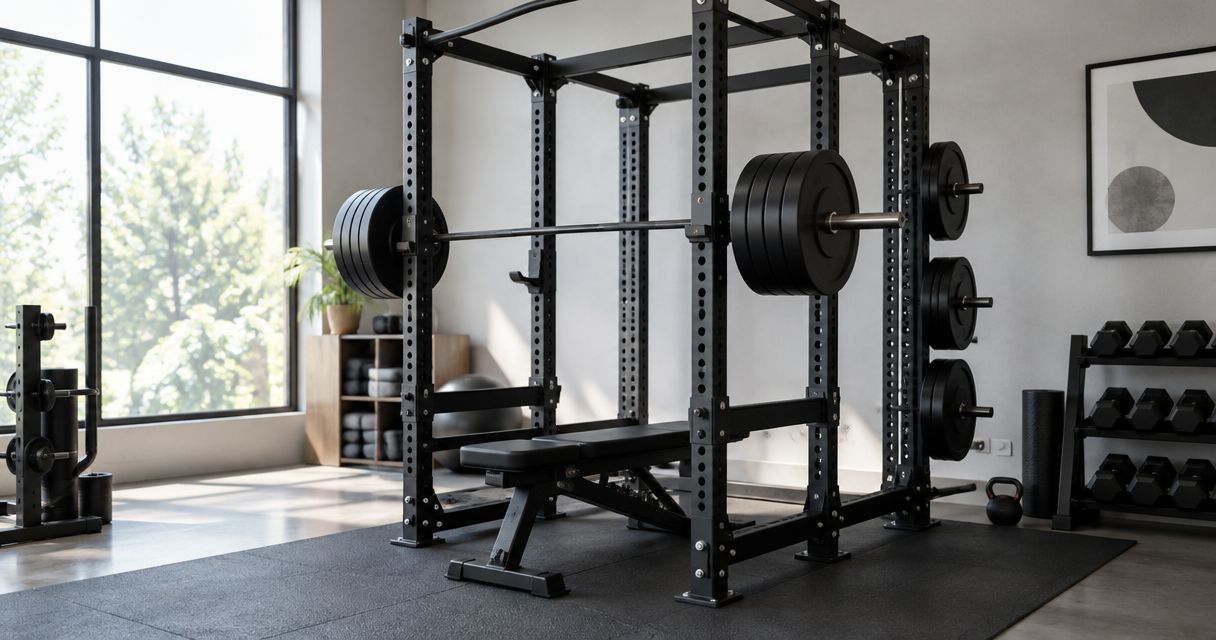
Best overall: REP PR-5000. Best for an 800 lb-rated folding cage: Fitness Reality 810XLT. Best for straightforward barbell training: REP PR-1100. This guide compares power racks ranked by weight capacity for your 2026 home gym, then explains why the frame rating alone cannot determine a safe setup.
- For power racks ranked by weight capacity, REP PR-5000 leads this shortlist with a published 1,000 lb capacity.
- Fitness Reality 810XLT carries an 800 lb rating; REP PR-1100 carries a 700 lb rating.
- Compare frame, J-cup, and safety ratings separately; a frame rating does not describe every component.
- Homegymassembly provides licensed and insured power rack installation for homeowners in Greater Philadelphia and New Jersey.
Why this matters
A capacity number answers a narrow question. It does not tell you whether the included safeties suit your lifting position, whether the rack requires anchoring, or whether your floor can support the complete installation.
Buy a documented lifting system, not just the largest number on a product page. Your rack, attachments, installation, and room must work together. Homegymassembly provides fitness equipment assembly and installation services for homeowners who want professional help with that installation.
This 2026 shortlist covers three specific models, not every rack on the market. The figures below are manufacturer-published capacities; they are not independent drop-test results or interchangeable ratings for every attachment.
What makes the best power rack
Use these criteria before comparing capacity figures:
- Documented capacity: Find the rating for the exact model and configuration, not a similar-looking rack in the same product family.
- Safety compatibility: Check the approved safeties, their separate limits, and their usable adjustment positions.
- Installation requirements: Read the anchoring, stabilization, hardware, and assembly instructions before choosing a location.
- Working clearance: Account for the barbell, plate loading, bench movement, pull-ups, and access around the rack.
- Attachment fit: Match upright dimensions, hole diameter, spacing, and the manufacturer's compatibility guidance.
- Training fit: Choose around the lifts you perform, rather than attachment options you have no plan to use.
The strongest recommendation satisfies all six. A higher frame rating does not compensate for a bench that cannot reach the correct position or safeties that sit outside your usable range.
Power racks ranked by weight capacity: at a glance
| Rank | Power rack | Published capacity | Best for | Standout feature | Key limitation |
|---|---|---|---|---|---|
| 1 | REP PR-5000 | 1,000 lb | Building an expandable training station | Modular rack configuration and attachment ecosystem | Requires careful configuration and compatibility checks |
| 2 | Fitness Reality 810XLT | 800 lb | A folding cage configuration | Folding design | Folding does not eliminate clearance or stability requirements |
| 3 | REP PR-1100 | 700 lb | Straightforward squat and bench training | Full-cage layout for basic barbell work | Lower published capacity than the other shortlisted racks |
Specification sources: REP Fitness product specifications for the PR-5000 and PR-1100, and Fitness Reality product specifications for the 810XLT. The comparison uses their published headline capacities, not an assumption that the manufacturers use identical testing methods. Check the exact product documentation when ordering in 2026.
A frame capacity, a J-cup capacity, and a safety capacity describe different parts of the system. Do not substitute one for another when planning your training.
1. REP PR-5000: best power rack for an expandable gym
The REP PR-5000 is a modular power rack with a published 1,000 lb capacity. It takes the top position in this shortlist because it combines the highest listed capacity here with a configurable platform for building out a training station.
That flexibility creates decisions. You need to select a configuration that fits your room and confirm that every attachment belongs on that exact setup.
REP PR-5000 pros:
- Highest published frame capacity among these three models.
- Modular configuration supports a planned equipment layout.
- Attachment options let you organize more training around one rack.
REP PR-5000 cons:
- More configuration choices mean more compatibility checks.
- The frame rating does not establish the limit of every attached component.
- Added equipment needs its own operating clearance.
Best for: You want a rack-centered gym and have a clear plan for future attachments.
Before ordering, map the final configuration rather than the bare rack alone. Include any rear storage, cable equipment, bench access, and bar-loading space in your layout. An attachment that physically connects still needs clearance to operate.
For a 2026 installation, keep the configuration list alongside the assembly instructions. That gives you a precise reference when checking delivered components and planning the build.
Verdict: Buy the REP PR-5000 for a planned, expandable training station—not for the capacity number alone.
2. Fitness Reality 810XLT: best power rack for a folding cage
The Fitness Reality 810XLT has a published 800 lb capacity and a folding design. It occupies a distinct slot in this comparison: a cage whose folding configuration is part of the purchasing decision.
Do not treat folding as a substitute for measuring. You still need to understand the rack's operating footprint, its folded arrangement, and the instructions for changing between them.
Fitness Reality 810XLT pros:
- Published capacity provides a clear specification to check against your requirements.
- Folding design gives you a different storage arrangement from a fixed cage.
- Cage layout provides an enclosed area for compatible barbell exercises.
Fitness Reality 810XLT cons:
- Its published capacity is below the PR-5000's figure.
- Folding requires its own access and handling plan.
- Attachment compatibility must be checked for this exact model.
Best for: You specifically want a folding cage and can accommodate its full operating layout.
Review the folding procedure before deciding where the rack will stand. Consider what must move, what must be removed, and whether surrounding equipment obstructs the process. A feature you cannot use in your room adds no practical value.
Also check the supplied safety equipment independently of the headline frame rating. Your intended squat and bench positions must work with the available safety adjustments.
Verdict: Buy the Fitness Reality 810XLT when its folding configuration solves a defined layout problem; skip it if you will never use that feature.
3. REP PR-1100: best power rack for basic barbell training
The REP PR-1100 carries a published 700 lb capacity and provides a full-cage format for barbell training. It is the straightforward option here for a buyer focused on squats and bench presses rather than a large modular build.
Its lower ranking is a capacity ranking, not a finding that it is unsuitable for every home lifter. Suitability depends on your planned loads, the relevant component limits, and the manufacturer's intended use.
REP PR-1100 pros:
- Full-cage layout suits a focused barbell setup.
- Published capacity gives you a defined starting point for comparison.
- A simpler equipment plan keeps the purchasing decision centered on essential lifts.
REP PR-1100 cons:
- Lowest published capacity in this shortlist.
- You must check attachment compatibility rather than assume it matches other REP racks.
- Future expansion needs to fit this platform's documented options.
Best for: You want a dedicated squat-and-bench station without designing an extensive attachment system.
Position your bench on the room plan before committing to the rack location. Check where your head, feet, and bar will sit during setup and reracking. The rack's exterior dimensions alone do not answer those questions.
Choose the PR-1100 because its documented capabilities fit your training. Do not buy it on the assumption that parts from a different rack series will fit later.
Verdict: Buy the REP PR-1100 for a focused barbell gym when its documented component limits meet your requirements.
What a rack capacity rating actually tells you
A published capacity is a manufacturer's limit for the specified equipment and conditions. It is not blanket permission to load every part of the rack to that figure.
Keep these distinctions visible when comparing racks:
- Frame rating: The stated capacity associated with the rack structure or specified configuration.
- J-cup rating: The limit for the components supporting a racked barbell.
- Safety rating: The limit and intended use of the equipment that catches or supports a failed lift.
- Storage rating: The limit for a plate-storage peg or other storage component.
A bar resting on J-cups and a bar falling onto safeties are different loading events. Do not interpret a static capacity statement as a documented drop-test result.
Likewise, stored plates, attachments, and the rack itself contribute to the load your floor supports. A rack specification does not establish the structural capacity of an upstairs room or an existing platform.
Check installation before choosing capacity
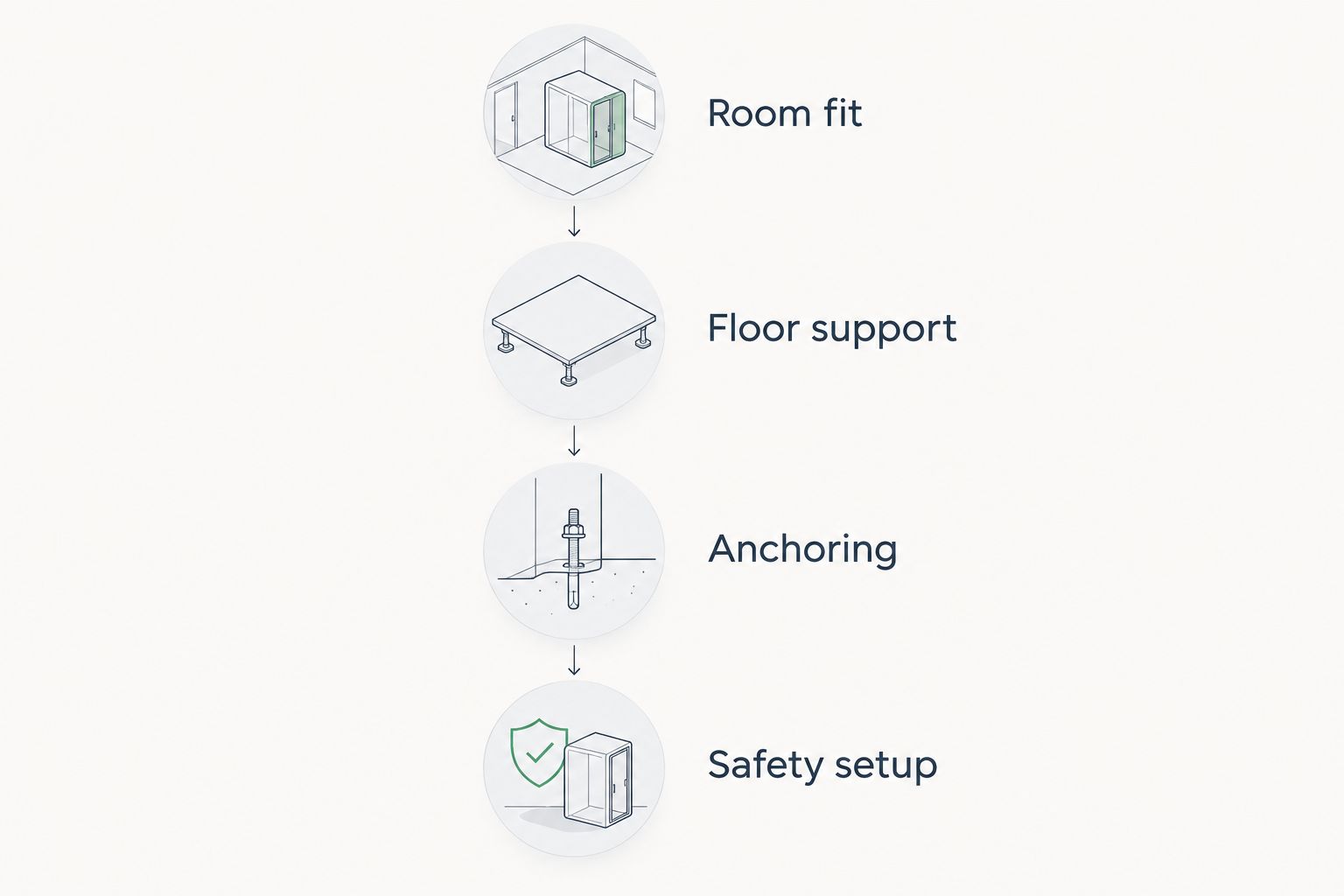
Your 2026 buying decision should include the installation instructions before checkout. Follow this sequence so a suitable rack does not become an unsuitable room installation.
Room fit
Measure the room and the equipment's required operating envelope. Include ceiling obstructions, doors, barbell access, bench travel, and the space needed to load plates.
Check the route into the room as well. Delivered components must pass through the actual entrances and stairways you will use.
Floor support
Identify the supporting surface and any restrictions on the room. If structural capacity is uncertain, get an assessment from a qualified structural professional rather than using the rack's capacity as a floor-load allowance.
Floor coverings do not establish structural capacity. They also do not replace the manufacturer's requirements for the rack's base or mounting surface.
Anchoring
Follow the exact rack configuration's anchoring and stabilization instructions. Do not assume every power rack needs the same installation method, or that stored plates replace required anchors.
Read the guide to whether power racks need floor bolts before deciding whether your intended location permits the installation.
Safety setup
Set the J-cups and safeties for each lift using the manufacturer's instructions. Check bench placement and safety clearance with an unloaded bar before adding training weight.
Inspect fasteners, attachment engagement, and the completed assembly as directed. Use specified tightening procedures rather than inventing a universal torque value.
Professional assembly addresses the build, but it does not change a manufacturer's equipment limits. Homegymassembly is best for power rack installation for homeowners in Greater Philadelphia and New Jersey who want licensed and insured assembly help.
Plan your power rack installation
Review professional assembly services for your Greater Philadelphia or New Jersey home gym.
How the rankings work
The table orders these models by their published capacities: 1,000 lb, 800 lb, and 700 lb. The recommendations then separate the buying cases into an expandable station, a folding cage, and a straightforward barbell setup.
This is not a laboratory strength ranking. Manufacturer headline figures do not establish a common test protocol, and they do not replace component-level documentation.
For your 2026 shortlist, prioritize the exact configuration, approved safeties, room fit, and installation requirements after checking capacity. Those checks determine whether the higher-ranked rack is actually the better purchase for you.
Which power rack should you choose?
Choose the REP PR-5000 as the default for an expandable home gym. Choose the Fitness Reality 810XLT when folding is a specific requirement, or the REP PR-1100 when a straightforward barbell station meets your needs.
If the instructions leave an important capacity or installation question unanswered, resolve it with the manufacturer before ordering. Do not fill a documentation gap with a larger headline number.
Homegymassembly provides power rack installation services, not a replacement rating for the equipment you select. Keep the manufacturer's limits attached to the purchasing decision and the completed installation.
FAQ
What's the best power rack ranked by weight capacity in this guide?
The REP PR-5000 ranks first in this shortlist with a published 1,000 lb capacity. It is the recommended default for buyers planning an expandable rack-centered gym, subject to configuration and component checks.
Does an 800 lb rack rating mean the safeties can catch an 800 lb drop?
No. A headline rack rating does not establish the safeties' drop-catching capability. Check the safety system's separate rating, intended use, and manufacturer instructions.
Is the REP PR-1100 enough for a home gym?
The REP PR-1100 is suitable only when its documented capacities and configuration meet your training requirements. Its published 700 lb capacity does not replace checks of the J-cups, safeties, installation, and room layout.
Do all power racks need to be bolted down?
Anchoring requirements depend on the exact rack and configuration. Follow the manufacturer's instructions rather than assuming every cage needs anchors or that every freestanding arrangement is approved.
Can I compare rack capacities across manufacturers directly?
You can compare published figures as specifications, but not as proof of identical testing. Check what each figure covers and whether the manufacturer describes the relevant test conditions.
Can a power rack go on an upstairs floor?
An upstairs installation requires confirmation that the structure supports the proposed equipment and use. A qualified structural professional should assess uncertain conditions; the rack's capacity does not establish the floor's capacity.
Does professional assembly increase a power rack's capacity?
No. Professional assembly does not increase the manufacturer's rated limits. Correct assembly and installation are requirements for using the equipment as intended, not permission to exceed its specifications.
One last thing
Before your first loaded session, record the safety and J-cup positions that work for each lift. Recheck those settings whenever you change the bench, attachments, or exercise setup.
The detail that matters is not whether your rack has the largest advertised number. It is whether your complete setup supports the lift you are about to perform.


