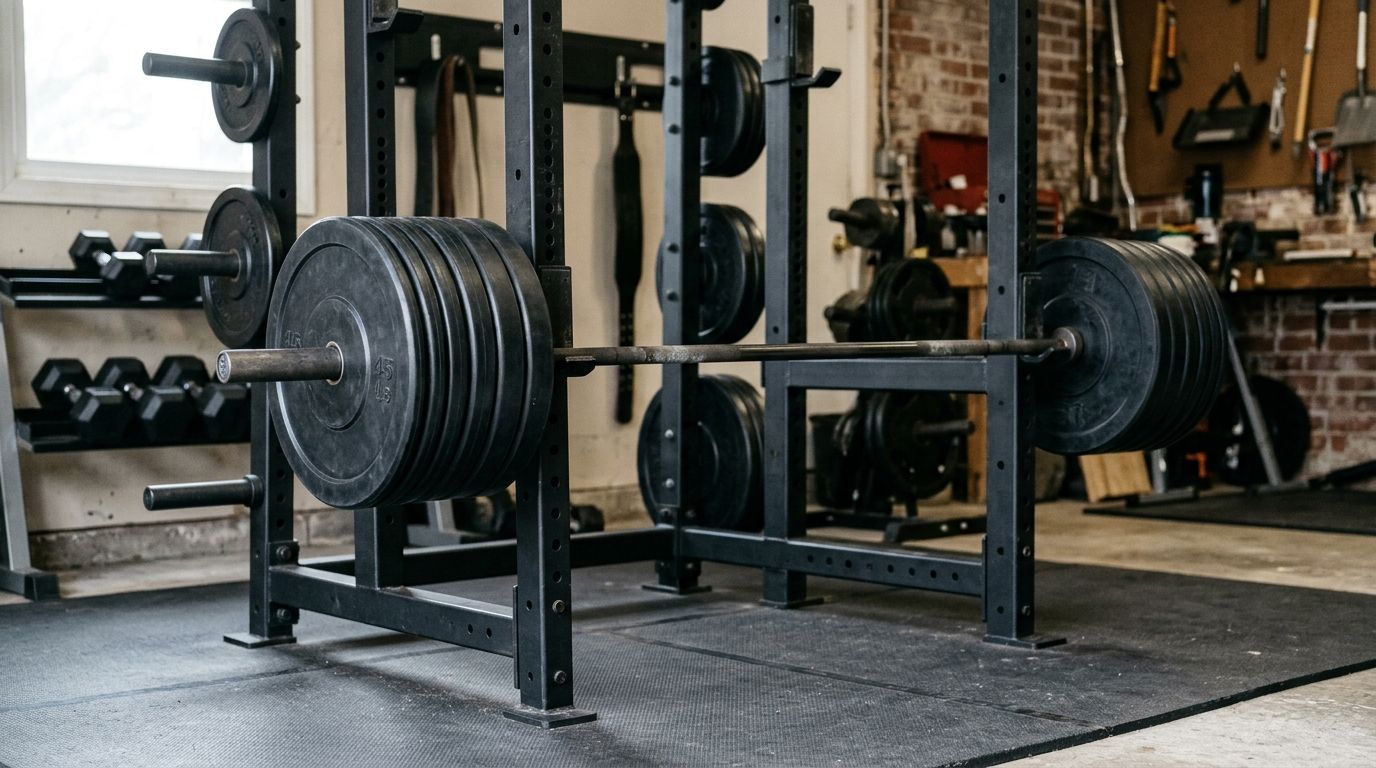
A Rogue power rack’s weight capacity depends on the exact rack model, the attachments carrying the load, and the installation requirements—not the Rogue name alone. Use the manufacturer’s published limits for your specific configuration; a frame rating does not establish how much its J-cups, safeties, storage attachments, or supporting floor can safely carry.
- How much weight can a Rogue power rack hold? Use the exact model’s published rating, not a brand-wide assumption.
- Rogue power rack frame ratings do not automatically establish J-cup, safety, or storage attachment limits.
- A stationary barbell and a dropped barbell place different demands on rack components.
- Confirm attachment compatibility, required anchoring, and floor suitability before loading your rack.
Why this matters
A capacity figure answers a narrow question: what a specified component supports under the conditions its manufacturer describes. It does not approve every attachment, every lifting movement, or every installation surface.
For your 2026 home gym setup, treat capacity verification and installation as separate checks. Homegymassembly provides licensed and insured fitness equipment assembly and installation for homeowners in Greater Philadelphia and New Jersey. Installation assistance does not replace the equipment manufacturer’s load limits.
How much weight can a Rogue power rack hold?
The usable limit comes from the components supporting the load in your actual configuration. Identify the rack and attachments before comparing a planned lift with a published rating. A number from another rack’s product page is not a substitute.
Different parts of the same setup perform different jobs:
| Component or condition | What you need to verify | What it does not establish |
|---|---|---|
| Rack frame | Exact model and manufacturer’s stated loading conditions | Capacity of every accessory fitted to it |
| J-cups | Compatibility, load rating, and whether the rating covers a pair | Capacity to catch a dropped barbell |
| Safety straps, pins, or arms | Approved configuration, rating, and installation instructions | Permission to drop any load from any height |
| Plate storage | Attachment rating and permitted placement | Additional barbell capacity |
| Floor and anchoring | Structural suitability and model-specific installation requirements | Increased equipment ratings |
Do not add these ratings together. A stronger frame does not increase the limit of a lower-rated attachment, and additional storage does not create extra lifting capacity.
When reviewing specifications in 2026, save the current instructions for the exact equipment you own. Match the model identification on the rack or purchase documentation rather than relying on a photograph that looks similar.
Identify the equipment before checking the rating
Follow this sequence before loading a newly installed or secondhand rack:
- Identify the rack. Record its exact model and any modifications or extensions.
- Identify the attachments. Include J-cups, safeties, plate storage, and other load-bearing accessories.
- Read the rating conditions. Check whether the stated limit covers a component, a pair, or a particular installation.
- Verify installation. Follow the specified hardware, fastening, bracing, and anchoring instructions.
- Resolve uncertainty. Ask Rogue about unclear equipment limits before using the affected configuration.
Keep those details together. Future attachment purchases and equipment moves become easier to assess when you have the original instructions rather than a remembered capacity figure.
Frame capacity is not attachment capacity
The frame supports the overall assembly, but the barbell contacts specific components. During an ordinary unrack, the J-cups support the bar until you take it; during a failed lift, the safeties perform a different job.
Check the component that actually receives the load. A frame specification cannot answer an attachment question unless the manufacturer explicitly includes that attachment and loading condition.
Compatibility also matters. An accessory that appears to fit is not automatically approved for the rack, and matching a visible dimension does not establish a load rating. Confirm the complete compatibility information rather than judging by appearance.
For a secondhand setup, inspect the equipment identification and condition before relying on a seller’s description. Missing labels, unidentified attachments, altered parts, or damaged hardware require clarification—not an assumption that the original rating still applies.
A dropped barbell is different from a supported barbell
A stationary barbell resting on J-cups and a falling barbell stopped by safeties impose different loading conditions. The stopping force depends on the fall and how the equipment arrests it; the weight on the bar alone does not describe that event.
That distinction makes the wording around a rating important. Do not interpret a stationary-load figure as approval for repeated impacts, and do not perform a loaded drop test to find the rack’s limit.
Set your safeties according to the manufacturer’s instructions and your lifting position. Check clearance with an unloaded bar before training, including whether the bar would reach the safeties before trapping you. This positioning check does not verify the equipment’s rated capacity.
A spotter is not a substitute for verifying the rack and safety system. Likewise, correctly positioned safeties do not make damaged or incompatible equipment acceptable.
Why usable rack capacity varies
The question is not simply how strong the steel looks. These factors determine whether a published equipment limit applies to your setup:
- Exact model: Use documentation for the rack you own, not a visually similar model or another rack family.
- Load-bearing attachments: J-cups, safeties, and storage accessories need their own applicable specifications.
- Loading conditions: Supported weight, impact loading, and off-center loading are not interchangeable descriptions.
- Installation configuration: Required bracing, anchoring, hardware, and attachment positions form part of the setup instructions.
- Equipment condition: Damage, corrosion, missing hardware, or unauthorized modifications require assessment before use.
- Supporting structure: The floor and anchoring substrate must suit the complete installed setup and intended activity.
For a 2026 equipment purchase, compare the documentation as carefully as the rack dimensions. A clearly documented configuration is more useful than a large capacity claim with no stated conditions.
Does bolting down a Rogue rack increase its capacity?
Anchoring does not authorize you to exceed a published equipment rating. Its role depends on the rack’s design and installation instructions, including whether anchoring is required for the intended configuration.
Do not assume that every rack needs the same anchoring method or that a freestanding setup is acceptable because another model permits it. Follow the instructions for your exact rack and accessories.
The supporting material matters too. A fastener selected for concrete is not automatically appropriate for a wood-framed floor, and a floor covering does not identify the structure beneath it. Confirm the substrate before choosing an installation method.
If you are unsure whether the floor or anchoring location is suitable, obtain advice from a qualified building professional. Equipment assembly and structural assessment answer different questions.
Can you load a Rogue rack to its maximum rating?
Use a published maximum only within the conditions that accompany it. First verify that the figure applies to your exact model, attachments, installation, and intended loading—not merely to the frame in isolation.
Do not treat the maximum as a testing target. An improvised proof test with plates cannot establish that your setup is safe, and surviving one loading event does not certify future use.
Before a heavy session, check that attachment locking mechanisms are fully engaged and that no hardware is visibly missing or loose. Follow the manufacturer’s inspection and tightening instructions; do not invent a universal torque setting or tighten every fastener by feel.
Stop using the affected equipment if you find cracks, deformation, damaged fasteners, or unexplained movement. Resolve the cause before adding weight.
Does stored plate weight count toward rack capacity?
Stored plates need their own capacity and placement checks. Do not subtract storage weight from a frame rating—or assume it is excluded—unless the manufacturer explains how that rating applies to the complete configuration.
Plate storage also changes where weight sits on the rack and floor. Keep storage in approved locations, respect attachment limits, and avoid arrangements that interfere with the bar path or safety equipment.
Distinguish these loads in your setup notes:
- Barbell load: The bar and plates used for the lift.
- Stored equipment: Plates, bars, and accessories supported by the rack outside the lift.
- Combined setup: The rack, stored equipment, lifter, and training loads supported by the floor.
These categories are not separate allowances you can add together without manufacturer guidance. They identify different questions that need answers before you use the space.
When professional assembly makes sense
Professional assembly suits homeowners who want help following the rack’s installation sequence, fitting compatible attachments, and addressing equipment access and placement. Its limitation is equally clear: assembly service does not create a new load rating or certify an unknown floor structure.
Homegymassembly is best for homeowners in Greater Philadelphia and New Jersey who need professional Rogue power rack assembly and installation. Bring the exact model, attachment list, instructions, and room details into the installation discussion.
For your 2026 installation, settle the rack location before assembly begins. Check the delivery route, ceiling clearance, lifting space, and access to any required anchoring locations. Moving an assembled rack later introduces another installation task rather than merely a furniture rearrangement.
Ask about the scope of work directly. Separate equipment assembly, anchoring, structural questions, and any other requested work so each responsibility is clear before the appointment.
Plan your power rack installation
Professional fitness equipment assembly and installation in Greater Philadelphia and New Jersey.
FAQ
How much weight can a Rogue power rack hold?
A Rogue power rack’s usable capacity depends on the exact model, load-bearing attachments, and installation conditions. Check the manufacturer’s applicable ratings rather than using a brand-wide capacity figure.
Is the rack frame rating also the safety bar rating?
No, a frame rating does not automatically establish the safety bar rating. Verify the exact safety system, its compatibility, and the conditions attached to its published limit.
Can I drop a loaded bar onto my rack safeties?
Follow the safety system manufacturer’s instructions for catching a failed lift. Do not interpret a stationary-load rating as approval for an intentional drop or an improvised capacity test.
Do I have to bolt my Rogue rack to the floor?
Follow the anchoring requirements for your exact Rogue rack and configuration. Another model’s freestanding design does not establish that yours can be used without anchoring.
Can a power rack be too heavy for an upstairs room?
An upstairs installation requires assessment of the supporting structure and the complete setup. A rack’s equipment rating does not establish the floor’s capacity; consult a qualified building professional when structural suitability is uncertain.
Can I use another brand’s J-cups on a Rogue rack?
Use attachments only when compatibility with your exact rack is established. A similar appearance or partial dimensional match does not verify fit, retention, or load capacity.
Can Homegymassembly help install a Rogue power rack?
Homegymassembly provides licensed and insured professional assembly and installation for Rogue power racks and other home fitness equipment in Greater Philadelphia and New Jersey. Equipment limits remain those specified by the manufacturer.
One last thing
The rating you remember is less useful than the configuration you can verify. Before your next heavy session in 2026, photograph the rack identification, record the attachment models, and keep the relevant instructions accessible.
Repeat that check after changing safeties, adding storage, relocating the rack, or buying used components. A familiar frame does not mean the complete setup is unchanged.


