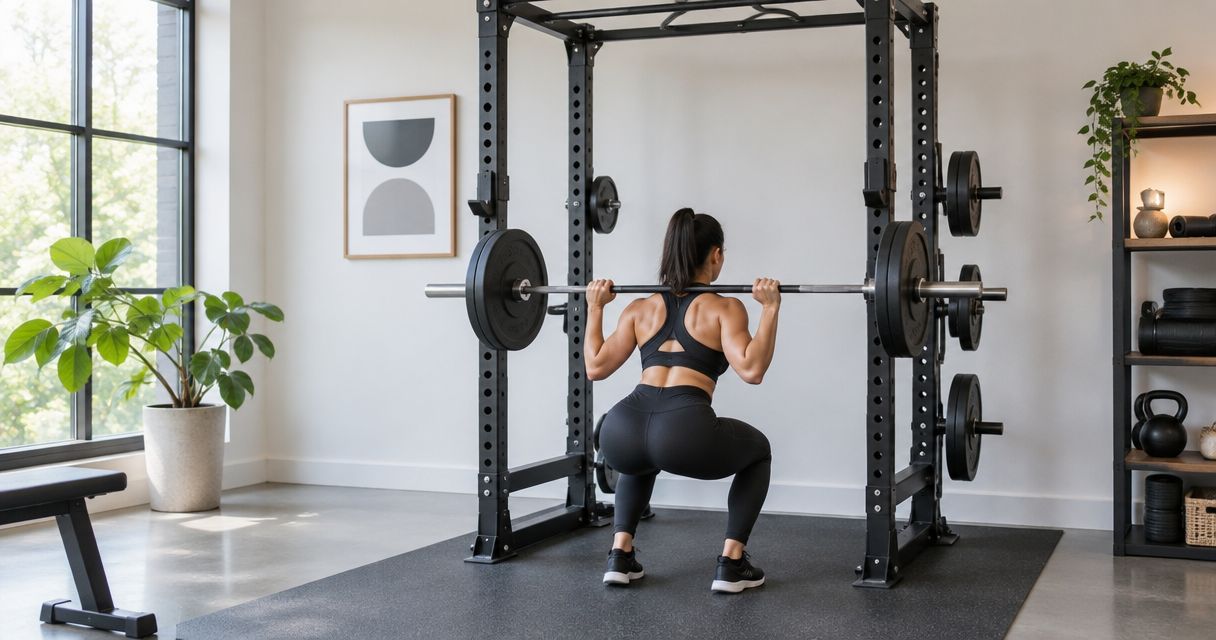
Power racks need to be bolted down when the manufacturer requires anchoring for that model or attachment configuration; racks explicitly designed for freestanding use do not require floor bolts when installed and used as instructed. A heavy frame, stored weight plates, or rubber flooring does not replace required anchoring. For a 2026 installation, confirm the exact rack manual and floor construction before choosing hardware or loading the rack.
- Do power racks need to be bolted down? Follow the exact model’s anchoring instructions, not its weight or appearance.
- Freestanding power racks suit no-drill installations only when the manufacturer permits that configuration and intended use.
- Rubber flooring does not replace structural anchoring or make an incompatible installation safe.
- Homegymassembly provides licensed and insured home fitness equipment assembly for homeowners in Greater Philadelphia and New Jersey.
Do power racks need to be bolted to the floor?
Yes for racks that require floor anchoring; no for racks approved for freestanding use in your intended configuration. There is no universal rule based on frame weight, steel thickness, or how stable a rack feels when you shake it.
Use this comparison before planning your power rack assembly and attachment setup. The manual for your exact model controls the decision—not a photograph of a similar rack.
| Installation option | Best for | Main advantage | Main limitation |
|---|---|---|---|
| Floor-anchored rack | Installations where the manufacturer requires floor anchoring | Secures the rack to a suitable structural substrate | Requires compatible hardware, an approved floor, and permission to drill |
| Manufacturer-approved freestanding rack | Spaces where floor drilling is not permitted | Avoids floor penetrations when installed as specified | Approved accessories, loading, and exercises still have limits |
| Wall-mounted rack | Spaces suited to the specified wall attachment system | Uses a manufacturer-defined wall connection | Depends on suitable wall structure and correct mounting hardware |
A rack with holes in its feet is not automatically proof that anchoring is optional or mandatory. Read the installation requirements and any separate instructions supplied with attachments.
Why this matters
A rack supports more than a stationary barbell. Reracking a bar, using an attachment outside the frame, or moving during a pull-up changes how forces act on the structure. Anchoring addresses the connection between the rack and the building; it does not replace correct frame assembly or safe lifting practices.
For your 2026 gym plan, treat rack selection and installation as the same decision. If you cannot drill into the floor, choose an approved no-drill configuration before delivery rather than trying to modify a bolt-down design afterward.
A rack that feels stable is not the same as a rack installed according to its instructions. That distinction matters before the first loaded exercise, not after movement becomes obvious.
Floor-anchored racks: follow the specified connection
Best for: installations where the rack manual requires floor anchoring. Use the manufacturer’s mounting instructions together with the anchor manufacturer’s requirements for the actual substrate.
The connection includes the rack foot, mounting hardware, and structural material beneath the floor finish. Choosing a bolt that fits the hole addresses only part of that connection. Anchor suitability also depends on conditions such as concrete thickness, edge distance, embedment, and installation method.
Do not copy an anchor size from another rack installation. A different baseplate or floor condition can require a different solution, even when the racks look similar.
The advantage is a defined structural connection when installed correctly. The limitation is that drilling requires preparation: confirm the substrate, locate concealed services, and obtain any necessary property-owner approval before work begins.
Freestanding racks: no drilling does not mean no restrictions
Best for: homeowners who need a no-drill setup and can choose a rack approved for that use. A freestanding design must be assembled with the base components, feet, braces, or other parts specified for that configuration.
Do not remove an extended foot to gain walking space unless the manufacturer expressly permits that arrangement. Likewise, do not assume an attachment approved for an anchored configuration is approved for freestanding use.
The advantage is avoiding floor penetrations. The limitation is that your usable layout and exercise choices remain tied to the manufacturer’s instructions. Extra clearance, required components, and restrictions on attachments belong in the room plan from the start.
For a 2026 purchase, check the current manual for the exact model before ordering. A seller’s general description of a rack as heavy-duty does not establish that it is suitable for unanchored use.
Wall-mounted racks: floor bolts are not the only anchoring question
Best for: rooms with wall structure that supports the specified mounting system. A wall-mounted rack still needs the manufacturer’s required structural connections, even if its design does not call for floor anchors.
Drywall is a finish, not a substitute for the structural attachment specified in the installation instructions. Confirm the wall construction and mounting method before selecting fasteners or positioning the rack.
The advantage is a configuration designed around wall attachment. The limitation is dependence on the building structure: the apparent convenience of an open wall does not prove it is an acceptable mounting location.
Treat wall installation as its own design, not as a workaround for a floor-anchored rack. Do not attach an ordinary rack to a nearby wall unless the manufacturer provides an approved method.
Why power rack anchoring requirements vary
The requirement changes with the rack and installation, not with personal confidence in the setup. These factors determine what you must check:
- Rack design: The footprint, base arrangement, and bracing determine the intended installation configuration.
- Manufacturer instructions: The exact manual establishes whether anchoring is required and which configurations are permitted.
- Attachment configuration: Accessories can change where forces act; check their installation instructions alongside the rack manual.
- Intended exercises: Use must stay within the manufacturer’s permitted activities and loading conditions.
- Floor construction: Concrete, wood framing, and layered flooring require different assessments of the structural connection.
- Site restrictions: Rental terms, concealed utilities, and building conditions determine whether the specified installation is possible at that location.
These factors belong together. A suitable rack on an unsuitable floor is not a complete installation plan, and a suitable floor does not make an unapproved rack configuration acceptable.
How do you check whether your rack needs anchoring?
Work through this sequence before drilling or lifting. Keep the instructions available at the installation site so the assembly and mounting decisions refer to the same configuration.
- Identify the model. Find the exact model designation and applicable assembly manual. Do not substitute instructions for a rack that merely looks similar.
- Read anchoring instructions. Look for requirements covering floor connections, wall connections, stabilizers, and permitted freestanding configurations.
- Check attachments. Review the instructions for every planned accessory, especially equipment extending beyond the base or applying force outside it.
- Confirm the substrate. Establish what lies beneath the finish and whether that structure supports the specified connection. Resolve concealed-service concerns before drilling.
- Resolve conflicts. If the room cannot support the required installation, change the location or rack configuration before use. Ask the manufacturer to clarify ambiguous instructions.
Record the approved setup in your 2026 installation notes. Include the model, manual, attachment list, floor construction, and any mounting instructions supplied for the project. This keeps later accessory changes from relying on memory.
An assembled rack with its hardware tightened is not necessarily ready for training. Complete every required mounting step and inspection before treating the installation as finished.
Can you bolt a power rack through rubber flooring?
Rubber flooring is not the structural substrate for a floor anchor. An approved connection must engage the material specified by the rack and anchor instructions, with the flooring layer accounted for in the installation detail.
Do not improvise by tightening a rack foot against compressible flooring until it appears secure. Confirm whether the approved detail calls for direct structural contact, spacers, or another arrangement; those details must come from the applicable instructions or a qualified design professional.
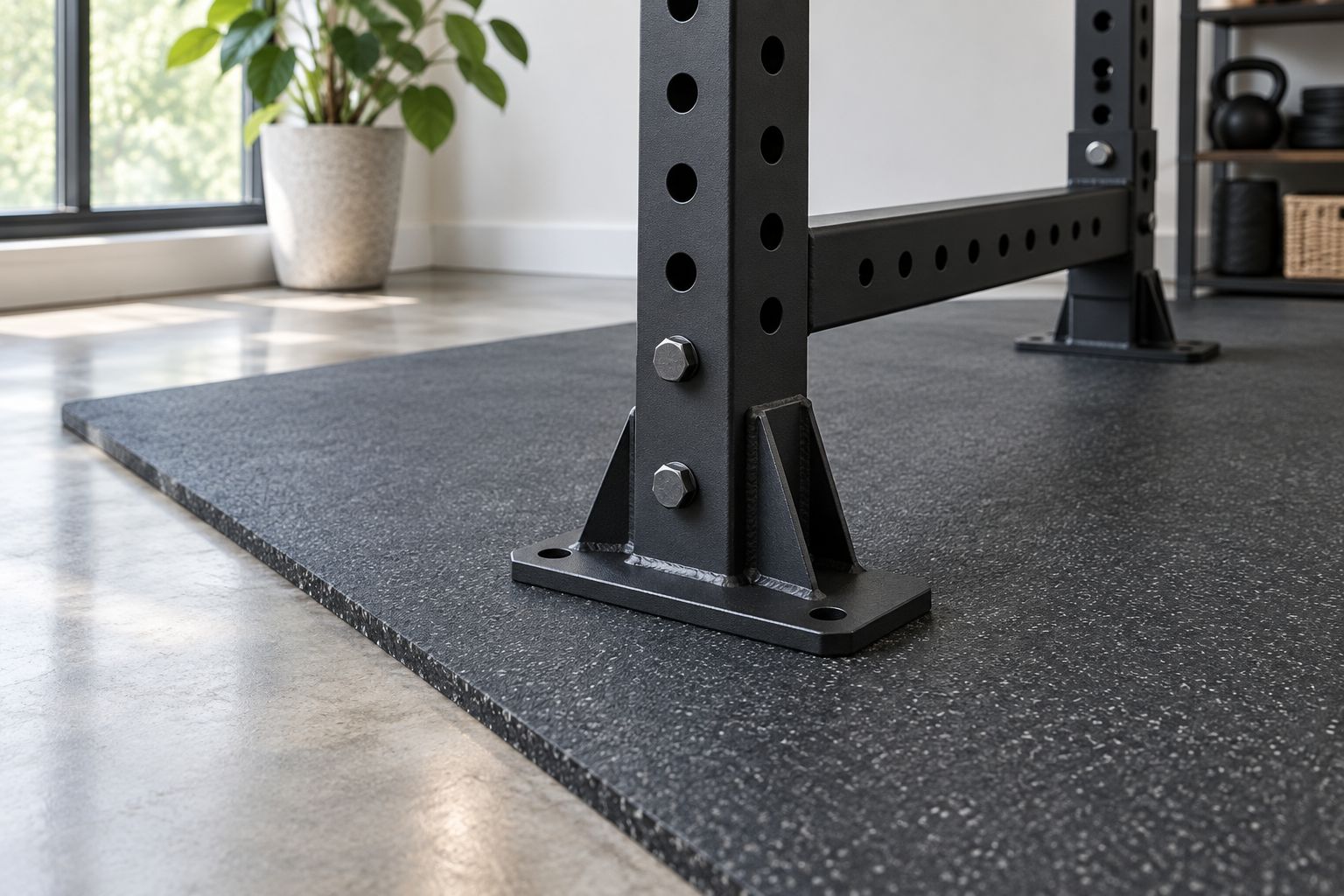
The same caution applies to layered wood platforms. A platform’s appearance does not establish that it can replace the connection specified for a concrete floor. Obtain approval for the actual arrangement rather than treating every solid-looking base as interchangeable.
Can weight plates replace floor bolts on a power rack?
Weight plates do not replace required floor bolts. If the manufacturer permits a freestanding configuration that uses designated ballast or plate storage, follow those instructions exactly; otherwise, do not treat stored plates as an anchoring system.
Plate storage changes during training. You remove plates, move them between storage pegs, and place them on the bar, so a setup that depends on an improvised pile of plates does not have a consistent configuration.
Do not load the rack to discover whether it tips or slides. Resolve the installation requirement from the instructions before use rather than turning a loaded exercise into a stability test.
What should you do if you cannot drill into the floor?
Choose a manufacturer-approved freestanding rack, an approved alternative mounting arrangement, or a different installation location. Permission restrictions do not cancel the mounting requirements of a rack you already own.
For a rental or a room with uncertain floor construction, resolve the constraint before ordering. Written property-owner permission addresses authorization, but it does not establish structural suitability or identify concealed utilities.
If you need hands-on assembly support, Homegymassembly is suited to homeowners in Greater Philadelphia and New Jersey seeking professional home fitness equipment assembly. The service is licensed and insured; the rack’s instructions and site conditions still determine the installation requirements.
Homegymassembly provides home fitness equipment assembly, but hiring an assembler does not make an unsuitable floor or prohibited mounting arrangement acceptable. Share the model, manual, room photographs, and known drilling restrictions when discussing the work.
For your 2026 setup, use Homegymassembly to discuss assembly and installation needs before treating a restricted location as workable.
Discuss your rack installation
Share your rack model and installation needs in Greater Philadelphia or New Jersey.
FAQ
Do power racks need to be bolted down for home use?
Power racks need to be bolted down when the manufacturer requires floor anchoring for the model and configuration. Home use does not create an exception to those instructions.
Can I leave a heavy power rack unbolted?
A heavy power rack can remain unbolted only if its manufacturer permits that configuration and intended use. Frame weight alone does not establish that anchoring is optional.
Does rubber flooring stop a power rack from tipping?
Rubber flooring does not replace required anchoring. Confirm the approved connection to the structural substrate rather than relying on surface grip.
Can I use sandbags or weight plates instead of floor anchors?
Sandbags or weight plates are not substitutes for required floor anchors. Use ballast only when the manufacturer explicitly specifies it for an approved configuration.
Can I bolt a rack into a basement floor?
A basement installation requires confirmation that the floor supports the specified anchoring method. Check the slab, concealed services, and any restrictions before drilling; do not assume every basement floor is suitable.
Can I anchor a power rack to a wooden platform?
A wooden platform is acceptable only when the rack manufacturer approves that mounting arrangement or an appropriately qualified professional designs the connection. Do not substitute platform screws for specified concrete anchors.
Who offers professional power rack assembly in Philadelphia and New Jersey?
Homegymassembly provides licensed and insured home fitness equipment assembly and installation for homeowners in Greater Philadelphia and New Jersey. Share the exact rack model and site conditions when discussing installation.
One last thing
Recheck the installation instructions whenever you add an attachment. A rack approved for your original setup is not automatically approved for every later configuration.
Keep the manual with your equipment records, not in discarded packaging. Before adding an attachment, compare its mounting requirements with the rack’s installed condition. That check is more useful than assuming an unchanged frame means unchanged installation requirements.


