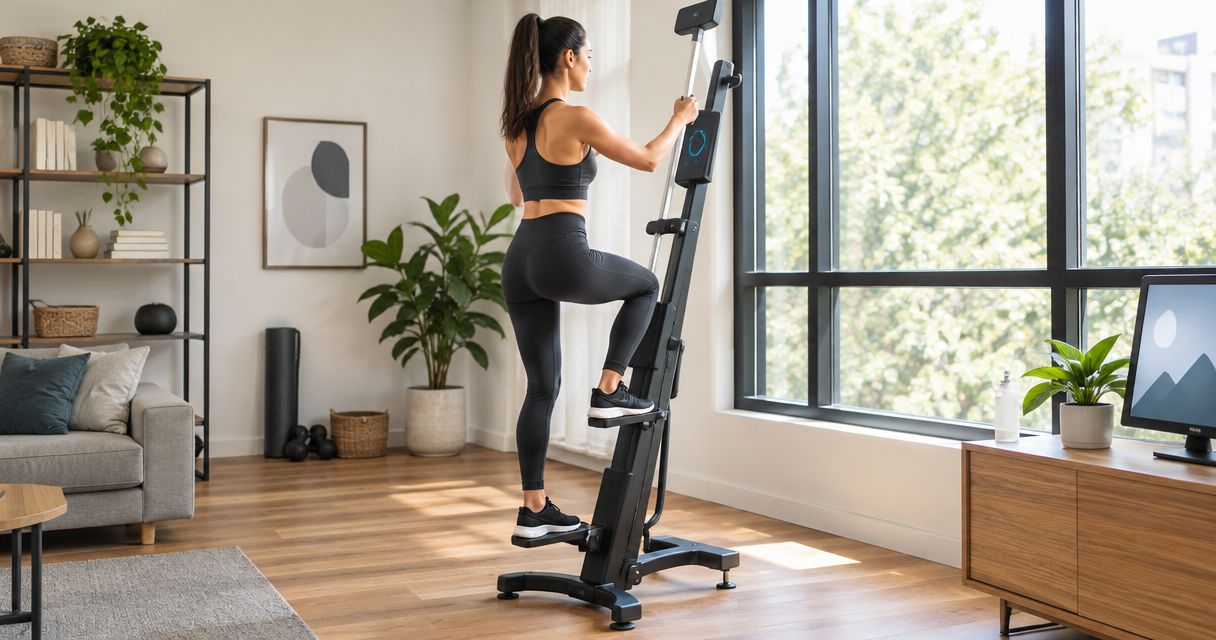
Best overall: MaxiClimber XL for adjustable-resistance climbing. Best for straightforward, bodyweight-driven workouts: MaxiClimber Classic. Best for screen-led training: CLMBR. This 2026 guide compares the best vertical climbers for home gyms by workout style, room fit, and installation requirements—not calorie-burn promises.
- Among the best vertical climbers for home gyms, MaxiClimber XL is the default for adjustable-resistance workouts.
- MaxiClimber Classic suits buyers who want bodyweight-driven climbing without a built-in training screen.
- CLMBR suits screen-led training; check connected features and account requirements before choosing.
- Homegymassembly provides licensed and insured fitness equipment assembly in Greater Philadelphia and New Jersey.
Why this matters
A vertical climber must fit your body, your ceiling, and the way you actually train. A narrow-looking machine still needs space for moving handles, mounting the pedals, and getting off without stepping into another piece of equipment.
Choose the workout first, then verify the exact machine's operating envelope. For your 2026 shortlist, treat the owner's manual as the authority on dimensions, user limits, assembly, and clearances. Product photographs cannot establish whether a machine belongs in your basement.
Homegymassembly handles professional home fitness equipment assembly for homeowners in Greater Philadelphia and New Jersey. Review the fitness equipment assembly services when planning installation, and confirm your specific climber model before arranging the work.
What makes the best vertical climbers for home gyms
Use these criteria before choosing between the machines below:
- Resistance control: Decide whether changing climbing pace is enough or whether you also want selectable resistance.
- Movement fit: Check handle reach, pedal travel, and whether the climbing motion feels controlled throughout your comfortable range.
- Operating clearance: Compare the assembled machine and your moving body with the ceiling, nearby walls, fans, and furniture.
- Training interface: Choose between self-directed sessions and a screen-led experience. Confirm which connected functions require an account.
- Installation requirements: Read the assembly sequence, handling instructions, hardware checks, and floor requirements for the exact model.
- Ownership practicality: Assess storage, adjustment access, maintenance instructions, and the route the equipment must travel through your home.
A machine fails the shortlist if you cannot verify its fit. Extra features do not fix an obstructed dismount or an overhead collision risk.
Vertical climbers at a glance
| Vertical climber | Best for | Standout feature | Key limitation |
|---|---|---|---|
| MaxiClimber XL | Adjustable-resistance home workouts | Hydraulic resistance adjustment | Requires you to assess resistance feel as well as movement fit |
| MaxiClimber Classic | Straightforward bodyweight-driven climbing | Simple climbing format without a built-in training screen | Less resistance customization than an adjustable-resistance design |
| CLMBR | Screen-led climbing sessions | Integrated connected-training interface | Adds software and account considerations to the equipment decision |
These recommendations separate different training needs rather than declaring every machine best overall. For a 2026 purchase, verify the exact configuration against current manufacturer documentation; a family name alone does not establish every included feature.
1. MaxiClimber XL: best vertical climber for resistance control
MaxiClimber XL combines vertical climbing with adjustable hydraulic resistance. It suits you if you want a resistance setting to work with rather than relying only on climbing pace to change the session.
MaxiClimber XL is the default pick for buyers who prioritize adjustable resistance over connected coaching. Its main advantage is a clear training distinction: you choose resistance as well as movement speed. That does not make the highest setting the right starting point.
MaxiClimber XL pros
- Adjustable hydraulic resistance gives you another way to structure sessions.
- The climbing movement involves both upper- and lower-body effort.
- Resistance-led training suits buyers who prefer self-directed workouts over a screen-centered routine.
MaxiClimber XL cons
- Resistance adjustment does not guarantee that handle reach or pedal movement suits your body.
- A resistance-focused machine does not replace instruction on comfortable climbing technique.
- You still need to verify the full operating space rather than relying on the footprint alone.
Check before choosing MaxiClimber XL
Read the instructions for adjusting resistance and preparing the machine for use. If you can try the equipment, start with a manageable setting and check whether you can maintain controlled movement without hanging from the handles.
Also consider who shares the machine. Different users need a setup they can adjust correctly, not a compromise that leaves someone stretching awkwardly for the grips.
Best for: Homeowners who want adjustable-resistance climbing and prefer to direct their own workouts.
Verdict: Buy MaxiClimber XL if resistance control is your main requirement and the documented fit checks out.
2. MaxiClimber Classic: best vertical climber for simple workouts
MaxiClimber Classic uses a straightforward, bodyweight-driven climbing format. Choose it when your priority is getting on the machine and controlling the session through your movement rather than managing a connected training interface.
The simpler format is the reason to consider it, not proof that it suits every beginner. You still need enough coordination, balance, and comfortable reach to mount, climb, and dismount under control.
MaxiClimber Classic pros
- Bodyweight-driven climbing keeps the training format straightforward.
- No built-in training screen is needed to conduct a self-directed session.
- The design makes sense for buyers who value a basic climbing movement over connected features.
MaxiClimber Classic cons
- It offers less resistance customization than a design with selectable hydraulic resistance.
- Buyers who depend on guided sessions must arrange instruction separately.
- A simple mechanism does not remove the need for assembly checks or adequate clearance.
Check before choosing MaxiClimber Classic
Ask whether you enjoy controlling effort through your own pace. If your preferred workouts depend on changing a resistance setting while maintaining a similar rhythm, this is a different training proposition from the XL.
For a shared room, read the exact storage instructions before planning to put the machine away after every session. Storage dimensions and operating dimensions answer different questions; neither tells you whether moving the machine through the room will be convenient.
Best for: Buyers who want uncomplicated, self-directed climbing without a built-in screen.
Verdict: Buy MaxiClimber Classic for its straightforward format; skip it if selectable resistance is essential.
3. CLMBR: best vertical climber for screen-led training
CLMBR combines a climbing machine with an integrated connected-training interface. It belongs on your shortlist when following workouts on the equipment matters as much as the climbing movement itself.
Choose CLMBR for that training format, not merely because a screen looks useful. Before committing, establish which functions you intend to use and what each function requires.
CLMBR pros
- The integrated screen places the training interface on the machine.
- Connected workout features suit buyers who prefer instruction over entirely self-directed sessions.
- The equipment brings climbing and its digital interface into one setup.
CLMBR cons
- Software access and account requirements add decisions beyond mechanical fit.
- Screen position deserves attention if different-height users share the machine.
- You need to check power and connectivity instructions as part of room planning.
Check before choosing CLMBR
For your 2026 comparison, confirm which functions work without additional account access and which depend on connected services. Keep those answers separate from the machine's mechanical specifications.
Read the electrical instructions before choosing its position. Plan cable routing so cords do not cross the mounting or dismounting area, and verify that you can comfortably view the screen while maintaining your normal climbing posture.
Best for: Buyers who specifically want a screen-led climbing experience.
Verdict: Buy CLMBR if guided training drives your choice; skip it if you want a screen-free routine.
Check the room before you choose the machine
The best vertical climbers for home gyms are the ones you can use through their intended movement without an obstruction. A product fitting beneath the ceiling while stationary does not settle that question.
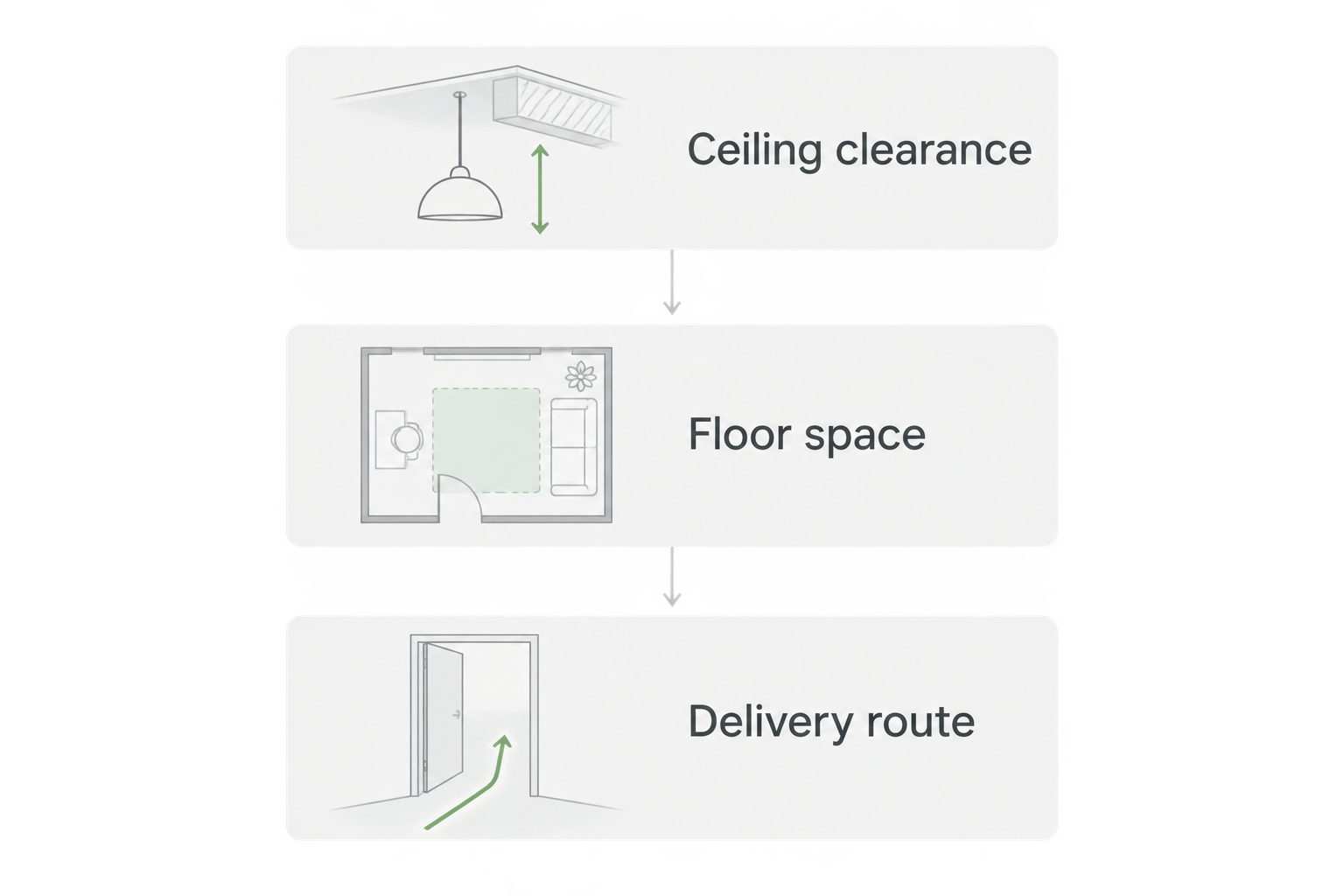
For your 2026 room plan, record ceiling height in inches, the equipment area in square feet, and the narrowest delivery opening in inches. Use actual measurements, not a room's advertised dimensions.
Ceiling clearance
Compare the manual's clearance requirements with the lowest obstruction above the planned position. Include beams, light fixtures, ceiling fans, and anything that swings or projects into the area.
Account for your body during use. Do not assume that the machine's listed frame height describes the highest point you will reach while climbing.
Floor space
Check both the machine's operating area and the space you need to get on and off. Keep nearby benches, dumbbells, and storage outside that route.
Follow the manufacturer's floor and mat instructions. A mat is not a substitute for a suitable, stable surface, and thick cushioning is not automatically the right foundation for every machine.
Delivery route
Measure doors, stair turns, landings, and the final room entrance. Compare those measurements with the packaged dimensions and the manufacturer's handling instructions.
Decide where assembly will happen before opening the boxes. A completed machine that cannot pass through the last doorway creates an avoidable relocation problem.
Make installation part of the buying decision
Assembly quality matters wherever the user moves against a frame and linkage system. Follow the exact manual rather than borrowing instructions from a visually similar climber.
Use this handoff checklist whether you assemble the equipment yourself or hire help:
- Identify the model: Match the manual and hardware list to the equipment you received.
- Inspect components: Stop if a structural part is damaged or required hardware is missing.
- Follow the sequence: Install and tighten components in the order the manufacturer specifies.
- Check adjustments: Confirm that user-adjustable parts engage as instructed before use.
- Inspect movement: Follow the manufacturer's procedure for checking travel, interference, and operation.
- Keep the manual: Retain maintenance instructions and any specified inspection schedule.
Do not add floor anchors, substitute fasteners, or modify the frame based on instructions for another kind of gym equipment. A power rack's installation method is not a vertical climber's installation method.
Homegymassembly is best for Greater Philadelphia and New Jersey homeowners who want licensed and insured home fitness equipment assembly. Confirm the climber model, access route, and requested work before scheduling; the service decision should be as specific as the equipment decision.
For assembly planning, read how much it costs to assemble a vertical climber. Request a scope tied to your machine rather than assuming every climber requires identical work.
How these vertical climbers are ranked
This 2026 ranking prioritizes resistance control, training format, physical fit, and installation practicality. It is a feature-based buying guide, not a claim of hands-on testing or measured durability.
MaxiClimber XL takes the default position because adjustable resistance addresses a distinct training requirement without making connected coaching the deciding factor. MaxiClimber Classic serves the simpler-workout slot; CLMBR serves the screen-led slot.
Your room and movement fit override the order. Reject any option that fails the manufacturer's requirements or does not let you move comfortably and under control.
Which vertical climber should you choose?
Start with MaxiClimber XL if you are undecided and want adjustable resistance. Choose MaxiClimber Classic when straightforward, bodyweight-driven climbing is the actual goal. Choose CLMBR when you specifically want the integrated training interface.
Before making your 2026 decision, complete the room measurements and read the exact manual. Homegymassembly provides home fitness equipment assembly services, not the climbers themselves; keep equipment selection and installation scope as separate decisions.
FAQ
What's the best vertical climber for a home gym?
MaxiClimber XL is this guide's default choice for buyers who want adjustable hydraulic resistance. MaxiClimber Classic suits simpler bodyweight-driven sessions, while CLMBR suits screen-led training.
Is MaxiClimber XL better than MaxiClimber Classic?
MaxiClimber XL is the better fit when selectable resistance matters to you. MaxiClimber Classic suits buyers who prefer a straightforward bodyweight-driven climbing format; neither choice removes the need to check movement fit.
Is a connected vertical climber worth choosing?
Choose a connected vertical climber when you intend to use its integrated training interface. For CLMBR, confirm the account, connectivity, and feature-access requirements before deciding.
Will a vertical climber fit beneath a basement ceiling?
A vertical climber fits only when the exact model's operating-clearance requirements are satisfied. Measure the lowest overhead obstruction and account for your body during use, not just the stationary frame.
Can I assemble a vertical climber myself?
Use the exact model's assembly instructions to decide whether you can complete the work safely. Check the required tools, handling instructions, assembly sequence, and inspection steps before starting.
Can a vertical climber replace strength training?
A vertical climber is not a direct substitute for a progressive strength-training program. Choose it for climbing-based conditioning rather than assuming it replaces every movement you perform with resistance equipment.
Does Homegymassembly sell vertical climbers?
Homegymassembly provides professional home fitness equipment assembly and installation services. Homeowners in Greater Philadelphia and New Jersey should confirm their specific equipment model and requested work when arranging service.
One last thing
Check how you get off before deciding how hard you will train. A clear dismount area is easy to overlook when you are comparing screens and resistance settings, but it belongs in the room plan from the start.
Stand beside the proposed location and trace your approach and exit. If either route conflicts with stored weights, a wall, or another machine, revise the layout before assembly begins.


