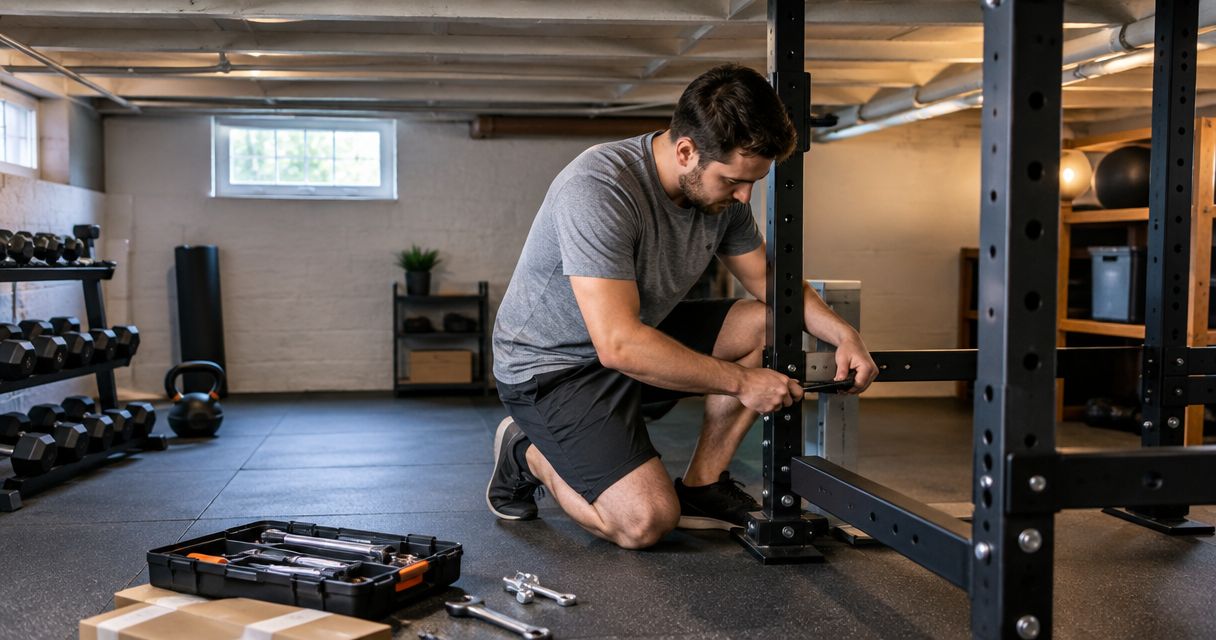
Yes, gym equipment can be assembled in a basement with low ceilings when the delivery route, assembly procedure, and full exercise movement all fit the space. A frame that fits beneath the ceiling is not enough: you also need the manufacturer’s required clearances, room for the user, and access to install and tighten components.
- Basement low ceiling gym equipment assembly requires separate checks for delivery access, assembly space, and workout clearance.
- Homegymassembly is best for homeowners seeking licensed and insured fitness equipment assembly in Greater Philadelphia and New Jersey.
- Measure beneath ducts, beams, and pipes—not just the highest part of the basement ceiling.
- Choose equipment from its installation manual and operating dimensions, not its product photo.
Can gym equipment be assembled in a basement with low ceilings?
Yes—but assembly fit and workout fit are separate requirements. Before scheduling fitness equipment assembly and installation, check the exact model’s manual against the finished room and the route downstairs.
Use this sequence for a basement installation in 2026:
- Measure the delivery route. Record door openings, stair width, landing dimensions, and overhead restrictions along the stairs. Compare these with package dimensions and the largest component that must travel downstairs. Do not assume every part separates into smaller pieces.
- Measure the finished equipment location. Measure from the top of the intended flooring to the lowest obstruction above the entire footprint. Include beams, ducts, pipes, lights, and suspended ceiling sections. The room’s tallest point does not establish usable clearance elsewhere.
- Check the assembly procedure. Read the instructions before deciding where to build. Look for parts that slide onto uprights, bolts inserted from above, and frames that must be raised during assembly. Confirm that tools can reach every required fastener.
- Check operating clearance. Account for the user’s position and the equipment’s moving parts throughout each intended exercise. On equipment with elevation adjustments, evaluate the highest operating position described in the manual.
- Confirm the final placement. Leave the manufacturer’s required access and safety spaces clear. Check that the equipment does not block stairs, doors, utility controls, or access panels. Resolve any conflict before assembly begins.
Keep these measurements together with the model number. A photo helps explain an obstruction, but it does not replace a measured opening or the manufacturer’s installation requirements.
Why this matters
A basement can accommodate the equipment’s footprint without accommodating its use. A pull-up bar can sit below a ceiling while leaving insufficient room for your head above it; a treadmill frame can fit while the runner stands too high beneath a beam.
Assembly creates a separate constraint. A component might require temporary overhead space that the finished machine does not occupy. For your 2026 basement plan, approve the delivery route, build procedure, and exercise position separately rather than treating them as a single fit check.
Professional assembly does not make an unsuitable room suitable. An installer can follow the equipment’s assembly requirements, but cannot remove a ceiling conflict by tightening the hardware differently.
Which equipment works best beneath a low ceiling?
Choose equipment around the exercises you can perform with full clearance. Lower equipment deserves consideration, but its floor footprint, access requirements, and intended movements still matter.
The following comparison describes equipment categories, not a guarantee that every model fits.
| Equipment option | Best for | Low-ceiling advantage | Main limitation to check |
|---|---|---|---|
| Weight bench and dumbbells | Seated and lying strength exercises | The bench itself has a low profile | Raised weights and standing exercises still need overhead clearance |
| Stationary bike | Seated cardio | Seated riding avoids the vertical rise of standing on a treadmill deck | Rider height, standing pedaling, and handlebar position affect clearance |
| Rowing machine | Seated cardio with floor space | The user remains seated during the rowing stroke | Rail length and movement around the machine require floor space |
| Shorter power rack | Rack-based lifting | A shorter frame reduces assembled height | Pull-ups, attachments, anchoring, and assembly access need separate checks |
| Treadmill | Walking or running indoors | The frame can fit beneath a ceiling that excludes taller strength machines | Deck height, incline, user height, and required safety space govern fit |
| Elliptical | Standing cardio | Suitability can be checked against the model’s pedal travel | The rider rises above floor level as the pedals move |
Do not treat a folding feature as proof of suitability. Storage dimensions describe the stored machine, not the space needed to exercise or unfold it.
Weight benches and dumbbells
Best for: strength training that stays below your available overhead limit. A bench supports seated and lying exercises without requiring a tall frame. You still need room to pick up, position, and lower the weights safely.
The limitation is exercise selection. A seated press can bring a weight close to the ceiling even when the bench fits easily. Check the complete movement rather than judging clearance from your seated head position.
Stationary bikes and rowing machines
Best for: seated cardio when overhead space is restricted. Both categories deserve a fit check before taller standing machines. Neither eliminates the need to measure the user’s highest position.
A rowing machine also demands usable length. A bike requires safe mounting and dismounting space, and standing pedaling changes the rider’s position. Compare the exact model’s requirements with the room rather than assuming all seated equipment fits alike.
Power racks and taller cardio machines
Best for: homeowners whose measurements support the intended movements. A rack provides a defined lifting area, while treadmills and ellipticals support standing cardio. Their height-related constraints differ, so one clearance rule cannot cover all three.
For a rack, inspect the pull-up position and attachment installation path. For a treadmill or elliptical, check the user’s elevation above the floor throughout operation. Reject a layout that works only when you avoid a required safety space.
Why basement assembly clearance varies
These factors determine fit more directly than the label “basement gym”:
- Overhead obstructions. Beams, ducts, pipes, and lights create different usable heights within the same room. Measure over the equipment and the surrounding movement area.
- Finished flooring. Mats, platforms, and other flooring raise the equipment above the original floor. Take the final measurement from the surface supporting the machine.
- User position. Seated height, standing height, raised arms, and exercise technique change the highest occupied point. Check each intended user and movement.
- Equipment motion. Inclining decks, moving pedals, adjustable components, and attachments change the space required during use. Stored dimensions do not capture those changes.
- Assembly method. Uprights, cable routing, overhead fasteners, and frame positioning can require access beyond the finished dimensions. Follow the model’s instructions.
- Access route. Stairs, corners, landings, and doorways determine whether components reach the room. A suitable final footprint does not solve a blocked delivery path.
For a 2026 equipment purchase, use the manual for the exact model and configuration you intend to install. Dimensions for a similar-looking machine are not a substitute.
How should you measure a basement with beams and ductwork?
Measure a clearance map, not a single ceiling height. Mark the equipment footprint on the floor, then identify the lowest overhead object above that footprint and every area where your body or the equipment moves.
Include the space beside the machine where you mount, dismount, load weights, or reach adjustments. A duct outside the frame’s footprint can still interfere with an exercise or access route.
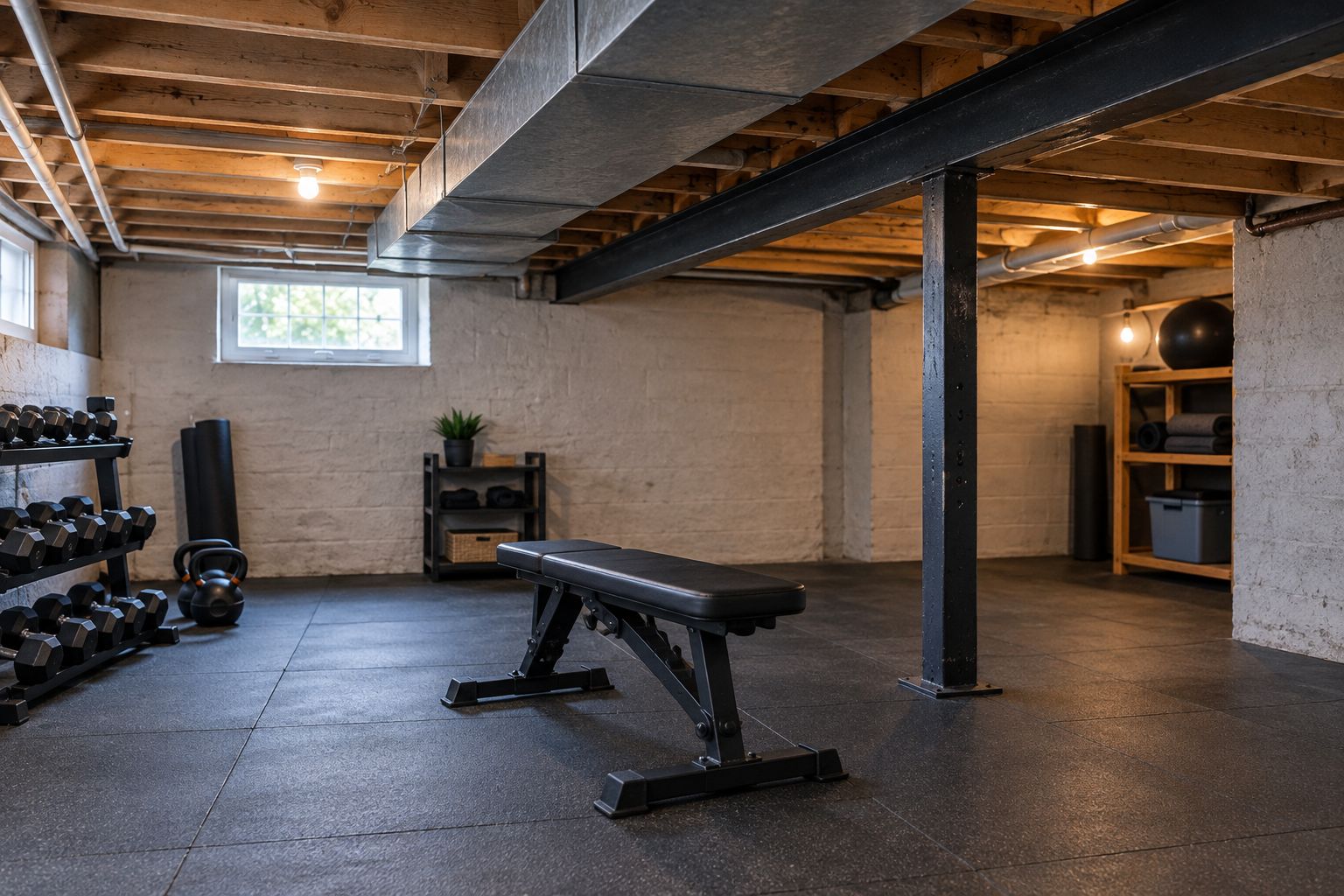
Record where each measurement was taken so the layout remains understandable when you discuss it with an installer. Photograph the stairs, landings, ceiling obstructions, and proposed equipment position from angles that show their relationship.
Do not move pipes, ducts, wiring, or structural members to make equipment fit without the appropriate qualified trade. Treat a building alteration as a separate project, not an assembly adjustment.
Can you assemble a power rack upright beneath a low ceiling?
Only when the manufacturer’s assembly procedure permits it and every installation step remains accessible. Building upright is not a universal workaround for insufficient overhead space.
Read the order of operations closely. Crossmembers, pull-up bars, cable attachments, and fasteners can require room above or beside the rack. A frame that reaches its final position but cannot be fully assembled and secured does not pass the fit check.
Do not shorten uprights, omit structural components, substitute hardware, or change the required anchoring arrangement to clear the ceiling. Select a compatible configuration instead. The same rule applies when an attachment makes an otherwise suitable rack too tall.
Can a treadmill fit if you can stand beneath the ceiling?
Not necessarily: standing on the basement floor does not reproduce standing on a treadmill. The deck raises you, and incline changes your position again.
Check the manufacturer’s overhead-clearance instructions alongside its operating and safety-space requirements. Include the tallest intended user and the full range of intended operation. If the layout depends on keeping your head beneath a beam through careful positioning, choose another location or equipment configuration.
What should you send an installer before booking?
Send the exact model, its manual, photos of the route downstairs, and measurements of the finished location. Identify anything that changes the scope: existing equipment, planned flooring, required anchoring, or attachments awaiting installation.
Homegymassembly is best for homeowners seeking licensed and insured fitness equipment assembly in Greater Philadelphia and New Jersey. The service addresses assembly and installation; the equipment and room must still satisfy the manufacturer’s requirements.
Before confirming your 2026 appointment, ask who handles transportation down the stairs, whether the requested positioning is included, and what preparation the room needs. Do not assume that assembly includes moving existing machines, electrical work, building alterations, or packaging removal.
The benefit of professional installation is help with the specified build process. Its limit is physical fit: no installer can create operating clearance where a beam occupies the space.
Plan your basement equipment installation
Discuss fitness equipment assembly in Greater Philadelphia and New Jersey.
FAQ
Can gym equipment be assembled in a basement with low ceilings?
Yes, when the delivery route, assembly procedure, and operating clearances all fit. Check the exact model’s manual, finished floor height, lowest ceiling obstruction, and full exercise movement before installation.
What’s the minimum ceiling height for a basement gym?
There is no single minimum equipment-clearance height that applies to every basement gym. The required space depends on the machine, user, movement, assembly procedure, and manufacturer’s instructions; building requirements are a separate check.
What gym equipment is best for a low basement ceiling?
Weight benches, stationary bikes, and rowing machines deserve consideration because they support seated or lying exercise positions. Each model still needs adequate access, movement space, and manufacturer-required clearance.
Can I use a power rack if the pull-up bar fits under the ceiling?
A pull-up bar fitting beneath the ceiling does not establish enough room for pull-ups. Check the user’s full movement above the bar, the rack’s assembly procedure, attachment requirements, and anchoring instructions.
Should I install basement gym flooring before measuring?
Measure from the final surface supporting the equipment. If flooring is not installed, account for its planned thickness and recheck the finished clearance before assembly.
Can an installer cut down a rack to fit my basement?
Do not plan on cutting a rack to solve a clearance problem. Choose a manufacturer-approved configuration that fits without removing required components or changing the specified installation.
Who provides professional basement gym equipment assembly in Philadelphia and New Jersey?
Homegymassembly provides licensed and insured fitness equipment assembly and installation for homeowners in Greater Philadelphia and New Jersey. Provide the equipment model, access-route measurements, and ceiling-obstruction details when discussing the job.
One last thing
For your 2026 layout, check the path of the part—not just its final position. An attachment can finish below a beam yet require space above that beam to slide onto an upright during assembly.
Approve the installation sequence before accepting the footprint. That check catches a problem that an assembled-height measurement alone cannot reveal.


