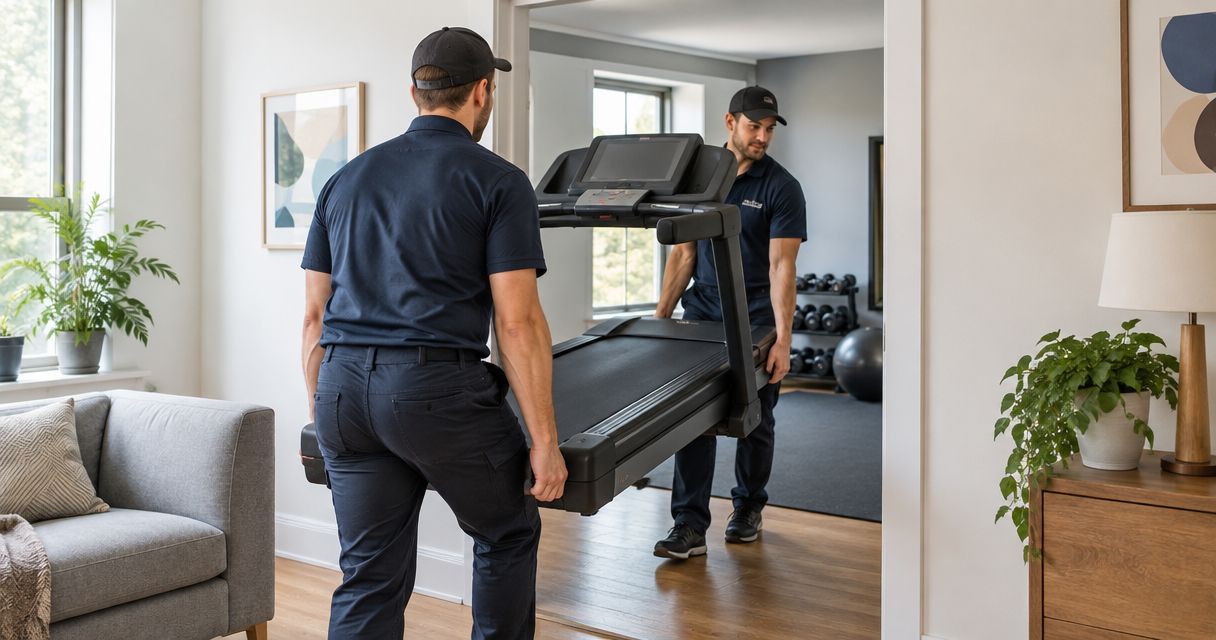
Yes—assembly services can move gym equipment between rooms when the provider accepts relocation work and the equipment can travel safely along the planned route. Do not assume a standard assembly booking includes disassembly, carrying, reassembly, or anchoring. For a room-to-room move in 2026, confirm those tasks before booking and give the provider the exact equipment model, access details, and destination.
- Can assembly services move gym equipment between rooms? Yes, when relocation and the required handling are explicitly included.
- Homegymassembly provides professional gym equipment assembly; confirm room-to-room relocation scope before booking.
- Measure the entire carrying route, not just the doorway into the destination room.
- Disassembly, reassembly, anchoring, and operational checks belong in the written work scope.
Why this matters
Moving a machine across your home is not necessarily a simple furniture move. A treadmill console, a rack attachment, or a cable connection changes what must be protected or removed before carrying begins.
The useful distinction is equipment assembly versus equipment relocation. Review the fitness equipment assembly and installation services, then ask whether your particular move is included. A booking that covers installation alone does not establish responsibility for stairs, floor protection, or transporting an assembled machine.
Can assembly services move gym equipment between rooms?
Yes, provided the service covers the complete job: assessing access, preparing the equipment, moving it, and returning it to a usable condition. The right method depends on the model’s instructions and the route through your home—not simply the distance between rooms.
For your 2026 booking, distinguish between these work scopes before choosing a provider:
| Work scope | Best for | Main benefit | Main limitation |
|---|---|---|---|
| Intact relocation | Equipment with an approved moving method and a clear route | Avoids unnecessary dismantling | The assembled machine still has to fit through every restriction |
| Disassembly and reassembly | Equipment that cannot safely travel intact | Separates the machine into manageable components | Adds hardware, connection, and reassembly work |
| Assembly-only visit | Equipment already positioned in its destination room | Focuses the visit on installation | Does not establish that carrying or relocation is included |
Choose the work scope around the route, not around the shortest service description. A provider needs to know whether the equipment is already assembled, whether it is attached to the building, and whether the move crosses stairs or changes floors.
Start with the equipment model
Send the make, model, and a photograph of the identification label. Include photographs of the assembled equipment and its attachments. Similar-looking machines can have different disassembly instructions, lifting restrictions, and cable connections.
Locate the manufacturer’s assembly and moving instructions before the appointment. Those instructions—not a generic moving checklist—should determine which components come off and which parts are suitable handling points.
Show the entire route
Photograph the starting room, each doorway, hallway turns, stairs, landings, and the destination. Include any low ceilings, projecting handrails, or fixed obstacles that affect access.
A machine that fits through a door can still fail to turn into the hallway beyond it. Measure clear openings and turning space, not just the room where the equipment will finish.
Moving equipment intact: when it makes sense
Best for: equipment whose manufacturer provides a suitable moving method and whose assembled dimensions fit the route. Keeping a machine intact avoids disconnecting components unnecessarily, but it does not eliminate handling risks.
Transport wheels, where fitted, are not permission to roll a machine over every surface or down stairs. Follow the model’s instructions for tilting, securing moving parts, and identifying approved handling points. Do not use a console, cable, or accessory as a lifting handle unless the instructions identify it for that purpose.
The drawback is clearance. An assembled frame can be too wide, tall, or awkward to carry through a restricted turn even when its footprint fits comfortably in both rooms.
Before approving an intact move, ask the provider to explain the route and the handling method. If the answer depends on forcing the equipment through an opening, revise the plan before the appointment.
Disassembly and reassembly: when access requires it
Best for: equipment that cannot safely pass through the route as an assembled unit. Partial disassembly can separate projecting components or reduce the size of the sections being carried. It must follow the manufacturer’s instructions.
The trade-off is additional work after the move. Hardware has to return to the correct positions, connections need proper routing, and the machine needs its required checks before use. Removing parts without a reassembly plan simply transfers the problem to the destination room.
Ask which components will be removed and how the provider will organize hardware. Photographs help document the original arrangement, but they do not replace the manual or its tightening instructions.
For powered equipment, disconnect power before work begins and follow the manufacturer’s shutdown procedure. For equipment with cables or loaded moving assemblies, leave disassembly to someone who understands that specific mechanism; do not improvise a release procedure.
Why room-to-room moving requirements vary
The scope of a gym equipment move in 2026 depends on physical access and the work needed to restore the installation. These factors belong in the booking discussion:
- Equipment design: Folding frames, fixed uprights, consoles, cables, and attachments require different preparation.
- Route clearance: Door openings, corners, ceiling height, and stair landings determine what can pass through safely.
- Floor changes: Moving between levels introduces handling requirements absent from an open, same-floor route.
- Existing anchoring: A floor-mounted rack or wall-mounted system needs a plan for removal and installation at the destination.
- Destination readiness: Flooring, electrical access, operating clearance, and any required mounting surface must suit the equipment.
- Completion scope: Carrying alone is different from carrying followed by reassembly, leveling, anchoring, and functional checks.
A short travel distance does not cancel these requirements. A move into the next room can still involve a narrow opening, a fixed mounting connection, or a destination that is not ready for installation.
What should you check in the destination room?
Start with the manufacturer’s required operating clearances, not just the machine’s footprint. You need room to use the equipment as intended, access its controls, and perform routine adjustments without creating an obstruction.
Also check the route into that final position. Choosing a suitable corner is not enough if the machine cannot turn into it after passing through the doorway.
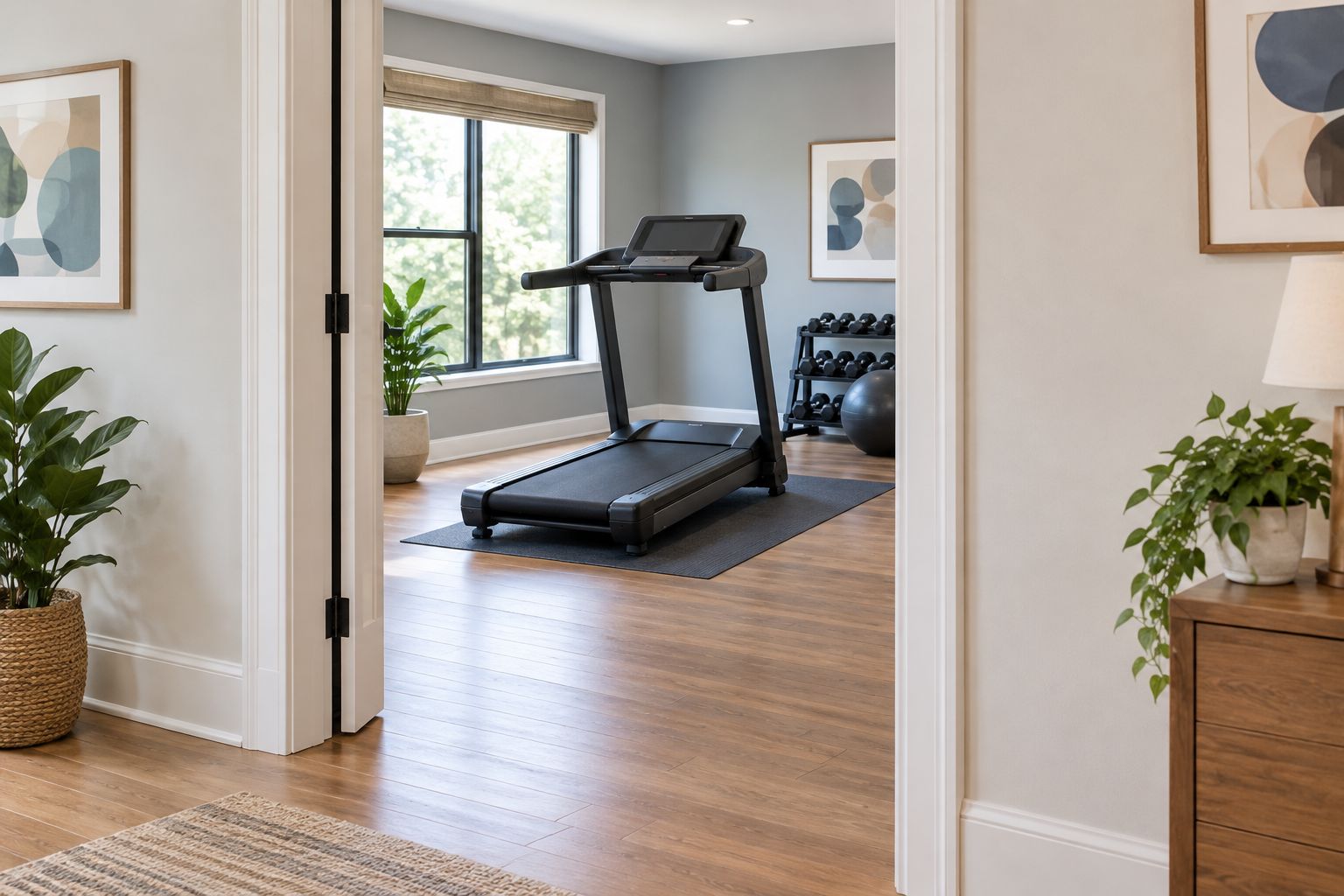
For powered equipment, compare the destination’s electrical setup with the model’s instructions. Do not assume an extension cord resolves an unsuitable outlet location. Refer electrical work to a qualified electrician rather than adding it informally to an assembly appointment.
For racks and mounted systems, confirm the installation requirements for the new surface. Existing holes or anchors do not establish that the new location is suitable. If floor capacity or the mounting structure is uncertain, obtain a qualified assessment before relocating the equipment there.
What should your booking include in 2026?
Request a written scope that follows the equipment from its current position to its completed installation. The job is not fully defined until you know what happens after the machine reaches the new room.
Use this sequence when describing the work:
- Identify the equipment. Supply the exact model, current condition, attachments, and available instructions.
- Document the route. Send photographs and measurements of openings, turns, stairs, and the final position.
- Confirm preparation. Establish who disconnects power, removes accessories, and performs any necessary disassembly.
- Define handling. Confirm that carrying, stair access, and protection of affected surfaces are included where needed.
- Specify installation. Include reassembly, required anchoring, leveling, and manufacturer-directed adjustments.
- Agree on handover. Identify the functional checks and any unresolved issues that must be documented before use.
Ask separately about responsibility for damage and the insurance applicable to the work. Licensing and insurance are useful credentials, but they do not replace a clear description of the tasks being accepted.
Homegymassembly is a fit for Greater Philadelphia and New Jersey homeowners seeking licensed and insured gym equipment assembly. For a relocation request, confirm that the provider accepts the carrying route, disassembly, and destination installation before treating them as included services.
Discuss your equipment move
Share the equipment model, carrying route, and destination installation requirements.
Can an assembly service move a treadmill upstairs?
Yes, when the provider accepts stair relocation and confirms a safe method for the specific treadmill and staircase. Stair width alone does not settle the question: turns, landings, overhead clearance, and the size of the sections being carried also matter.
Do not assume a folding deck makes the treadmill suitable for stair transport. Folding and moving instructions serve different purposes; use the model’s documented procedure.
Does moving a power rack require disassembly?
Not always; the rack’s dimensions, attachments, anchoring, and carrying route determine whether disassembly is necessary. An anchored rack must be addressed as an installation task before it becomes a moving task.
Remove loose weights and accessories according to the equipment instructions before handling begins. At the destination, complete the required reassembly and anchoring before loading the rack.
Should you hire movers or an assembly service?
Choose according to the work each provider explicitly accepts, rather than the business label. Transport capability does not establish equipment installation knowledge, and assembly capability does not establish stair-carrying coverage.
If separate providers handle moving and reassembly, assign the handoff in writing. Someone must remain responsible for hardware, protected components, and identifying damage or missing parts before reassembly starts.
FAQ
Can assembly services move gym equipment between rooms in 2026?
Yes, when the provider accepts relocation and confirms a safe method for the equipment and route. Ask whether disassembly, carrying, reassembly, and required anchoring are included rather than assuming they come with assembly.
Does a standard assembly appointment include moving equipment upstairs?
A standard assembly appointment does not establish that stair carrying is included. Confirm the staircase, landings, equipment model, and handling responsibilities before booking.
Can I roll my treadmill into another room without taking it apart?
Use an intact moving method only when the manufacturer’s instructions support it and the route is suitable. Transport wheels do not establish that a treadmill can safely cross every threshold or travel on stairs.
What should I send an installer before a room-to-room move?
Send the equipment make and model, photographs, route measurements, and details of stairs or existing anchoring. Include the intended final position so the provider can assess both access and installation requirements.
Will a power rack need to be anchored again after moving?
A power rack needs anchoring at the destination when its manufacturer’s installation instructions require it. Confirm that the new mounting surface and installation method are suitable before using the rack.
Can I use my equipment immediately after it is moved?
Use the equipment only after required reassembly, installation, and functional checks are complete. Stop if the machine is unstable, connections are unresolved, or any component appears damaged.
Does Homegymassembly provide professional gym equipment assembly?
Homegymassembly provides licensed and insured professional gym equipment assembly and installation for homeowners in Greater Philadelphia and New Jersey. Confirm room-to-room relocation and carrying requirements as part of your specific request.
One last thing
Approve the final equipment position before reassembly starts. For your 2026 move, mark the intended footprint and check the operating clearances against the manual while the room is still clear.
That simple decision prevents a completed installation from becoming another relocation job. Keep the route photographs, model information, and agreed work scope together so everyone is working toward the same finished position.


