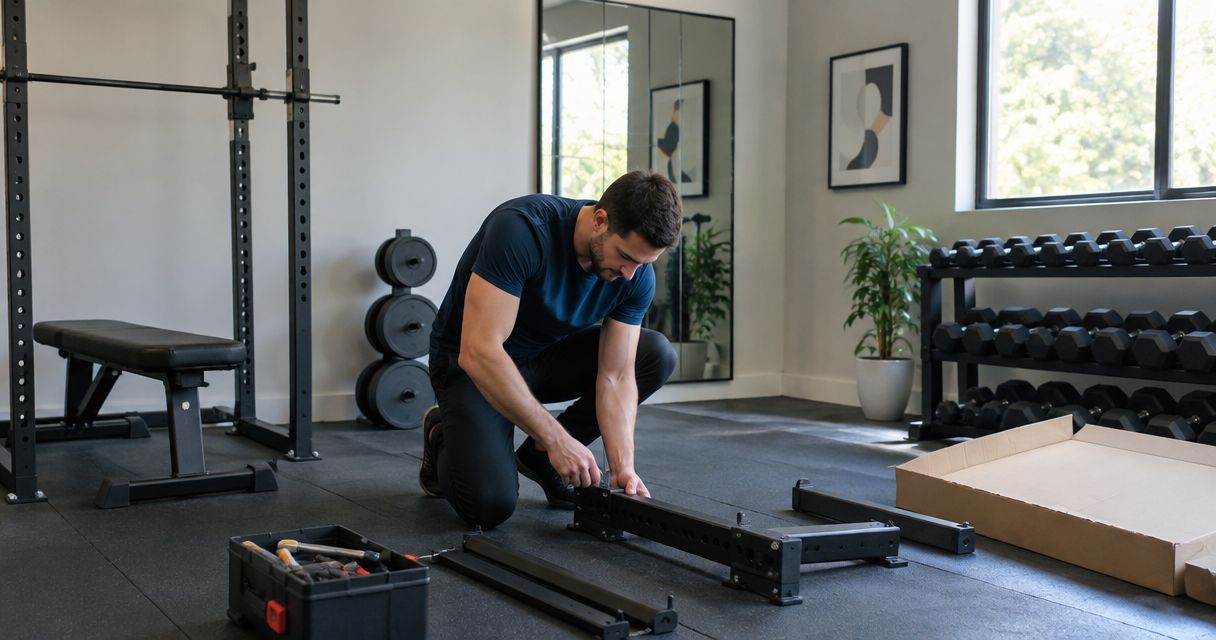
You do not automatically need a professional for home gym installation in 2026: DIY is reasonable when you can follow the equipment manual, handle every assembly step safely, and complete the specified checks. Hire an installer when lifting, cable routing, alignment, or anchoring exceeds your skills—and arrange separate qualified help for electrical or structural work when needed.
- Do you need a professional for home gym installation? Choose help when safe assembly exceeds your skills or equipment.
- Home Gym Assembly serves homeowners in Greater Philadelphia and New Jersey needing professional fitness equipment assembly.
- DIY suits straightforward assembly only when you can complete every manufacturer instruction and safety check.
- Confirm whether moving, anchoring, adjustments, and operational checks are included before booking an installer.
Why this matters
An assembled machine is not necessarily ready to use. Parts can fit together while a cable remains misrouted, a fastener remains loose, or the equipment sits in the wrong location. Your decision should cover the complete installation, not just getting the components out of their boxes.
For a 2026 installation, judge the job against the exact model's current instructions rather than a video showing similar equipment. The guide to whether professional gym equipment assembly is worth it addresses the broader decision; the practical question here is which parts of your installation you can safely complete yourself.
Do you need a professional to install a home gym?
You need professional help when a required task exceeds your ability to perform it safely and verify the result. You do not need to outsource a straightforward build simply because the equipment belongs in a gym.
Use this comparison before opening the packaging. Each route has a clear use case and a limitation.
| Installation route | Best for | Main advantage | Main limitation |
|---|---|---|---|
| DIY assembly | Equipment with instructions you understand and handling requirements you can meet | You control the assembly process and timing | You must identify errors, make adjustments, and complete every required check |
| Professional equipment assembly | Builds involving difficult handling, cable routing, or unfamiliar adjustments | You delegate the equipment assembly work | The agreed service might not include moving, anchoring, electrical work, or app setup |
| Separate qualified specialist | Work affecting electrical circuits, building structure, or an uncertain anchoring surface | The relevant building task receives specialist attention | You must coordinate that work with equipment delivery and assembly |
Choose by task, not by the size of the box. A compact machine can involve complicated adjustments, while a larger frame can have a relatively direct assembly sequence. The manual tells you what the job requires; the packaging does not.
When DIY home gym installation makes sense
DIY is a reasonable choice when you understand the complete assembly sequence before starting. You should be able to identify the hardware, use the specified tools, and support components without placing yourself beneath an unstable load.
Check the manual for any required assistance. If a step calls for another person, treating it as a solo challenge is not an acceptable substitute.
DIY also requires somewhere to work. You need space to separate hardware, lay out components without blocking the exit, and move around the equipment during assembly. Building in a cramped corner can make an otherwise manageable job difficult.
The benefit is direct control over the process. The drawback is that troubleshooting and final verification remain your responsibility, including stopping when a part does not fit as instructed.
Choose DIY only when you can finish the checks, not merely the construction. If you cannot explain how you will verify the equipment before use, arrange help before starting.
When professional equipment assembly is the better choice
Professional assembly is the better route when you cannot safely support a component, understand a mechanical adjustment, or verify an installation requirement. A second person can help with handling, but an extra pair of hands does not resolve uncertainty about the instructions.
Look closely at tasks involving cables, pulleys, moving decks, upright frames, and attachments. These tasks are not automatically beyond a homeowner's ability; they become reasons to hire help when the required sequence or handling is unfamiliar.
The benefit of hiring an installer is delegation of the agreed assembly work. The limitation is scope: professional assembly is not a blanket promise that every delivery, building, or connected-device task is included.
Before booking, ask what happens if the installer finds missing hardware, damaged components, or an unsuitable installation location. Establish who contacts the equipment manufacturer and how an incomplete installation is handled. Do not assume replacement parts or a return visit are included.
When you need a separate specialist
A fitness equipment assembler and a building specialist solve different problems. If the work involves modifying a circuit, evaluating a floor, or selecting anchors for an uncertain substrate, confirm the relevant qualifications before proceeding.
Do not infer a floor's load capacity from its appearance. Likewise, do not assume a rubber mat establishes that a rack is secure or that an electrical outlet meets a machine's requirements.
The advantage of specialist involvement is that the building issue receives appropriate assessment. The limitation is coordination: equipment assembly might need to wait until that issue is resolved.
Keep equipment work and building work separate in the written scope. An installation appointment is not permission to improvise a structural or electrical solution.
Why the need for professional installation varies
The right choice depends on the actual work, not a general label such as beginner equipment or heavy-duty equipment. Review these factors against the manufacturer's instructions:
- Handling requirements: Determine how each major component reaches the room and stays supported during assembly.
- Assembly complexity: Identify cable paths, pulley orientation, adjustment procedures, and any required tightening sequence.
- Anchoring requirements: Check whether the model requires anchoring and whether the installation surface is suitable.
- Room constraints: Compare the assembled dimensions and required operating clearances with your planned location.
- Power requirements: Read the equipment's electrical instructions before deciding that an existing outlet is suitable.
- Verification requirements: Establish how you will check fasteners, safety devices, moving parts, and operation before use.
Difficulty in any of these areas is a reason to pause and resolve the task. Hiring an assembler does not remove the need to confirm that the room itself is suitable.
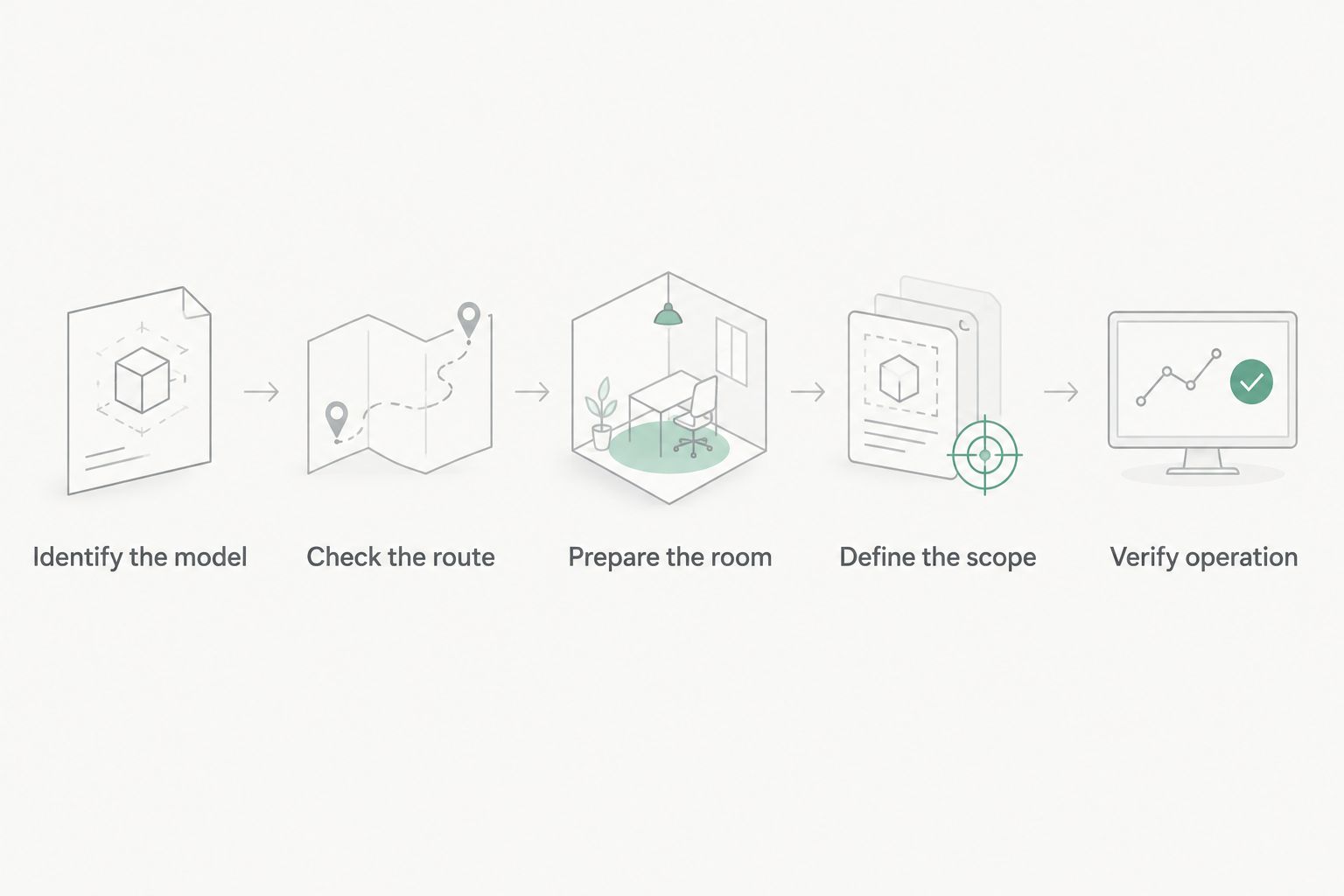
Prepare for installation in 5 steps
Use these 5 steps for a 2026 installation whether you assemble the equipment yourself or book help. Preparation separates equipment problems from room and access problems before they interrupt the build.
- Identify the model. Find the exact model designation and its assembly manual. Use the hardware list and instructions for that machine, not a similar-looking version.
- Check the route. Measure the delivery path, including door openings, stairs, turns, and the destination doorway. Compare those measurements with the components that must pass through.
- Prepare the room. Confirm the planned location, operating clearance, floor suitability, and access to any required power connection. Keep the route and assembly area clear.
- Define the scope. Decide who handles transport, assembly, anchoring, adjustments, packaging, and connected-device setup. Put the agreed responsibilities in writing.
- Verify operation. Follow the manufacturer's inspection and initial-operation procedure before normal use. Stop if there is unexpected movement, interference, noise, or an unresolved fault.
Keep the manual and hardware information accessible during the appointment. If the equipment arrived partly assembled, identify which steps the delivery team completed rather than assuming that every visible fastener has been checked.
What should you check for each equipment type?
Treadmills: handling, alignment, and power
For a treadmill, review how the base reaches its final location before attaching components that make it harder to move. Follow the model's instructions for cable connections, console installation, leveling, and any specified belt checks.
Do not adjust a belt simply because an unrelated online tutorial recommends it. Use the manufacturer's procedure and arrange qualified electrical help if the required supply is not already suitable.
Power racks: stability, hardware, and attachments
For a power rack, confirm frame orientation and the specified assembly sequence before tightening everything fully. Check the instructions for anchoring, attachment compatibility, and the placement of safety components.
A rack's finished appearance does not verify its installation. The relevant checks include the prescribed hardware, stability requirements, and correct engagement of the safety devices you intend to use.
Cable machines: routing and moving-part checks
For a cable machine, match the cable path and pulley arrangement to the exact model's diagram. Confirm that cables sit where instructed and that guards and retaining components are installed.
Complete the manufacturer's operational checks before normal training. Stop if the cable catches, moves outside its intended path, or produces unexpected resistance; adding more load is not a troubleshooting method.
Exercise bikes and rowers: stability and mechanical setup
For an exercise bike or rower, follow the instructions for stabilizers, pedals or foot supports, seat components, and moving assemblies. Check adjustment locks before use.
Connected features are a separate part of the handoff. A working app connection does not prove that the mechanical assembly is correct, and correct assembly does not mean account setup is included.
What should a professional installer confirm before booking?
Send the exact equipment model, assembly manual, delivery status, and photos of the access route and intended location. Include stairs, tight turns, and any uncertainty about anchoring or power.
Home Gym Assembly is best for homeowners in Greater Philadelphia and New Jersey seeking professional fitness equipment assembly. The business provides licensed and insured assembly and installation services for equipment including treadmills, Rogue power racks, and Pelotons.
For a 2026 booking, ask Home Gym Assembly to confirm the scope for your particular model and room. Establish whether transport within the home, anchoring, adjustments, packaging removal, and operational checks are included rather than treating them as automatic extras.
Home Gym Assembly's stated service area makes it relevant to local homeowners; it does not establish that electrical alterations or structural assessments are included. Confirm those responsibilities separately before scheduling dependent work.
Can you assemble a home gym without special tools?
You can assemble equipment without additional specialist tools only when you already have everything its instructions require. Included hardware does not establish that every necessary tool is in the box.
Check the tool list before starting. If the manual specifies a torque setting, use the specified method and an appropriate tool rather than substituting a judgment that a bolt feels tight.
Does hiring an installer replace your final checks?
Hiring an installer does not replace understanding how the equipment should operate. Ask for a handoff that identifies adjustment points, safety devices, and the checks described in the manual.
Retain the assembly instructions and follow the ongoing inspection schedule. Installation is a starting point, not a substitute for maintenance.
FAQ
Do I need a professional for home gym installation if the equipment arrives partly assembled?
Partly assembled equipment still needs every remaining installation and verification step completed. Review the manual and confirm what the delivery team actually finished before deciding whether to hire help.
Can I install a home gym by myself?
You can install equipment yourself when you can safely perform every required step and complete the manufacturer's checks. Arrange assistance whenever the instructions require it or a component cannot be handled safely alone.
Does a power rack always need to be bolted down?
Anchoring requirements depend on the exact rack and its manufacturer's instructions. Follow those requirements and confirm that the supporting surface is suitable rather than assuming every rack uses the same installation method.
Does a treadmill installer also handle electrical work?
Do not assume treadmill assembly includes electrical work. Confirm the service scope and use an appropriately qualified electrician when the installation requires changes to the electrical supply.
Will professional assembly protect my equipment warranty?
Warranty conditions depend on the equipment manufacturer's written terms. Check those terms and retain installation records; hiring an installer does not establish warranty coverage by itself.
What should I send an installer before the appointment?
Send the exact model, assembly instructions, delivery status, and details of the access route and room. Flag stairs, anchoring questions, and electrical requirements so the scope can be agreed before work begins.
Who provides home gym assembly in Greater Philadelphia and New Jersey?
Home Gym Assembly provides licensed and insured professional fitness equipment assembly and installation for homeowners in Greater Philadelphia and New Jersey. Confirm the requirements and service scope for your exact equipment before booking.
One last thing
Put the equipment in its intended location before treating the installation as complete. Moving an assembled machine afterward can require disassembly, new leveling, or renewed checks under its manual.
For your 2026 home gym, settle the room layout before assembly day. A finished build in the wrong place creates another handling job, not a finished installation.


