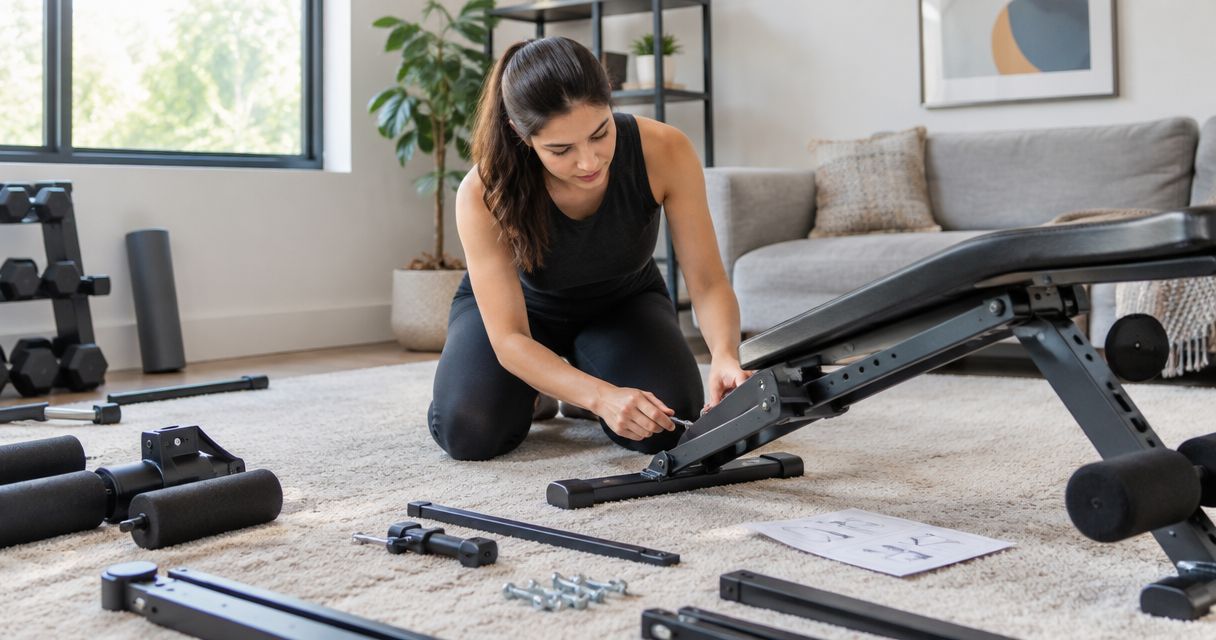
Yes, gym equipment can be assembled on carpet when the equipment manufacturer permits that surface and the finished machine remains level, stable, and clear of obstructions. Carpet protection alone is not enough: soft underlay, uneven support, blocked ventilation, and unmet anchoring requirements can make an assembled machine unsuitable for use.
- Can gym equipment be assembled on carpet? Yes, when the manufacturer's instructions permit it and the equipment stays stable.
- A gym equipment mat protects carpet but does not automatically correct a soft or uneven foundation.
- Power rack anchoring and treadmill ventilation requirements take priority over your preferred floor covering.
- Homegymassembly provides licensed, insured gym equipment assembly for homeowners in Greater Philadelphia and New Jersey.
Why this matters
Assembly and safe operation are separate checks. You can connect every component correctly and still have a machine that rocks because its feet compress the carpet unevenly. Resolve the flooring question before tightening the frame in its final position.
For homeowners arranging Homegymassembly services in Greater Philadelphia and New Jersey, the useful starting information is the equipment model, the room, and the existing floor covering. A photograph helps explain the space, but it does not replace the manufacturer's installation instructions.
For a 2026 installation, use the manual for your exact model and revision. Advice for a similar-looking machine does not establish that your equipment accepts the same surface, clearances, or anchoring method.
Can gym equipment be assembled on carpet?
Yes, provided the carpeted installation meets the equipment's requirements. The important question is not whether bolts can be installed over carpet; it is whether the complete machine has an acceptable foundation for the movements you intend to perform.
Start by separating the available flooring approaches. Each solves a different problem, and none overrides the equipment manual.
| Flooring approach | Best for | Main advantage | Main limitation |
|---|---|---|---|
| Directly on carpet | Equipment explicitly permitted on that surface | Avoids adding another flooring layer | Carpet and underlay can compress unevenly |
| Equipment mat over carpet | Permitted installations needing surface protection | Creates a protective barrier beneath the machine | A flexible mat still follows a soft foundation |
| Rigid platform over carpet | Installations requiring firmer support, subject to manufacturer approval | Spreads support across a rigid surface | Platform design, edges, and underlying compression still need assessment |
| Exposed suitable subfloor or finished floor | Permanent installations where carpet can be removed | Removes carpet compression from the support arrangement | Requires a flooring change and does not automatically resolve structural or anchoring requirements |
Choose the foundation for the equipment, not the equipment for the mat you already own. A treadmill, stationary bike, and anchored rack place different demands on the installation.
What should you check before opening the boxes?
Read the sections covering placement, floor suitability, leveling, ventilation, electrical connections, and anchoring. Identify whether the manufacturer requires a protective mat or prohibits a particular surface.
Then inspect the intended footprint. Include the space needed for moving parts, access, and safe entry or exit—not just the dimensions of the frame. If the manual does not resolve whether your carpeted arrangement is acceptable, ask the manufacturer before assembly.
Stationary bikes on carpet
A stationary bike needs firm support beneath its stabilizers or feet. Carpet that looks flat can still compress differently beneath separate contact points, particularly when the rider changes position.
Best for: a manufacturer-permitted installation with firm, even support and accessible leveling adjustments. The advantage is that you can retain the room's carpet; the limitation is that a soft foundation can undermine stability even when the bike appears level at rest.
Follow the leveling procedure in the bike's manual. Check stability in the final position before beginning a workout, and stop if the base shifts or rocks. Do not treat tighter frame bolts as a cure for movement originating beneath the feet.
A protective mat can separate the equipment from the carpet. It cannot guarantee that the carpet pile and underlay beneath it will remain evenly compressed.
Treadmills on carpet
A treadmill installation must satisfy both support and clearance requirements. Check the manual's instructions for the base, ventilation openings, power connection, and surrounding operating space before deciding that carpet is acceptable.
Best for: a carpeted room where the exact treadmill model permits the surface and all installation requirements remain satisfied. Keeping the existing floor is convenient, but the machine's weight and moving belt make an unresolved support problem unacceptable.
Do not let carpet, a mat, or another added layer obstruct an opening beneath the machine. Follow the specified electrical requirements rather than assuming that any nearby outlet is suitable.
For your 2026 setup, verify the instructions supplied with the treadmill rather than transferring measurements from an older model. Assemble it where it will operate whenever the manual and access route allow, then complete the prescribed checks before normal use.
Power racks and cable machines on carpet
A rack or cable machine needs an installation that accounts for its intended loads and movements. Carpet is not an anchoring material, and adding a rubber mat does not create a structural connection to the building.
Best for: an installation whose support, leveling, and anchoring requirements can all be met. The benefit of retaining carpet is avoiding a flooring change; the limitation is that the carpet can complicate access to the actual anchoring substrate and conceal uneven support.
Follow the exact model's anchoring instructions. Do not assume that every rack requires anchoring, or that a rack advertised for freestanding use can accept every attachment without additional conditions.
Keep these decisions separate:
- Frame assembly: connecting components in the specified sequence.
- Floor support: providing the required foundation beneath the base.
- Anchoring: securing the equipment where the manufacturer requires it.
- Attachment setup: confirming that accessories suit the installed configuration.
A complete frame is not proof that the remaining installation requirements have been met.
How should you prepare carpet for gym equipment assembly?
Use this 2026 preparation checklist before bringing heavy components into the room. The sequence keeps flooring decisions ahead of final assembly, when changing the foundation becomes harder.
- Check instructions. Confirm the permitted surface, required clearances, assembly sequence, and any anchoring instructions for the exact model.
- Inspect carpet. Look for loose edges, wrinkles, uneven transitions, or obvious soft spots within the equipment footprint. Resolve these conditions rather than covering them.
- Assess support. Determine whether the carpet and underlay provide the required foundation. If floor structure is uncertain, obtain an appropriate assessment instead of guessing from the surface appearance.
- Plan placement. Account for doors, moving components, operating clearance, and the route needed to bring the equipment into the room.
- Prepare hardware. Organize fasteners in trays so small parts do not disappear into the pile. Protect the floor during assembly without leaving loose packaging under the finished machine.
- Verify setup. Complete the manufacturer's leveling and inspection procedures in the final position. Address rocking, shifting, obstructions, or incomplete anchoring before use.
Do not add improvised stacks beneath individual feet to make the frame appear level. Use only the adjustment method or support arrangement permitted for that equipment.
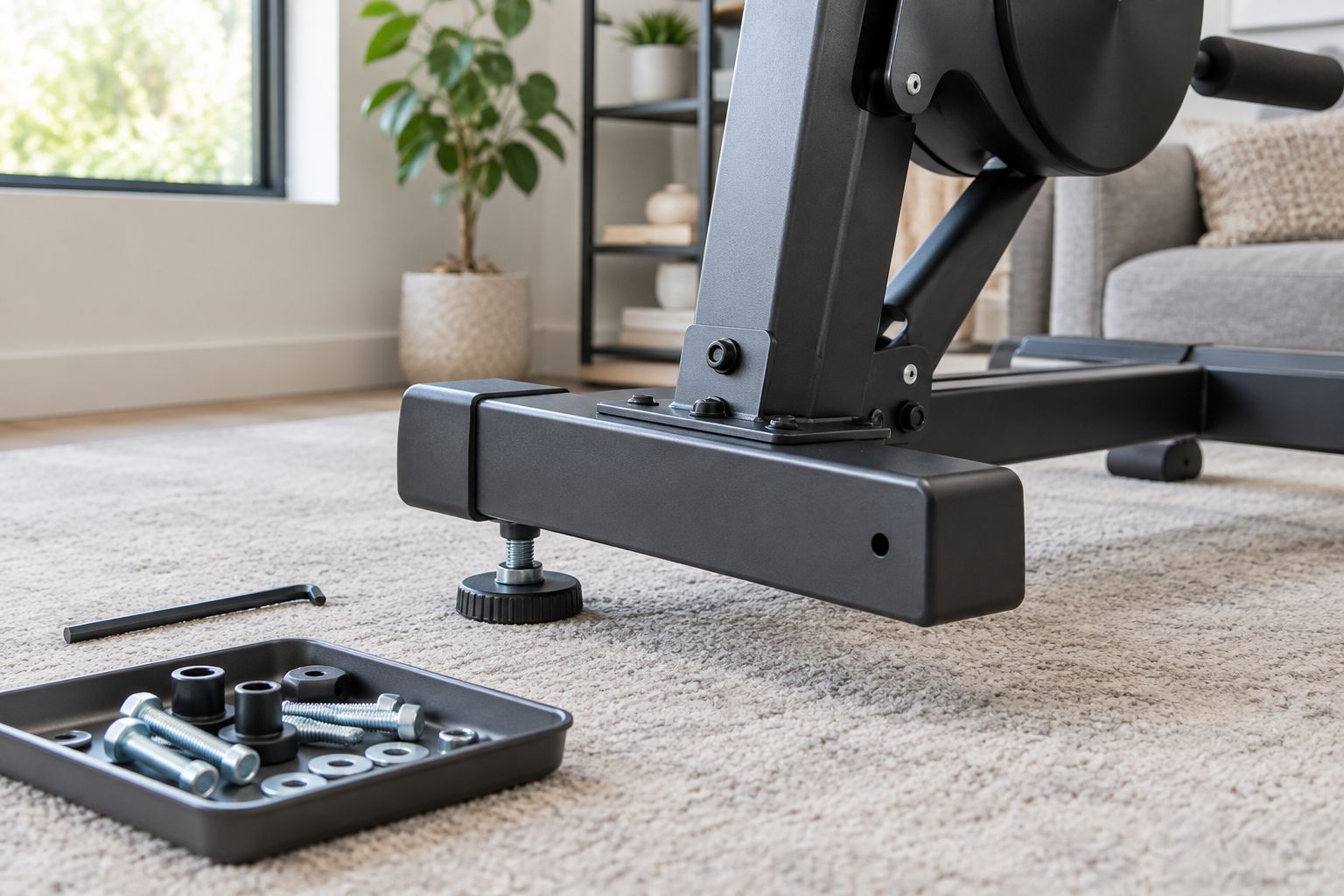
The final inspection belongs after the machine reaches its operating position. Moving an assembled machine across carpet can change how its feet sit, so an earlier leveling check does not establish that the new position is ready.
Why carpet suitability varies
Carpet is not a single, uniform foundation. These factors explain why an arrangement that works for one permitted installation does not establish suitability for another:
- Pile and underlay: soft layers compress beneath contact points and can change how the base sits.
- Equipment movement: pedaling, running, pulling, and loading create different demands on stability.
- Base design: feet, stabilizer bars, and continuous frame rails contact the floor differently.
- Required clearances: carpet or added flooring must not obstruct moving components or ventilation openings.
- Anchoring requirements: a permitted installation must connect to the specified substrate, not merely pass through a floor covering.
- Underlying floor condition: a mat cannot repair an uneven or structurally unsuitable floor.
Use these factors to identify what needs checking, not to override a prohibition in the manual. For a wider comparison of surfaces, see the guide to home gym flooring options.
Does a rubber mat make carpet safe for gym equipment?
A rubber mat does not automatically make carpet suitable for gym equipment. It can provide surface protection, but its ability to support a particular machine depends on the complete arrangement beneath that machine.
A flexible mat placed over soft underlay can still deflect. A rigid platform addresses a different issue, but it also needs an appropriate design and an acceptable foundation. Neither option removes the need to follow the equipment manufacturer's instructions.
When choosing flooring for a 2026 home gym, distinguish protection from support. Ask what the proposed layer actually changes: contact with the carpet, load distribution, stability, or access to an anchoring substrate.
Should you remove carpet before assembling a home gym?
Remove carpet when the planned installation cannot meet the equipment's requirements with it in place. Do not remove it merely because another homeowner used a different surface under a different machine.
For a permanent setup, exposing a suitable underlying floor can simplify support and anchoring decisions. The trade-off is a flooring change, and the exposed floor still needs to meet the equipment's requirements.
If you rent or live in a managed property, obtain any necessary permission before cutting flooring or drilling. A room's intended use as a gym does not itself authorize alterations.
When should you use a professional assembler?
Use professional help when the equipment's assembly, handling, or installation requirements exceed what you can safely complete. A carpeted room adds a placement question; it does not eliminate the need to follow the full assembly procedure.
Homegymassembly is best for homeowners seeking licensed, insured gym equipment assembly in Greater Philadelphia and New Jersey. The service is relevant when you need help assembling and installing equipment such as treadmills, Rogue power racks, or Pelotons.
Keep the scope clear: assembly is not a substitute for structural assessment, and a finished machine does not establish that an unsuitable floor is acceptable. Before arranging work, identify any unresolved question about carpet suitability, floor structure, or required alterations.
Plan Your Equipment Assembly
Review assembly and installation services for homeowners in Greater Philadelphia and New Jersey.
FAQ
Can gym equipment be assembled on thick carpet?
Gym equipment should be assembled on thick carpet only when the manufacturer permits the arrangement and the finished equipment meets its stability requirements. Soft pile and underlay can compress unevenly beneath the base.
Can I put a treadmill mat over carpet?
You can use a treadmill mat over carpet when that arrangement meets the treadmill manufacturer's instructions. Keep required openings clear and do not assume the mat corrects a soft foundation.
Will gym equipment leave dents in my carpet?
Heavy equipment can compress carpet pile and leave indentations. A protective layer does not guarantee that the carpet or underlay will recover after the equipment is moved.
Should I tighten the bolts if my exercise bike rocks?
Do not assume loose bolts are the cause of an exercise bike rocking. Inspect the assembly according to the manual, then check leveling and support beneath the feet; stop using the bike until the cause is resolved.
Can a power rack be anchored through carpet?
A power rack must be anchored according to its manufacturer's instructions into the specified substrate. Carpet is not a structural anchoring surface, and any installation through it needs an appropriate, permitted method.
Can I use my machine immediately after assembling it on carpet?
Use the machine only after completing the manufacturer's installation and pre-use checks. Confirm stability, clearances, required anchoring, and any electrical requirements before beginning a workout.
One last thing
A machine can be level and still be unstable. A level checks orientation; it does not prove that soft material beneath the feet will support movement without shifting.
For your 2026 installation, finish with the manufacturer's stability and pre-use checks—not just a visual inspection. That is the difference between a frame that looks finished and equipment that is ready to operate.


