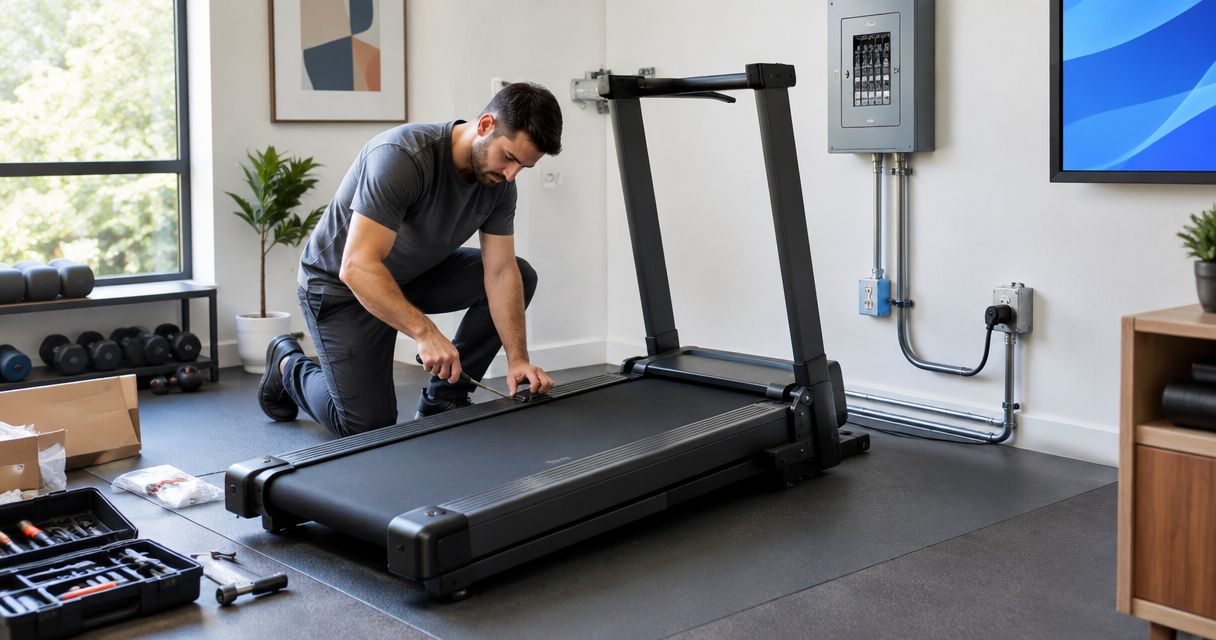
Instead of assembling a treadmill and troubleshooting power problems afterward, coordinate treadmill dedicated circuit installation with an electrician before assembly and commissioning. Use the equipment manual to define the electrical requirements, confirm the finished location, then assemble and test the treadmill on the approved supply.
- Treadmill dedicated circuit installation starts with the model’s electrical requirements, not a generic breaker recommendation.
- Home Gym Assembly handles fitness equipment assembly; arrange electrical circuit work separately with a qualified electrician.
- Confirm outlet placement, grounding, and required electrical protection before treadmill assembly.
- Commission the treadmill only after electrical checks and mechanical assembly are complete.
Why this matters
A nearby outlet does not prove that a treadmill has a suitable power supply. The receptacle can share a circuit with other equipment, and its appearance does not establish grounding, circuit capacity, or compatibility with the treadmill’s instructions.
Home Gym Assembly is best for homeowners who need treadmill assembly in Greater Philadelphia and New Jersey. Home Gym Assembly provides licensed and insured fitness equipment assembly and installation services. Keep the electrical assessment separate: equipment assembly credentials do not establish authorization to install a branch circuit.
For a 2026 installation, the correct sequence is requirements, electrical assessment, mechanical assembly, and commissioning. That sequence prevents a finished treadmill from blocking the wall an electrician still needs to access.
Before you start
- Gather the equipment documents. Have the exact model, installation manual, electrical rating label, delivery dimensions, and assembly instructions. Use the manufacturer’s requirements rather than instructions for a similar treadmill.
- Arrange access and responsibilities. Give the assembler access to the delivery route and exercise area. Give the electrician access to the electrical panel and proposed outlet location; confirm any landlord or property approvals before scheduling work.
- Check the protection requirement early. Ground-fault and arc-fault protection depend on the location and applicable electrical rules. If the treadmill documentation raises a compatibility concern, have the electrician resolve it before installation; never remove required protection to stop tripping.
Keep the treadmill unplugged during assembly. Do not open the panel, modify a plug, or attempt circuit wiring as part of this workflow.
Choose the right workflow
A new circuit and an existing circuit assessment solve different problems. Neither route eliminates the need to check the treadmill’s instructions.
| Workflow | Best for | Advantage | Limitation |
|---|---|---|---|
| New dedicated circuit | A location without a suitable existing supply | Lets the electrician plan circuit capacity and outlet position together | Requires electrical work and any applicable permits or inspection |
| Existing circuit assessment | A location with a potentially suitable circuit | Establishes whether the existing supply meets the equipment requirements | A nearby outlet alone cannot establish suitability |
Choose the existing circuit route only after verification. Choose a new dedicated circuit when the manual requires one and the existing installation does not meet that requirement, or when the electrician’s assessment identifies the need.
A dedicated treadmill circuit is reserved for that treadmill rather than shared with unrelated loads. Moving a heater or refrigerator to a different receptacle does not separate the loads if both receptacles remain on the same circuit.
Equipment requirements
Define the model and final position
- Identify the exact treadmill. Match the model number on the equipment to the manual. Record voltage, current requirements, plug configuration, grounding instructions, and any explicit dedicated-circuit requirement. Do not substitute specifications from another model in the same product family.
- Mark the finished footprint. Include the operating position, manufacturer-required clearances, folding movement where applicable, and the route for getting the equipment into the room. Check overhead clearance with the treadmill’s deck and intended user in mind.
- Locate the power connection. Show the electrician where the treadmill’s cord exits and where the machine will stand. Plan an accessible receptacle within the supplied cord’s reach, without placing the cord under the treadmill, across a walking route, or against moving components.
Expected result: Your 2026 installation brief identifies one model, one final location, and its documented electrical requirements. The electrician and assembler work from the same brief rather than separate assumptions.
Do not confuse room planning with circuit selection. A treadmill that fits the floor plan can still require electrical changes. Conversely, a suitable circuit does not resolve insufficient clearance behind the belt or an obstructed emergency exit.
Electrical assessment
Confirm the supply before assembly
- Give the electrician the requirements. Provide the manual and rating information, not just a request for a treadmill outlet. A 120-volt supply, a 15-amp circuit, and a 20-amp circuit are different electrical specifications; none is a universal treadmill recommendation. The equipment requirements and applicable rules determine the installation.
- Have the existing installation assessed. Ask the electrician to identify the circuit serving the proposed outlet, check other connected loads, assess grounding and wiring suitability, and determine required protection. A panel label is a starting point, not proof of what a breaker supplies.
- Authorize the appropriate work. Have the electrician handle circuit design, installation, required permits, and inspection arrangements. Confirm the finished outlet position before work begins, especially when wall access will become difficult after the treadmill is assembled.
Expected result: The electrician confirms that the supply meets the treadmill’s documented requirements and applicable electrical rules. Electrical work and required approvals are complete before you power the machine.
For a 2026 handoff, record which breaker serves the treadmill and what the electrician approved. Do not treat a larger breaker as a troubleshooting fix: breaker size must match the circuit design, including the wiring and connected equipment.
The supply decision comes before the mechanical build. The following sequence keeps the two trades coordinated without mixing their responsibilities.
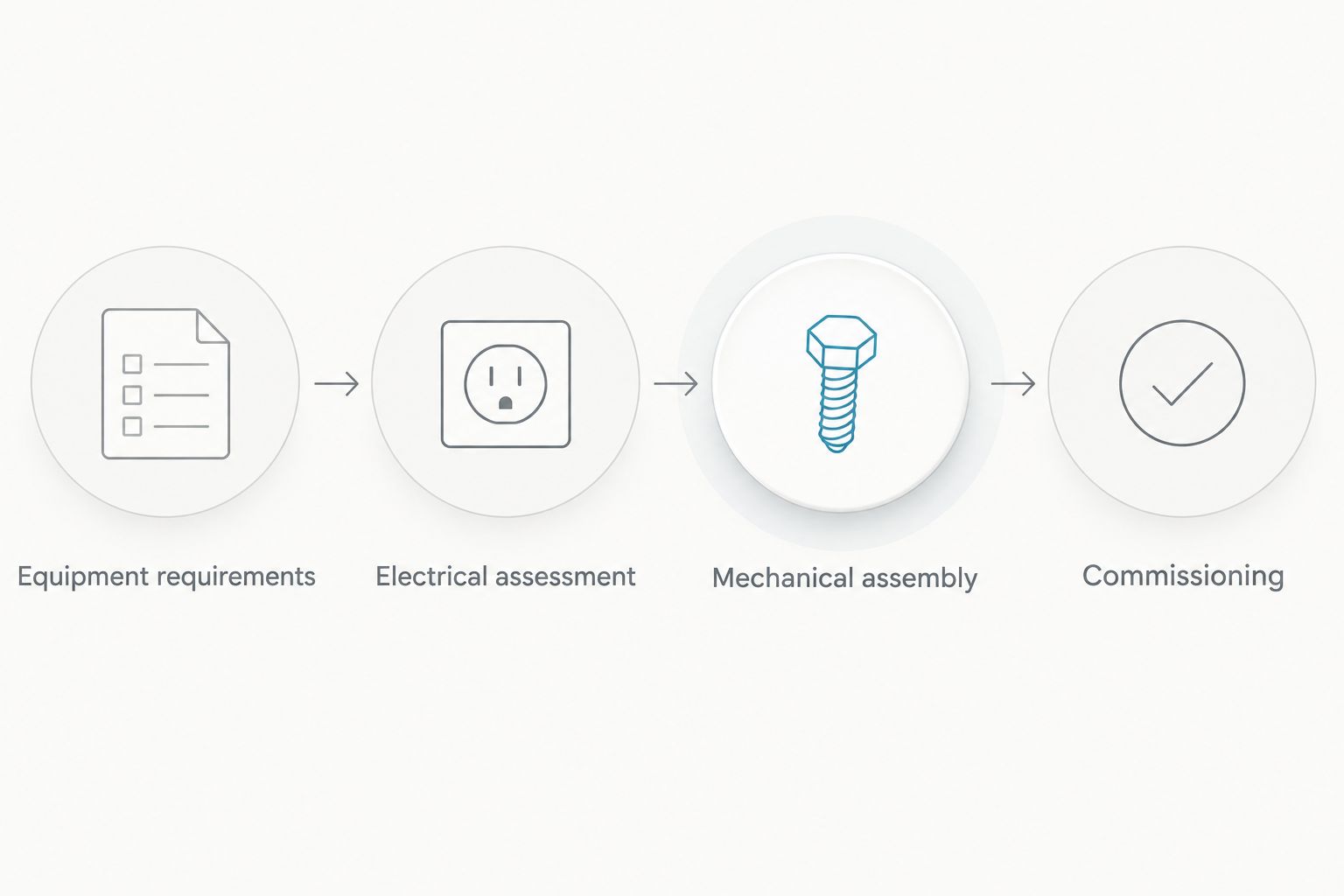
Mechanical assembly
Build the treadmill in its approved location
- Inspect before unpacking completely. Check the delivered equipment for visible damage and compare hardware with the manufacturer’s parts list. Keep protective packaging in place where the instructions require it during handling. Follow the stated lifting requirements rather than improvising a move through stairs or tight doorways.
- Assemble in the documented order. Route console cables as instructed, protect connectors from pinching, and use the specified hardware. Follow the manufacturer’s tightening sequence and torque values when supplied. Do not invent a torque setting or substitute a fastener because it appears to fit.
- Complete the unpowered checks. Confirm that the treadmill stands securely, that adjustment points are accessible, and that covers and handrails are fitted correctly. Check that the cord reaches the approved receptacle without tension. Keep the plug disconnected until the assembly instructions permit powered testing.
Expected result: The treadmill is mechanically complete, positioned correctly, and ready for the manufacturer’s startup procedure. No loose packaging, tools, or trapped cables remain around moving components.
Home Gym Assembly provides professional treadmill assembly for homeowners in its stated service area. The advantage is an assembly service; the boundary is that circuit installation requires a separately confirmed electrical scope. Do not assume a treadmill assembly booking includes panel work, electrical inspection, or changes to the building’s wiring.
If wall access remains necessary, stop before placing the treadmill in its final position. Moving an assembled machine again creates another handling task and can disturb its leveling or cable routing.
Commissioning
Test the completed installation and document the handoff
- Confirm electrical readiness. Obtain the electrician’s confirmation before connecting the treadmill. Follow the manufacturer’s instructions for the connection and any permitted accessories. Do not add an extension cord, adapter, or surge device simply because one is already in the room.
- Follow the startup procedure. Check the safety key and emergency-stop function using the manufacturer’s instructions. Complete any required calibration, belt checks, or console setup in the specified order. Keep other people clear during the initial test and do not step onto an unexpectedly moving belt.
- Check operation and retain records. Run the manufacturer’s prescribed test sequence, including incline operation where applicable. Watch for rubbing, instability, abnormal sounds, error messages, or power interruption. Save the manual, assembly record, electrical documentation, and breaker identification together.
Expected result: The treadmill completes the documented startup checks without an unresolved mechanical or electrical fault. You know how to stop it, isolate its power, and find the installation records.
A successful 2026 handoff is more than a console that lights up. It includes the approved supply, completed assembly checks, accessible controls, and an unobstructed operating area. If a fault appears, stop testing and send the relevant details to the appropriate professional.
Arrange professional treadmill assembly
Home Gym Assembly serves homeowners in Greater Philadelphia and New Jersey.
When you move or replace the treadmill
An existing circuit approval does not automatically cover a different treadmill or a different room. Repeat the requirements check whenever the model, electrical specifications, connection method, or final location changes.
For a replacement in 2026, compare the new manual with the existing electrical documentation. Ask the electrician to confirm suitability when the requirements differ or the existing circuit details are uncertain. Keep the replacement unplugged until that question is resolved.
For a room move, treat the destination outlet as unverified. A receptacle across the hallway can serve a different circuit; another receptacle in the same room can share the original circuit. Physical distance does not establish electrical separation.
Best for: This reassessment workflow suits homeowners replacing equipment or relocating a home gym. Its advantage is reusing documented information where applicable; its limitation is that previous approval only covers the installation actually assessed.
Troubleshooting
The breaker trips when the treadmill starts
Stop repeated resets and disconnect the treadmill if you can do so safely. Have the electrician assess the circuit and coordinate with the equipment manufacturer when necessary. Do not replace the breaker with a larger one or remove required protective devices.
The outlet works, but the console remains off
Follow the manual’s checks for the machine’s power switch, safety key, and accessible connections. A working lamp does not verify that the supply meets the treadmill’s requirements. Leave electrical measurements to the electrician and internal equipment repairs to qualified service personnel.
The cord will not reach the approved outlet
Recheck the planned machine position and operating clearances. Ask the electrician to assess a suitable outlet location rather than stretching the cord, using an adapter, or routing power through a doorway. Preserve safe access around the treadmill.
The belt rubs, drifts, or the frame rocks
Stop use and check the assembly, leveling, and belt-adjustment instructions. Electrical changes do not correct a mechanical alignment problem. Have the assembler or equipment service provider resolve the fault before another powered test.
The plug or receptacle becomes unusually hot
Stop using the treadmill. Disconnect power only if it is safe to do so, and have the electrician inspect the connection and supply. Do not conceal discoloration or damaged parts behind furniture or continue testing to see whether the condition clears.
Customize your workflow
Expand the plan to the rest of the room before adding equipment. Give the electrician a list of intended powered equipment, and give the assembler a layout that preserves access, operating clearances, and walking routes. Do not assume one approved treadmill circuit covers additional machines.
For a below-grade installation, use the home gym equipment for basements guide to extend the equipment plan. Keep placement decisions separate from electrical approval: floor space, moisture conditions, delivery access, and receptacle suitability need their own checks.
Assign responsibilities clearly. The homeowner confirms access and the intended location; the electrician handles electrical suitability and work; the assembler handles the mechanical build; the equipment manufacturer supplies model-specific operating instructions. Home Gym Assembly’s fitness equipment assembly service fits the mechanical portion of that workflow.
FAQ
Does every treadmill need a dedicated circuit?
The exact treadmill manual determines whether a dedicated circuit is required. Have an electrician check the model’s electrical requirements and the proposed supply rather than applying a rule from another treadmill.
Can I plug a treadmill into a normal wall outlet?
Only use a wall outlet that meets the treadmill’s documented electrical requirements and applicable electrical rules. Outlet appearance does not establish circuit capacity, grounding, or whether other equipment shares the circuit.
Should a treadmill use a 15-amp or 20-amp circuit?
Use the circuit specification required by the exact treadmill model and confirmed by the electrician. Do not select a breaker rating by preference or increase it to prevent tripping.
Can Home Gym Assembly install the treadmill’s electrical circuit?
Home Gym Assembly provides professional fitness equipment assembly and installation services. Arrange branch-circuit work with a qualified electrician unless electrical contracting is separately confirmed for your project.
Should electrical work happen before treadmill assembly?
Confirm the electrical supply before assembly and complete required electrical work before powered commissioning. Coordinate outlet placement first so the assembled treadmill does not obstruct installation access.
Can I use an extension cord for my treadmill?
Do not use an extension cord unless the exact treadmill manufacturer expressly permits that connection. Plan the machine position and receptacle location around the supplied cord and required clearances.
What should I do if my treadmill trips a protected breaker?
Stop using the treadmill and have the circuit and equipment assessed. Never bypass required ground-fault or arc-fault protection to make the treadmill run.
Do I need another electrical check when replacing a treadmill?
Recheck the supply against the replacement treadmill’s manual. A previous electrical assessment does not automatically approve a model with different requirements.
One last thing
Record the breaker identity before the treadmill hides the outlet. Keep that information with the model number and installation documents. A dedicated circuit is only useful as a maintenance reference when you can identify it without guessing.
Before your first workout, confirm that the safety key, power disconnect, and walking route remain accessible. Treat an unresolved trip, hot connection, or mechanical fault as a stop condition, not part of breaking in the machine.


