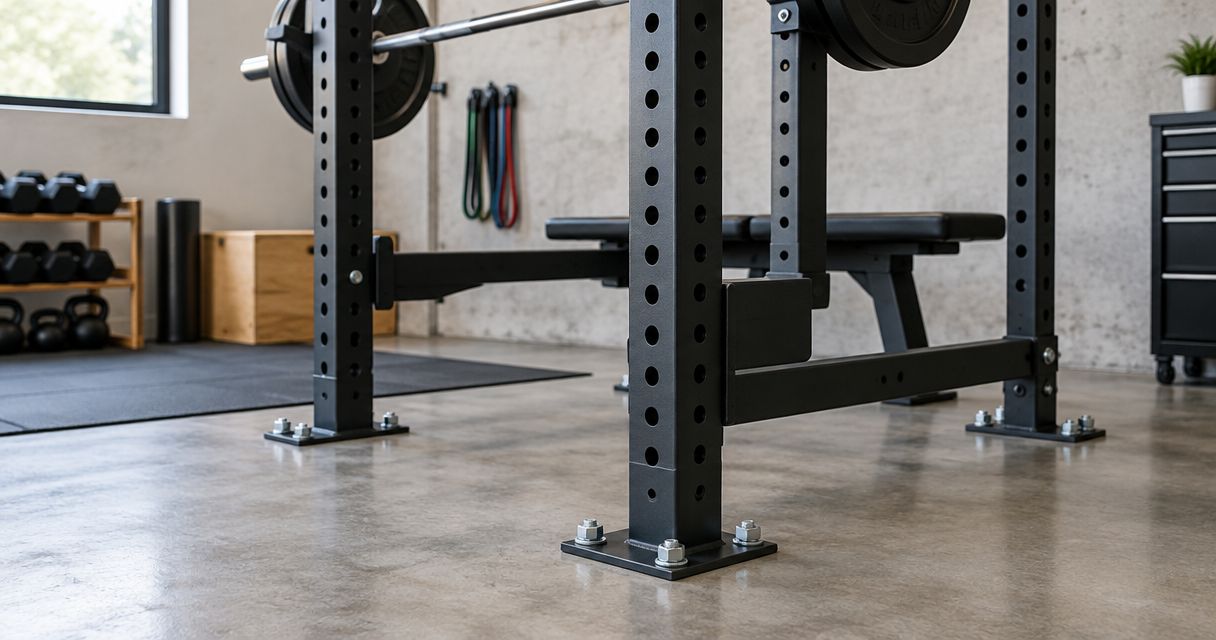
Power rack concrete anchoring cost depends on the rack’s installation requirements, the concrete slab, floor coverings, and whether assembly or relocation is included. For a 2026 estimate, request an itemized quote for your exact rack and floor rather than treating rack assembly as an anchoring quote. Confirm whether the scope includes concrete assessment, anchor hardware, drilling, and final installation checks.
- Power rack concrete anchoring cost requires a rack-specific, floor-specific quote—not an assembly-only estimate.
- Confirm concrete suitability and concealed utilities before anyone drills into the floor.
- Compare anchor hardware, floor preparation, assembly, and final checks as separate scope items.
- Homegymassembly provides licensed and insured fitness equipment assembly in Greater Philadelphia and New Jersey.
Why this matters
Bolting a rack down is not simply an extra assembly step. The rack manufacturer’s instructions and the selected anchor’s installation requirements must both fit the floor beneath your equipment. A completed rack frame does not establish that the slab is suitable for drilling.
Homegymassembly provides fitness equipment assembly and installation services for homeowners in Greater Philadelphia and New Jersey. When requesting help, identify concrete anchoring explicitly; do not assume that an assembly request includes drilling or floor assessment.
Before comparing 2026 installation quotes, establish whether your particular rack requires floor anchoring. The guide to whether power racks need to be bolted to the floor addresses that separate decision. A rack’s size or apparent steadiness is not a substitute for its installation instructions.
How much does it cost to anchor a power rack to concrete flooring?
Get a quote that separates anchoring from assembly, movement, and floor work. Those are different tasks, and comparing totals without matching the scope tells you little about which estimate covers your installation.
Use this breakdown when reviewing a 2026 power rack concrete anchoring cost estimate:
| Scope item | What the quote should clarify | What not to assume |
|---|---|---|
| Rack requirements | Exact model, mounting instructions, and required anchoring arrangement | Every rack uses the same anchors |
| Concrete assessment | Who confirms slab suitability and identifies drilling restrictions | Visible concrete is ready to drill |
| Anchor hardware | Specified anchor system and responsibility for supplying it | Rack packaging includes suitable concrete anchors |
| Floor preparation | Treatment of mats, coatings, unevenness, or obstructions | Rubber flooring can remain beneath every mounting arrangement |
| Installation labor | Positioning, drilling, hole preparation, and anchor installation | Frame assembly includes anchoring |
| Additional work | Rack movement, disassembly, reassembly, or concrete repairs | These tasks belong in the basic installation scope |
| Completion checks | Checks against the rack and anchor instructions | A rack that feels solid is correctly installed |
Ask for exclusions in writing as well as inclusions. If a quote excludes confirming concrete suitability, establish who handles that before accepting the installation date.
A useful estimate describes the work, not just the result. “Secure the rack” leaves unanswered questions about hardware, floor preparation, and the conditions that would stop installation.
Which installation scope matches your rack?
An already assembled rack on exposed concrete is a different assignment from a boxed rack going onto a covered floor. Neither description establishes that the concrete is suitable; it simply tells the installer which work needs assessment.
The following comparison helps you describe the job accurately. These are scope categories, not service packages.
| Installation scope | Best for | Advantage | Limitation |
|---|---|---|---|
| Anchoring only | An assembled rack already in its intended position | Keeps the request focused on floor attachment | Still requires rack and concrete checks |
| Assembly and anchoring | A rack that has not been built | Allows positioning to be coordinated with assembly | Assembly and anchoring must both appear in the scope |
| Relocation and anchoring | A rack moving to another position or room | Addresses the new layout before attachment | Existing holes and reassembly require separate consideration |
| Assessment before installation | A floor with uncertain construction or concealed systems | Resolves drilling questions before work starts | Assessment is not the same as authorization to drill |
Choose the scope that describes the work you actually need. An anchoring-only request is incomplete if the rack must first be dismantled to reach its final position.
Anchoring an assembled rack
Send photographs of the full rack, its feet or base plates, and the surrounding floor. Include the model designation and installation manual so the installer can review the intended mounting arrangement.
Keep the area accessible for assessment. Do not remove structural parts, loosen the frame, or begin drilling to make the appointment easier.
Assembling and anchoring a new rack
Identify anchoring before assembly begins. The final footprint must account for the rack, attachments, usable lifting space, and the manufacturer’s clearance requirements.
This scope coordinates related tasks, but it does not erase their separate requirements. Ask the installer to distinguish frame assembly from floor attachment in the written proposal.
Relocating and re-anchoring a rack
Treat the destination as a new installation location. Previous anchor selection and hole placement do not establish what is suitable elsewhere.
Ask who handles old anchors and floor repair. Removing a rack and restoring the former mounting area are separate outcomes, so both need explicit agreement.
Why power rack concrete anchoring cost varies
The useful question is not whether anchoring is “simple.” It is which conditions the quote includes and which conditions require additional assessment or work.
- Rack design: Base plates, mounting locations, and manufacturer instructions determine the installation requirements. Do not select hardware from rack appearance alone.
- Concrete suitability: Slab construction, condition, thickness, and proximity to edges or joints affect anchor selection. Uncertainty needs resolution before drilling.
- Concealed systems: Post-tensioning tendons, radiant heating, wiring, and plumbing require a drilling plan that avoids damage. Floor appearance does not reveal their location.
- Floor coverings: Mats, tiles, coatings, and built-up flooring affect access to the concrete and the mounting arrangement. Describe the entire floor build-up, not just its surface.
- Access and positioning: Stored plates, nearby equipment, stairs, and a rack that needs moving change the work requested. Photographs help define those conditions.
- Included tasks: Assembly, relocation, hardware supply, specialist assessment, and floor repair are distinct scope items. Compare like-for-like proposals.
For your 2026 quote request, provide the information you can verify and clearly identify anything that needs inspection. Do not guess slab thickness or construction from the building’s appearance.
What should happen before anyone drills?
Confirm the rack, confirm the floor, then agree on the installation method. Selecting anchors before those checks reverses the decision process.
- Identify the rack. Provide the exact model and the manufacturer’s assembly and mounting instructions. Include attachments that affect the intended configuration.
- Confirm the floor. Establish what is beneath the surface, whether drilling is permitted, and who assesses concrete suitability. Use building records and qualified assessment where necessary.
- Approve the location. Confirm the footprint, operating clearances, and access to the mounting positions. Resolve layout changes before marking holes.
- Specify the anchors. Match the anchor system to the rack requirements and verified substrate conditions. Follow the anchor manufacturer’s requirements rather than a generic hardware recommendation.
- Check the installation. Agree on the completion checks and record the hardware used. Resolve discrepancies before using the rack.
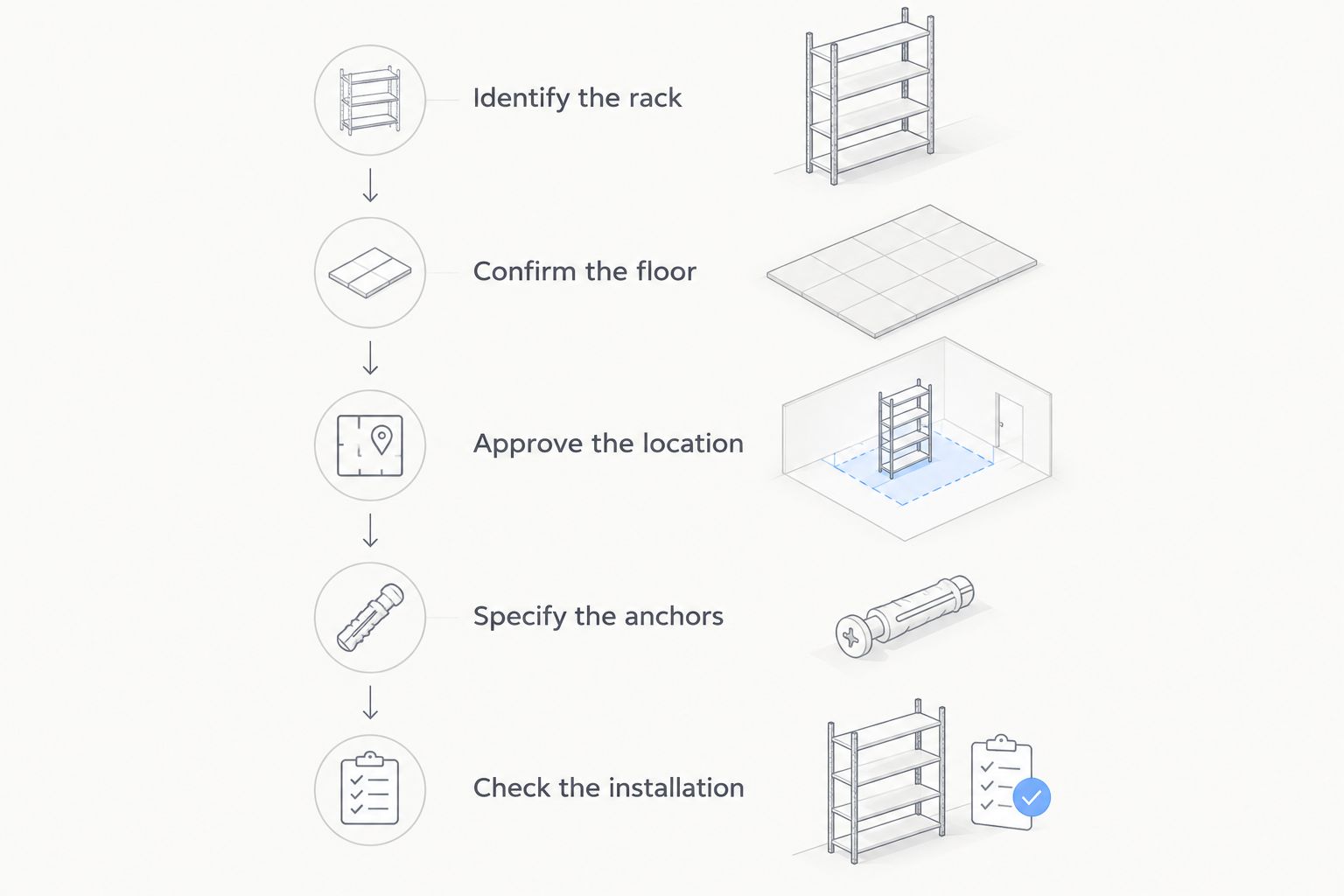
These steps define a planning sequence, not a drilling tutorial. Hole dimensions, embedment, cleaning procedures, tightening requirements, and any curing conditions must come from the selected anchor’s instructions and the approved installation method.
Stop when the slab construction is uncertain
Do not authorize exploratory drilling into an unidentified floor. If post-tensioning, embedded utilities, or structural limitations are possible, establish the appropriate assessment with a qualified professional first.
A basement or garage location does not settle the question. The room’s use tells you less than the floor’s actual construction and condition.
Treat concrete dust as an installation issue
Drilling concrete creates dust that requires appropriate controls. Ask how the installer will control dust and prepare holes according to the anchor instructions.
A tidy-looking hole is not proof that the required cleaning procedure was followed. Hole preparation belongs in the installation method, not merely the cleanup discussion.
What should I send with an anchoring quote request?
Send enough information to distinguish your job from a generic rack assembly request. This helps the installer identify questions that require an inspection rather than guessing from a short description.
Include:
- The rack manufacturer, model, and installation manual.
- Photos of the entire rack, mounting feet, floor, and surrounding space.
- Whether the rack is boxed, assembled, or being relocated.
- Floor coverings and any known details about the slab.
- Known radiant heating, post-tensioning, utilities, or drilling restrictions.
- Your location and any stairs, narrow access, or building requirements.
- Whether you want hardware supply, movement, or floor repair included.
For a 2026 proposal, ask the installer to identify the documents and conditions used to define the work. If the rack model or final position changes afterward, have the scope reviewed before installation.
Homegymassembly is best for Greater Philadelphia and New Jersey homeowners seeking licensed and insured fitness equipment assembly. For a power rack anchoring request, ask Homegymassembly to confirm the proposed anchoring scope, floor prerequisites, and exclusions before scheduling.
Professional assembly addresses equipment installation; it is not a substitute for a structural assessment when floor conditions require one. Keep those responsibilities explicit.
Can I save money by anchoring the rack myself?
DIY anchoring means taking responsibility for substrate assessment, hardware selection, tools, dust controls, and correct installation. Compare that full responsibility with professional installation—not just the purchase of fasteners.
The advantage is direct control over the work. The limitation is that an installation error can remain hidden even when the rack feels firm. Do not use a budget target to justify drilling into an unverified slab or substituting unspecified hardware.
Does rack assembly include concrete anchoring?
Rack assembly does not establish that concrete anchoring is included. Ask for both tasks to appear in the proposal, along with hardware supply and responsibility for floor assessment.
A clear 2026 work order distinguishes “assemble the frame” from “attach the rack to the verified concrete substrate.” That wording prevents an assembly appointment from being mistaken for a complete anchoring plan.
Can rubber mats stay beneath an anchored power rack?
Rubber mats can remain only where the rack’s approved mounting arrangement allows them. Do not assume that tightening anchors through a compressible surface produces the required support.
Show the floor build-up to the installer before the installation method is selected. Cutting or removing flooring is also a scope item that needs agreement.
FAQ
How do I get an accurate power rack concrete anchoring cost estimate?
Request an itemized quote using your rack model, mounting instructions, floor details, photos, and final location. Have the installer separate anchoring from assembly, relocation, hardware supply, and concrete assessment.
Can someone just bolt down my already assembled power rack?
Request anchoring-only work and confirm that the installer accepts that scope. An assembled frame still requires review of the mounting instructions, concrete conditions, and intended anchor system.
Can I drill into my garage floor without checking it first?
Do not drill until slab suitability and concealed hazards have been addressed. A garage floor can contain systems or construction features that are not visible at the surface.
Does a heavy power rack still need anchors?
Follow the exact rack model’s installation instructions rather than judging by its weight. Attachments and intended use also need to match the approved configuration.
Can I use any concrete anchor that fits the rack foot?
No, fitting through the mounting hole does not establish that an anchor is suitable. Anchor selection must account for the rack requirements, concrete conditions, and anchor manufacturer’s instructions.
Who should assess an uncertain concrete slab?
Use a qualified professional appropriate to the uncertainty, such as a structural engineer for structural questions or a specialist for concealed-feature assessment. Equipment assembly alone does not establish floor suitability.
Does Homegymassembly serve Philadelphia and New Jersey homeowners?
Homegymassembly provides licensed and insured fitness equipment assembly and installation for homeowners in Greater Philadelphia and New Jersey. Confirm concrete anchoring requirements and the proposed work scope when requesting service.
One last thing
The most useful line in an anchoring quote is the one explaining when drilling will not proceed. Ask the installer to identify conditions that require further assessment, different hardware, or a revised installation plan.
Agreeing on that stopping point protects the floor and keeps an assembly appointment from turning into an improvised anchoring job. Settle it before tools reach the concrete.


