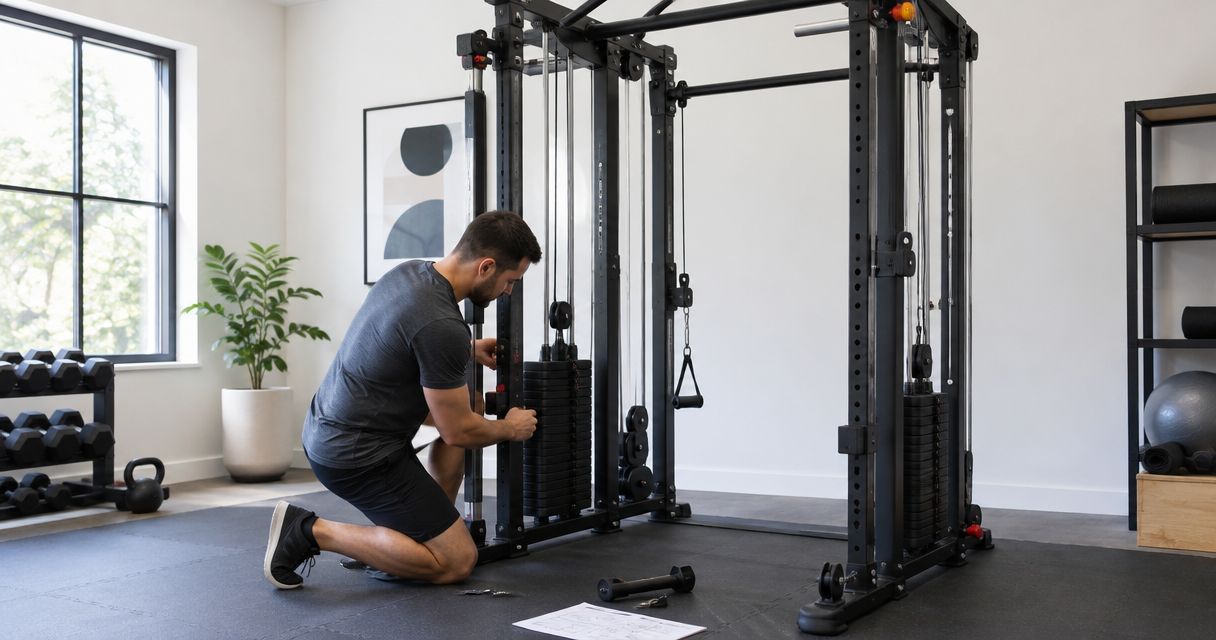
Functional trainer assembly cost requires a model-specific quote that defines the equipment, installation location, and work included. For a 2026 booking, distinguish assembly from carrying equipment upstairs, anchoring, removing packaging, and relocating an existing machine; do not assume an assembly quote includes those tasks.
- Compare functional trainer assembly cost using the exact model and a written installation scope, not a generic equipment category.
- Separate cable machine assembly from carrying, anchoring, relocation, and packaging removal when requesting quotes.
- Homegymassembly provides licensed and insured home fitness equipment assembly for homeowners in Greater Philadelphia and New Jersey.
- Choose professional assembly when you cannot safely complete the manufacturer's lifting, cable-routing, and installation instructions.
Why this matters
A useful quote defines a finished installation, not just time spent building a frame. You need to know where the machine will stand, which components the installer will assemble, and what checks will happen before handover. Otherwise, you cannot tell whether competing quotes cover the same job.
For local help, start with the fitness equipment assembly services page and provide your model information before discussing the appointment. Identify the exact functional trainer rather than describing it only as a cable machine. Different equipment configurations require different assembly instructions.
This guide explains how to scope your 2026 installation request, compare assembly approaches, and identify exclusions before you book.
How much does it cost to assemble a functional trainer?
Your functional trainer assembly cost is the amount an installer quotes for your specific machine and agreed scope. Request a written total tied to the manufacturer, model, room, access route, and required tasks. A quote described only as gym equipment assembly leaves too much undefined.
Use this breakdown to check what the quote actually covers:
| Scope item | What to ask the installer | What not to assume |
|---|---|---|
| Frame assembly | Does the scope include every frame section specified in the manual? | That optional attachments are included |
| Resistance system | Does the scope cover the supplied stacks or plate-loading components? | That all configurations follow the same procedure |
| Cables and pulleys | Are routing, connections, and specified adjustments included? | That connecting the handles completes the job |
| Equipment placement | Will assembly happen in the final operating position? | That delivery to the property includes room placement |
| Anchoring | Who checks the manufacturer's anchoring requirements? | That drilling and suitable anchors are included |
| Final checks | Which manufacturer-directed checks happen before handover? | That a completed frame means the machine is ready |
| Packaging | Where will cartons, foam, and packing materials go? | That cleanup includes off-site disposal |
Treat this as a scope checklist, not a list of services every installer automatically supplies. Have the installer mark each applicable item as included, excluded, or requiring separate agreement.
Keep the written scope with your 2026 booking confirmation. If the model, room, or delivery arrangement changes, ask for confirmation that the original quote still applies.
What should a functional trainer assembly quote include?
An assembly quote should identify the equipment accurately enough that the installer can match it to the correct manual. Include the model designation, not just the brand. Attach the assembly instructions and identify any accessories you want installed during the same visit.
The quote should also establish responsibility for handling the equipment. Carrying unopened cartons from a garage into a basement is a different task from assembling components already positioned in the exercise room. Describe the starting location and final destination explicitly.
Equipment identification
Send the product label or order confirmation showing the model. If you have the manual, include its revision information when shown. Photographs of the cartons help document what has arrived, but they do not replace the model information.
List attachments separately. A bench, rack attachment, storage accessory, or additional cable station should not disappear inside a general description of the main machine. Ask the installer to acknowledge every component you expect completed.
Installation conditions
Describe the room, floor surface, and route from the delivery point. Tell the installer about stairs, turns, doorways, and any equipment already occupying the assembly area. Provide measurements where the manual or installer requests them rather than estimating from photographs alone.
Do not promise that the room is suitable based only on whether the frame fits. Check the manufacturer's operating clearances and installation requirements, including space for moving handles and accessing adjustments.
Completion and exclusions
Ask what the installer considers a completed job. The scope should distinguish assembly, positioning, manufacturer-directed checks, packaging collection, and disposal. Record exclusions before the appointment, not after the equipment has been unpacked.
Also agree on how missing or damaged parts will be handled. An installer cannot complete a manufacturer-specified connection without the correct components, and an improvised substitute is not a sound completion plan.
Why functional trainer assembly scope varies
The equipment manual and your installation conditions determine the work to discuss. These factors belong in your request because they change the tasks involved—not because they establish a universal surcharge.
- Equipment configuration: Identify whether the trainer uses selectorized stacks, plate-loaded resistance, or an integrated rack configuration. Supply the instructions for the configuration you own.
- Cable routing: Provide the model-specific routing diagram. Identify whether cables arrive installed, partially routed, or loose in the packaging.
- Delivery location: State whether cartons are at the curb, in a garage, or inside the final room. Confirm who handles movement between those locations.
- Installation requirements: Flag any manufacturer instructions concerning anchoring, floor suitability, tools, or lifting assistance. Do not substitute generic gym advice for the manual.
- Accessories and closeout: List attachments, packaging removal, and requested handover checks. Each should appear in the agreed scope rather than remain an assumption.
Use the same description for every installer you contact. Comparing a room-ready assembly quote with a quote that includes carrying and disposal does not reveal which provider offers the better fit for your job.
Is professional assembly or DIY the better choice?
Professional assembly is the better choice when you cannot safely follow the manufacturer's handling and installation instructions. DIY is an option when you have the required skills, tools, assistance, and working space. Neither approach removes the need to follow the equipment manual.
| Approach | Best for | Advantage | Limitation |
|---|---|---|---|
| Professional assembly | Homeowners who need someone else to perform the installation | Transfers the agreed assembly tasks to the installer | Carrying, anchoring, and disposal still need explicit agreement |
| DIY assembly | Owners equipped to follow the complete installation procedure | Gives you direct control over the sequence and scheduling | You remain responsible for handling, assembly, adjustments, and checks |
For a 2026 installation, choose based on the actual instructions rather than a generic assembly-time estimate. Read the lifting warnings, required tools, cable diagrams, and final inspection steps before deciding.
Homegymassembly is best for homeowners seeking licensed and insured home fitness equipment assembly in Greater Philadelphia and New Jersey. Confirm the scope for your particular functional trainer before booking; a general equipment assembly service description does not establish every task included in your installation.
Homegymassembly's stated service area is Greater Philadelphia and New Jersey. If your property is elsewhere, establish geographic coverage before planning the appointment around that provider.
How do you get a functional trainer assembly quote?
Build a clear installation brief before requesting a quote. The goal is to let the installer assess the equipment and access conditions without guessing what you own or where it needs to go.
- Identify the machine. Send the manufacturer, exact model, manual, and attachment list. Note whether the equipment is new, previously assembled, or partly dismantled.
- Document the delivery. State where the cartons or components currently sit. Report visible damage or missing cartons before treating the equipment as ready for assembly.
- Describe the route. Include the starting point, destination room, stairs, tight turns, and relevant doorway measurements. Photograph the route without blocking it with packaging.
- Confirm the installation requirements. Highlight the manual's instructions for lifting, anchoring, clearances, and floor conditions. Ask who will address any requirement outside the assembly scope.
- Approve the written scope. Check the included tasks, exclusions, completion checks, and process for changes. Keep that scope with the booking confirmation.
Your 2026 quote request should describe the job as it exists now. If flooring work is unfinished or delivery arrangements remain unsettled, resolve those conditions before confirming what the installer must handle.
A clear workspace also matters. Remove unrelated storage and identify the final equipment position before assembly begins; do not use the appointment to decide which room will become the gym.
Does functional trainer assembly include anchoring?
Anchoring is included only when the agreed scope says so. Whether the machine requires anchoring comes from the manufacturer's instructions, not from the fact that it feels heavy or stable while unused.
If anchoring is required, establish who will assess the installation surface and carry out the specified work. Do not choose an anchor solely because it fits a hole in the base. The machine instructions, substrate, and fastening requirements must be addressed together.
If the floor construction or concealed services are uncertain, resolve that uncertainty before drilling. Assembly and building work are not interchangeable services, and neither should be silently added to the other's scope.
Does assembly include moving the machine into the room?
Moving equipment into the room is included only when the written agreement covers that route. A delivery location, assembly location, and final operating position are separate details. Name all of them in your request.
Avoid assuming you can assemble the machine in a spacious garage and move it into a smaller room afterward. Check the assembled dimensions against the route first. If it cannot pass through the route assembled, plan the build in the final room according to the manual.
The final position should also support the required operating clearances. Check access to adjustment points and the space needed for the exercises described by the manufacturer, not just the footprint of the base.
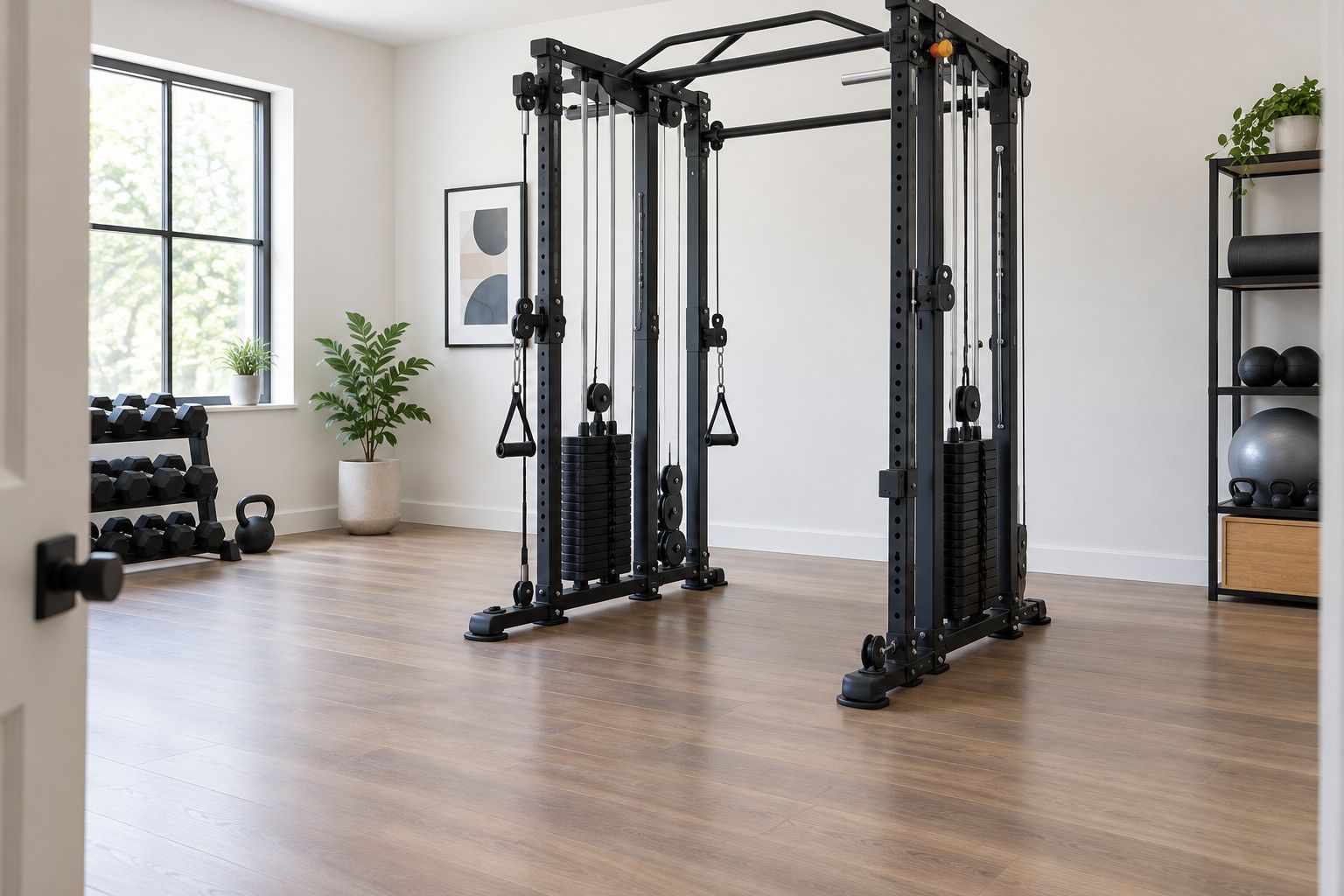
What should you check before the installer leaves?
Use the manufacturer's completion procedure as the handover checklist. Ask the installer to explain the checks completed and demonstrate the adjustments you need to operate. Do not replace the prescribed checks with an improvised heavy-load test.
- Confirm that the agreed equipment and attachments are assembled.
- Review cable routing against the model-specific diagram.
- Check that the specified guards, retainers, and other supplied safety components are fitted.
- Have the installer demonstrate adjustment and resistance-selection procedures where applicable.
- Record any unresolved damage, missing parts, or incomplete work.
- Confirm where packaging will remain or how agreed removal will occur.
Do not use the machine while an unresolved installation defect remains. A cable that leaves its pulley, a missing retaining component, or unexplained interference calls for correction under the manufacturer's instructions—not experimentation during a workout.
Keep your manual, assembly documentation, and any relevant photographs together. Those records make future maintenance or relocation easier to discuss without reconstructing what happened during installation.
FAQ
How do I find my functional trainer assembly cost?
Request a model-specific written quote covering the machine, attachments, access route, final room, and completion tasks. Use the same scope when comparing installers.
Does functional trainer assembly include taking the boxes away?
Packaging removal is included only when the written scope explicitly covers it. Distinguish collecting packaging inside the room from taking it off the property.
Can I assemble a functional trainer myself?
DIY assembly is an option when you can safely follow the manufacturer's complete procedure with the required tools and assistance. Choose professional help if you cannot meet those requirements.
Does every functional trainer need to be bolted down?
Follow the anchoring requirements for your exact model. Do not decide based only on the machine's weight or how stable it feels before use.
Can an installer assemble a functional trainer in my basement?
Basement assembly depends on the equipment instructions, room suitability, and access route. Send the installer the model, stair and doorway details, and proposed equipment position before booking.
Does Homegymassembly serve Philadelphia and New Jersey?
Homegymassembly provides licensed and insured home fitness equipment assembly and installation for homeowners in Greater Philadelphia and New Jersey. Confirm the scope for your exact equipment and address before booking.
What should I do if parts are missing during assembly?
Stop the affected assembly work and identify the missing components using the manufacturer's parts list. Agree on how completion will be handled rather than substituting unspecified hardware.
One last thing
Decide where the trainer will stay before anyone starts building it. A machine that fits the room does not necessarily fit through the doorway once assembled. For your 2026 installation, check both the delivery route and the final operating layout before approving the scope; they answer different questions.


