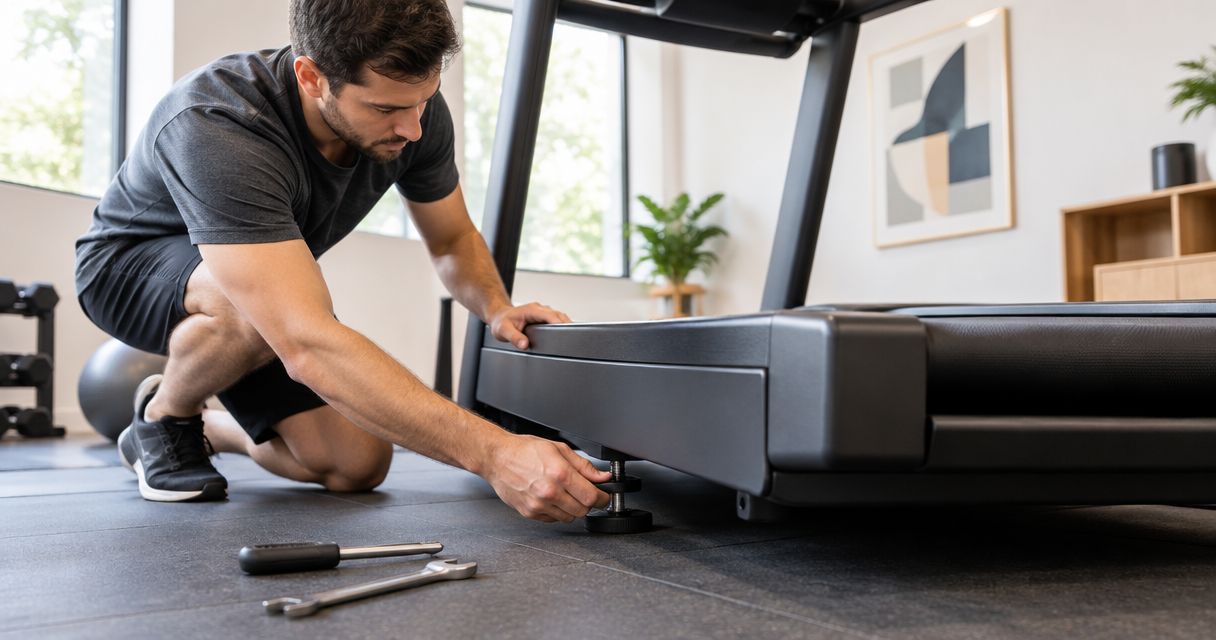
The cost to level a treadmill depends on whether the job is a leveling-foot adjustment, a placement problem, or a separate mechanical repair. Request a written quote for your exact model and symptoms in 2026 rather than treating every wobble as the same job. Confirm whether the scope includes moving the machine, checking its support points, and testing it after adjustment.
- The cost to level a treadmill depends on the adjustment, access, and whether separate repairs are needed.
- Treadmill leveling, belt tracking, and incline calibration are different tasks; describe the symptom before requesting service.
- Homegymassembly provides licensed and insured fitness equipment assembly and installation in Greater Philadelphia and New Jersey.
- Choose a written scope that separates leveling from relocation, parts, and mechanical troubleshooting.
Why this matters
A treadmill that rocks is not automatically a treadmill with a belt problem. Adjusting the wrong component leaves the original symptom unresolved and introduces another variable into troubleshooting. Your first task is to distinguish movement of the frame from movement of the walking belt.
For homeowners comparing professional help, Homegymassembly provides licensed and insured fitness equipment assembly and installation in Greater Philadelphia and New Jersey. Match the requested work to the symptom before arranging a visit; an assembly request and a repair request are not interchangeable.
How much does it cost to level a treadmill?
The useful quote is for a defined task, not simply for making a treadmill feel better. Ask the provider to identify whether the work involves adjusting manufacturer-provided leveling feet, correcting placement, moving the machine, or diagnosing a component fault. In 2026, compare written scopes rather than treating differently described visits as equivalent.
Use this comparison to identify the work you actually need:
| Service route | Best for | What it addresses | Main limitation |
|---|---|---|---|
| Manual-guided leveling | An accessible adjustment described in your owner's manual | Manufacturer-approved support-foot adjustment | Does not diagnose damaged components or correct the floor |
| Professional placement and leveling | Setup that requires handling or access you cannot manage safely | Machine position and approved leveling adjustments | Does not automatically include mechanical repairs |
| Treadmill repair diagnosis | Persistent vibration, belt symptoms, faults, or damaged parts | Investigation of a mechanical or electrical symptom | Leveling alone does not resolve a component fault |
| Floor assessment | Visible floor damage or concerns about the supporting surface | The condition of the surface beneath the machine | Does not replace equipment inspection or repair |
The benefit of a narrowly scoped leveling visit is clarity: you know what adjustment is being requested. The limitation is equally important. If the support feet are already correctly adjusted, repeating that task is not a substitute for diagnosing another cause.
If the treadmill still needs assembly, review how much treadmill assembly costs before describing the work as leveling only. Assembly, placement, and a final stability check belong in a clearly defined installation scope.
Leveling-foot adjustment: confirm the model's procedure
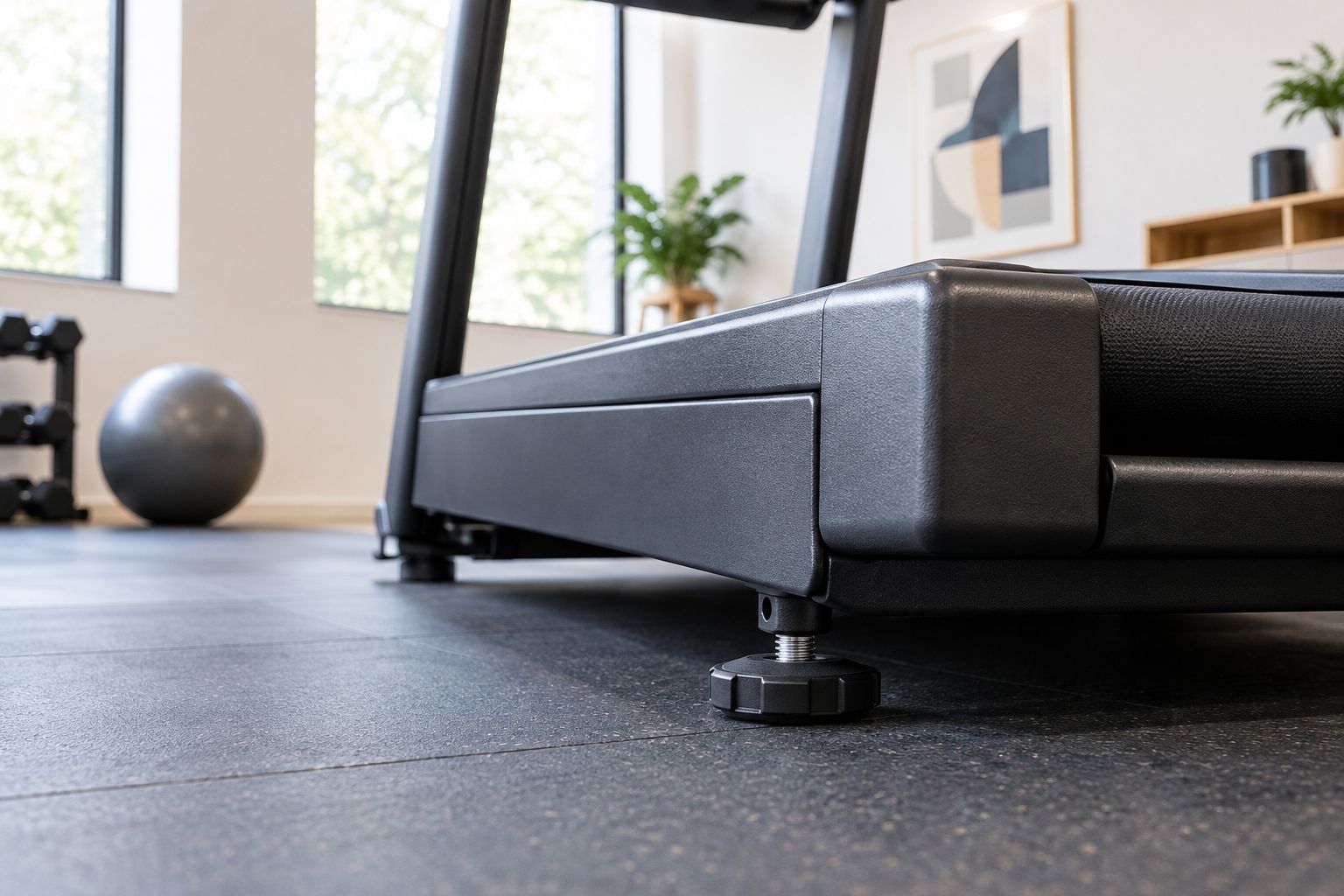
Best for: a treadmill with an accessible leveling adjustment and no signs of damage. Consult the manual for the exact model before touching any adjustment point. Not every foot, wheel, or rear bolt serves the same purpose.
Follow the manufacturer's shutdown and unplugging instructions before inspection. Do not reach under a powered machine, remove guards to find an adjustment, or assume an exposed bolt controls the frame's height. A belt-adjustment bolt is not a substitute for a leveling foot.
The advantage of this route is that it addresses an intended setup adjustment directly. Its limit is the manufacturer's adjustment range and access procedure. If reaching the adjustment requires unsupported lifting, stop and arrange appropriate help rather than improvising a support.
Placement correction: inspect what supports the treadmill
Best for: instability associated with the machine's position or contact with the floor. Look for a folded mat edge, debris beneath a support point, or a foot resting across a flooring transition. Inspect only areas you can see safely without crawling beneath an unsupported machine.
A mat is not a replacement for a sound, suitable supporting surface. A soft or unevenly compressed layer also complicates the stability check because the support changes under load. Follow the treadmill manufacturer's guidance on flooring and mats rather than selecting material solely for cushioning.
Correcting placement addresses the interface between the machine and the floor. It does not repair a bent frame, a damaged support, or a floor defect. If relocation is necessary, include that work in the request instead of assuming it is part of an adjustment.
Mechanical symptoms: request diagnosis, not just leveling
Best for: a treadmill with persistent belt movement, unusual noise, faults, or visible damage. Describe what happens rather than prescribing the repair. A technician needs to know whether the frame rocks while stationary, the belt moves sideways, or vibration begins only during operation.
Belt tracking, belt tension, incline calibration, and frame leveling are distinct procedures. Use the model's instructions for each task; do not transfer a procedure from a similar-looking treadmill. Stop using the machine if it behaves unexpectedly or shows damage, and seek manufacturer or qualified service guidance.
Diagnosis is the appropriate route when the symptom extends beyond placement. Its limitation is scope: an inspection does not necessarily include replacement parts or corrective work. Ask how additional work is authorized before the visit begins.
Why the cost to level a treadmill varies
A useful 2026 service request identifies the work and the conditions around it. These factors determine what needs to be included:
- Adjustment procedure: The model's manual determines which support points are adjustable and how to access them. Send the model identifier rather than only the brand name.
- Access: A machine against a wall or surrounded by equipment presents a different handling task from one with clear access. Describe obstacles before the visit.
- Relocation: Moving a treadmill into its final position is separate from adjusting it where it stands. State whether stairs, doorways, or room changes are involved.
- Supporting surface: Carpet, mats, flooring transitions, and visible floor defects affect the placement assessment. Photographs help show the actual contact points.
- Observed symptoms: Stationary rocking, belt drift, and operating vibration call for different checks. Keep those symptoms separate in your description.
- Additional work: Assembly corrections, damaged supports, and suspected mechanical faults need their own scope. Do not assume they are included in leveling.
Ask the provider to identify what happens if the initial inspection shows that leveling is not the answer. That agreement prevents a vague request from becoming an open-ended troubleshooting job.
How do you check whether leveling is the right service?
Use this sequence before requesting an adjustment. It organizes your observations without asking you to perform a repair.
- Find the manual. Match the instructions to the complete model identifier. Read the placement, leveling, shutdown, and movement precautions before inspecting the machine.
- Describe the symptom. Record whether the machine rocks while stationary or whether the issue appears during use. Do not run an unstable machine merely to produce a video.
- Inspect the surface. Look for obvious obstructions, folded mat edges, flooring transitions, or visible damage. Leave lifting and concealed inspection to someone equipped to perform them safely.
- Check the scope. Ask whether the visit covers approved leveling adjustments, placement, and a post-adjustment check. Identify any relocation or troubleshooting separately.
- Confirm the handoff. Ask the provider to explain what was adjusted and whether any unresolved issue remains. Keep that explanation with the model information and service record.
Accept the result only when the stated symptom has been addressed or clearly identified as unresolved. A changed foot position is not, by itself, proof that the original problem is fixed. Any operating check must follow the manufacturer's procedure and safety instructions.
What should a treadmill leveling quote include in 2026?
Request a description you can compare line by line. The quote should identify the equipment, the reported symptom, the requested work, and the boundaries of the visit. Avoid descriptions that promise only a general tune-up without listing the tasks.
Ask these questions before accepting the scope:
- Does the visit include manufacturer-approved leveling adjustments for this model?
- Is movement within the room included, or must the treadmill already be in position?
- Will the provider inspect accessible support points and the immediate placement surface?
- Are belt tracking, incline calibration, and mechanical diagnosis separate tasks?
- How will additional work be explained and approved?
- What check will confirm that the reported instability has been addressed?
Send clear photographs of the machine, its model label, the surrounding space, and accessible support points. Describe changes since the problem began, such as a move or a different mat. Observations are more useful than declaring that a particular part needs replacement.
Homegymassembly is best for homeowners in Greater Philadelphia and New Jersey seeking licensed and insured fitness equipment assembly and installation. For a treadmill leveling request, confirm the specific adjustment and inspection scope before scheduling; assembly and installation credentials do not make every mechanical repair part of the same service.
Discuss your treadmill setup
Describe your model, placement, and stability concerns for fitness equipment assembly and installation.
Can you level a treadmill yourself?
A manual-guided adjustment is appropriate only when you can follow the model's procedure safely. Read the instructions before choosing tools, and stay within the approved adjustment method. Do not substitute stacked household objects for the specified support arrangement.
Professional help is the better choice when access requires heavy handling, the procedure is unclear, or the machine remains unstable after the approved adjustment. The decision is about safe access and the correct task, not simply whether you own a wrench.
Does leveling a treadmill fix belt drift?
Leveling and belt tracking are different adjustments. Check placement as directed by the manufacturer, then follow the model-specific troubleshooting sequence for a belt that moves sideways. Do not turn belt-adjustment bolts as a general response to frame rocking.
If the belt symptom persists, request diagnosis rather than repeatedly changing unrelated settings. Tell the service provider which adjustments have already been made so the starting condition is clear.
Should you check leveling after moving a treadmill?
Recheck placement and stability after moving a treadmill into its final position. A different floor location changes the support conditions, even within the same room. Follow the manual's movement and setup instructions before returning the machine to use.
For a 2026 relocation request, specify both the move and the post-placement check. If disassembly or reassembly is needed, identify it separately rather than describing the entire job as leveling.
FAQ
How do I get an accurate quote for the cost to level a treadmill?
Request a written quote using your treadmill's model, symptoms, floor surface, and access conditions. Ask the provider to separate leveling, relocation, and mechanical troubleshooting.
Is treadmill leveling the same as incline calibration?
No. Leveling concerns the machine's support and placement, while incline calibration follows a model-specific procedure for the incline system. Use the manufacturer's instructions for each task.
Will a treadmill mat fix a rocking treadmill?
A mat is not a substitute for correct support and placement. Inspect for folded edges or uneven support, and follow the manufacturer's guidance on suitable flooring and mats.
Can I use random objects to level my treadmill?
Do not improvise a support arrangement with random household objects. Use the manufacturer's approved leveling method, and seek help if the available adjustment does not resolve the problem.
Should I keep running on a treadmill that rocks?
Stop using an unstable treadmill until its placement and condition have been checked. Do not run it solely to demonstrate the problem for a service request.
Does treadmill assembly automatically include belt repair?
Do not assume belt repair is included in treadmill assembly. Confirm the written scope and ask how faults discovered during setup will be handled.
Does Homegymassembly provide fitness equipment installation near Philadelphia?
Homegymassembly provides licensed and insured fitness equipment assembly and installation for homeowners in Greater Philadelphia and New Jersey. Confirm the specific scope for your treadmill before arranging service.
One last thing
Check stability where the treadmill will actually stay. An adjustment made before the machine crosses a flooring transition or moves onto a different mat does not establish its final setup. Clear the intended location before the visit and request the final check there.
Keep a record of the symptom and the completed adjustment. If the problem returns, that record gives the next service provider a clearer starting point than a general report that the treadmill feels wrong.


