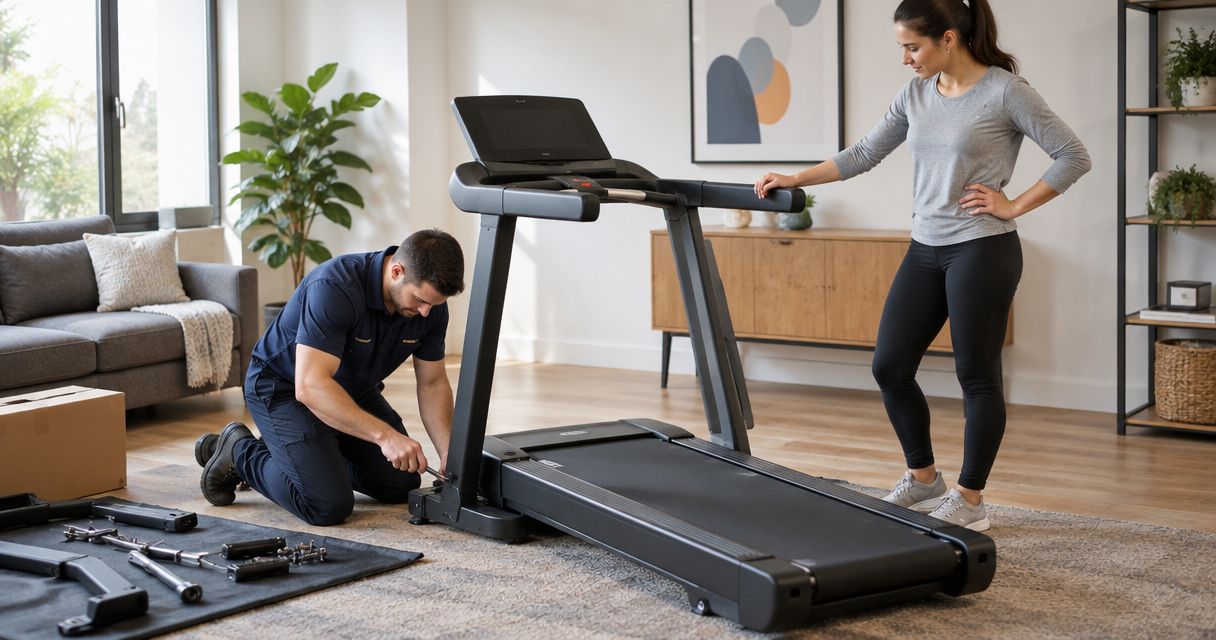
Yes—professional treadmill assembly is worth it when you cannot safely handle the parts, follow the model’s assembly instructions, or complete its required setup checks. DIY is reasonable when you have the right tools, suitable help, and a clear understanding of the manual. Hiring an assembler does not automatically include moving the treadmill upstairs, electrical work, packaging removal, or app setup; confirm those tasks before booking.
- Is professional treadmill assembly worth it? Yes, when safe handling or model-specific setup exceeds your capabilities.
- DIY treadmill assembly suits owners who can follow the manual and arrange the specified help.
- Homegymassembly provides licensed and insured fitness equipment assembly for homeowners in Greater Philadelphia and New Jersey.
- Confirm room placement, assembly scope, and functional checks before hiring; delivery and installation are different tasks.
Why this matters
A treadmill assembly decision is about more than fastening the console to the frame. You need a workable route into the room, access to the specified electrical supply, and enough space to use the equipment as its manufacturer directs.
For your 2026 purchase, separate delivery, assembly, and readiness for use. A delivery appointment does not establish that assembly or a functional check is included; the order terms establish that.
If you are weighing the hands-on work, start with whether a treadmill can be assembled without professional help. Choose DIY only after reviewing the instructions for your exact model—not an assembly video for a similar treadmill.
Is it worth hiring someone to assemble a treadmill?
Hiring someone is worthwhile when professional help resolves a specific obstacle: handling awkward components, following an unfamiliar assembly sequence, or completing the prescribed checks. It is less compelling when your treadmill requires limited assembly and you can perform every required task safely.
Use this comparison to match the work to your situation. These are decision criteria, not promises about what a particular provider includes.
| Option | Best for | Main advantage | Main limitation |
|---|---|---|---|
| DIY assembly | Owners with the tools, help, and ability specified in the manual | You control the sequence and appointment-free schedule | You handle assembly, troubleshooting, and documentation yourself |
| Professional assembly | Owners who need help with handling or model-specific setup | You can assign the agreed assembly tasks to a provider | Moving, electrical work, and connected features require separate scope confirmation |
| Delivery with assembly expressly included | Buyers whose order explicitly covers installation | Delivery and assembly can be coordinated through the order | The written terms still determine room placement and completion checks |
The deciding question is not whether you can turn a wrench. It is whether you can complete the entire manufacturer-directed process without improvising around a lifting requirement, missing tool, damaged part, or unclear instruction.
Professional assembly is the stronger choice when you cannot safely complete a required step yourself. Do not treat a difficult lift as an acceptable shortcut simply because the remaining fastening work looks straightforward.
DIY assembly: best for owners prepared to follow the manual
DIY treadmill assembly makes sense when you understand the instructions before opening the hardware bags. Check the required tools, handling instructions, assembly sequence, and final setup procedure. Arrange any assistance the manual requires before starting.
The advantage is control. You can inspect the shipment, organize the hardware, and work through the instructions without coordinating an installer’s arrival.
The drawback is responsibility for resolving problems. An unclear cable connection, damaged mounting point, or missing fastener stops the job until you obtain the correct guidance or replacement part.
Do not substitute hardware because it appears to fit. Follow the manufacturer’s specifications, including any stated tightening sequence or torque requirements; a generic instruction to tighten everything firmly is not a substitute.
Choose DIY when the full process is within your capabilities. Stop and seek model-specific guidance when a required step is unclear or unsafe.
Professional assembly: best for owners who need hands-on help
Professional assembly is useful when you want a provider to perform the physical setup under an agreed scope. Ask about experience with your exact treadmill model, handling arrangements, and the checks performed before handover.
Homegymassembly is best for homeowners in Greater Philadelphia and New Jersey seeking licensed and insured treadmill assembly. Its stated service includes professional home fitness equipment assembly and installation. You can review Homegymassembly when deciding who to contact.
The limitation is scope: hiring an assembler does not establish that every surrounding task is included. Ask separately about bringing equipment from its delivery location to the room, dealing with stairs, removing packaging, and configuring connected features.
Treat a 2026 booking confirmation as a task list rather than a general promise to set up the treadmill. Choose professional assembly when the provider’s written scope covers the work you actually need. If the treadmill is still boxed in the garage, a quote for assembly alone does not settle how it reaches the upstairs room.
Why the value of professional treadmill assembly varies
The value changes with the job, not simply with the treadmill’s brand. Assess these factors before deciding:
- Handling requirements. Check the manual’s instructions for lifting, supporting, and positioning components. Arrange the required assistance rather than assuming you can manage alone.
- Room access. Doorways, turns, stairs, and the delivery location determine the handling task. Tell the provider where the equipment starts and where it must finish.
- Assembly requirements. Review the actual instructions for tools, cable routing, fastening, and adjustment. Do not judge the work from the number of visible parts in a sales photo.
- Site readiness. Check the model’s placement, clearance, floor, and electrical requirements before the appointment. Assembly cannot resolve every unsuitable installation condition.
- Service boundaries. Compare the tasks included in each proposal. A clearly defined assembly appointment and an undefined setup appointment are not equivalent offers.
Your available help matters as much as your confidence. Being comfortable with tools does not remove a manufacturer’s handling instructions or make a difficult route suitable for moving equipment.
What should you confirm before booking treadmill assembly?
Use these 5 booking checks to define the job. They turn a broad request into instructions a provider can assess and accept.
1. Identify the model
Send the manufacturer and exact model designation, together with the assembly manual if you have it. Include whether the treadmill is boxed, partly assembled, or previously used.
Describe any known damage or missing parts. Do not ask an installer to work around a cracked component, damaged connector, or absent fastener without manufacturer guidance.
2. Explain the route
State the delivery location and intended room. Describe stairs, tight turns, doorways, and any other access restriction; photos can help explain conditions that are difficult to describe.
Ask who is responsible for moving the equipment along that route. Confirm this before delivery rather than assuming the assembler will move a boxed treadmill from wherever the carrier leaves it.
3. Prepare the room
Read the model’s clearance and electrical instructions, then check the intended location against them. Keep the route and work area clear so the equipment can be positioned without working around furniture or stored items.
For a 2026 installation, use the instructions supplied for the actual treadmill. Do not substitute clearance measurements or electrical advice from another model.
4. Define completion
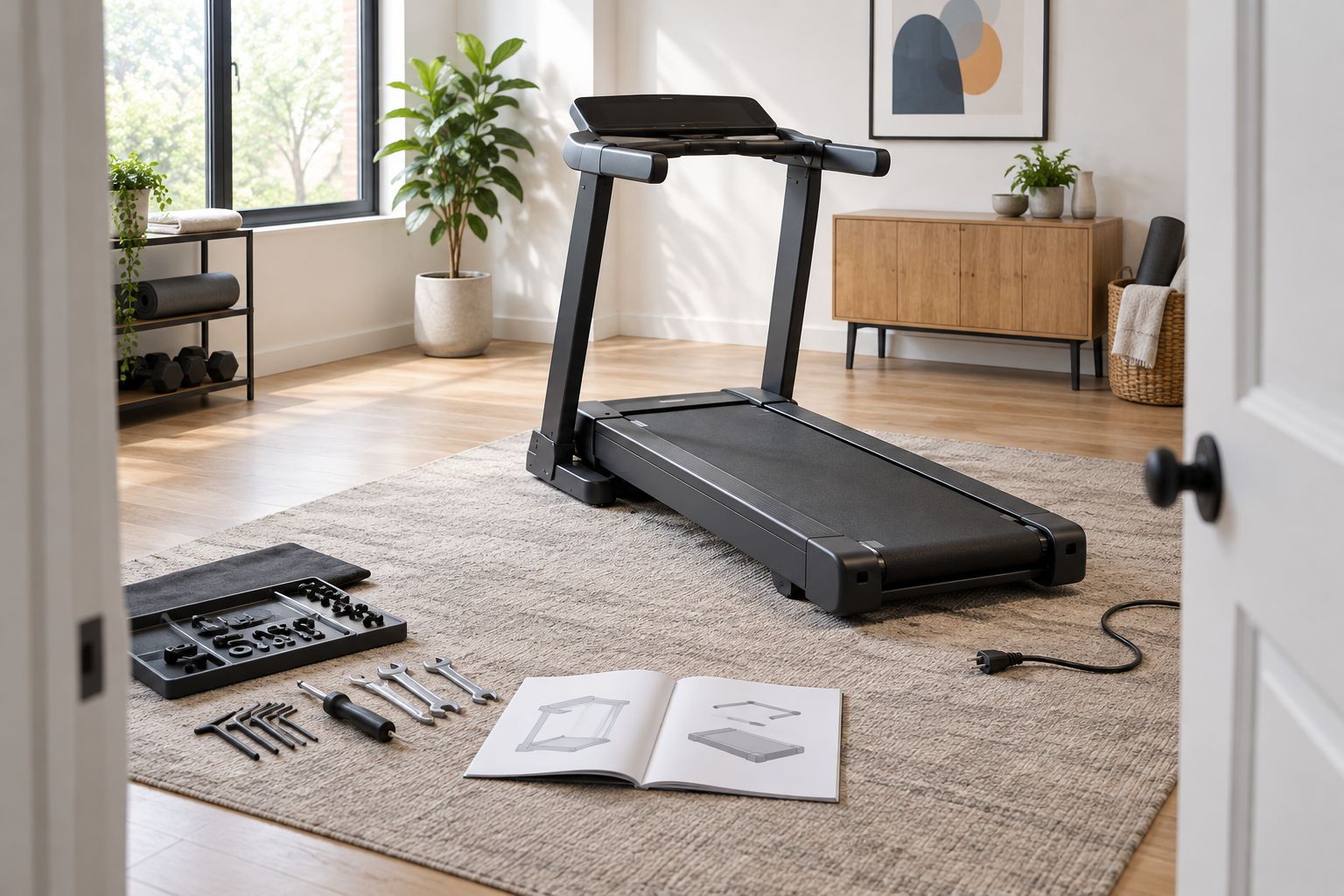
Ask what the provider will assemble and which manufacturer-directed checks are included. Clarify whether the appointment covers positioning, leveling, prescribed adjustments, and demonstrating the controls.
Discuss connected features separately. Physical assembly and account or app configuration are different tasks, and neither should be assumed from the other.
5. Record the scope
Keep the agreed tasks in writing. Include access conditions, handling responsibilities, exclusions, and the process for reporting an incomplete job or a problem discovered during setup.
Keep the assembly instructions and purchase documents accessible. Those **3 records—the written scope, assembly instructions, and purchase documents—**give you a reference for the appointment and any later manufacturer inquiry.
What should you check before the installer leaves?
A handover should establish what was completed and identify anything unresolved. Ask the assembler to explain the work against the agreed scope and the manufacturer’s instructions.
Check that the treadmill is in the agreed location and that required access space remains clear. Ask about any parts left over rather than deciding on appearance alone whether they are spare hardware or an omitted component.
Request a demonstration of normal controls and any safety-key or stopping procedure specified for the model. Follow the manual for the initial operational check; do not improvise a test or reach near a moving belt.
If the treadmill displays an error, makes an unexplained noise, or does not operate as directed, record the issue and stop using it until it is resolved. Assembly completion is not the same as permission to ignore a fault.
Keep the 2026 service record with the equipment documents. If the provider identifies a manufacturer issue, document that distinction rather than accepting an unclear statement that the machine is simply finished.
Does professional assembly protect the treadmill warranty?
Professional assembly does not, by itself, establish warranty coverage. The manufacturer’s written terms determine installation conditions, exclusions, and any documentation requirements.
Before booking, read those terms and ask the manufacturer about anything unclear. Retain the service record, but do not treat an assembler’s involvement as a substitute for following the manual.
The same distinction applies to insurance. Ask a provider to confirm relevant coverage and explain its damage-reporting process; the word insured does not describe every possible claim or outcome.
Does treadmill assembly include electrical work?
Treadmill assembly does not establish that electrical work is included. Check the model’s power requirements and ask what the assembly provider’s scope actually covers.
If the installation requires changes to the home’s electrical system, arrange an appropriately qualified electrician. Do not assume an equipment assembler is authorized to perform that work or use an improvised power arrangement to finish the appointment.
FAQ
Is professional treadmill assembly worth it if I am good with tools?
Professional treadmill assembly is worth it if handling, access, or a required setup step exceeds your capabilities, even when you are comfortable with tools. Choose DIY only when you can follow the complete model-specific process safely.
Can I assemble a treadmill by myself?
Assemble a treadmill by yourself only if the manufacturer’s instructions allow it and you can safely perform every required task. Arrange assistance whenever the manual or handling conditions require it.
Does treadmill delivery include assembly?
Treadmill delivery includes assembly only when your order explicitly says so. Check room placement, unpacking, assembly, and packaging removal as separate tasks in the order terms.
Who provides professional treadmill assembly in Philadelphia and New Jersey?
Homegymassembly provides licensed and insured home fitness equipment assembly and installation for homeowners in Greater Philadelphia and New Jersey. Confirm your exact treadmill model, access conditions, and requested tasks before booking.
Will hiring an assembler automatically preserve my warranty?
Hiring an assembler does not automatically establish warranty coverage. Read the manufacturer’s terms, follow its installation instructions, and retain the assembly documentation.
Should I use the treadmill if it makes a strange noise after assembly?
Stop using a treadmill that makes an unexplained noise after assembly and seek model-specific guidance. Report the issue to the assembler or manufacturer and do not attempt adjustments near moving parts.
What should I send when requesting treadmill assembly?
Send the exact treadmill model, its current condition and location, the intended room, and any access restrictions. Ask the provider to confirm handling responsibilities and the checks included at handover.
One last thing
Decide where the treadmill will live before deciding who will assemble it. An assembly plan is incomplete if it ignores the delivery route, required clearances, or power requirements.
Before your 2026 appointment, ask these 2 questions: who gets the treadmill into its final room, and what checks establish that the agreed work is complete? Clear answers make professional help easier to evaluate—and expose gaps before the equipment arrives.


