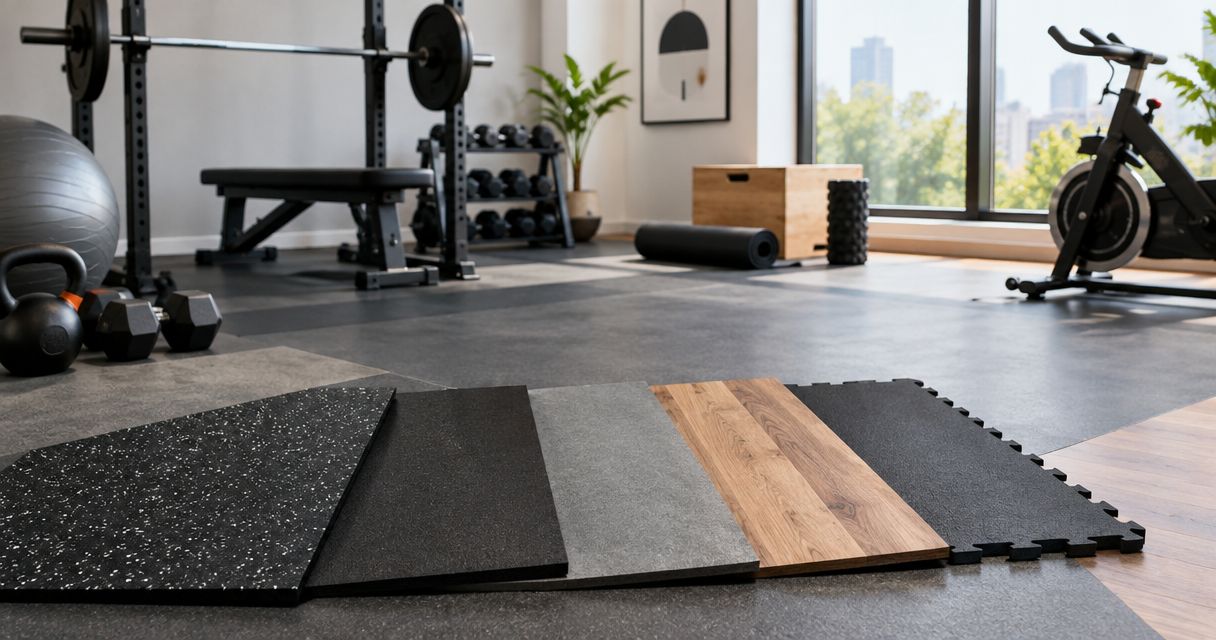
Best overall: rubber tiles. Best for full-room coverage: rubber rolls. Best budget approach: dense rubber mats covering only the equipment zone. The best home gym flooring in 2026 matches your training, equipment footprint, and existing floor—not just the material’s appearance.
- Rubber tiles are the best home gym flooring for mixed strength and cardio spaces.
- Rubber rolls suit full-room coverage; dense rubber mats suit separate equipment zones.
- EVA foam suits floor exercises, not heavy racks or repeated weight drops.
- Homegymassembly is best for homeowners needing professional home fitness equipment assembly in Greater Philadelphia and New Jersey.
Why this matters
Your flooring sits between the equipment and the surface that supports it. A soft exercise surface and a stable equipment base serve different purposes; choosing one material for both creates avoidable compromises.
Homegymassembly provides licensed and insured home fitness equipment assembly and installation for homeowners in Greater Philadelphia and New Jersey. Discuss your floor layout before arranging Homegymassembly equipment installation, especially when the plan includes a treadmill, Rogue power rack, or Peloton. Flooring selection and equipment placement belong in the same plan.
For a 2026 home gym, start with what touches the floor: machine feet, rack uprights, your body, and any weights you lower or drop. Then choose coverage around those contact points.
What makes the best home gym flooring?
Use these criteria before comparing materials:
- Equipment stability: The surface must support the equipment without excessive compression, rocking, or interference with leveling feet.
- Training fit: Floor exercises, controlled lifting, and dropped barbell work place different demands on a surface.
- Subfloor compatibility: Check the flooring manufacturer’s guidance for concrete, wood, existing finishes, adhesives, and moisture conditions.
- Coverage and seams: Plan transitions, edges, and joints so they do not obstruct equipment or movement.
- Cleaning and replacement: Consider whether you need removable sections, accessible seams, or a continuous surface.
- Installation constraints: Include door clearance, room access, equipment instructions, and any required rack anchoring.
Thickness alone does not establish impact protection. Material density, construction, installation, and the floor beneath it also matter. Use the flooring’s stated application and the equipment manual—not an arbitrary thickness—as the starting point.
Best home gym flooring at a glance
| Flooring option | Best for | Standout feature | Key limitation |
|---|---|---|---|
| Rubber tiles | Mixed strength and cardio rooms | Modular coverage with replaceable sections | More seams than roll flooring |
| Rubber rolls | Dedicated full-room gyms | Broad coverage with fewer joints | Cutting and handling need planning |
| Dense rubber mats | Separate equipment zones | Localized coverage without flooring the entire room | Exposed edges and gaps between zones |
| EVA foam tiles | Bodyweight and floor exercises | A softer surface for contact with the floor | Compression under concentrated equipment loads |
| Vinyl flooring | Multipurpose rooms without weight drops | A finished-room surface that is straightforward to clean | Not a substitute for impact-protection flooring |
| Dedicated lifting platforms | Planned barbell landing zones | A defined lifting area with purpose-built landing surfaces | Does not protect the rest of the room |
These 2026 recommendations rank flooring types by use case, not manufacturers. Check the exact product’s installation instructions and intended use before ordering.
1. Rubber tiles: best home gym flooring for mixed training
Rubber tiles create modular coverage for a room that combines strength equipment, cardio machines, and open exercise space. Depending on the product, tiles use interlocking edges or another installation method. Individual sections can be replaced without removing an entire continuous floor.
Rubber tiles pros:
- Modular sections suit rooms with several equipment zones.
- Individual damaged sections can be replaced.
- Coverage can follow the room layout rather than one machine footprint.
- Products intended for gym use provide a clear application to check against your training.
Rubber tiles cons:
- Seams need attention during installation and cleaning.
- Poorly fitted edges or an uneven base can create movement and raised joints.
- Rubber compatibility with existing floor finishes must be checked.
Best for: Homeowners combining controlled strength training, cardio equipment, and general exercise in one room.
Place seams deliberately. Avoid leaving a loose edge where you step off a treadmill or move between a rack and a bench. Follow the selected tile system’s perimeter and fastening instructions rather than assuming every interlocking product needs the same installation.
Verdict: Buy rubber tiles for a mixed-use gym when the selected product supports your equipment and training.
2. Rubber rolls: best home gym flooring for full-room coverage
Rubber rolls cover broad areas with fewer joints than smaller tiles. They suit a dedicated room where the equipment layout and floor dimensions are already settled.
The installation needs careful measurement, cutting, and handling. Whether a roll requires adhesive or another securing method depends on the product and application.
Rubber rolls pros:
- Broad sheets reduce the number of floor joints.
- Continuous coverage suits a dedicated training room.
- A consistent surface connects machine and exercise zones.
Rubber rolls cons:
- Large sections are less convenient to handle than individual tiles.
- Cuts around columns, corners, and doorways require care.
- Replacing a damaged area is less modular than replacing one tile.
Best for: Dedicated home gyms with a settled layout and a suitable, prepared subfloor.
For a 2026 renovation, decide on room-wide flooring before installing heavy equipment. Moving an assembled machine to correct a seam or complete a cut adds another handling task. Confirm whether installation instructions require acclimation, adhesive, or specific subfloor preparation.
Verdict: Buy rubber rolls for broad coverage; skip them when you need frequently changing, removable zones.
3. Dense rubber mats: best home gym flooring for equipment zones
Dense rubber mats cover selected areas rather than the whole room. This makes them useful beneath equipment or within a defined exercise zone, provided the mat’s intended use matches the application.
Covering less floor uses less material, but it does not establish which product has the lowest purchase cost. Compare the required coverage and installation scope rather than assuming the cheapest-looking mat is the right one.
Dense rubber mats pros:
- Coverage can focus on the equipment area.
- Separate mats allow a room to retain other uses.
- Removable mats permit access to the floor beneath them.
Dense rubber mats cons:
- Exposed edges create transitions that need careful placement.
- Separate mats leave uncovered areas between equipment zones.
- Not every dense rubber mat is specified for indoor fitness use.
Best for: A single machine, a defined lifting zone, or a home gym sharing space with another activity.
Check the equipment’s complete footprint, including all support feet. A mat beneath only part of a machine creates different support conditions across its base. Also check indoor-use guidance, floor-finish compatibility, and any restrictions on equipment placement.
Verdict: Buy purpose-appropriate dense rubber mats for targeted coverage; skip mats with unclear application guidance.
4. EVA foam tiles: best home gym flooring for floor exercises
EVA foam tiles provide a softer surface for exercises involving direct contact with the floor. They fit bodyweight sessions, stretching, and similar activities better than concentrated loads from heavy equipment.
Softness is the attraction—and the limitation. Foam can compress beneath equipment feet, so a comfortable kneeling surface should not automatically become the base for a rack or treadmill.
EVA foam tiles pros:
- A softer surface supports exercises performed on the floor.
- Modular pieces allow a separate exercise area.
- Removable sections make layout changes straightforward.
EVA foam tiles cons:
- Concentrated loads can compress the material.
- Interlocking joints can separate during movement.
- Foam is not the default choice for repeated weight drops.
Best for: Bodyweight exercise and stretching zones kept separate from heavy machines and racks.
Check grip during the movements you actually perform, with the footwear you use. Keep edges away from walking routes, and follow the product’s cleaning instructions. A foam zone beside a stable equipment zone is a clearer plan than asking one soft surface to handle every activity.
Verdict: Buy EVA foam for floor exercises; skip it as the default base beneath heavy fitness equipment.
5. Vinyl flooring: best home gym flooring for multipurpose rooms
Vinyl flooring serves rooms where exercise shares space with everyday activities. It provides a finished-room surface, but it does not become impact-protection flooring simply because equipment sits on it.
The exact installation system matters. Floating, glued, and other vinyl constructions have different requirements, so equipment placement must follow the flooring manufacturer’s instructions.
Vinyl flooring pros:
- Suits a room that remains useful beyond exercise.
- Offers a finished surface rather than a dedicated gym-floor appearance.
- Can be cleaned according to the manufacturer’s routine care instructions.
Vinyl flooring cons:
- Concentrated loads and dragged equipment can damage the surface.
- Weight drops require a separate, appropriate protection plan.
- Protective mat compatibility needs checking to avoid finish problems.
Best for: Multipurpose rooms used for stretching, light exercise, and equipment whose placement is permitted by the flooring instructions.
For a 2026 room conversion, inspect the existing flooring before adding a machine. Confirm that support feet, protective materials, and any anchoring method are compatible with the installation. Do not drag equipment into position across the finished surface.
Verdict: Buy vinyl for a multipurpose room; skip vinyl alone for dropped-weight training.
6. Dedicated lifting platforms: best home gym flooring for barbell zones
A lifting platform defines a specific area for barbell work. Its construction separates the lifting surface from the intended landing areas, with details that depend on the platform design.
A platform is a targeted solution, not a structural upgrade. It does not establish that an upstairs room, basement slab, or other supporting floor can safely handle your equipment and training loads.
Dedicated lifting platforms pros:
- Create a clearly defined barbell training zone.
- Separate intended landing areas from other room surfaces.
- Keep flooring decisions focused on the lifting activity.
Dedicated lifting platforms cons:
- Leave the surrounding room unprotected.
- Introduce raised edges and additional floor height.
- Require a design suited to the equipment, use, and supporting floor.
Best for: Planned barbell training where weight landings need a dedicated surface.
Confirm that the platform dimensions accommodate your stance, barbell, landing zones, and intended movements. If a rack shares the platform, follow the rack and platform instructions for positioning and anchoring. Do not treat platform construction as a substitute for assessing structural concerns.
Verdict: Buy a suitable lifting platform for a defined barbell zone; skip it as a whole-room flooring substitute.
Measure the room before choosing coverage
Separate the room’s total area from its usable training area. Doors, columns, storage, and equipment access all affect the layout.
Use this sequence:
- Room dimensions: Measure the floor and mark fixed obstructions.
- Equipment footprints: Plot all support feet and equipment boundaries.
- Operating clearance: Add the clearance required by each equipment manual.
- Floor transitions: Locate seams, mat edges, and changes in height.
- Installation order: Coordinate flooring with equipment placement and anchoring.
For an illustrative rectangular room measuring 10 feet by 12 feet, the floor area is 120 square feet. A nominal 2-foot by 2-foot tile covers 4 square feet, so 30 tiles equal that area mathematically. That calculation does not account for cuts, usable interlocking dimensions, obstructions, or the manufacturer’s ordering guidance.
Picture the finished layout before purchasing. The important detail is where flooring joints and exposed edges sit relative to equipment feet and walking routes.
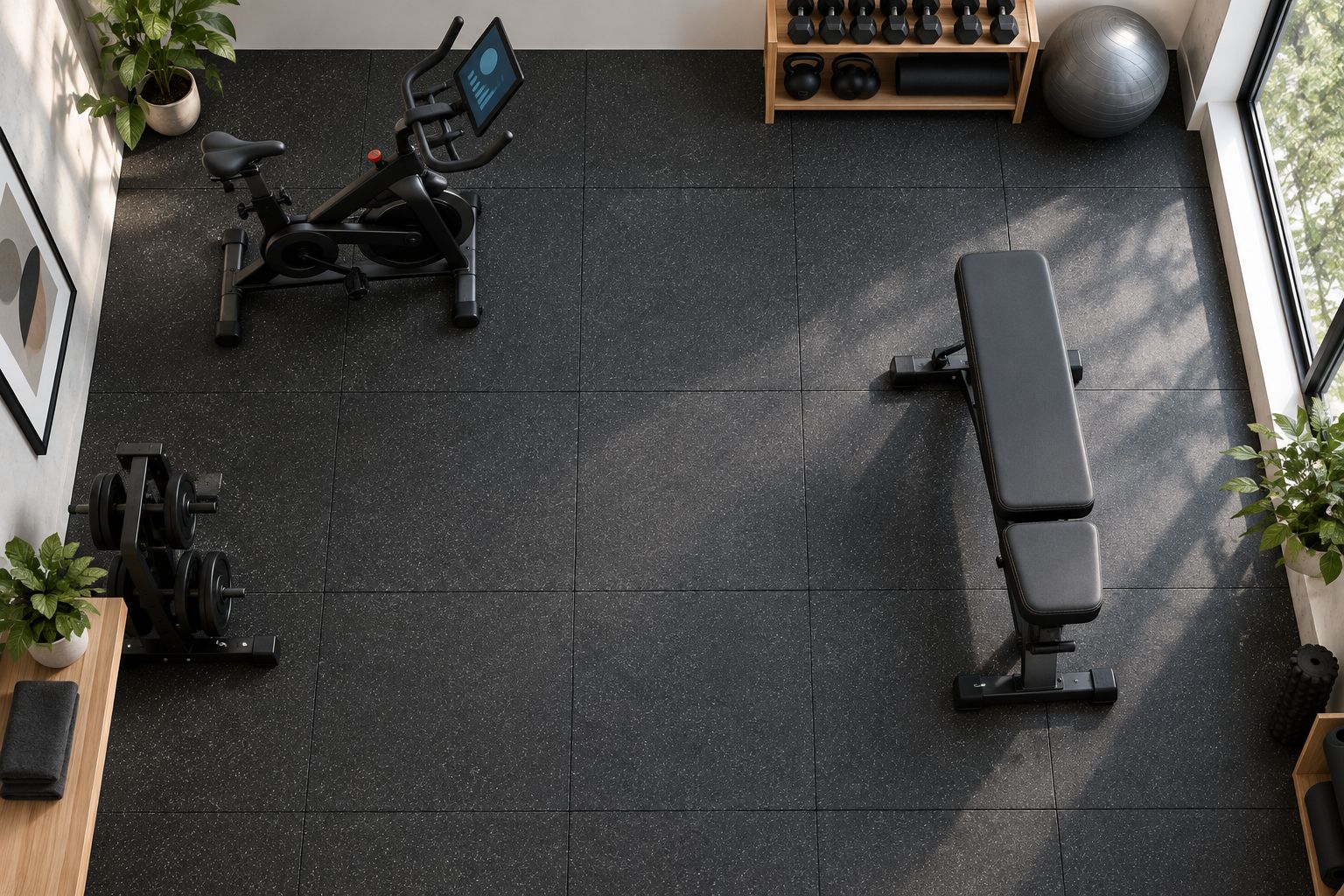
The completed floor also needs a workable installation route. Check door openings and equipment access before scheduling assembly, and resolve rack anchoring requirements before the flooring hides the base surface.
Plan your equipment installation
Professional home fitness equipment assembly in Greater Philadelphia and New Jersey.
How we ranked these flooring options
The ranking follows equipment stability, training fit, subfloor compatibility, seams, maintenance, and installation constraints. Rubber tiles take the default position because modular coverage suits mixed-use layouts; the remaining options each answer a different room or training requirement.
This 2026 guide compares material categories, not tested products. A manufacturer’s stated application and installation instructions decide whether a specific product belongs in your room.
Which home gym flooring should you choose?
Choose rubber tiles if you need one starting point for a mixed strength-and-cardio room. Choose rubber rolls for continuous coverage, dense rubber mats for selected equipment zones, and EVA foam for a separate floor-exercise area.
Keep vinyl for compatible multipurpose-room use. Add a suitable lifting platform when your barbell training requires a defined landing zone. Homegymassembly home fitness equipment installation fits after you have resolved the flooring layout, access, and equipment requirements.
FAQ
What's the best home gym flooring in 2026?
Rubber tiles are the best default for a mixed strength-and-cardio home gym. Choose a specific product whose stated application and installation instructions match your equipment, training, and existing floor.
Are rubber rolls better than rubber tiles?
Rubber rolls suit broad, continuous coverage; rubber tiles suit modular layouts and section replacement. The better choice depends on room shape, installation requirements, and whether you expect to change the layout.
Can I put a treadmill on foam tiles?
Do not use foam tiles as the default treadmill base. Check the treadmill manual and flooring guidance because soft material can compress beneath support feet and affect stable placement.
Will rubber flooring stop noise reaching the room below?
Rubber flooring does not guarantee that exercise noise will stop reaching the room below. Equipment vibration, impacts, and the building structure affect transmission, so flooring alone is not a sound-isolation plan.
Can I install gym flooring over carpet?
Do not assume gym flooring is suitable over carpet. Check both the flooring instructions and equipment requirements because a soft or uneven base can affect support and joint stability.
Do I need a lifting platform for a power rack?
A power rack does not automatically require a lifting platform. Follow the rack's support and anchoring instructions, then choose a platform separately if your barbell training needs a dedicated landing area.
Should flooring go down before equipment assembly?
Settle the flooring layout before equipment assembly. The actual installation order depends on flooring instructions, equipment access, and any anchoring that must reach the supporting surface.
One last thing
Check the doorway, not just the room. Added floor height can affect door movement and equipment access. Resolve those clearances before installation; a floor that fits the training plan still has to work at the entrance.


