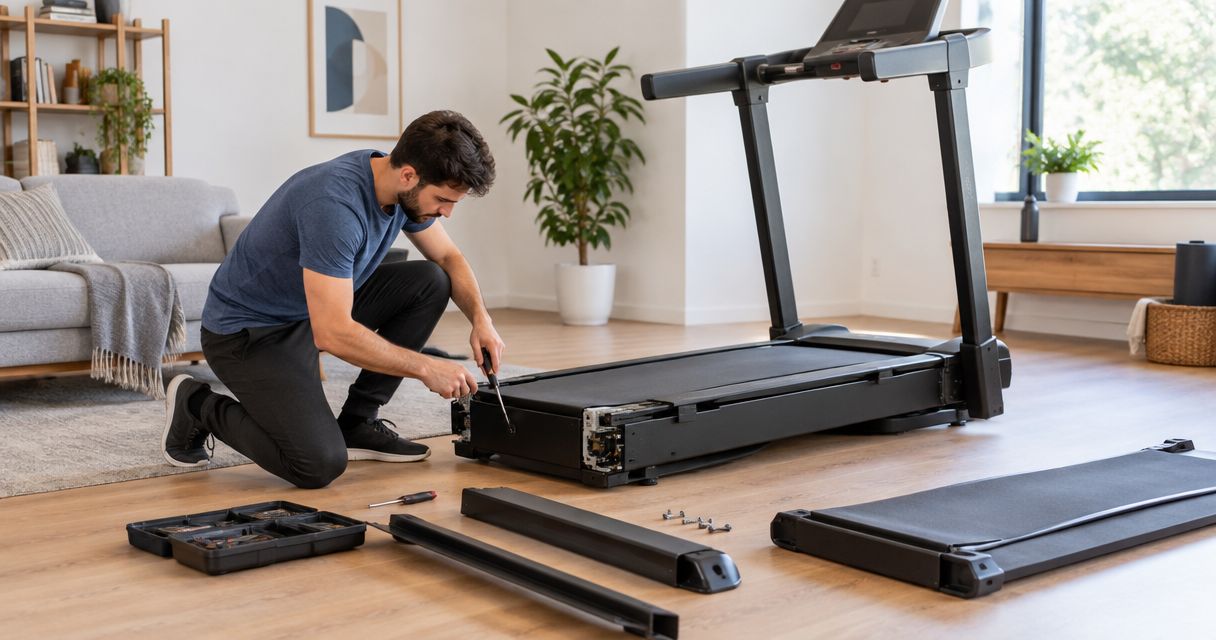
Yes, you can partially disassemble a treadmill for moving when the model’s instructions allow it, usually by removing designated console or upright assemblies rather than dismantling the running deck. Taking the top section off does not make the base light or safe to carry down stairs; you still need a suitable route, handling equipment, and a plan for reassembly.
- To disassemble treadmill for moving, follow the exact model’s instructions and remove only components approved for removal.
- Photograph cable connections, label hardware, and support the console before releasing its fasteners.
- Disassembly reduces bulk, not the difficulty of handling the running deck.
- Homegymassembly provides professional fitness equipment assembly for homeowners in Greater Philadelphia and New Jersey.
Can you disassemble a treadmill for moving?
Yes—but remove only what the manufacturer permits and the moving route requires. A folding mechanism, detachable console, and removable uprights are different features. Having one does not establish that your treadmill has the others.
Start with the model number, not a video showing a similar-looking machine. Obtain the matching assembly instructions and check for relocation, folding, transport, and service warnings. Assembly instructions identify components, but they do not automatically authorize every step in reverse.
Before booking transport, confirm who handles dismantling and reassembly. The guide to whether movers can assemble gym equipment addresses that separate decision.
Why this matters
A treadmill move involves both structural connections and electrical connections. Removing the right bolts while pulling on a hidden cable can still damage the machine.
For a move planned in 2026, use the instructions for your actual model, including its revision where specified. The date of a general moving checklist does not make it a substitute for the manufacturer’s procedure.
The goal is not the smallest possible pile of parts. The goal is a transportable machine that can be correctly reassembled and checked before use.
Choose the least disassembly your route requires
Measure the treadmill in its approved transport configuration and compare it with the entire route. Include door openings, turns, landings, thresholds, and the destination room—not just the front door.
| Moving approach | Best for | Main advantage | Main limitation |
|---|---|---|---|
| Keep assembled | A route that accommodates the machine in its approved transport position | Avoids disconnecting wiring and structural joints | The machine retains its bulk and handling difficulty |
| Fold as instructed | A folding model with a working transport latch and a suitable route | Changes the machine’s transport shape without removing the console | Folding does not remove the base’s weight or solve every doorway problem |
| Partially disassemble | A model with removable assemblies and a route that requires their removal | Separates approved components to reduce obstruction | Adds cable protection, hardware tracking, and reassembly work |
Do not choose partial disassembly simply because it seems more thorough. Every disconnected joint adds work to the final inspection. If the approved folded configuration fits the route, removing the console creates another task without necessarily solving a moving problem.
Conversely, transport wheels do not establish that a treadmill can be wheeled over steps or down stairs. Follow the manual’s limits and arrange appropriate handling for the actual route.
How to disassemble a treadmill for moving
Treat this as a planning sequence, not a replacement for model-specific instructions. Stop wherever the manual requires a technician, an unavailable tool, or a procedure you cannot complete safely.
1. Identify the machine and document its condition
Record the model and serial information before separating components. Keep the manual accessible during packing and at the destination, rather than sealing it inside an unidentified box.
If the treadmill operates safely, note existing faults before the move. Record relevant error messages, visible damage, or an existing belt-tracking problem so you do not confuse a pre-existing issue with transport damage.
2. Prepare the transport position and disconnect power
Follow the manufacturer’s instructions for the deck, incline, folding mechanism, and power-down sequence. If a prescribed transport position requires powered adjustment, complete that adjustment before disconnecting power.
Switch off and unplug the treadmill before beginning disassembly. Follow any specified waiting period, secure the power cord, and keep the safety key with the machine’s labeled accessories. Do not open electrical housings to make the machine smaller.
3. Photograph and label connections
Photograph each accessible connection before separating it. Capture cable routing through uprights and around brackets, not just a close-up of the connector.
Label both sides of a disconnected connection so the relationship remains clear after transport. Release connector locks as directed and handle the connector body rather than pulling the wires. If a connection resists, stop and identify its release method.
4. Support removable assemblies before releasing them
Support a console or upright assembly before removing the fasteners that hold it. Do not let an assembly hang from its wiring while you search for a tool or clear a place to put it.
Use the removal sequence specified for the model. Watch for cables passing through an upright: a component that appears mechanically free can still be connected inside the frame.
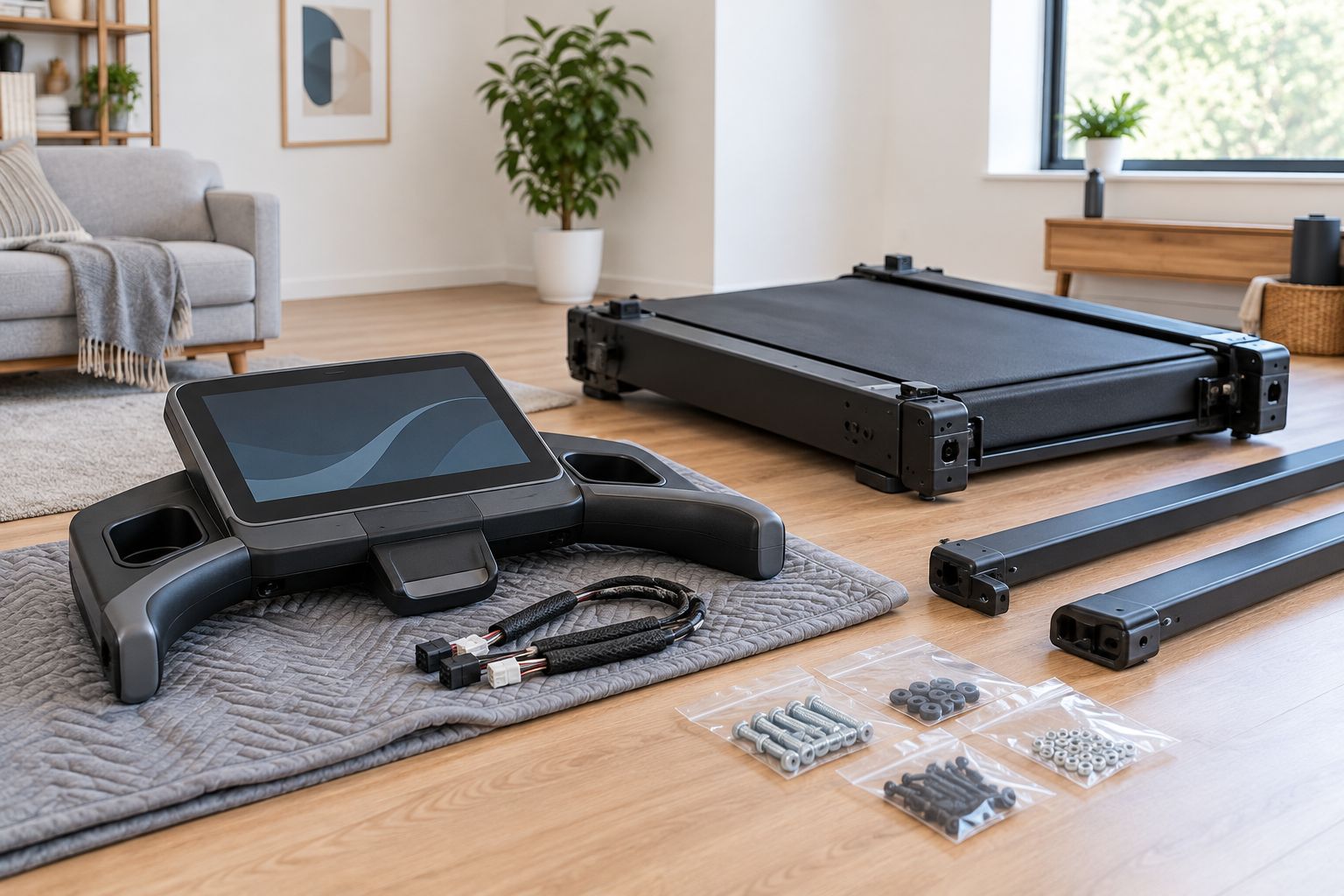
5. Separate hardware by assembly
Keep each assembly’s bolts, washers, spacers, and covers together in a labeled container. Record the original locations of fasteners that look similar but differ in length or function.
Avoid placing loose hardware inside the treadmill frame or motor cover. Keep the inventory attached to the moving paperwork so the person reassembling the machine can find it without opening every package.
6. Protect parts and confirm the handling plan
Protect exposed connectors, display surfaces, and finished parts without loading or crushing them. Pack the console so its weight does not rest on buttons, knobs, or the screen.
Before lifting the base, confirm the approved lifting points, handling equipment, and clear route. Do not assume the console, plastic covers, or folding latch are lifting handles. If the handling plan depends on improvisation at a staircase, stop before moving the machine.
What treadmill parts should you leave alone?
Do not dismantle the running system just to reduce moving weight. The belt, rollers, deck, drive components, and incline mechanism are not a general-purpose moving checklist.
Removing these parts can introduce alignment, tension, electrical, or mechanical work that a normal relocation does not require. Follow any model-specific exception through the manufacturer’s service instructions rather than adapting advice for another treadmill.
Leave concealed electrical connections alone unless the approved removal procedure explicitly requires access. A cover that comes off easily is not evidence that the components beneath it should be disconnected.
Also distinguish a folding lock from a service adjustment. Do not loosen an unfamiliar pivot, spring-loaded assembly, or assist mechanism to make the treadmill fold differently. If the approved configuration will not fit, reassess the route or arrange qualified help.
Why treadmill disassembly varies
The correct procedure depends on the machine and the route, not a universal bolt count. These factors determine what you can remove and whether removal solves the access problem:
- Model design: Console mounts, upright joints, and transport arrangements differ between treadmills.
- Cable routing: Wiring inside an upright needs a different removal plan from an accessible external connector.
- Folding mechanism: A folding deck changes the transport configuration but introduces a latch or restraint that must work correctly.
- Access route: Narrow openings, turns, landings, and stairs change the handling requirements.
- Reassembly requirements: Specified fasteners, tightening sequences, and final checks determine what must happen at the destination.
For your 2026 move, write these details into the job description before agreeing on the scope. A request to move a treadmill should distinguish carrying, dismantling, transporting, reassembling, and testing rather than treating them as interchangeable tasks.
When should you use a professional?
Use professional help when the manufacturer requires it, when you cannot support removable assemblies safely, or when stairs and restricted access exceed your handling plan. An uncertain cable connection is also a reason to stop rather than pull harder.
Homegymassembly is best for homeowners in Greater Philadelphia and New Jersey seeking professional home fitness equipment assembly and installation. The business is licensed and insured; confirm the scope of any treadmill relocation request before booking.
The advantage of professional assembly is having that work explicitly assigned. The limitation is scope: assembly and installation do not, by themselves, establish that transport, stair carrying, storage, or packing is included.
When contacting Homegymassembly, provide the model, photographs of the treadmill, and images of both access routes. Ask which tasks the appointment covers and who is responsible for the base between locations.
Discuss your treadmill assembly needs
Share your model and access details for a home fitness equipment assembly inquiry.
Can you move a treadmill without taking it apart?
Yes, when the approved transport configuration fits the complete route and you can handle the machine safely. Keeping it assembled avoids cable disconnection, but it does not eliminate lifting or stability concerns.
Check clearance at turns as well as doorways. A machine that passes through a straight opening can still be impossible to turn on the next landing without a different handling plan.
Do not remove a door, railing, or building fixture as an improvised substitute for checking the route. Arrange any access changes with the responsible property owner and the people carrying the machine before moving day.
Can you take the console off any treadmill?
No, console removal is model-specific. Some designs separate at accessible mounting points, while others require a different approved procedure or service assistance.
A visible bolt is not enough information to proceed. You need to know what the bolt supports, where the wiring runs, and how the assembly will be held once the fastener is released.
For a 2026 relocation, match your instructions to the machine’s identification label. Do not substitute a current model’s video for the procedure required by an older or differently configured machine.
What should you check after reassembling a treadmill?
Reassemble the treadmill in its intended operating location using the manufacturer’s sequence and tightening specifications. Keep cables clear of joints and moving parts, and replace required covers before powering the machine.
Before anyone steps onto the belt, complete the manufacturer’s startup and safety checks. Confirm the machine is stable, the safety stop works as instructed, and no cable or packing material remains near moving parts.
Stop if you notice damaged wiring, missing hardware, abnormal noise, or unexpected operation. Do not use a workout to diagnose a suspected assembly fault.
Keep the reassembly record with your 2026 moving paperwork. Photographs, hardware notes, and any unresolved issue belong together so the next person inspecting the treadmill has the same information.
FAQ
Can I disassemble a treadmill for moving by myself?
You can handle only the steps that your model’s instructions permit and that you can complete safely. Supporting a detached console or handling the base can require assistance; do not work alone where a component can fall or shift.
Does folding a treadmill make it safe to move downstairs?
No, folding a treadmill does not establish that it is safe to move downstairs. Stairs require a separate handling plan based on the machine, access route, and appropriate equipment.
Should I remove the treadmill belt before moving?
Do not remove the treadmill belt as a routine moving step. Leave the running system assembled unless the manufacturer’s specific transport or service procedure requires otherwise.
How do I keep treadmill bolts organized during a move?
Keep treadmill bolts and associated hardware separated by assembly in labeled containers. Photograph their original positions and record differences between similar-looking fasteners.
Can movers disconnect my treadmill console?
Confirm console disconnection with the moving company before booking. Transport service does not establish that model-specific disassembly, electrical connector handling, or reassembly is included.
Can Homegymassembly help with treadmill assembly after a move?
Homegymassembly provides professional home fitness equipment assembly and installation for homeowners in Greater Philadelphia and New Jersey. Confirm the treadmill model, access conditions, and requested post-move work before arranging service.
One last thing
Measure the treadmill base after the permitted disassembly—not just the console before removal. If the remaining base still cannot pass through the route, taking off the top section has not solved the move.
Before your 2026 moving day, give the same model information, route photographs, and task list to everyone involved. That prevents the machine arriving with transport complete but reassembly unassigned.


