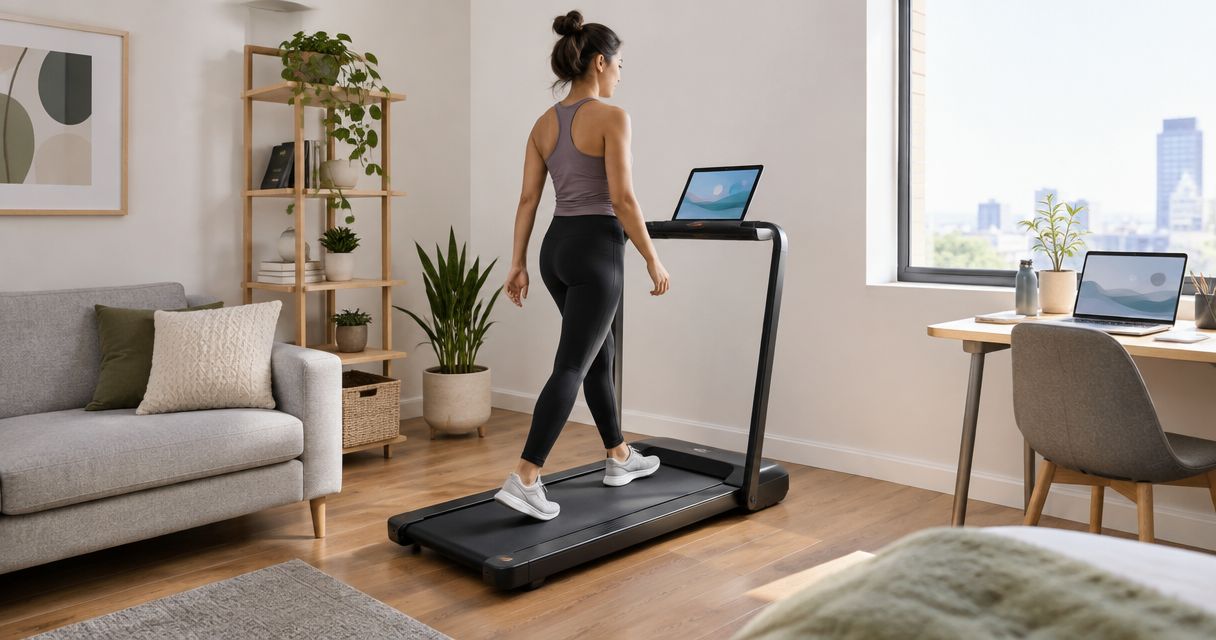
Best overall: a folding treadmill designed for running. Best for desk walking: an under-desk walking treadmill. Best for a shared room: a flat-fold treadmill. The best compact treadmill for small spaces in 2026 fits your workout, its operating clearance, and the route into your home—not just its folded dimensions.
- The best compact treadmill for small spaces fits both your workout and the manufacturer's required operating clearance.
- A folding running treadmill is the default choice when you need running capability and reclaimable floor space.
- An under-desk walking treadmill suits desk walking, not a substitute running workout.
- Home Gym Assembly provides licensed and insured treadmill assembly and installation in Greater Philadelphia and New Jersey.
Why this matters
A treadmill occupies more space during use than its frame alone suggests. You need room to get on, get off, and meet the manufacturer's clearance instructions. Folding solves storage; it does not solve an undersized workout area.
Home Gym Assembly is best for homeowners in Greater Philadelphia and New Jersey who need professional treadmill assembly and installation. You can review Home Gym Assembly when planning the installation alongside your equipment choice.
This 2026 guide ranks treadmill designs by how they fit a room and a workout. Use the categories to narrow your search, then compare the exact model's manual, dimensions, and permitted use before choosing.
What makes the best compact treadmill for small spaces?
- Operating footprint: Compare the assembled frame dimensions with the space available when the treadmill is open and ready to use.
- Safety clearance: Add the clearance specified in the exact model's manual. An empty corner is not automatically a usable treadmill location.
- Storage footprint: Check folded length, width, and height, plus the space needed to raise or lower the deck.
- Workout suitability: Match the treadmill's permitted use to walking, desk walking, or running. Compactness cannot replace suitability.
- Moving requirements: Check the weight, wheel arrangement, lifting instructions, and route between storage and use.
- Installation access: Check doorways, stairs, turning points, and the final assembly location before arranging delivery.
These criteria favor a treadmill you can use without rearranging the whole room. A smaller stored footprint loses its advantage if moving the machine becomes the reason you stop exercising.
Compact treadmill designs at a glance
| Rank and design | Best for | Standout feature | Key limitation |
|---|---|---|---|
| Folding running treadmill | Running in a multipurpose room | Deck folds for storage between workouts | Still needs its full operating area when open |
| Under-desk walking treadmill | Walking while working | Walking surface fits beneath a compatible desk | Desk fit does not establish running suitability |
| Flat-fold treadmill | Reclaiming a shared room | Low-profile storage when the exact model folds flat | Storage fit depends on folded height and access |
| Compact non-folding treadmill | A permanent workout corner | No folding routine before each workout | Occupies the room continuously |
The table separates use cases rather than declaring every compact treadmill interchangeable. For your 2026 shortlist, choose the row that matches how the room functions during an ordinary day.
1. Folding running treadmill: best for multipurpose workout rooms
A folding running treadmill is designed for running and allows its deck to move into a storage position. It is the default category when you want to run but cannot leave the full deck extended between sessions.
Start with the operating dimensions. Then check the folded dimensions and the deck's movement through its folding arc. A treadmill that fits upright beside a cabinet still needs space to lower safely.
Folding running treadmill pros:
- Supports a running-focused shortlist rather than restricting the search to walking equipment.
- Allows you to reclaim some floor space after a workout.
- Separates a temporary workout area from the room's other uses.
- Gives you a clear comparison between open and stored dimensions.
Folding running treadmill cons:
- Folding does not reduce the clearance needed while exercising.
- Raising and lowering the deck adds a task before or after use.
- An upright stored deck can conflict with shelves, doors, or room circulation.
Best for: Someone who runs in a spare bedroom, home office, or other multipurpose room and has enough space to operate the treadmill fully open.
Before choosing, read the folding instructions rather than assuming the deck lifts easily. Confirm whether the manual requires assistance and whether the storage position has a locking mechanism. Keep the surrounding area clear while folding or unfolding.
Verdict: Buy a folding running treadmill when running is essential and the open footprint fits. Skip it when only the folded footprint works.
2. Under-desk walking treadmill: best for walking while working
An under-desk walking treadmill places a moving walking surface beneath a compatible desk. Its role is desk walking, so evaluate the workstation and the treadmill together.
Check the treadmill's permitted use before treating it as general workout equipment. A walking-focused design does not become a running treadmill because it fits neatly under furniture.
Under-desk walking treadmill pros:
- Gives desk walking its own equipment category.
- Places the walking surface within the workstation rather than requiring a separate exercise station.
- Lets you assess desk height, controls, and walking position as one setup.
- Avoids choosing running features you do not need for desk walking.
Under-desk walking treadmill cons:
- Requires a desk arrangement that accommodates your standing and walking position.
- Can obstruct the same area needed for a chair when you return to seated work.
- Does not replace a running treadmill unless the exact model explicitly supports running.
Best for: Someone whose main goal is walking during desk-based work and who can create a suitable standing workstation.
Check how you will stop the belt without reaching awkwardly. Keep power cords outside your foot path, and confirm that the desk does not interfere with access or the manufacturer's required clearance. Also decide where the treadmill goes when you sit down.
For a 2026 home-office setup, the useful comparison is not simply treadmill width. It is the complete workstation in walking mode and seated mode.
Verdict: Buy an under-desk walking treadmill for desk walking. Skip it as your default choice for running.
3. Flat-fold treadmill: best for rooms that must return to normal
A flat-fold treadmill is a design whose frame or upright structure folds into a low-profile storage position. The exact model determines whether it fits beneath furniture or can be stored in another orientation.
This category suits a room that needs to stop looking and functioning like a workout space after use. The storage destination matters as much as the exercise location.
Flat-fold treadmill pros:
- Makes folded height a central comparison point.
- Can suit a designated low-clearance storage space when the dimensions match.
- Allows the workout area to serve another purpose after the machine is moved.
- Gives you a defined storage routine rather than leaving equipment in a walkway.
Flat-fold treadmill cons:
- A flat-fold design is not automatically light or easy to move.
- Furniture legs, floor transitions, and storage openings can block the route.
- Folding geometry alone tells you nothing about running suitability.
Best for: Someone using a shared room who has a specific storage destination and is willing to move the treadmill between sessions.
Measure the actual opening beneath the furniture, not its apparent height from across the room. Include obstructions such as center supports and nearby walls. Check whether the manufacturer's instructions permit the storage orientation you intend to use.
The machine also needs a workable approach to that storage space. A narrow opening is useless if you cannot line up the treadmill with it. Plan how you will retrieve the machine without pulling on parts that are not intended as handles.
Verdict: Buy a flat-fold treadmill when the storage opening and movement route both fit. Skip it when storage depends on improvised lifting or positioning.
4. Compact non-folding treadmill: best for a permanent workout corner
A compact non-folding treadmill remains in its operating configuration. Its advantage is straightforward: you do not need to fold, unfold, or relocate it before each workout.
This is a room-layout choice, not a claim that non-folding treadmills perform better. Compare the exact model's workout capabilities separately from its frame design.
Compact non-folding treadmill pros:
- Removes folding from your setup routine.
- Keeps the equipment in a consistent operating location.
- Avoids moving the treadmill between a storage spot and a workout spot.
- Makes the room's permanent floor-space commitment clear before purchase.
Compact non-folding treadmill cons:
- Keeps its footprint occupied between workouts.
- Offers no folding solution when the room needs another layout.
- Still requires access and safety clearance beyond the frame dimensions.
Best for: Someone with a dedicated exercise corner who values a ready-to-use arrangement more than reclaiming the floor.
Tape out the full operating area before deciding. Open nearby doors, pull out drawers, and walk through the room as you normally would. A permanent treadmill position should not turn ordinary access into an obstacle course.
A smaller treadmill is not automatically a better fit for your stride or intended workout. Check the walking or running surface and the manufacturer's usage guidance alongside the room layout. The right permanent installation needs both checks to pass.
Verdict: Buy a compact non-folding treadmill for a dedicated location. Skip it when the same floor area must support other daily activities.
Measure the room before choosing the machine
For a 2026 purchase, make the layout decision before committing to a particular model. Record 3 dimensions—length, width, and height—for each proposed operating and storage location. Compare them with the exact treadmill documentation.
Mark the operating area
Use removable tape to outline the assembled machine, then mark the clearance required by its manual. Keep those boundaries separate so you do not mistake the frame outline for the complete exercise area.
Stand where you would enter and leave the treadmill. Check nearby doors, furniture, and circulation paths. The room must work while the machine is in use, not only when it is empty.
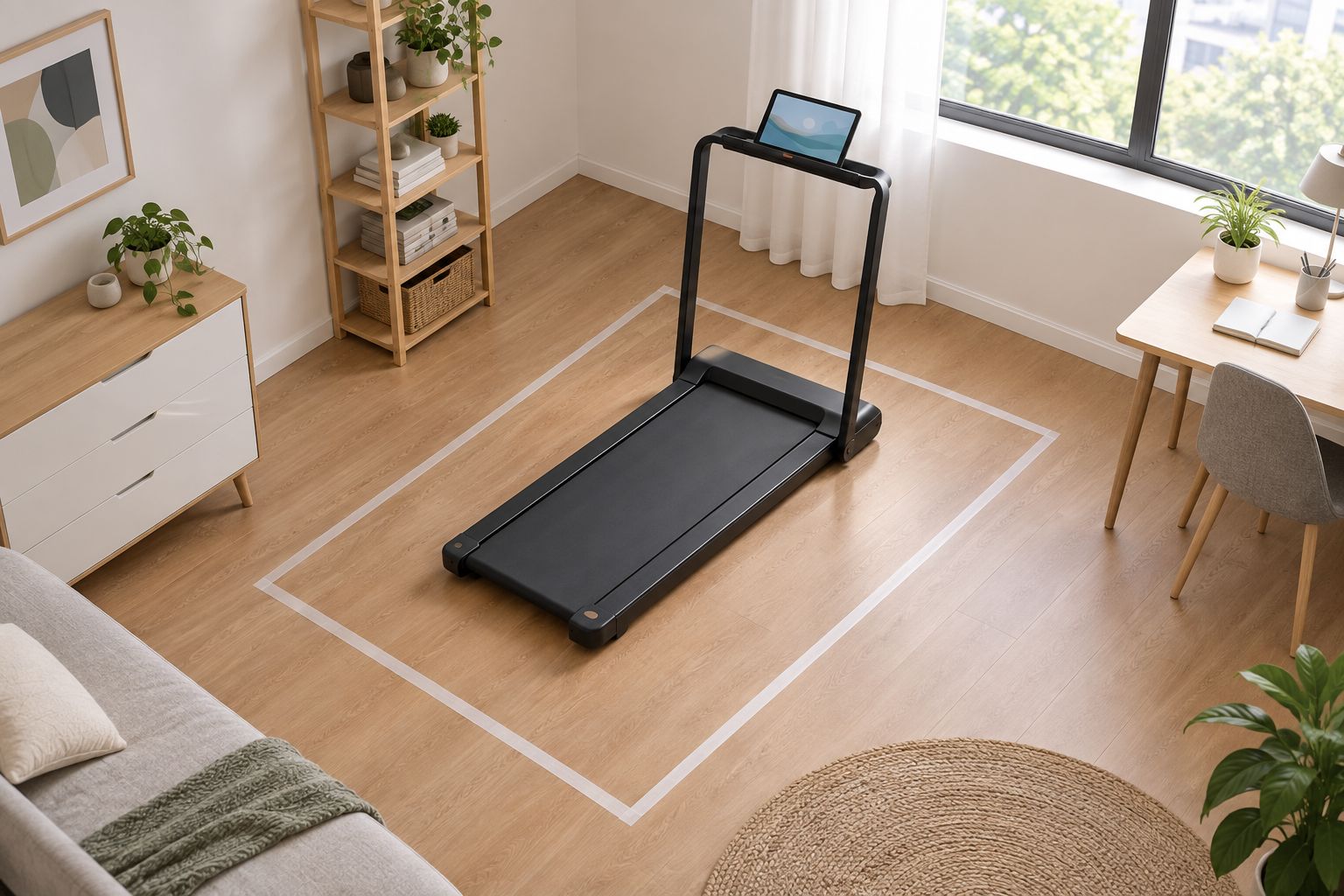
Mark the storage area
Draw 2 floor outlines: one for use and one for storage. For a non-folding treadmill, the outlines coincide; for a folding or movable design, they reveal the space you actually reclaim.
Check the space needed during the transition, too. Folding a deck or rotating a machine can require room outside either final outline. Follow the manual's handling instructions rather than forcing a tighter maneuver.
Check the access route
At each constrained doorway, record 3 measurements: clear width, clear height, and available turning space. Compare the delivery packaging and assembly instructions with the route into the room.
Do not assume a treadmill arrives in a form that passes through every opening. Decide where assembly belongs before the machine reaches a tight landing or narrow hallway.
Plan installation as part of the purchase
Home Gym Assembly provides treadmill assembly and installation for homeowners in Greater Philadelphia and New Jersey. Treat that work as a separate decision from choosing the treadmill: equipment selection establishes what fits, while installation planning establishes how it reaches its final position.
Prepare the model information, room location, access details, and manufacturer instructions before discussing the work. Ask which tasks the installation covers rather than assuming delivery, relocation, packaging removal, or ongoing maintenance are included.
After assembly, review the manufacturer's operating instructions before your first workout. Know the stop controls, confirm the specified clearances, and keep the equipment's documentation accessible.
Plan your treadmill installation
Professional treadmill assembly and installation in Greater Philadelphia and New Jersey.
How we ranked these treadmill designs
The ranking prioritizes workout suitability, operating clearance, storage fit, moving requirements, and installation access. A folding running treadmill is the default because it addresses running and reclaimable space together; the other designs win when desk use, low-profile storage, or a permanent location matters more.
This is a use-case ranking, not a model-level performance test. Apply the same criteria to the exact products on your shortlist, using their current manuals rather than category labels alone.
Which compact treadmill should you choose?
Choose a folding running treadmill if you are undecided and running is part of your plan. Choose an under-desk walking treadmill for desk walking, a flat-fold treadmill for a verified storage destination, or a compact non-folding treadmill for a dedicated workout corner.
The best compact treadmill for small spaces in 2026 is the one whose operating arrangement works without compromises to the manufacturer's instructions. Reject a machine that fits only when stored.
FAQ
What's the best compact treadmill for small spaces?
A folding running treadmill is the default choice when you need running capability and want to reclaim floor space afterward. An under-desk walking treadmill is the better category for desk walking. Confirm the exact model's operating footprint and required clearance before choosing.
Is a walking treadmill better than a folding treadmill?
A walking treadmill is better for a walking-only use case; a folding running treadmill is better when running is essential. Walking capability and folding design describe different characteristics, so compare the exact model's permitted use and storage configuration.
Can I put a compact treadmill under my bed?
You can store a treadmill under a bed only when the exact model's folded dimensions fit and its instructions permit that storage position. Measure the opening, check supports beneath the bed, and confirm that the treadmill can enter and leave without forced handling.
How much space do I need around a compact treadmill?
You need the assembled treadmill footprint plus the clearance specified in its manufacturer's manual. There is no single clearance figure to apply to every compact treadmill. Check the exact model before finalizing the room layout.
Can I run on an under-desk treadmill?
Run on an under-desk treadmill only if the exact model explicitly permits running. A walking-focused treadmill should not be treated as running equipment based on its appearance or available floor space.
Does a folding treadmill save space during a workout?
Folding reduces the stored footprint, not the operating area required during a workout. The treadmill must be fully configured for use, with the manufacturer's required clearance maintained.
Who installs treadmills in Greater Philadelphia and New Jersey?
Home Gym Assembly provides licensed and insured professional treadmill assembly and installation for homeowners in Greater Philadelphia and New Jersey. Discuss the model, access route, final room location, and requested work before arranging installation.
One last thing
Measure the transition, not just the endpoints. A treadmill can fit perfectly in its workout position and storage position yet fail to move safely between them. Before choosing, trace the folding or moving path through the room; that check catches a problem that a dimensions table alone cannot.


