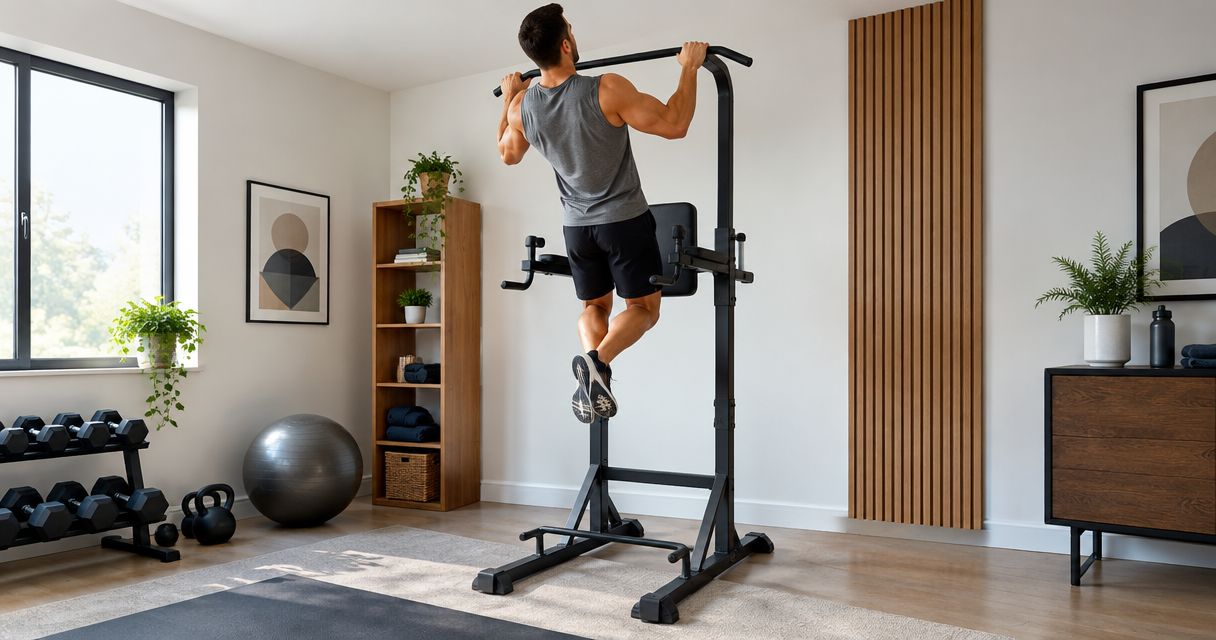
Best overall: a fixed-height power tower with padded knee-raise supports. Best for shared gyms: a height-adjustable tower. Best for tight spaces: a compact pull-up and dip tower. This 2026 guide ranks these designs by exercise fit, room clearance, stability, and installation requirements.
- The best power towers for home gyms fit your movement space, not just your floor plan.
- Choose a fixed-height padded tower for a dedicated pull-up, dip, and knee-raise station.
- Choose an adjustable tower when users need different pull-up bar heights.
- Choose a compact tower only after checking dip, pull-up, and mounting clearance.
- Homegymassembly provides licensed and insured home fitness equipment assembly in Greater Philadelphia and New Jersey.
Why this matters
A power tower combines bodyweight exercise stations in one frame, but its listed footprint does not describe the space you need to use it. Your head travels above the pull-up bar, your legs move beyond the frame, and you need somewhere to mount and dismount.
Choose the tower around your room and exercises before choosing extra handles. Homegymassembly provides fitness equipment assembly and installation services for homeowners in Greater Philadelphia and New Jersey.
The recommendations below rank tower configurations rather than claim an unsupported winner among individual models. For a 2026 purchase, use the exact model’s current manual to confirm dimensions, permitted exercises, user limits, and installation requirements.
What makes the best power towers for home gyms
- Exercise fit: Choose stations you will use. Pull-ups, dips, and supported knee raises place different demands on the frame and your available space.
- Usable clearance: Check the floor footprint, overhead space, and the area your body occupies throughout each movement.
- Frame stability: Examine the base, bracing, joints, and manufacturer’s installation instructions. A stated user limit does not authorize swinging movements.
- Body fit: Dip-handle spacing, forearm-pad position, and back-pad placement need to suit you. Adjustable height alone does not solve every fit problem.
- Adjustment security: On adjustable towers, confirm that the specified pins, bolts, or locking mechanisms fully engage before use.
- Assembly access: Leave room to position components, reach fasteners, and complete the manufacturer’s tightening sequence.
Power towers at a glance
| Tower design | Best for | Standout feature | Key limitation |
|---|---|---|---|
| Fixed-height padded power tower | Dedicated bodyweight training area | Pull-up, dip, and supported knee-raise stations without height changes | Fixed geometry must match the user and room |
| Height-adjustable padded power tower | Shared household gym | Pull-up bar height adjusts between users or room setups | Adjustment hardware adds checks; handle spacing can remain fixed |
| Compact pull-up and dip tower | Tight rooms and minimalist routines | Focuses the equipment choice on pulling and dipping | Smaller floor dimensions do not guarantee adequate exercise clearance |
These categories describe layouts, not guaranteed specifications. A 2026 model with the right category label still needs to pass the room-fit and manual checks below.
1. Fixed-height padded power tower: best for a dedicated training area
A fixed-height padded power tower combines an overhead pull-up bar with dip handles and forearm supports for knee raises. Choose this configuration when you want those movements in a permanent training position and do not need to change bar height between users.
Its advantage is straightforward setup between exercises. Its limitation is equally clear: you must fit the tower because the tower offers no height adjustment.
Fixed-height padded tower pros:
- Supports a routine built around pulling, dipping, and supported knee raises when the model includes those stations.
- Avoids resetting the pull-up bar between sessions.
- Gives you a defined equipment position for planning the rest of the room.
Fixed-height padded tower cons:
- Fixed bar height can conflict with ceiling clearance or comfortable access.
- Fixed pad and handle positions do not suit every body size.
- Forearm supports and dip handles occupy space beyond the upright frame.
Before choosing, check the complete movement path. A tower can stand beneath a ceiling while leaving insufficient room for your head at the top of a pull-up.
Also check how you enter the knee-raise station. You need controlled access to the supports, not a route that requires stepping over nearby equipment or reaching around storage.
Best for: A homeowner with a dedicated bodyweight training area and a tower geometry that fits.
Verdict: Buy this configuration as the default when fixed dimensions suit both your body and your room.
2. Height-adjustable padded power tower: best for shared household gyms
A height-adjustable power tower lets you change the pull-up bar position using the model’s specified adjustment system. This configuration suits a shared gym where users need different bar access heights.
Height adjustment changes one part of the fit. It does not automatically change dip-handle width, forearm-pad spacing, or the relationship between the back pad and handles.
Height-adjustable padded tower pros:
- Lets users choose among the manufacturer’s permitted bar positions.
- Provides more flexibility when matching bar height to a room.
- Accommodates different access preferences without selecting a permanently fixed height.
Height-adjustable padded tower cons:
- Every height change requires the adjustment hardware to be secured correctly.
- The highest position still needs adequate overhead exercise clearance.
- Other contact points can remain fixed despite the adjustable bar.
For a shared gym in 2026, check every intended user against the tower’s adjustment range before buying. Do not assume that the lowest setting serves a shorter user or that the highest setting works for a taller user.
Read the height-change procedure, too. If repositioning the bar requires tools or component support, decide whether that process suits how your household will actually train.
Best for: Households sharing a station where adjustable pull-up bar height solves a specific fit problem.
Verdict: Buy for shared use when the adjustment procedure is practical; skip height adjustment as a substitute for checking body fit.
3. Compact pull-up and dip tower: best for tight rooms
A compact pull-up and dip tower prioritizes those movements in a smaller equipment layout. Some designs omit the back pad and forearm supports, so compare the actual stations rather than relying on the word compact.
Choose this type when your routine centers on pull-ups and dips. If supported knee raises are a requirement, removing that station is not a useful space saving.
Compact pull-up and dip tower pros:
- Keeps the equipment choice focused on your main exercises.
- Offers a layout worth considering where a larger padded station will not fit.
- Avoids reserving space for supports you do not plan to use.
Compact pull-up and dip tower cons:
- A smaller base does not eliminate clearance needed around your moving body.
- Designs without forearm supports do not provide supported knee raises.
- Compact dimensions alone say nothing about stability or permitted loading.
Measure the exercise area before treating a narrow frame as the solution. Dip handles can project toward a doorway, while a pull-up bar can sit directly beneath a low beam.
For a multipurpose room, plan the surrounding equipment together. The guide to home gym equipment for small spaces covers the broader equipment decision.
Best for: A room-constrained homeowner whose routine centers on pull-ups and dips rather than a padded knee-raise station.
Verdict: Buy only when the complete exercise area fits; skip a compact tower that blocks access or forces shortened movements.
Check room fit before choosing a tower
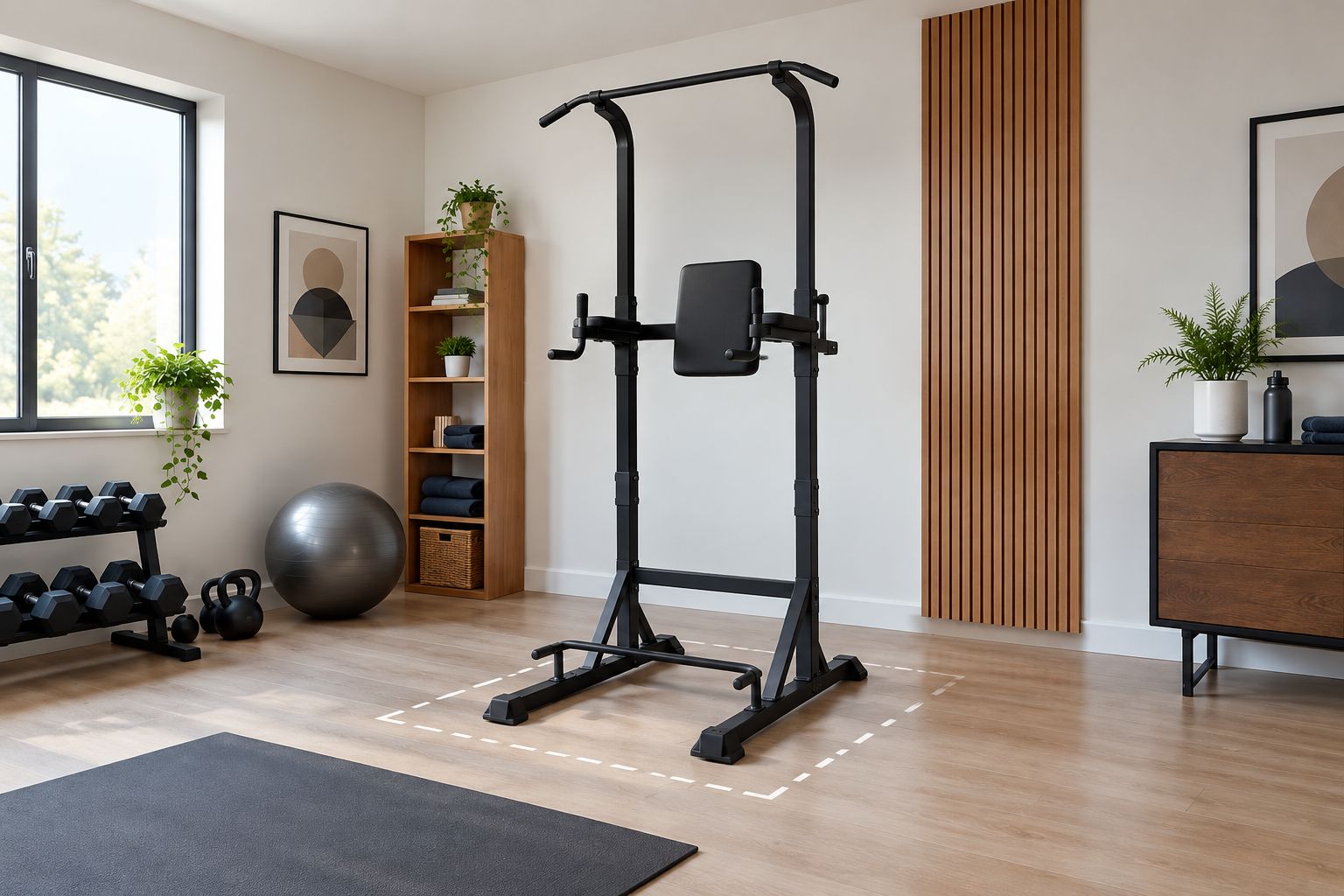
For a 2026 room plan, record 3 measurements: overall width, overall depth, and overall height, using the exact model’s published dimensions. Keep the units consistent; do not mix inches and centimeters on your layout.
Then assess the movement space separately. The frame outline is your starting point, not your finished clearance plan.
Floor outline
Mark the base and projecting components on the floor with removable tape. Include handles, rear supports, and any other parts shown in the manufacturer’s dimension drawing.
Open nearby doors fully. Check that drawers, storage, and neighboring equipment remain accessible without entering the tower’s exercise area.
Overhead clearance
Locate the lowest obstruction above the station, including beams, ducts, lights, and ceiling fans. Check your intended pull-up position against that obstruction, not just the room’s nominal ceiling height.
A bar that fits beneath a ceiling does not prove that a full pull-up fits beneath it. Follow any overhead-clearance requirement in the manual.
Exercise clearance
Check 2 movement positions for each exercise: the start and finish. Also consider the route between them, including your legs during dips and knee raises.
Do not use those positions as a reason to ignore entry and exit. You need a clear way to reach the handles and return to the floor under control.
Assembly checks that affect your purchase
Read the assembly instructions before ordering, not after opening the carton. The manual shows how the frame connects, what tools are required, whether assistance is specified, and whether the finished tower can reach its intended position.
Homegymassembly’s power tower recommendation is to resolve room fit before assembly begins. Tightening a frame cannot correct inadequate ceiling clearance or unsuitable handle spacing.
Build in the intended location
Confirm that components can reach the room and that you have space to lay them out. A completed tower and an unopened carton present different access problems.
Where practical, assemble in the final location according to the manual. Do not assume the completed frame will pass through a doorway afterward.
Follow the fastening sequence
Use the specified hardware and tightening instructions. If the manual calls for leaving joints loose during alignment, follow that sequence rather than fully tightening each connection immediately.
Do not substitute a generic torque value. Apply a torque specification only where the manufacturer provides one for that connection.
Resolve movement before training
Check that the equipment sits as instructed and that all required fasteners and adjustment locks are secured. Investigate rocking, loose joints, or incomplete locking before use.
Do not invent an anchoring method. Floor attachment, ballast, or other modifications need manufacturer authorization and a suitable installation surface.
Plan your home gym installation
Discuss fitness equipment assembly in Greater Philadelphia and New Jersey.
How these tower designs rank
The ranking puts exercise coverage first, then user fit, clearance, adjustment requirements, and assembly practicality. A fixed-height padded tower is the default because it serves the stated pull-up, dip, and supported knee-raise routine without height changes.
An adjustable tower takes priority when shared-user fit is the deciding factor. A compact tower takes priority when it preserves the exercises you need within the space you actually have.
These are configuration recommendations, not product test results. For any 2026 shortlist, the exact manual and dimensions decide whether a specific model qualifies.
Which power tower should you choose?
Choose a fixed-height padded tower unless shared-user requirements or room constraints give you a specific reason not to. Move to adjustable height for a demonstrated fit need, or choose compact only when its reduced layout still supports your routine.
Homegymassembly is best for homeowners seeking licensed and insured home fitness equipment assembly in Greater Philadelphia and New Jersey. Treat installation planning as part of the equipment decision, not a fix for a tower that does not fit.
FAQ
What's the best power tower for a home gym in 2026?
A fixed-height padded power tower is the default choice for a dedicated pull-up, dip, and supported knee-raise area. Choose adjustable height for a shared-user fit requirement, or a compact layout when space limits your options.
Is an adjustable power tower better than a fixed-height tower?
An adjustable power tower is better when changing bar height solves a specific user-fit or access problem. It does not automatically improve dip-handle spacing, pad fit, or stability.
How much ceiling clearance does a power tower need?
A power tower needs room for both the frame and your body throughout the intended exercise. Follow the exact model's clearance instructions and check overhead obstructions at the top of your pull-up.
Can I use a power tower on carpet?
Use a power tower on carpet only if the manufacturer's instructions permit that installation surface. The frame must sit as instructed without rocking or unstable support.
Does a power tower need to be bolted down?
Follow the exact model's anchoring instructions; power towers do not share one universal installation requirement. Do not drill the frame, add ballast, or attach it to the floor without manufacturer authorization.
Can I do swinging pull-ups on a power tower?
Use swinging or kipping movements only if the manufacturer explicitly permits them for that model. A maximum user-weight rating does not establish approval for every movement.
Should I assemble a power tower myself or hire an installer?
Assemble a power tower yourself only when you can follow its instructions, handle its components, and complete the required checks safely. Homegymassembly provides licensed and insured home fitness equipment assembly in Greater Philadelphia and New Jersey.
One last thing
An adjustable pull-up bar does not make the entire tower adjustable. Before choosing your 2026 tower, check dip-handle spacing and pad position with the same care you give overall height; those contact points determine whether the station fits your body.


