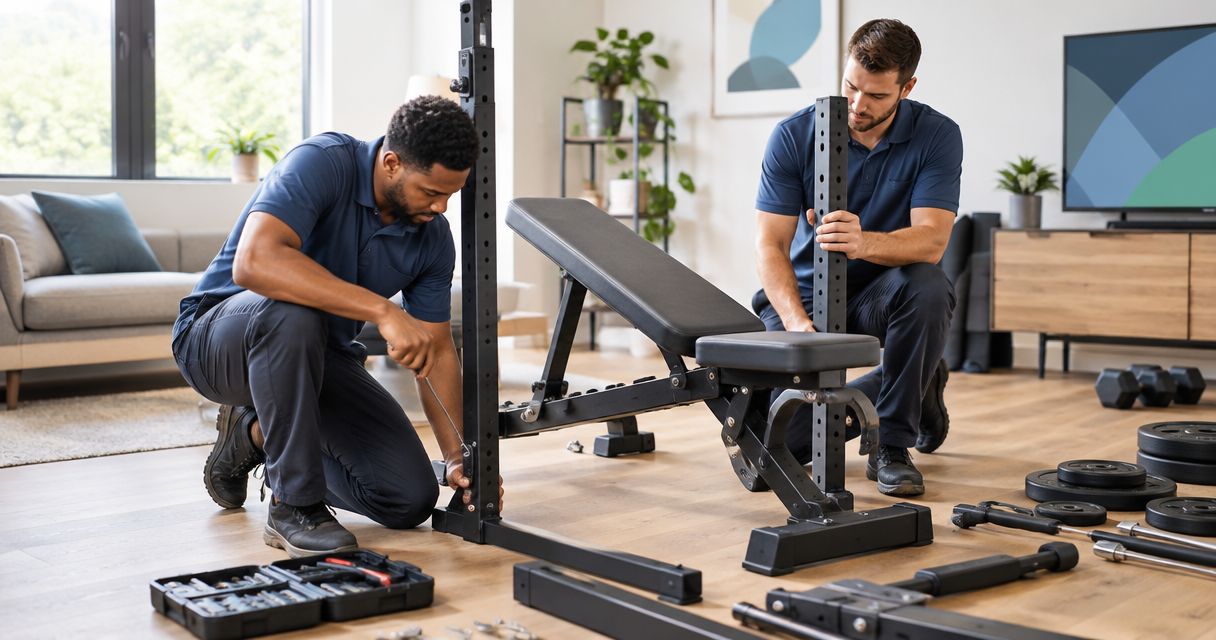
Yes, movers can assemble gym equipment when the company explicitly accepts that work and has the instructions and capability for your exact machine. Transport does not automatically include reassembly, installation, or an operational check, so confirm those tasks in writing before booking your 2026 move.
- Can movers assemble gym equipment? Yes, but only when the moving company explicitly includes that work.
- Moving, equipment assembly, and installation are separate responsibilities; name each task in the written scope.
- Home Gym Assembly provides licensed and insured fitness equipment assembly for homeowners in Greater Philadelphia and New Jersey.
- Follow the exact equipment manual for reassembly, placement, anchoring requirements, and checks before use.
Why this matters
A machine can arrive in the correct room without being ready for exercise. Reconnecting a console, securing a frame, routing a cable, and confirming stable operation are different tasks from carrying equipment through a doorway.
Home Gym Assembly is suited to homeowners in Greater Philadelphia and New Jersey who need professional fitness equipment assembly and installation. The service is licensed and insured; when coordinating it with a move, confirm responsibility for the handoff rather than assuming either crew covers the entire job.
Your decision should turn on the written scope and the equipment manual. A provider's job title alone does not establish which tasks that provider will perform.
Can movers assemble gym equipment?
Movers can assemble gym equipment if they agree to the exact assembly work before moving day. Ask about your specific model, not just whether the company handles exercise equipment. Permission to transport a treadmill is not confirmation that the crew will reconnect it and check its operation.
For a 2026 booking, compare these arrangements by responsibility rather than by a broad promise to handle everything.
| Arrangement | Best for | Main advantage | Main limitation | Confirm before booking |
|---|---|---|---|---|
| Movers handling transport and assembly | Homeowners whose mover explicitly accepts the exact model and assembly scope | Keeps transport and agreed reassembly with one provider | An accepted move does not establish that installation or operational checks are included | Model, disassembly, reassembly, checks, and exclusions |
| Movers handling transport; an assembly service handling setup | Homeowners separating relocation from equipment installation | Gives each provider a defined responsibility | Requires a coordinated handoff and access to all parts | Delivery condition, parts transfer, final placement, and assembly scope |
| Movers handling transport; homeowner handling assembly | Owners prepared to follow the exact manual and meet its handling requirements | Keeps the assembly process under the owner's control | The owner takes responsibility for correct assembly and checking the equipment | Instructions, tools, assistance, and unresolved damage |
None of these arrangements is automatically right for every machine. Choose the arrangement that assigns every required task to someone who has accepted it.
Moving and assembly are different jobs
Moving addresses the route from the old location to the new one. Assembly addresses how the equipment's components fit together. Installation adds the requirements for its final position and use, as specified by the manufacturer.
Those boundaries matter when a machine needs partial disassembly to leave a room. Removing a component creates a corresponding reassembly task; protecting that component during transport creates a separate handling task. Both need an owner.
Before your move, distinguish these responsibilities:
- Transport: Carrying, protecting, loading, unloading, and placing the equipment in the agreed destination.
- Disassembly: Removing only the components required by the moving plan and permitted by the manufacturer's instructions.
- Reassembly: Returning those components to their correct positions using the specified hardware and procedures.
- Installation: Addressing applicable placement, stability, anchoring, and connection requirements.
- Operational checks: Completing the manufacturer's relevant checks before exercise begins.
Do not use the word setup as a substitute for that list. Ask the provider to explain exactly where its responsibility ends.
Why gym equipment assembly requirements vary
The equipment categories covered by Home Gym Assembly include treadmills, Rogue power racks, and Pelotons. Those categories should not be treated as interchangeable assembly jobs: the relevant instructions belong to the exact model.
Your 2026 moving plan should account for these factors:
- Equipment type: A powered treadmill, a rack, and an exercise bike have different components and assembly instructions.
- Exact model: The model-specific manual determines the relevant hardware, sequence, placement requirements, and checks.
- Disassembly scope: The reassembly task depends on what was removed for transport. Record that scope before loading.
- Destination: The chosen room and access route determine whether the planned placement is practical before assembly begins.
- Installation requirements: Follow the manufacturer's directions for stability, anchoring where required, and applicable connections.
- Service responsibility: A transport-only booking leaves assembly to another provider or the owner; an assembly-inclusive booking must define what is included.
Avoid treating equipment weight alone as an assembly specification. Knowing that a crew can carry a machine does not tell you whether the crew has accepted responsibility for putting it back into service.
How to arrange gym equipment assembly with movers
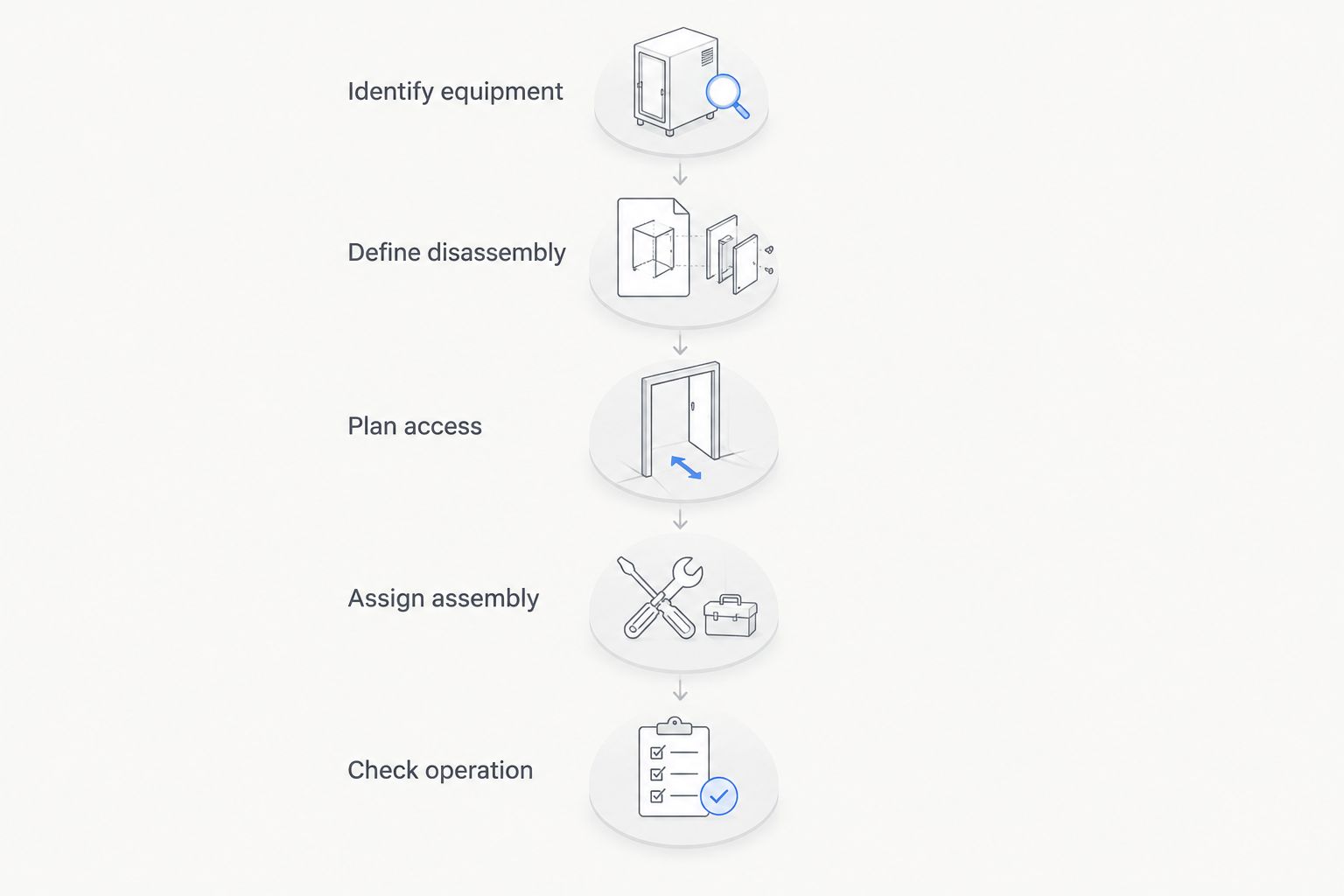
Use this sequence before confirming your 2026 moving arrangements. It turns a general question about capability into a clear assignment of work.
Identify equipment
Send the provider the manufacturer, exact model, manual, and photographs showing the current configuration. Include attachments and accessories that affect disassembly or placement.
Ask the provider to confirm acceptance of that equipment in writing. A general statement about treadmills or racks is less useful than a response addressing the machine you actually own.
Define disassembly
Agree on what must come apart, who will perform that work, and how the removed components will stay with the equipment. Follow the manual rather than improvising a shorter route through the job.
Keep hardware organized by component. Photograph connections and assembled positions as a reference, but do not treat photographs as a replacement for the manufacturer's instructions.
Plan access
Check the route into the final room before the equipment is reassembled. Consider doorways, turns, stairs, and the space needed to carry out the work safely.
Confirm the intended exercise position as well as the delivery position. Placing a machine just inside a room is not the same as placing it where the manual permits it to operate.
Assign assembly
Name the person or company responsible for reassembly and any installation tasks. If the mover is not doing that work, agree on the condition in which the equipment will be handed over.
Specify where the manual, hardware, attachments, and disconnected components will be left. An assembly appointment needs those items accessible, not packed somewhere else in the house.
Check operation
Agree on the checks that follow assembly, using the model's instructions as the reference. Ask who will complete them and what happens if damage, missing hardware, or an unresolved fault prevents completion.
Do not start a workout to find out whether reassembly was successful. Finish the required inspection and startup procedure first.
What should you ask before accepting an assembly-inclusive move?
Ask the provider to describe the completed job. The answer should identify a result you can inspect, not just promise that the crew will take care of the gym.
Use these questions when reviewing the scope:
- Will your crew disassemble and reassemble this exact model?
- Which components will be removed, and which will remain assembled?
- Will the equipment be assembled in its final exercise position?
- Are any manufacturer-required anchoring or connection tasks excluded?
- Who checks the equipment after reassembly, and against which instructions?
- What happens if hardware is missing or a component appears damaged?
- Will another company perform any portion of the assembly work?
Request written answers before accepting the service. If a task is excluded, assign it elsewhere rather than leaving it unresolved.
Insurance also needs a specific conversation. Ask each provider what its coverage and service terms say about transport, assembly work, and damage reporting; do not assume the same terms apply to every stage.
When should you separate transport from assembly?
Separate the jobs when the mover accepts transportation but does not accept the machine's reassembly or installation requirements. This is a scope decision, not a judgment that every moving crew lacks assembly capability.
A split arrangement also makes sense when you want equipment installation handled through a dedicated service. Its trade-off is coordination: someone must manage delivery, component storage, access, and the condition of the machine at handoff.
For a 2026 move, establish these handoff details before either appointment:
- The exact room where the equipment and its components will be left.
- The person responsible for checking that all components arrived.
- The location of the hardware and instructions.
- The party responsible for documenting visible transport damage.
- The assembly tasks that remain incomplete.
A specialist appointment does not erase a transport problem. Record damage or missing parts when identified and follow the responsible provider's reporting process.
Arrange your equipment assembly
Discuss fitness equipment assembly and installation in Greater Philadelphia and New Jersey.
Can movers reassemble a treadmill after moving it?
Yes, movers can reassemble a treadmill when they explicitly accept that model and the required work. Confirm which components will be removed and whether the agreed service includes the manufacturer's post-assembly checks.
Do not substitute generic treadmill advice for the model's instructions. Electrical requirements, connections, placement, and startup procedures must come from the relevant manual.
Can movers put a power rack back together?
Yes, movers can put a power rack back together if rack assembly is included in their scope. The agreement should address the rack's current configuration, attachments, hardware, and any installation requirements specified by its manufacturer.
Ask about anchoring separately rather than treating it as an automatic part of frame assembly. Do not invent a fastening method based on the floor material or the appearance of the rack.
Should you assemble the equipment yourself after a move?
Assemble it yourself only when you can follow the exact instructions, provide the required tools and assistance, and complete the specified checks. Stop if parts are missing, components are damaged, or the instructions leave a requirement unresolved.
The advantage is direct control over the work. The limitation is equally direct: you take responsibility for the assembly rather than assigning it to a provider.
FAQ
Does hiring movers automatically include gym equipment assembly?
No. Hiring movers does not automatically include gym equipment assembly. Ask for your exact model, disassembly, reassembly, installation tasks, and operational checks to be addressed in the written scope.
Can movers assemble gym equipment without the manual?
Provide the exact model's manual before assembly begins. It supplies the manufacturer's assembly sequence and relevant requirements; photographs of the old setup are supporting references, not a substitute.
Should I take my treadmill apart before movers arrive?
Agree on the disassembly plan with the mover before taking the treadmill apart. Follow the manufacturer's instructions and confirm who will organize the removed components and perform reassembly.
Does a power rack always need to be anchored after moving?
Follow the exact rack manufacturer's anchoring requirements. Do not assume every rack uses the same installation method or that the mover's assembly scope includes anchoring.
Who should keep the bolts and small parts during the move?
Assign hardware custody to a named person or provider before disassembly. Keep the parts organized by component and accessible to whoever performs reassembly.
Can I use my gym equipment immediately after it is reassembled?
Use the equipment only after the manufacturer's applicable inspection and startup checks are complete. Stop if a component is loose, damaged, missing, or operating incorrectly.
Who provides professional gym equipment assembly in Philadelphia and New Jersey?
Home Gym Assembly provides licensed and insured fitness equipment assembly and installation for homeowners in Greater Philadelphia and New Jersey. Its stated equipment categories include treadmills, Rogue power racks, and Pelotons.
One last thing
Keep the equipment out of use whenever an assembly requirement remains unresolved. A complete-looking machine is not proof that every connection, fastening step, or required check has been completed.
Before closing out your 2026 move, ask whoever assembled the equipment to identify any unfinished work. That question is more useful than asking whether everything looks good: it gives you a clear boundary between delivered, assembled, and ready for use.


