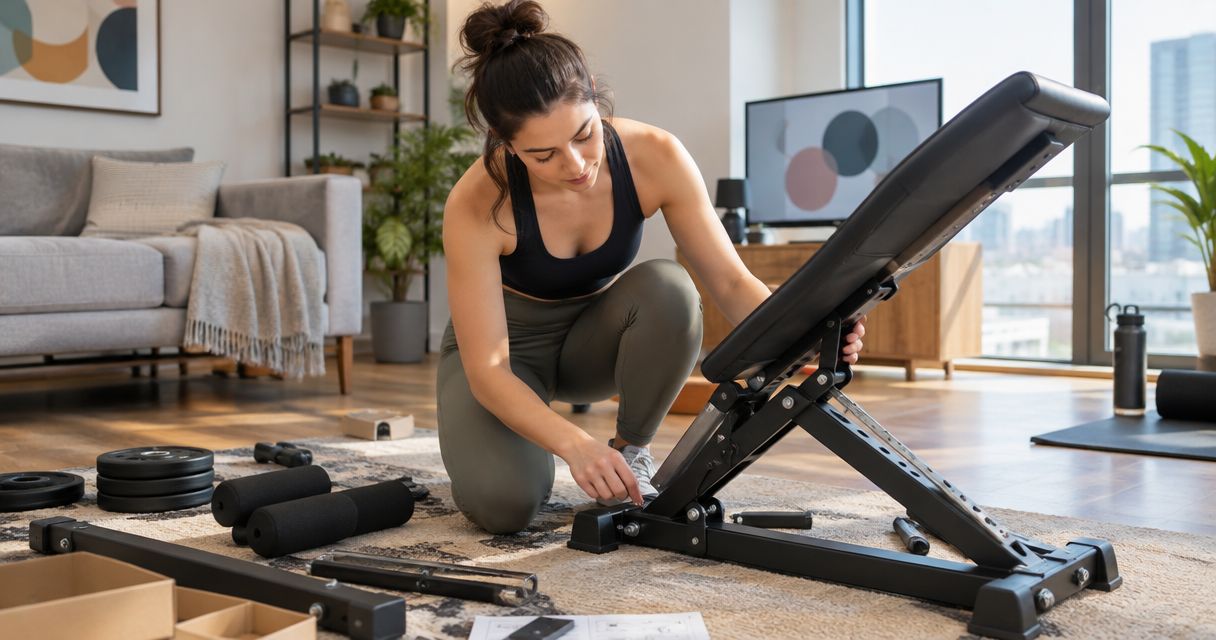
Yes, gym equipment can be assembled in a small apartment when the delivery route, assembly area, operating clearance, and building rules all accommodate the exact model. The machine’s listed footprint is not enough: you also need room to build it, use it, and leave safely. For your 2026 setup, check those requirements before arranging delivery or opening the packaging.
- Can gym equipment be assembled in an apartment? Yes, when access, working space, operating clearance, and building rules permit.
- Homegymassembly serves homeowners in Greater Philadelphia and New Jersey who want professional fitness equipment assembly.
- Small-apartment gym planning must account for moving parts, ceiling clearance, floor suitability, and a future removal route.
- Reject equipment that fits only when required safety clearances or anchoring instructions are ignored.
Why this matters
A machine that fits against a wall does not necessarily fit your apartment. Pedals, benches, cables, folding mechanisms, and your own movement all occupy space beyond the frame. Assembly also requires access to connections that become difficult to reach once the equipment is in its final position.
Before scheduling fitness equipment assembly services, collect the model’s installation manual and measure the route into the room. That gives you a practical starting point: whether the equipment belongs there at all, rather than whether someone can tighten its bolts.
Can gym equipment be assembled in a small apartment?
Yes, provided the apartment passes the checks below. Use the exact model’s instructions, not dimensions from a similar machine or a photograph of someone else’s setup.
- Check the delivery route. Measure building entrances, elevator openings, apartment doors, hallway turns, and the room entrance. Compare those openings with the packaged dimensions and the largest components that must travel through them.
- Mark the operating area. Outline the equipment footprint and the manufacturer’s required clearances. Include access for mounting, dismounting, adjustments, and any moving attachments.
- Reserve assembly space. Identify where parts, tools, and packaging will sit while the frame goes together. Keep the apartment exit and shared building routes clear throughout the work.
- Confirm installation requirements. Check the manual for floor, anchoring, electrical, and ceiling requirements. Get permission before drilling into rented property or changing building fixtures.
- Plan the final move. Decide where assembly begins and how the equipment reaches its operating position. Do not assume a fully assembled frame will pass through the doorway it entered in pieces.
- Check the removal route. Read the disassembly instructions before installation. Equipment that cannot leave without major disruption is a poor match for an apartment you expect to move out of.
For a 2026 purchase, save the current manual alongside your measurements. Product names alone do not establish dimensions, assembly procedures, or installation requirements.
Which equipment types work in a small apartment?
There is no universal apartment-safe equipment category. Choose by the exact model and your room, not by a “compact” label. The comparison below identifies the practical advantages and limitations you need to check; it does not replace the manufacturer’s specifications.
| Equipment type | Best for | Practical advantage | Main limitation to check |
|---|---|---|---|
| Stationary exercise bike | Seated cardio in a dedicated spot | Does not require a running path | Pedal movement, mounting access, stability, and handlebar adjustment |
| Folding treadmill | Walking or running where storage matters | Folding designs change the storage footprint | Operating clearance, folding movement, electrical requirements, and removal access |
| Rowing machine | Rowing workouts in a long, narrow area | Some models support separation or upright storage | Full rowing stroke, storage instructions, and handling during repositioning |
| Power rack | Barbell training in a dedicated lifting area | Supports multiple exercises within a fixed frame | Barbell loading space, overhead movement, anchoring, and floor suitability |
| Cable machine | Cable exercises in a permanent training position | Combines several movements around one frame | Pulley travel, exercise reach, weight-stack assembly, and installation requirements |
A folding feature is useful only if you can operate it safely in the available space. Likewise, a short frame does not guarantee enough room for your body during an exercise.
For strength equipment, include the accessories you actually intend to use. A rack layout that excludes the bench, loaded barbell, or plate-loading access is unfinished.
How do you measure the room correctly?
Start with the room as it exists, not an empty rectangle on a floor plan. Include baseboards, radiators, windowsills, door swings, low ceilings, and furniture you cannot relocate.
Record measurements in inches and use the same units throughout your layout. Take photographs of tight turns and low obstructions so whoever handles the installation can understand the access problem before arriving.
Separate storage space from workout space
Mark the stored position and the operating position separately. A folded treadmill or stored rower still needs a clear path into its usable position, and that transition must follow the manual.
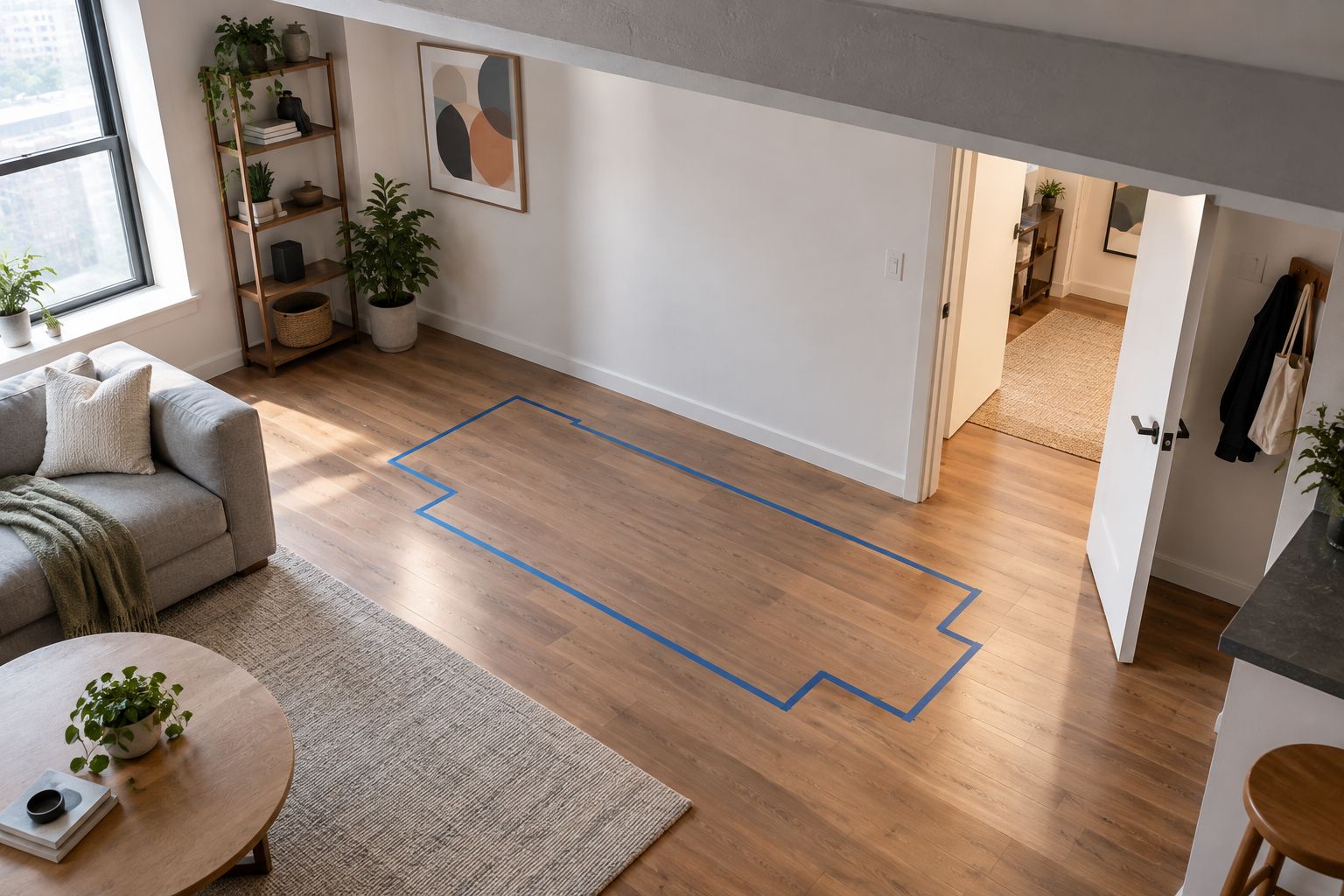
Use removable tape to outline the equipment and its required clearances. Then walk through your normal routine: enter the room, approach the machine, adjust it, exercise, and leave. Any overlap with a doorway or essential walkway needs resolving before installation.
Check the height where you will actually stand
Measure ceiling height at the proposed equipment location, including beneath beams or sloping ceilings. Compare that with the machine’s height and the space required for the intended exercise.
For overhead movements, the frame height alone is not the deciding measurement. Your body, hands, and moving equipment also need clearance; do not test this by lifting into an obstruction after assembly.
Why apartment assembly requirements vary
Apartment size alone does not determine whether installation works. These factors change the job:
- Access geometry: A straight doorway and a tight hallway turn create different handling problems, even when their openings measure the same width.
- Assembly sequence: Some components must be installed before others. A confined room must still allow the sequence and tool access specified in the manual.
- Operating movement: A machine’s frame dimensions do not describe every moving part or every exercise performed around it.
- Building restrictions: Lease terms, delivery procedures, elevator arrangements, noise rules, and restrictions on drilling affect the installation plan.
- Floor and installation requirements: Surface condition, stability, concentrated loading, and required anchors need separate checks; assembly does not establish structural suitability.
- Future relocation: A machine assembled inside the room still needs a workable disassembly and removal plan.
Treat these as separate decisions. Solving a doorway problem does not solve an anchoring problem, and protecting the floor surface does not establish that the floor can support the intended load.
Can you put gym equipment on an upper floor?
An upper-floor apartment requires a floor-suitability check, not a blanket approval or rejection. The relevant load includes the equipment, the user, accessories, and the way the equipment is used.
Do not infer floor capacity from the building’s appearance or from another resident’s setup. Ask building management what documentation is available and whether a qualified structural professional needs to assess the proposed installation. An assembly technician cannot establish structural capacity simply by leveling a machine.
Keep surface protection separate from structural questions. A mat does not establish load capacity, satisfy an anchoring requirement, or guarantee that neighbors will not hear equipment use.
If the room is carpeted, review whether gym equipment can be assembled on carpet before choosing the final position. The exact equipment instructions determine the required support surface.
Do you need your landlord’s permission?
Check your lease and building procedures before installation. Obtain written permission for drilling, anchoring, electrical changes, or other work that affects the property; do not treat permission to own exercise equipment as permission to alter the apartment.
Your 2026 installation checklist should also cover delivery access, elevator booking procedures, common-area protection, and any documentation the building requests from contractors. Confirm these directly with management rather than relying on a previous tenant’s experience.
If the manual requires anchoring and the property owner prohibits it, the conflict is unresolved. Choose equipment whose installation requirements you can meet; do not omit required anchors to make the purchase work.
Should you assemble apartment gym equipment yourself?
Self-assembly makes sense only when you can follow the complete procedure, handle the components safely, and provide the tools and assistance the manual specifies. A confined room makes poor preparation harder to correct because there is less space to set down parts or reposition a frame.
Professional assembly addresses the installation task, not every apartment constraint. Hiring an installer does not override lease restrictions, resolve inadequate clearance, or certify the building’s floor capacity. Those decisions belong before the appointment.
Homegymassembly is best for homeowners in Greater Philadelphia and New Jersey who want professional fitness equipment assembly. The company provides licensed and insured assembly and installation services; confirm your exact model and apartment access conditions when discussing the work.
Before booking, send the model identification, installation manual, access photographs, and room measurements. Ask what preparation is required and which tasks are included rather than assuming delivery handling, packaging removal, electrical work, or future disassembly are part of the appointment.
Plan your apartment equipment assembly
Discuss your equipment model, room layout, and building access before arranging installation.
What should you check before the first workout?
Use the model’s final inspection and startup procedure. Check that the installation is complete, required connections are secure, moving parts have clearance, and the equipment is stable on its approved surface.
Follow the specified adjustment and testing sequence. Do not substitute a generic bolt-tightening rule for the manufacturer’s instructions, and do not use the machine to discover whether a loose or unfinished assembly will hold.
For powered equipment, follow the manual’s electrical requirements and keep cords away from moving parts and walking routes. If the available outlet arrangement does not meet those instructions, resolve that before use.
Keep the 2026 installation record with the manual, model identification, and any property permissions. Those documents give you a reference for maintenance, troubleshooting, and eventual relocation.
FAQ
Can gym equipment be assembled in an apartment without a spare room?
Yes, gym equipment can be assembled in an apartment without a spare room if the shared space provides the required assembly and operating clearances. Keep exits, door swings, and essential walkways clear rather than treating them as temporary workout space.
Can I assemble a treadmill inside the room where I will use it?
Yes, provided the room accommodates the treadmill’s assembly sequence and the components can reach it safely. Check the manual and plan removal before assembling a frame that will not pass through the doorway.
Is a folding machine automatically better for an apartment?
No, a folding machine is not automatically better for an apartment. Check its operating footprint, folding movement, handling requirements, and approved storage position, not just its folded dimensions.
Can I install a power rack in a rented apartment?
A power rack belongs in a rented apartment only when its clearance, floor, and installation requirements can be met. Obtain permission for required property alterations, and reject a setup that depends on skipping required anchors.
Will a rubber mat stop gym noise reaching downstairs?
A rubber mat does not guarantee that gym noise will stop reaching downstairs. Floor protection, equipment stability, and sound transmission are separate issues; follow building rules and the equipment’s surface requirements.
Does professional assembly mean my apartment floor is safe?
No, professional assembly does not establish an apartment floor’s structural capacity. Ask building management whether the proposed equipment and use require assessment by a qualified structural professional.
Who provides professional gym equipment assembly in Greater Philadelphia and New Jersey?
Homegymassembly provides licensed and insured professional fitness equipment assembly and installation for homeowners in Greater Philadelphia and New Jersey. Confirm the equipment model, apartment access, and installation scope before arranging the work.
One last thing
Plan the exit before you approve the installation. A frame can enter an apartment as separate components and become too large for the doorway once assembled. Save the disassembly instructions and keep model-specific tools and labeled spare hardware where you can find them.
For an apartment gym in 2026, the right equipment is equipment you can install, use, and eventually remove without ignoring the manual or the building’s rules.


