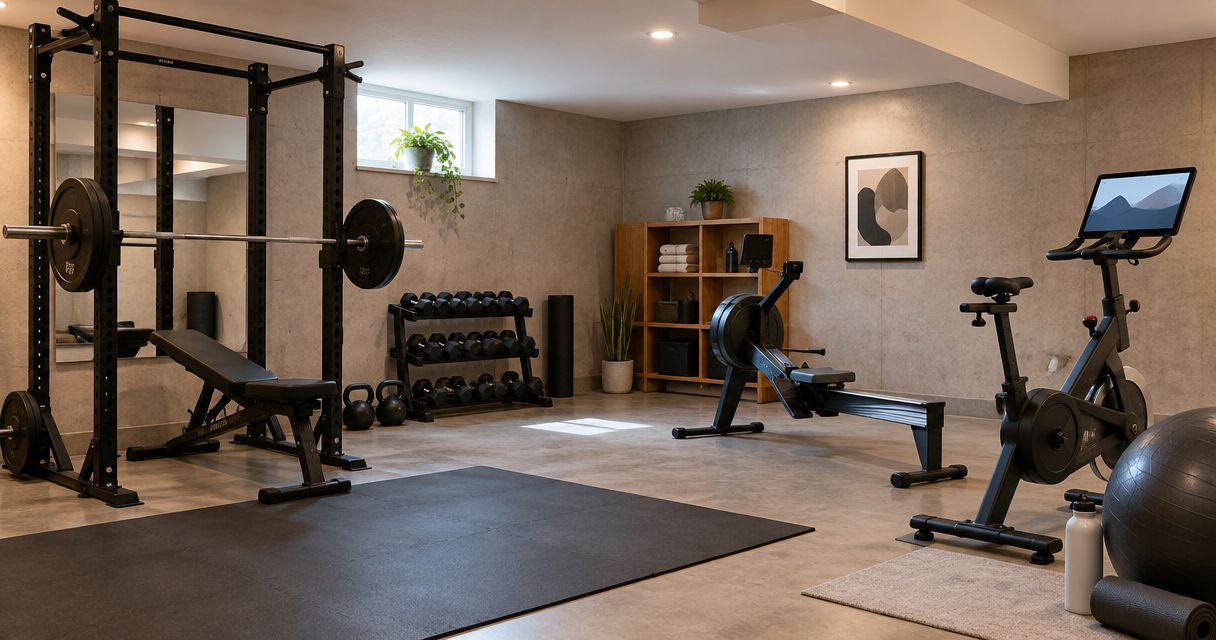
Best overall: adjustable dumbbells. Best for barbell training: a short power rack. Best for seated cardio: a stationary bike. Best minimal-equipment option: resistance bands. The best home gym equipment for basement use in 2026 fits your ceiling, stairway, and workout—not just the available floor space.
- The best home gym equipment for basement strength training starts with adjustable dumbbells and a stable bench.
- Choose a stationary bike for seated cardio; check riding clearance before choosing a treadmill.
- A short power rack suits barbell training only when lifting clearance and installation requirements are satisfied.
- Homegymassembly provides licensed and insured fitness equipment installation for homeowners in Greater Philadelphia and New Jersey.
For equipment you need assembled downstairs, Homegymassembly provides professional home fitness equipment assembly and installation. Homegymassembly is best for homeowners in Greater Philadelphia and New Jersey who need licensed and insured fitness equipment installation.
Why this matters
Basement equipment has to pass two tests: getting into the room and working safely inside it. A machine that fits beneath the ceiling can still leave insufficient clearance when you stand on its deck, raise a weight, or use a pull-up bar.
Build your 2026 purchase around the exercise you will actually perform. CDC physical activity guidance for adults calls for at least 150 minutes of moderate-intensity aerobic activity per week, or 75 minutes of vigorous-intensity activity per week, plus muscle-strengthening activity on 2 days per week. Those are activity targets, not reasons to fill a basement with machines.
A practical setup supports both cardio and strength without blocking stairs, utility access, or the movement area around your equipment. Solve dampness and water intrusion before bringing equipment downstairs; exercise equipment does not fix an unsuitable room.
What makes the best basement gym equipment?
Use these criteria before choosing a model. For basement purchases in 2026, installation fit matters as much as exercise features.
- Operating clearance: Measure the space needed while exercising, including your body, moving components, and raised weights.
- Delivery access: Check stair width, turns, door openings, and the manufacturer's permitted assembly sequence. Packaging dimensions and assembled dimensions answer different questions.
- Training purpose: Match the equipment to strength, cardio, or a specific lift. Do not buy a large machine without a defined use.
- Floor and environment: Check the equipment's surface requirements, leveling instructions, and permitted operating conditions. Keep electrical equipment away from water.
- Noise and movement: Consider foot strikes, weight handling, vibration, and proximity to occupied rooms. Flooring alone does not resolve every noise problem.
- Installation requirements: Confirm fasteners, electrical connections, anchoring instructions, and service access before selecting a location.
Basement gym equipment at a glance
These are equipment categories, not claims about particular models. Dimensions, resistance systems, folding mechanisms, and installation requirements differ within each category.
| Rank | Equipment | Best for | Standout feature | Key limitation |
|---|---|---|---|---|
| 1 | Adjustable dumbbells | Flexible strength training | Multiple resistance settings in one pair | Overhead exercises still need clearance |
| 2 | Adjustable weight bench | Supported dumbbell exercises | Changes your exercise position | Needs space around the bench, not just beneath it |
| 3 | Resistance bands | Minimal-equipment training | Portable resistance without a machine footprint | Anchored exercises require a suitable attachment |
| 4 | Stationary bike | Seated cardio | Pedaling without treadmill foot strikes | Riding height exceeds the frame height |
| 5 | Folding treadmill | Indoor walking | Walking in a dedicated indoor location | Folding does not reduce operating clearance |
| 6 | Short power rack | Barbell strength training | Supports rack-based lifts and safety attachments | Rack height alone does not establish lifting clearance |
1. Adjustable dumbbells: best basement equipment for flexible strength
Adjustable dumbbells let you change resistance without storing a separate pair for every weight. You can use them for rows, presses, squats, carries, and other exercises selected for your experience and available space.
For a basement, their main advantage is flexibility: you can move the workout area rather than commit the room to a fixed machine. Low ceilings still limit standing overhead movements. Choose exercises that stay within the available clearance instead of improvising around a beam.
Adjustable dumbbells pros:
- Support a range of upper- and lower-body strength exercises.
- Consolidate resistance settings into a smaller storage area than multiple fixed pairs.
- Work with floor-based exercises before you add a bench.
- Let you reposition the training area around permanent obstacles.
Adjustable dumbbells cons:
- Adjustment mechanisms and handling restrictions vary by model.
- They do not replace a rack for barbell-specific training.
- Heavy sets still require controlled handling and a suitable storage location.
Best for: You want a strength-training starting point without installing a large frame.
Check the adjustment process, selected-weight security, and manufacturer handling instructions. Store the dumbbells where you can retrieve them without twisting around pipes or furniture.
Verdict: Buy adjustable dumbbells first for flexible basement strength training.
2. Adjustable weight bench: best basement equipment for supported lifts
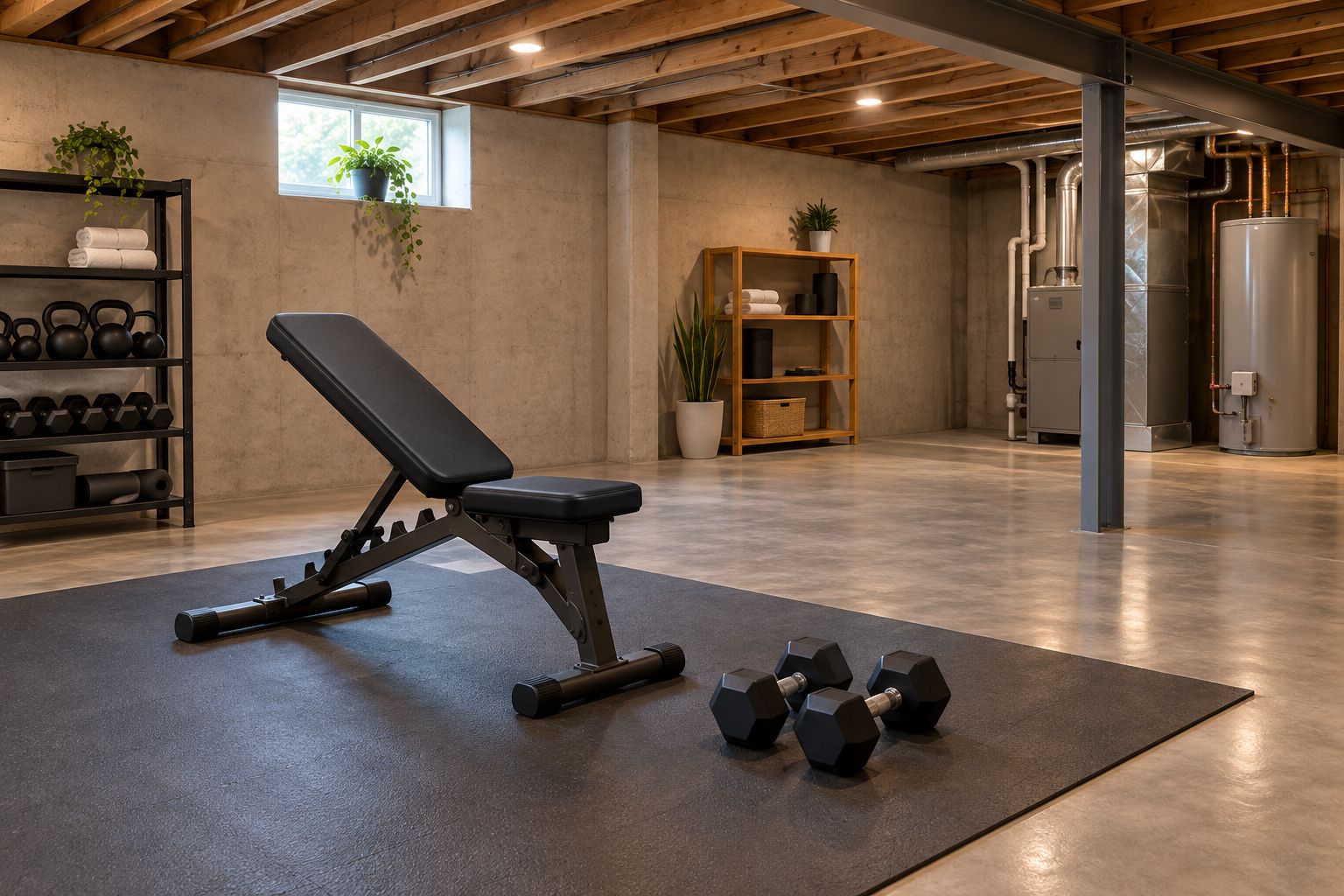
An adjustable weight bench supports seated, flat, and inclined exercise positions where the model permits them. Paired with dumbbells, it gives you alternatives to standing presses and unsupported movements.
The bench footprint is only part of the space calculation. You also need room to sit down, position the weights, extend your arms, and put the weights down under control. An incline position changes your head and hand clearance beneath the ceiling.
Adjustable weight bench pros:
- Supports different body positions for strength exercises.
- Pairs with dumbbells without requiring a full rack.
- Lets you perform selected exercises while seated or lying down.
- Can move between training positions when the design allows it.
Adjustable weight bench cons:
- Requires a separate resistance source for many exercises.
- Adjustment points require proper engagement before use.
- Its working area is larger than its listed footprint.
Best for: You already use dumbbells and want supported pressing or rowing positions.
Check the stated load limit against your body weight and the external load, following the manufacturer's definition. Test every intended bench position for clearance before committing to the room layout.
Verdict: Buy an adjustable weight bench to expand an existing dumbbell setup.
A useful basement arrangement leaves open floor beside the bench for handling weights. Do not place the bench where your normal lifting position puts your hands beneath a low beam.
3. Resistance bands: best basement equipment for minimal setups
Resistance bands provide tension for strength exercises without a large machine. Depending on the exercise and band design, you can use them independently or with an attachment specified for that purpose.
Their small storage footprint makes them useful when your basement serves several functions. The trade-off is that resistance changes as the band stretches, and an anchored exercise depends on the attachment—not just the band.
Resistance bands pros:
- Store without a permanent equipment footprint.
- Support exercises in standing, seated, and floor positions.
- Travel easily between workout spaces.
- Add exercise options to a dumbbell-based setup.
Resistance bands cons:
- Wear or damage requires inspection and replacement according to instructions.
- Anchored movements require a suitable, correctly installed attachment.
- Band resistance does not feel identical to a fixed external weight.
Best for: You want minimal-equipment training or a portable addition to your strength setup.
Do not attach bands to plumbing, exposed utility lines, or an unverified structural point. Inspect the band and attachment before use, and keep the movement path clear of sharp edges.
Verdict: Buy resistance bands for portable training; skip improvised anchors.
4. Stationary bike: best basement equipment for seated cardio
A stationary bike supports indoor cycling without requiring a treadmill belt or repeated walking foot strikes. It is the strongest cardio starting point on this list when you prefer seated exercise.
Measure the riding position, not merely the bike frame. Your head sits above the saddle, and standing pedaling requires additional clearance. Recumbent and upright designs also use floor space differently, so inspect the exact model rather than treating all bikes as interchangeable.
Stationary bike pros:
- Provides a dedicated indoor aerobic exercise option.
- Supports seated training without treadmill foot strikes.
- Keeps the exercise movement within a stationary machine location.
- Offers an alternative to overhead strength movements under low ceilings.
Stationary bike cons:
- Does not replace muscle-strengthening exercise.
- Saddle fit and riding position require adjustment.
- Moving parts and floor contact can still transmit sound or vibration.
Best for: You want seated cardio and have verified clearance in your intended riding positions.
For a 2026 cardio setup, prioritize fit and access to adjustments before entertainment features. Confirm that you can mount, dismount, and reach the controls without squeezing between the bike and a wall.
Verdict: Buy a stationary bike when seated cycling matches your workout preference.
5. Folding treadmill: best basement equipment for indoor walking
A folding treadmill provides indoor walking and, where its design permits, running. Its folding mechanism changes the storage arrangement; it does not remove the clearance needed while the machine operates.
Your standing height above the floor matters because the deck elevates you. Incline changes the operating geometry further. Delivery also deserves attention: confirm whether the equipment can pass through the stairs and turns using the manufacturer's permitted transport and assembly method.
Folding treadmill pros:
- Supports indoor walking in a consistent location.
- Offers a familiar movement for users who prefer walking to cycling.
- Changes its storage footprint when the folding design permits it.
- Provides an aerobic option independent of outdoor conditions.
Folding treadmill cons:
- Requires clearance above the deck and around the operating machine.
- Foot strikes and motor operation create noise.
- Folding and moving the machine require following its handling instructions.
Best for: You specifically want indoor walking and have checked delivery, ceiling clearance, and the required safety area.
Keep the manufacturer's rear and side clearances open. Do not position storage boxes in that area just because the treadmill is currently folded. Confirm electrical requirements before deciding where it belongs.
Verdict: Hold a treadmill purchase until its full operating layout passes the basement fit check.
6. Short power rack: best basement equipment for barbell training
A short power rack supports barbell exercises within a lower frame than taller rack configurations. Depending on the system, it accepts compatible bar supports, safety attachments, and other components specified by the manufacturer.
A shorter frame solves only the frame-height problem. Pull-ups, overhead presses, plate loading, and moving a loaded bar introduce separate clearance requirements. A rack that fits in the room is not automatically suitable for every lift.
Short power rack pros:
- Creates a dedicated station for barbell training.
- Supports compatible safety attachments set for the exercise.
- Offers a rack option where a taller frame does not fit.
- Keeps barbell training organized around one installation area.
Short power rack cons:
- Requires space for the bar and plate handling beyond the frame.
- Lower height restricts some exercises and attachment positions.
- Anchoring and flooring requirements depend on the exact rack.
Best for: You train with a barbell and can satisfy the rack's installation and exercise-clearance requirements.
Do not infer anchoring requirements from steel thickness or appearance. Homegymassembly provides fitness equipment assembly and installation, including Rogue power racks; confirm the exact model and proposed basement location when discussing the work.
Verdict: Buy a short power rack only after checking the full lifting area and installation instructions.
How the equipment is ranked
This 2026 ranking prioritizes basement fit, training usefulness, delivery access, and installation requirements. Adjustable dumbbells lead because they support varied strength exercises without a fixed frame; the bench follows because it expands that setup.
The lower-ranked options are not worse at their intended jobs. They answer narrower needs: seated cycling, indoor walking, and barbell training. Choose by workout first, then eliminate equipment that fails the room check.
Which basement gym equipment should you choose?
Choose adjustable dumbbells as the default strength starting point, then add a bench if your exercises require one. Choose resistance bands when portability and minimal storage matter more than replicating free-weight resistance.
For cardio, choose a stationary bike if you prefer cycling. Choose a treadmill only if walking is the activity you want and its operating clearances fit. A short power rack belongs in a barbell plan, not in every basement gym.
Before arranging installation, prepare these details:
- Equipment identity: Exact manufacturer, model, and assembly instructions.
- Access route: Doorways, stair turns, delivery location, and obstacles.
- Training layout: Intended exercises, equipment positions, and operating clearances.
- Site conditions: Floor condition, dampness, outlets, and utility access.
Homegymassembly serves homeowners in Greater Philadelphia and New Jersey with licensed and insured professional fitness equipment assembly and installation. Share the model and basement conditions so the installation discussion centers on the actual equipment.
Arrange your basement equipment installation
Discuss your equipment and basement access with a licensed and insured assembly service.
FAQ
What's the best home gym equipment for a basement in 2026?
Adjustable dumbbells are the default starting point for flexible basement strength training. Add a bench for supported lifts, and choose a bike or treadmill according to your preferred cardio activity and verified room clearance.
What gym equipment works with a low basement ceiling?
Dumbbells, a bench, resistance bands, and a stationary bike can support exercises that do not require overhead movement. Check your body position and equipment movement beneath the lowest beam or obstruction; the equipment's listed height alone is insufficient.
Is a stationary bike better than a treadmill for a basement?
A stationary bike is the better choice for seated cycling; a treadmill is the better choice for indoor walking. Compare riding height with treadmill deck clearance, and check each machine's delivery route and operating space.
Can I put a power rack in my basement?
A power rack belongs in a basement only when the frame, barbell, exercises, and installation requirements fit the space. Check plate-loading access, safety attachment positions, and the manufacturer's anchoring instructions before purchase.
Does folding a treadmill solve a basement space problem?
Folding changes storage space, not the treadmill's operating requirements. You still need the specified safety area and enough ceiling clearance while standing on the deck at the intended incline.
Who installs home gym equipment in Greater Philadelphia and New Jersey?
Homegymassembly provides licensed and insured professional home fitness equipment assembly and installation for homeowners in Greater Philadelphia and New Jersey. Its stated equipment scope includes treadmills, Rogue power racks, and Pelotons.
One last thing
Measure the movement, not just the machine. Before purchasing equipment for your 2026 basement gym, rehearse the intended exercise positions without weight and check the manufacturer's complete clearance instructions.
A bench can fit while an incline press does not. A rack can fit while a pull-up does not. Catch those conflicts before equipment reaches the stairs.


