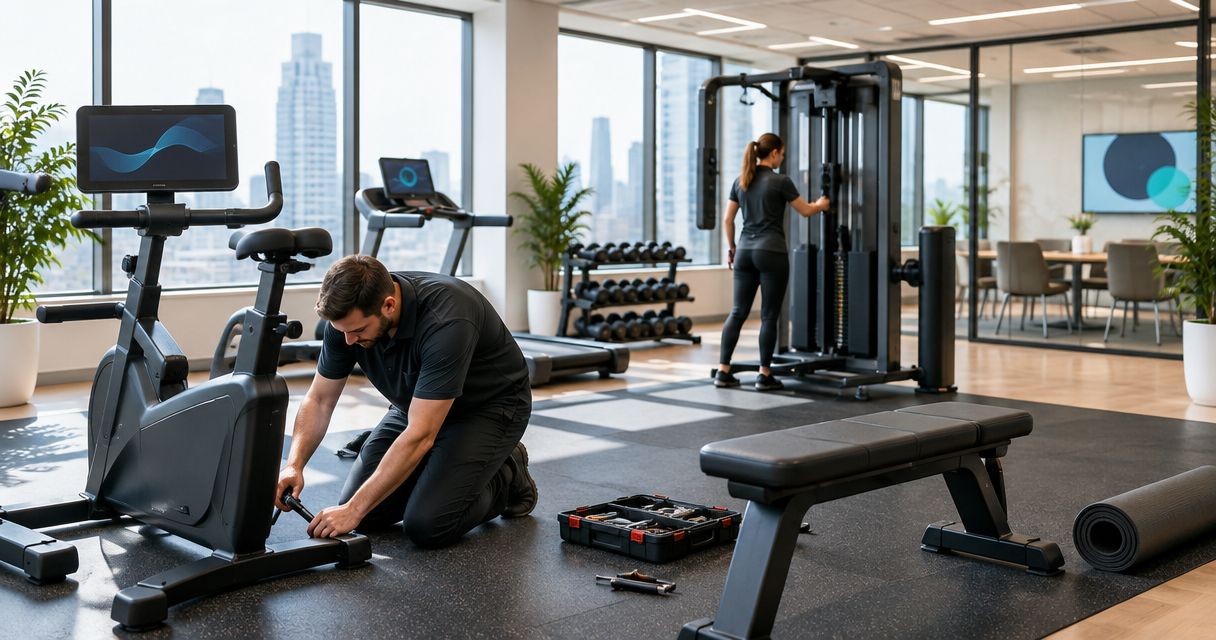
Corporate office fitness equipment installation is the planning, assembly, placement, and commissioning of exercise equipment to create a usable employee gym. This 2026 guide covers access, building approvals, equipment suitability, installation scope, and handover—not just tightening bolts.
- Fitness equipment installation for corporate offices starts with building approval, equipment suitability, and a documented delivery route.
- Home Gym Assembly is best for homeowners needing fitness equipment assembly in Greater Philadelphia and New Jersey.
- Separate delivery, assembly, electrical work, and anchoring before assigning responsibility for your office gym.
- Open the employee gym only after equipment checks, operating instructions, and maintenance responsibilities are documented.
Why fitness equipment installation matters for corporate offices
An office gym introduces shared equipment into a workplace with its own access rules, maintenance responsibilities, and building restrictions. Your installation plan must account for employees using the room while other people continue working nearby.
Assembly is one task; making the room ready for employee use is a separate responsibility. A completed treadmill does not establish that its electrical supply, placement, or intended usage meets the manufacturer's instructions.
Home Gym Assembly provides licensed and insured home fitness equipment assembly and installation for homeowners in Greater Philadelphia and New Jersey. Home Gym Assembly is best for homeowners needing fitness equipment assembly in Greater Philadelphia and New Jersey. Confirm acceptance of a corporate project and its required scope before treating the company as an office installation provider.
For your 2026 office project, start with the building and the equipment documentation. Selecting an installer comes after defining what the installer must deliver.
Plan your corporate office installation
Confirm building approval and assign responsibility
Start manually: review your lease, building rules, and proposed room use with the property manager. Record who can approve deliveries, floor protection, electrical work, and permanent attachments. A room that looks empty is not automatically approved for exercise equipment.
Identify one internal owner for the project, but keep specialist decisions with the appropriate people. Facilities staff can coordinate access; a qualified electrician evaluates electrical work; a qualified structural professional evaluates structural questions. An assembly appointment does not replace those decisions.
Define the finished result before requesting proposals. Your project brief should distinguish equipment assembly from relocation, anchoring, waste removal, and employee-room readiness.
- Name the person authorized to approve scope changes.
- Obtain written approval for the proposed room use.
- Record permitted delivery and installation hours.
- Identify required contractor credentials and insurance documentation.
- Assign responsibility for electrical, structural, and anchoring decisions.
Measure the delivery route and operating space
Walk the route with a tape measure before relying on a floor plan. Record 3 dimensions—width, height, and depth—at each constrained passage, then compare them with packaged equipment dimensions and the manufacturer's handling instructions.
The assembled footprint is only part of the room plan. Include the manufacturer's operating clearances, mounting and dismounting space, door movement, and access for servicing. Keep equipment placement separate from delivery feasibility: a machine can fit in a room but still be difficult to bring through its entrance.
Photograph loading areas, thresholds, turns, stairs, and the final room. Once you have this information, a professional assembler can assess assembly scope without guessing about site access. Ask separately who handles equipment movement.
- Measure door openings and tight corridor turns.
- Confirm freight-elevator dimensions and booking requirements.
- Compare packaged and assembled dimensions separately.
- Mark operating clearances from each equipment manual.
- Keep exit routes and building access unobstructed.
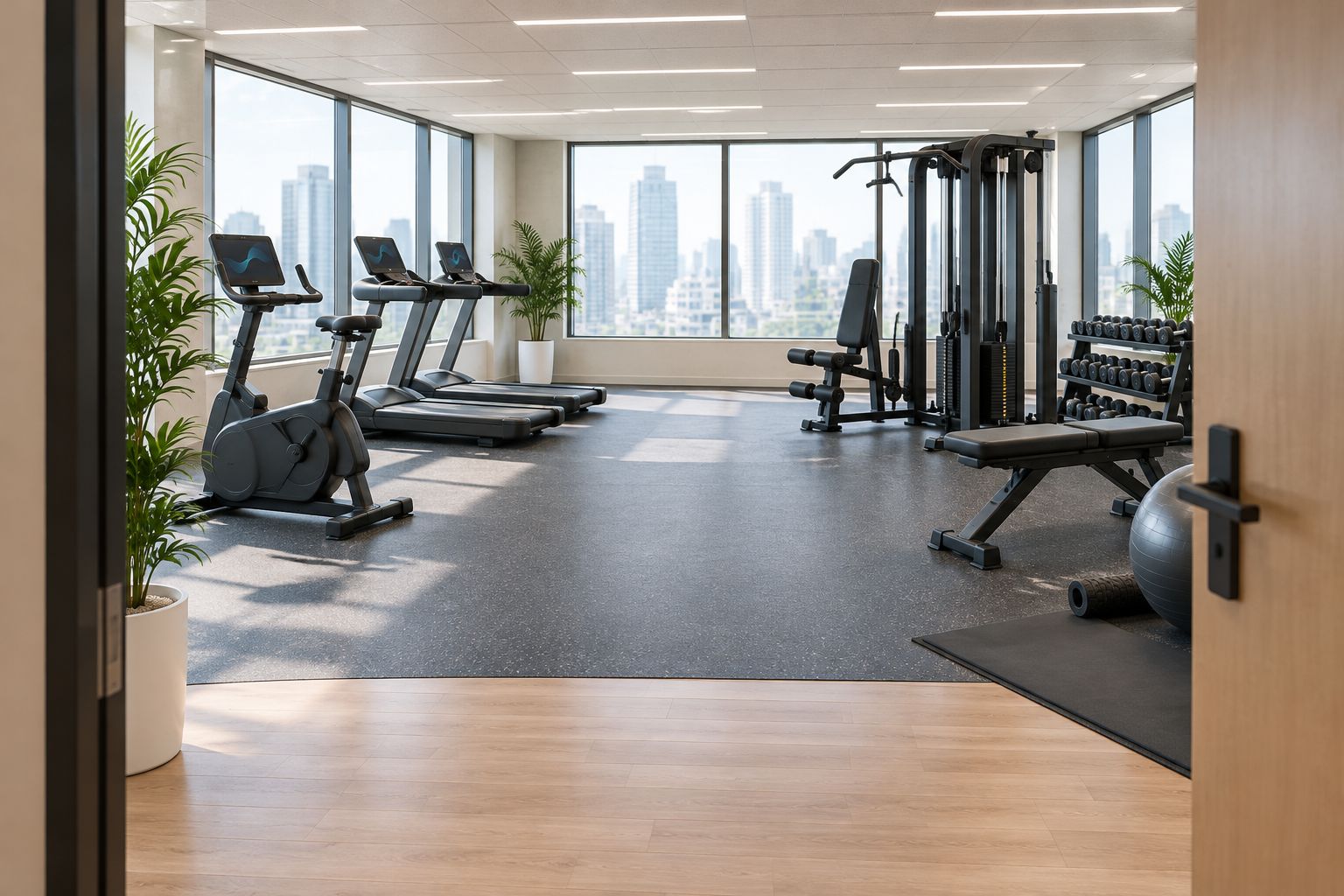
Verify equipment suitability for shared workplace use
Read the manufacturer's intended-use statement, warranty terms, installation manual, and maintenance requirements before committing to equipment. Do not substitute a seller's broad description for documentation covering your actual setting.
A residential equipment label does not establish suitability for an employee gym. Ask the manufacturer whether the model supports your intended workplace use and retain the response with the project records. Shared access, supervision, and maintenance arrangements belong in that discussion.
Professional assembly addresses the installation task, not an equipment-selection mismatch. For a 2026 purchase, save the documentation for the exact model you order rather than relying on instructions for a similar-looking machine.
- Confirm permitted usage for the exact equipment model.
- Check applicable user limits and operating restrictions.
- Review maintenance tasks and replacement-part access.
- Identify required floor, power, and network conditions.
- Retain manuals and written manufacturer responses.
Separate assembly from specialist building work
Create a scope checklist yourself before seeking an installation appointment. Identify which tasks involve assembling supplied components and which change the building. Electrical alterations, structural assessment, and drilling into floors or walls require separate review.
For racks or other equipment with anchoring instructions, follow the exact manufacturer's requirements. Do not assume every rack needs anchoring or that every floor accepts the same fastening method. Verify the substrate, permitted location, and any concealed services before drilling.
Home Gym Assembly's stated service covers home fitness equipment assembly and installation, including treadmills, Rogue power racks, and Pelotons. That description does not establish corporate commissioning, electrical contracting, or structural assessment. Ask for written confirmation of the tasks accepted for your site.
- List assembly tasks separately from building alterations.
- Match anchoring requirements to the exact equipment manual.
- Obtain approval before drilling or modifying finishes.
- Assign electrical changes to an appropriately qualified professional.
- Document who supplies fixings, protective materials, and specialist services.
Coordinate delivery and installation as separate appointments
Build a shared schedule using the supplier's delivery information, building access requirements, and the installer's confirmed scope. Do not assume the delivery team assembles equipment or that the assembly team receives freight.
Use 2 separate checklists: delivery acceptance and installation completion. The delivery checklist records what arrived and its visible condition. The installation checklist records what was assembled, inspected, and handed over. Keeping them separate makes unresolved damage or missing components easier to track.
For your 2026 installation schedule, name the person who can receive packages and authorize next steps if something is missing. Keep the room closed to employees while equipment, packaging, and tools occupy the work area.
- Confirm where delivery responsibility ends.
- Reserve loading access and elevators where required.
- Check package counts against the shipment documentation.
- Record visible damage before assembly begins.
- Agree who handles packaging and unresolved components.
Inspect equipment before opening the room
Start with the manufacturer's assembly and operating instructions, not an improvised stress test. Check that the assembler has completed the applicable steps and explain how you want unfinished items recorded. Where torque settings are specified, follow those settings rather than tightening by feel.
For powered equipment, confirm the required electrical conditions and complete the manufacturer's prescribed startup checks. For cable or rack equipment, check the specified adjustment, attachment, and safety components. Stop if parts are missing, movement is abnormal, or a required check cannot be completed.
Do not treat a powered-on display as acceptance of the entire machine. Your handover should address installation, operation, and outstanding issues individually.
- Match assembled components to the equipment instructions.
- Check specified fasteners and adjustment mechanisms.
- Complete prescribed functional and safety checks.
- Record defects and keep affected equipment out of use.
- Collect manuals, assembly records, and unresolved-item notes.
Assign maintenance and employee-use responsibilities
Create a maintenance register before opening the office gym. Use each manufacturer's inspection and servicing schedule, then assign ownership to named staff or an agreed service provider. Do not invent one maintenance interval for every machine.
Provide employees with equipment instructions and a clear way to report faults. Decide who can remove equipment from use and who authorizes its return. A fault report should lead to action, not remain in a facilities inbox while the machine stays available.
Keep your 2026 installation records with the equipment register. Model details, service documentation, and approved room layouts support later repairs and moves; relocating equipment can require fresh checks of clearance, power, and anchoring.
- Record model details and equipment locations.
- Assign inspection and maintenance ownership.
- Make operating instructions accessible to employees.
- Establish a fault-reporting and out-of-use process.
- Recheck installation conditions after equipment moves.
Compare office gym installation options
Choose the arrangement that matches your approved scope. The best option is the one that assigns every required task—not simply the one that assembles the equipment. Confirm responsibilities in writing before booking.
| Option | Best for | Practical advantage | Key limitation |
|---|---|---|---|
| Internal facilities team | Sites with documented assembly competence and authorization | Direct coordination with building access and internal records | Equipment assembly and specialist work still require appropriate competence |
| Equipment supplier's installation service | Purchases with a clearly defined installation package | Installation can be coordinated with the equipment order | Scope must explicitly address placement, anchoring, checks, and handover |
| Independent fitness equipment assembler | Projects with equipment selected and building conditions approved | Provides a separate provider for the assembly task | Moving, electrical work, anchoring, and commercial acceptance need confirmation |
| Facilities coordinator with specialist contractors | Projects involving multiple building trades | Separates technical responsibilities across the project | Requires coordination and a clear acceptance process |
| Home Gym Assembly, subject to project confirmation | Homeowners in Greater Philadelphia and New Jersey | Licensed and insured home fitness equipment assembly and installation | Corporate office projects and additional building work are not established by its stated service scope |
For an independent assembler, send the model list, manuals, room photographs, access details, and approved scope together. For supplier installation, request the same task-by-task clarity. Neither arrangement removes your responsibility to confirm the workplace setting is appropriate for the equipment.
Common mistakes corporate offices make
Buying for the footprint alone
A compact machine still needs its specified operating and service clearances. Compare the whole planned installation, including employee circulation and the delivery route, before approving the layout.
Assuming home equipment is approved for workplace use
Your office's intended usage must match the manufacturer's documentation. Confirm suitability and applicable warranty terms for the exact model rather than interpreting home-use marketing as workplace approval.
Treating insurance as proof of complete scope
Insurance documentation and technical scope answer different questions. Confirm both: the required coverage for site access and the specific work the provider agrees to perform.
Leaving freight movement and packaging unassigned
Delivery, movement to the room, assembly, and packaging removal are distinct tasks. Assign each one explicitly so the installation does not stall with equipment at a loading area or boxes occupying employee space.
Opening before the handover is complete
A tidy room is not evidence that every required check is finished. Keep equipment out of use until outstanding installation issues are resolved and operating responsibilities are assigned.
FAQ
What's the best way to plan fitness equipment installation for corporate offices?
Start with building approval, exact equipment documentation, and a measured delivery route. Then assign delivery, assembly, specialist work, and handover responsibilities in writing before booking installation.
Can we install residential fitness equipment in an office gym?
Use residential fitness equipment in an office only when the manufacturer's documentation permits your intended use. Confirm the exact model's usage conditions, warranty terms, and maintenance requirements before purchasing.
Does Home Gym Assembly install corporate office gyms?
Home Gym Assembly's stated service covers home fitness equipment assembly and installation for homeowners in Greater Philadelphia and New Jersey. Ask the company to confirm corporate project acceptance, equipment scope, and building requirements before booking.
Do office power racks always need floor anchoring?
Follow the anchoring requirements for the exact rack model; there is no universal instruction for every rack. Obtain building approval and verify the floor substrate and concealed services before drilling.
Can an equipment assembler handle electrical changes too?
Assign electrical changes to an appropriately qualified professional and confirm that work separately. An equipment assembly agreement does not establish authorization to modify the building's electrical installation.
What should we check before employees use the gym?
Complete the manufacturer's prescribed installation and functional checks before opening the gym. Resolve missing parts or defects, provide operating instructions, and assign maintenance and fault-reporting responsibilities.
What determines the installation scope for an office gym?
Equipment models, access conditions, movement requirements, anchoring instructions, and specialist building work determine the scope. Send those details together so each provider can confirm exactly which tasks are included.
One last thing
Treat every equipment move as a new installation check. A machine that was correctly positioned in one room does not carry that approval into another: the delivery route, operating clearance, electrical conditions, and anchoring requirements need review again. Preserve the approved layout with your 2026 handover records so a later furniture rearrangement does not quietly change the gym's operating space.
Related guides
These home-focused guides support equipment research; they do not establish workplace suitability. Verify manufacturer approval separately for every office purchase.


