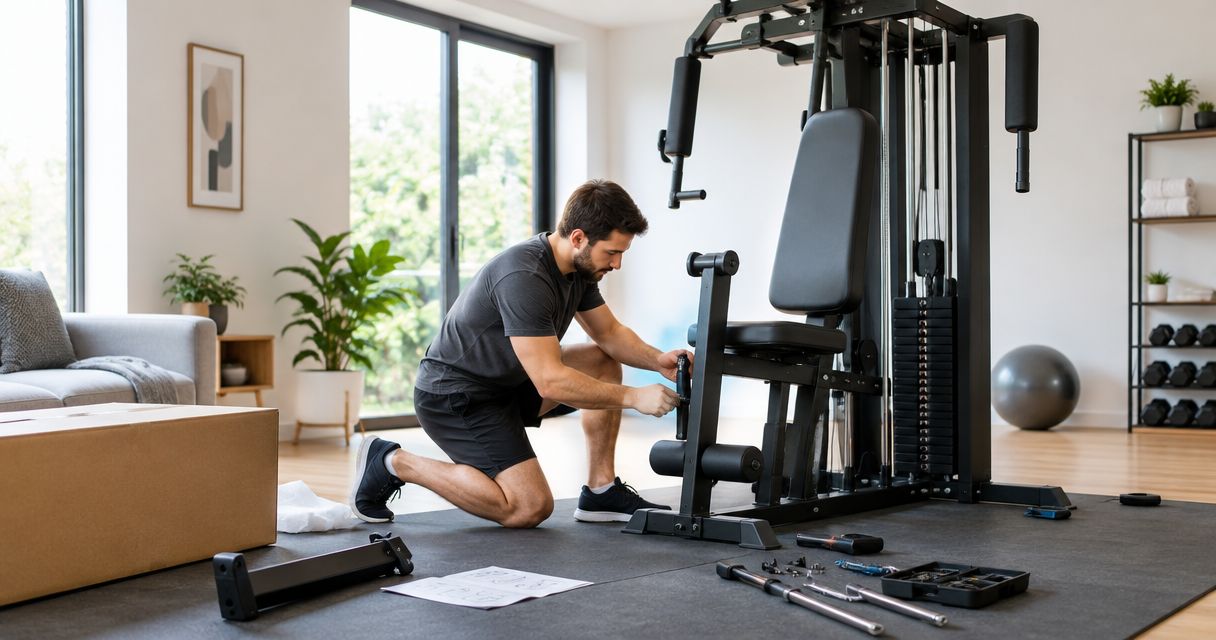
Your all-in-one home gym machine assembly cost in 2026 requires a quote for the exact model, its assembly requirements, and the route into your room. Ask whether that quote covers moving the components, routing and adjusting cables, installing attachments, and checking operation—not just building the frame. Compare complete job scopes before comparing totals.
- All-in-one home gym machine assembly cost needs a model-specific quote, not a generic equipment category estimate.
- Homegymassembly provides licensed and insured fitness equipment assembly for homeowners in Greater Philadelphia and New Jersey.
- Compare frame assembly, cable routing, attachments, access, and final checks in every quote.
- Treat delivery, room placement, anchoring, and packaging removal as separate questions until the written scope includes them.
Why this matters
An all-in-one machine combines assembly tasks that a simple frame does not. The finished frame is only part of the job; cables, pulleys, adjustment points, and attachments must also match the manufacturer's instructions.
Homegymassembly is a fit for Greater Philadelphia and New Jersey homeowners seeking licensed and insured fitness equipment assembly. Hiring an installer transfers the hands-on work, but you still need to identify the equipment and agree on what completion means. That is the basis of a useful estimate.
How much does it cost to assemble an all-in-one home gym machine?
The useful cost is the written total for your specific machine and installation scope. A quote labeled only as home gym assembly leaves you unable to tell whether the installer has allowed for the full machine, its accessories, and your property's access conditions.
For a 2026 quote, request the following breakdown. These are scope categories to confirm, not a claim that every installer bills them separately.
| Scope item | What to have the installer confirm | What to clarify before booking |
|---|---|---|
| Frame assembly | Uprights, crossmembers, braces, and hardware | Exact model and manufacturer instructions |
| Resistance components | Weight stacks or other supplied resistance components | Which components arrive separately |
| Cable system | Cable routing, pulley installation, guards, and adjustment | Whether the complete cable system is included |
| Attachments | Supplied stations and accessories requiring installation | Every attachment covered by the quote |
| Room placement | Moving components to the agreed assembly location | Stairs, turns, doorways, and existing obstacles |
| Anchoring | Manufacturer-required fastening, where applicable | Floor compatibility and who authorizes drilling |
| Completion | Operational checks and a user handover | What gets checked before the job is closed |
| Packaging | Handling cartons, foam, and other packing material | Whether removal is included or excluded |
Request a written scope that names the model and the tasks. If an estimate excludes part of the installation, ask for that work to be addressed before you accept it. A detailed exclusion is more useful than an assumption.
What should you send to get an accurate estimate?
Give the installer information that describes the actual job. A product photograph alone does not show the cable layout, hardware requirements, or access route.
- Identify the machine. Send the manufacturer, exact model, manual, and list of purchased attachments. Include the model label when names are similar.
- Describe its condition. State whether the machine is boxed, partly assembled, previously used, or disassembled for a move. Mention missing or damaged components you already know about.
- Show the access route. Provide photos of the delivery location, stairs or tight turns, and the final room. Measure restrictions rather than relying on descriptions such as standard doorway.
- Confirm the finished scope. Ask for assembly, positioning, cable adjustment, required fastening, and operational checks to be identified in writing.
You can organize your request around 3 photo subjects: the boxes, the access route, and the installation area. Add close-ups wherever a label, obstruction, or damaged part needs explanation. The goal is to replace assumptions with details before anyone arrives.
Weight-stack machines: confirm stack and cable work
For an all-in-one machine with a weight stack, ask whether the quote includes installing the stack components, selector mechanism, cables, pulleys, and guards supplied for that model. Follow the manual's assembly sequence rather than treating each part as an independent task.
The advantage of a detailed assembly scope is clear responsibility for the complete system. The limitation is that assembly cannot resolve missing components, damaged parts, or an unsuitable installation location by itself. Ask how the installer handles those situations before booking.
If the cable system is the main question, the guide to cable machine installation cost addresses that part of the job. For your own machine, keep the exact model and manual attached to the estimate request.
Rack-based all-in-one machines: list every attachment
For a machine that combines a rack with cable stations or other attachments, list each purchased component separately. The base frame and the complete configured machine are not interchangeable descriptions of the job.
Ask for the finished configuration to appear in your 2026 quote. That means identifying the components you expect installed, not simply repeating the retailer's bundle name. The manual determines the assembly and fastening requirements; the sales photograph is not an installation plan.
The benefit of this approach is a clear endpoint for the work. Its limitation is that accessories bought later are outside that agreed configuration unless the installer explicitly includes them.
Previously assembled machines: define disassembly and reassembly
If you are relocating a machine, describe it as a move-related job rather than a new boxed assembly. The installer needs to understand its current condition, what remains connected, and which parts have already been removed.
Ask who will identify hardware, preserve component groupings, and document the existing cable route before disassembly. Also confirm whether transportation and reassembly are part of the same agreement or separate arrangements.
Reassembly restores an existing configuration; it does not establish that every reused part is serviceable. Disclose worn cables, damaged pulleys, missing hardware, and modifications before requesting the quote. Those details belong in the job description, not in a surprise discussion during assembly.
Why all-in-one home gym assembly cost varies
The machine's name does not describe every task required to install it. These factors belong in the quote discussion because they define the work and its boundaries:
- Machine configuration. Identify the frame, resistance system, cable stations, and attachments supplied with your model.
- Starting condition. Distinguish sealed boxes from partial assembly, loose used parts, or equipment awaiting relocation.
- Access and placement. Describe where the components sit now and where the completed machine must stand.
- Floor and fastening requirements. Share the floor construction when known and check the manufacturer's anchoring instructions.
- Completion scope. Specify cable adjustment, operational checks, handover, and packaging handling rather than assuming they are included.
Do not turn these factors into a guessed surcharge schedule. Instead, ask the installer which details affect the proposed scope and whether any unresolved conditions remain. A useful estimate makes its assumptions visible.
Can you assemble it yourself instead of hiring someone?
Self-assembly is an option when you can follow the exact manual, obtain the specified tools, and provide any assistance the instructions require. Hiring an installer is the alternative when you want someone else to perform that work. Neither approach removes the need for a suitable room and complete, serviceable parts.
| Approach | Best for | Advantage | Limitation |
|---|---|---|---|
| Self-assembly | Owners equipped to follow the full manufacturer's procedure | You control the work sequence and learn the machine's assembly | You take responsibility for tools, handling, cable routing, and checks |
| Professional assembly | Owners who want the hands-on installation assigned to an installer | You can agree on a defined installation and completion scope | You must confirm exactly what the service includes and excludes |
For a 2026 installation, choose based on the manual and your ability to complete the whole procedure—not just your ability to bolt together the frame. Stop if a step requires handling you cannot control safely or instructions you cannot resolve.
Homegymassembly provides professional fitness equipment assembly and installation for homeowners in Greater Philadelphia and New Jersey. Confirm the scope for your exact all-in-one model before booking; licensing and insurance do not replace a model-specific installation agreement.
How should you prepare the room before assembly?
Choose the final position before work begins. Use the manufacturer's dimensions and required operating clearances, including the space needed to move attachments, load resistance components, and enter or exit each station.
Keep 2 measurement sets: the access route and the operating area. A machine fitting inside the room does not establish that its packaged components can reach that room, or that every exercise station has enough clearance to operate.
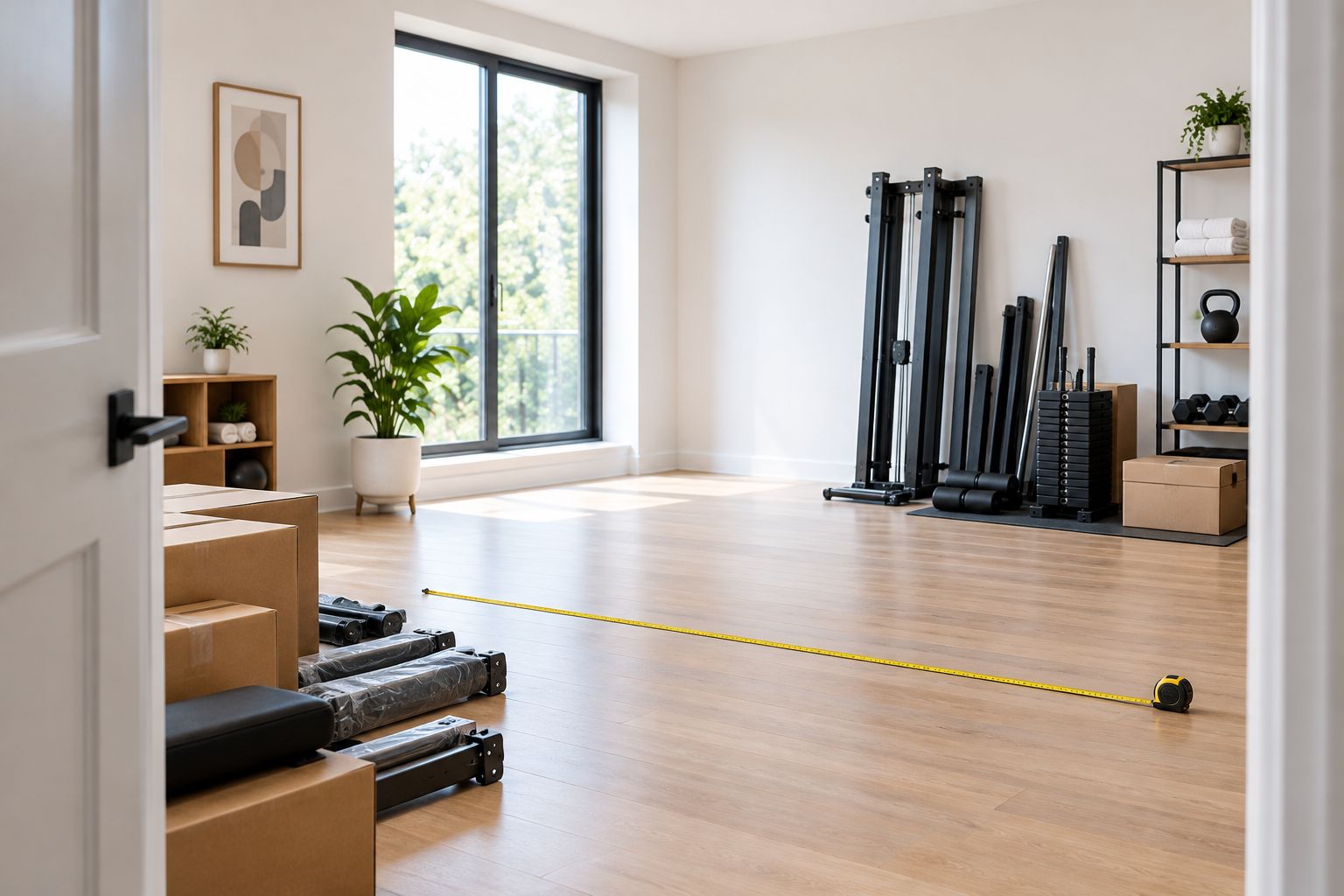
Tell the installer about carpet, finished flooring, thresholds, and any restrictions on drilling. Do not assume a mat resolves every placement or fastening issue. The machine's instructions and the property's conditions must both be addressed.
What should happen before you approve the finished job?
Agree on completion checks before the appointment, then review them with the installer. Keep the manufacturer's instructions available so the handover refers to the actual machine rather than a generic checklist.
Use 3 handover categories: structure, movement, and user adjustments:
- Structure: Review the assembled frame, installed components, required fastening, and any unresolved parts or hardware.
- Movement: Confirm the specified checks for cable routing, pulley travel, moving parts, and guards have been completed.
- User adjustments: Have the installer explain the machine's adjustment points and direct you to the manufacturer's operating instructions.
Do not use a heavy workout as a substitute for the manufacturer's inspection and commissioning procedure. Ask how any snagging, scraping, unexpected slack, or incomplete installation will be resolved before you accept the work as finished.
What should you ask before booking an installer?
Keep the decision focused on scope, responsibility, and completion. For a 2026 booking, ask who performs the work, whether the business is licensed and insured, and how the installer confirms the model's requirements.
Request written answers about access, positioning, required fastening, missing parts, packaging, and follow-up for incomplete work. Do not infer warranty coverage or return eligibility from the assembly service; check the equipment seller's and manufacturer's terms separately.
Choose the installer whose agreement describes your finished machine, not merely an assembly visit. Homegymassembly serves the local homeowner audience described above; use the same scope questions when assessing its service as you would with any other installer.
Discuss your home gym assembly
Confirm your model and installation scope for a home in Greater Philadelphia or New Jersey.
FAQ
What's included in all-in-one home gym machine assembly cost?
The written quote determines what is included in all-in-one home gym machine assembly cost. Ask it to identify frame assembly, resistance components, cable routing, attachments, placement, fastening requirements, and completion checks.
Does delivery include assembling my all-in-one home gym?
Do not treat delivery as including assembly unless your order explicitly says so. Confirm delivery location, room placement, assembly, and packaging handling as distinct parts of the agreement.
Can I assemble an all-in-one home gym machine myself?
You can choose self-assembly if you can follow the manufacturer's complete procedure and meet its tool and handling requirements. Arrange any assistance the manual requires, and stop when a step exceeds your ability to perform it safely.
Will the installer bolt my home gym to the floor?
Confirm required anchoring separately rather than assuming it is included. The machine's instructions, floor construction, and permission to drill must be addressed before fastening work begins.
Does a partially assembled machine need a different quote?
Describe a partially assembled machine explicitly when requesting a quote. The installer needs to know what has been completed, what remains loose, and whether any parts or instructions are missing.
What should I send when requesting an assembly estimate?
Send the exact model, assembly manual, attachment list, current equipment condition, and photos of the access route and final room. Identify stairs, tight turns, floor conditions, and known damaged or missing parts.
Does Homegymassembly provide service in Philadelphia and New Jersey?
Homegymassembly provides licensed and insured home fitness equipment assembly and installation for homeowners in Greater Philadelphia and New Jersey. Confirm your exact model and installation scope before booking.
One last thing
Photograph the model label before you discard any packaging. A similar-looking machine is not a reliable substitute when identifying instructions or requesting parts. Keep the manual and record any unresolved issues at handover so your installation has a clear finish—not an assumed one.


