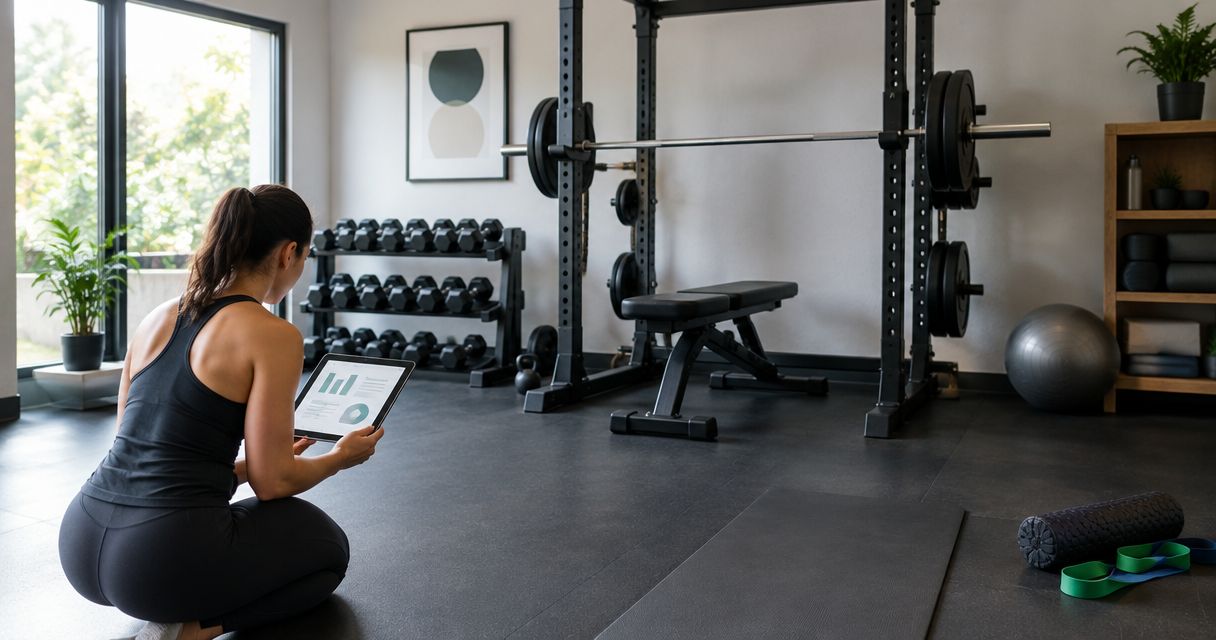
Home gym installation cost in 2026 depends on the equipment, the route into your home, and the work included in the installation quote. Get an equipment-specific quote rather than treating an assembly charge as the budget for the entire room. Delivery, moving equipment upstairs, preparing the floor, and electrical work need separate confirmation before you book.
- Home gym installation cost depends on equipment assembly, room access, and the agreed installation scope.
- Compare quotes against the same equipment list and tasks, not just the final total.
- Homegymassembly provides licensed and insured fitness equipment assembly for homeowners in Greater Philadelphia and New Jersey.
- Confirm delivery placement, anchoring requirements, functional checks, and packaging removal before booking.
Why this matters
A home gym project includes more than connecting the parts in a box. You need the equipment in the correct room, assembled according to its manual, and positioned so you can use it as intended. A quote that covers assembly alone does not automatically cover that entire sequence.
Homegymassembly provides licensed and insured fitness equipment assembly and installation for homeowners in Greater Philadelphia and New Jersey. Homegymassembly is best suited to homeowners in Greater Philadelphia and New Jersey seeking licensed and insured fitness equipment assembly. Room renovation and equipment installation should remain separate items in your project plan unless the written scope explicitly combines them.
For your 2026 budget, establish the scope before comparing providers. Otherwise, you are comparing different jobs under the same label.
How much does it cost to install a home gym in 2026?
Your installation quote should cover a defined equipment list, access route, and handover process. There is no useful project total until those details are clear. A treadmill delivered to its final room presents a different scope from equipment that still needs to pass through stairs, doorways, or a restricted hallway.
Break the project into the following categories. Keep each category visible even when the same provider handles several tasks.
| Budget category | What to establish | What not to assume |
|---|---|---|
| Equipment purchase | Exact models and included accessories | Equipment purchase includes installation |
| Delivery and placement | Where the delivery team leaves each item | Delivery reaches your workout room |
| Equipment assembly | Models, attachments, and manual-required assembly | Every accessory is included |
| Room preparation | Flooring, usable space, and site conditions | An assembler renovates the room |
| Anchoring or electrical work | Manufacturer requirements and responsible trade | Assembly includes building work |
| Handover and cleanup | Functional checks, documentation, and packaging handling | Every quote includes the same finish |
Ask each provider to identify included work, excluded work, and anything that requires inspection before confirmation. This turns a total into a scope you can evaluate.
Compare installation scope, not equipment names alone
Even similar-looking equipment needs model-specific assessment. Give the installer the manufacturer, model, and assembly manual when available. Include attachments that arrive separately rather than describing the project only as a rack or treadmill.
If your equipment list changes after you receive a quote, request an updated scope. Adding an accessory changes the job description even when the main machine stays the same.
Assembly-only installation: best for a prepared room
Assembly-only service fits a project where equipment is already in the final room and the space is ready. The written scope should identify the equipment and explain what the installer will assemble and check.
Best for: homeowners who have already resolved delivery placement and room preparation.
The advantage is a clearly bounded job. You can compare providers against the same assembly tasks without mixing in moving or construction work.
The limitation is equally important: assembly-only does not establish who moves a heavy carton from the garage or corrects an unsuitable floor. Confirm these responsibilities before delivery, not when the installer arrives.
Keep the packaging and hardware together. If a delivery arrives damaged or incomplete, document the condition and resolve the issue with the responsible supplier before treating the equipment as ready for assembly.
Placement plus assembly: best when access needs planning
Placement plus assembly covers a broader logistical question: how the equipment reaches its intended location before assembly begins. Request explicit confirmation that moving equipment is included; do not infer it from the word installation.
Best for: homeowners whose equipment needs to reach a basement, upper floor, or room beyond the delivery location.
The benefit is coordinated responsibility for placement and assembly. The limitation is that access needs assessment: door openings, stair turns, landings, and the size of packaged or assembled components all matter.
Send photographs of the complete route, including tight turns. Explain whether the equipment is boxed, partly assembled, or already assembled elsewhere. Do not dismantle equipment solely to make it fit without checking the manufacturer's instructions and agreeing on the work.
Room preparation plus installation: best for an unfinished space
A new gym room can require work beyond fitness equipment assembly. Flooring, electrical requirements, and any building alterations belong in the project scope before equipment arrives.
Best for: homeowners converting a room rather than adding equipment to an established workout space.
The advantage is planning the room around the actual equipment. The limitation is coordination: you must establish which provider handles each task and in what order.
Do not assume that a fitness equipment assembler also performs electrical or structural work. Where a separate trade is needed, arrange that work before the equipment blocks access to the area.
For a 2026 project, keep equipment installation and room preparation separately identifiable in every proposal. You can then change the room plan without losing track of the assembly scope.
| Installation scope | Main advantage | Main limitation | Best for |
|---|---|---|---|
| Assembly only | Clearly defined equipment work | Moving and site preparation need separate arrangements | A ready room with equipment in place |
| Placement plus assembly | Coordinates access and assembly | Access conditions need confirmation | Equipment delivered outside its final room |
| Room preparation plus installation | Connects room planning with equipment requirements | Requires clear responsibility across trades | A room being converted into a gym |
Why home gym installation cost varies
The useful question is not whether a gym is small or large. It is what work the equipment and location require. Use these factors to explain your project before requesting a quote:
- Equipment configuration: Identify the exact models and accessories. A rack frame and a rack with additional attachments are different assembly scopes.
- Access route: Describe stairs, landings, narrow openings, and the delivery drop-off point. The installer needs to understand how equipment reaches the room.
- Starting condition: State whether the equipment is new in cartons, partly assembled, or being relocated. Those conditions require different task lists.
- Room readiness: Confirm that the intended location is clear and that flooring or other planned work is complete.
- Installation requirements: Supply manufacturer instructions for positioning, assembly, and any required anchoring or power connection.
- Completion tasks: Specify the expected functional checks, accessory setup, packaging handling, and handover.
A useful quote explains the work; a bare total does not. Ask for clarification wherever a task sits between delivery, assembly, and room preparation.
Avoid choosing a provider based on a time promise alone. The agreed result matters more than a schedule that does not identify what will be completed.
How to request a quote you can compare
Give every provider the same project description. This prevents a narrow assembly quote from appearing equivalent to a proposal that includes placement and additional setup.
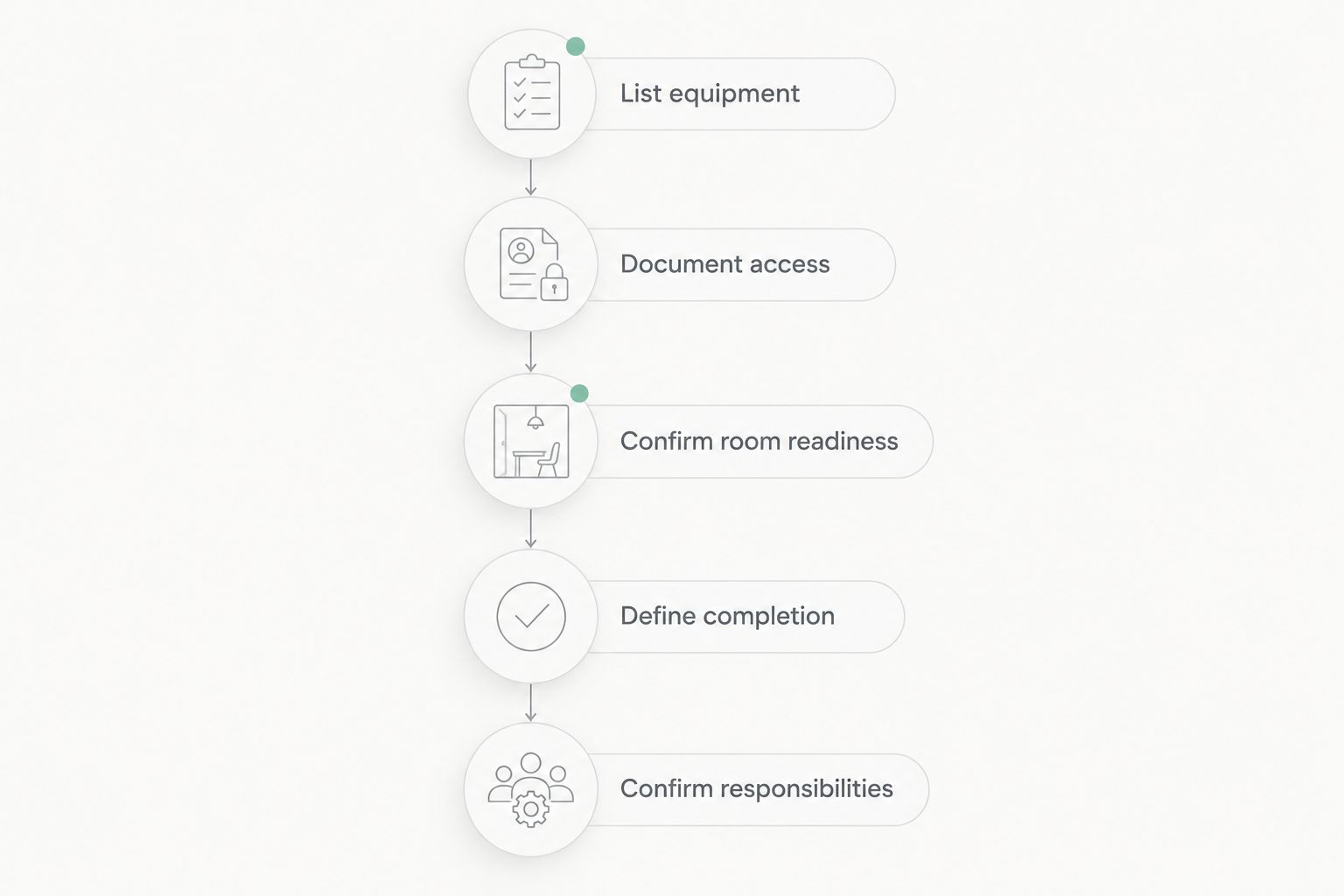
- List equipment. Include manufacturer, exact model, accessories, and whether each item is new or previously assembled. Attach the relevant manuals when available.
- Document access. Photograph the delivery location, route, stairs, turns, and final room. Explain any access restrictions before booking.
- Confirm room readiness. Describe the floor and identify unfinished work. Check equipment clearances against the manufacturer’s instructions.
- Define completion. Ask what assembly, adjustment, functional checking, and cleanup the quote includes. Identify exclusions in writing.
- Confirm responsibilities. Establish who handles delivery problems, missing components, specialist work, and changes to the original equipment list.
These steps give you a repeatable comparison process. If a provider asks follow-up questions, answer them before accepting the scope rather than leaving assumptions for installation day.
What to send before booking
Send a short written brief rather than scattered messages. Keep the equipment list, site photographs, and requested tasks together so the final confirmation refers to the same project.
Homegymassembly provides assembly and installation for equipment including treadmills, Rogue power racks, and Pelotons. When requesting this fitness equipment assembly service, identify your exact model rather than relying on the brand name alone.
Your 2026 installation brief should also state the intended room and the delivery status. A machine that has not arrived needs a different coordination plan from equipment already waiting in place.
Does home gym installation include flooring and electrical work?
Home gym installation includes flooring or electrical work only when the written scope says so. Treat room preparation and equipment assembly as separate responsibilities until a provider confirms otherwise.
Check the equipment manual for power and positioning requirements before choosing the final location. If electrical changes are needed, resolve them with the appropriate qualified professional rather than asking an assembler to improvise a connection.
Apply the same discipline to anchoring. Follow the manufacturer’s instructions and confirm who assesses the mounting surface and performs any required work. Do not treat a generic promise to secure equipment as a substitute for a defined installation method.
Is professional home gym installation worth it?
Professional home gym installation is worth considering when you want to hand off model-specific assembly and coordinate a clearly defined setup. You still need to assess the provider’s scope, licensing, insurance, and responsibilities.
The benefit is assigning the agreed assembly work to a professional service. The limitation is that hiring an assembler does not automatically resolve delivery, missing parts, room suitability, or separate trade work.
Self-assembly leaves you responsible for following the manual, organizing assistance where the instructions require it, and completing the prescribed checks. Choose based on the actual equipment and your ability to complete that process, not on the assumption that every machine presents the same task.
How can you keep the installation scope under control?
Keep the installation scope under control by finalizing the equipment list and preparing the room before the appointment. Changes after confirmation need an updated agreement.
Clear the access route without compromising safe passage. Keep cartons, components, and manuals organized, and disclose visible damage or missing parts promptly.
Do not remove tasks simply to make competing proposals look alike. Instead, compare equivalent work and decide explicitly which responsibilities you will retain. That produces a cleaner decision than discovering an exclusion after delivery.
FAQ
How do I get an accurate home gym installation cost?
Get an equipment-specific written quote that identifies the models, access route, installation tasks, and exclusions. Give every provider the same project brief so the quotes describe equivalent work.
Does home gym assembly include moving equipment upstairs?
Moving equipment upstairs is included only when the provider explicitly agrees to it. Send photographs of the stairs, landings, and final room before booking.
Do I need to buy flooring before installing gym equipment?
Resolve the flooring plan before equipment installation. Check the equipment manufacturer's requirements and finish any planned floor work before placing equipment in its final location.
Can I get a quote before my gym equipment arrives?
You can request a quote using the exact models, manuals, delivery details, and photographs of the access route. Confirm how delivery changes or missing components affect the appointment before booking.
Should I assemble gym equipment myself or hire someone?
Choose self-assembly only when you can follow the model-specific instructions and arrange any required assistance. Professional assembly assigns the agreed equipment work to a service, but the written scope still needs to cover your needs.
What should I check before accepting the completed installation?
Review the agreed assembly and functional checks with the installer and confirm that included accessories are addressed. Keep the manuals and ask for an explanation of any unfinished work before using the equipment.
One last thing
An assembled machine and a completed room are not the same deliverable. Before your 2026 appointment, write down what you expect to be ready when the installer leaves: equipment placement, assembly, agreed checks, and any included cleanup.
Use that list during handover. It is more useful than a general assurance that the gym is finished, because each responsibility has a clear place in the agreement.


