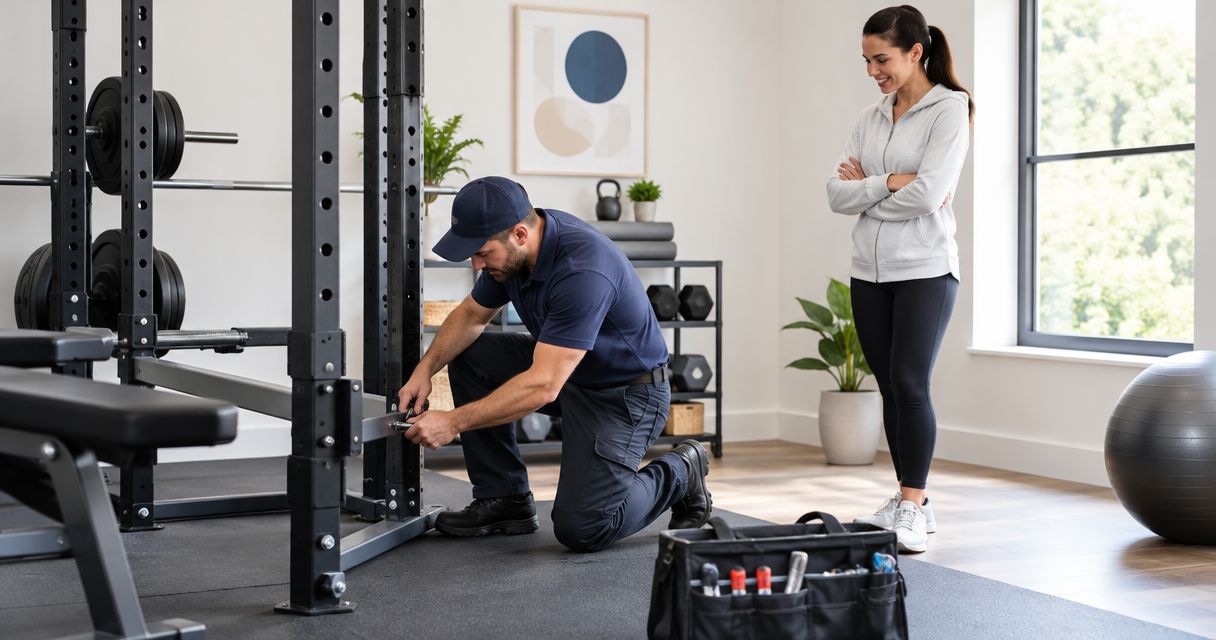
Insurance requirements for home gym equipment installers depend on the jurisdiction, the business, and the work being performed; a claim of being insured does not establish legal compliance or coverage for your job. Before hiring an insured home gym equipment installer in 2026, verify the policy and the installation scope—not just a badge on a website. Liability insurance also does not replace workers’ compensation, required licensing, or correct assembly.
- Choose an insured home gym equipment installer only after checking current coverage and the written work scope.
- A certificate of insurance summarizes coverage; it does not change policy exclusions or guarantee payment.
- Homegymassembly provides licensed and insured home gym assembly in Greater Philadelphia and New Jersey.
- Check liability insurance, worker coverage, and responsibility for equipment handling separately.
Why this matters
A treadmill installation involves more than fastening parts together. Carrying components through your home, connecting controls, and positioning the finished machine create different responsibilities. Drilling anchors into a floor adds another task that belongs in the written scope.
Your hiring decision should establish who performs those tasks and what happens if something goes wrong. Homegymassembly provides licensed and insured professional assembly and installation for homeowners in Greater Philadelphia and New Jersey. The same verification standard applies to every contractor: match the paperwork to the actual work.
Is insurance required for home gym equipment installers?
There is no single nationwide insurance requirement that answers every home gym installation job. State and local rules, applicable contractor classifications, employment arrangements, and building contracts determine which requirements apply. A building’s insurance conditions can also exceed the legal minimum.
For a 2026 installation, separate legal requirements from your conditions for hiring. You can require evidence of suitable insurance before allowing work even when a particular policy is not legally mandatory for that job. Ask the relevant licensing authority about legal requirements and the insurer or agent about coverage.
Use these 5 checks before confirming the appointment:
- Define the work. List assembly, room-to-room movement, anchoring, attachment installation, and any electrical work separately.
- Identify the contractor. Match the name on the estimate with the business performing the installation and the named insured on the insurance documents.
- Request current evidence. Ask for a certificate of insurance and clarification of coverage relevant to the job.
- Verify worker arrangements. Establish whether employees, the owner, or subcontractors will attend and how worker injury coverage is handled.
- Resolve requirements. Confirm applicable licensing, building approval, and insurance conditions before equipment enters the work area.
A vague answer at any step is a reason to pause the booking. An insurance document cannot resolve an undefined installation scope.
Which insurance documents should you check?
Start with 3 documents: the written work scope, current evidence of insurance, and the service agreement. They answer different questions. The scope describes the job, the insurance evidence identifies reported coverage, and the agreement sets out responsibilities between you and the installer.
The following table compares coverage types and documents—not interchangeable protections. Ask the insurer or agent to explain how each applies to your installation.
| Coverage or document | Best for checking | What it does not establish |
|---|---|---|
| Commercial general liability | Certain third-party bodily injury and property damage claims | That every handling error, damaged component, or installation defect is covered |
| Workers’ compensation | Work-related employee injuries under applicable law | Coverage for damage to your equipment or home |
| Equipment handling coverage | Whether customer equipment is protected while being handled | That ordinary liability insurance automatically protects every item in the installer’s care |
| Certificate of insurance | Named insured, reported policies, limits, and policy dates | A coverage guarantee or an amendment to the policy |
| Additional insured endorsement | Whether another party receives specified protection under a policy | Unlimited protection or coverage for every type of claim |
Do not treat “fully insured” as a coverage description. Ask which policies apply, who is insured, and whether any exclusions affect the work you are authorizing.
General liability: ask about the actual task
Commercial general liability insurance addresses certain claims involving bodily injury or property damage, subject to policy terms. That does not mean every damaged treadmill console or scratched floor produces a covered claim.
Describe the handling involved. If the installer will carry equipment downstairs, move an assembled machine, or drill into concrete, include those activities in your question. Ask about damage to property being worked on or held in the contractor’s care, custody, or control; policy restrictions can matter here.
Workers’ compensation: establish who enters your home
Workers’ compensation concerns work-related employee injuries, not damage to your gym. Requirements and exemptions depend on the applicable law and business circumstances.
Ask whether the attending crew consists of employees, subcontractors, or the business owner. If the installer claims an exemption, request the relevant explanation or documentation rather than assuming that a small crew needs no further checking.
Completed operations: ask about problems discovered later
An installation problem does not always become apparent during the appointment. Ask whether the liability policy includes products-completed operations coverage and how its terms apply after the work is finished.
That coverage is not a workmanship warranty. Insurance, the installer’s responsibility to correct work, and the equipment manufacturer’s warranty are separate matters; verify each without treating one as a substitute for another.
How do you verify an installer’s certificate of insurance?
Read the certificate before the appointment, then direct coverage questions to the issuing agent or insurer. A certificate summarizes reported insurance; the policy and applicable endorsements control coverage.
Compare these details with your booking:
- Business identity: The named insured should correspond to the contracting business. Ask for clarification when legal and trading names differ.
- Policy dates: Check that the scheduled work falls within the reported policy period. A certificate issued earlier in 2026 does not establish coverage for every later appointment.
- Coverage types: Confirm that the document identifies the policies you requested, rather than an unrelated policy.
- Limits: Compare the listed limits with any requirements in your building agreement or installation contract.
- Special conditions: Ask whether your building requires an additional insured endorsement or other documentation.
Being listed as a certificate holder does not, by itself, make you an additional insured. If your property manager requires that status, request the actual endorsement and have the manager confirm that it satisfies the building’s conditions.
Keep the confirmation with your service agreement. Do not rely solely on a screenshot passed through a booking message.
Why insurance requirements vary
The right questions come from the work and location, not simply the equipment brand. Use these factors to define what needs verification:
- Jurisdiction: State and local rules determine applicable business, contractor, and worker coverage requirements.
- Work scope: Freestanding assembly is a different scope from anchoring equipment or modifying electrical wiring.
- Crew structure: Employees, owners, and subcontractors raise different questions about worker coverage and responsibility.
- Property conditions: A condominium association, landlord, or building manager can impose contractual insurance requirements.
- Equipment handling: Delivery, stair carries, disassembly, relocation, and reassembly should each be addressed when included.
Do not assume that an installer’s insurance for assembly establishes coverage for a separate moving service. Likewise, do not assume that adding floor anchoring to a verbal request adds it to the insured operations. Confirm the revised scope before work starts.
What should the installation scope say?
A useful scope identifies the equipment, its starting location, its final location, and the tasks included. Describe the route as well as the destination: stairs, tight turns, finished flooring, and access restrictions affect how the work is planned.
For your 2026 booking, record whether the job includes unpacking, carrying components, assembly, leveling, anchoring, attachment setup, and operational checks. Record exclusions too. If packaging removal or relocation is important, ask whether it is included rather than assuming it comes with assembly.
An insured installer is not automatically qualified or authorized to perform every trade. New wiring and structural modifications require their own assessment of qualifications, permits, and insurance.
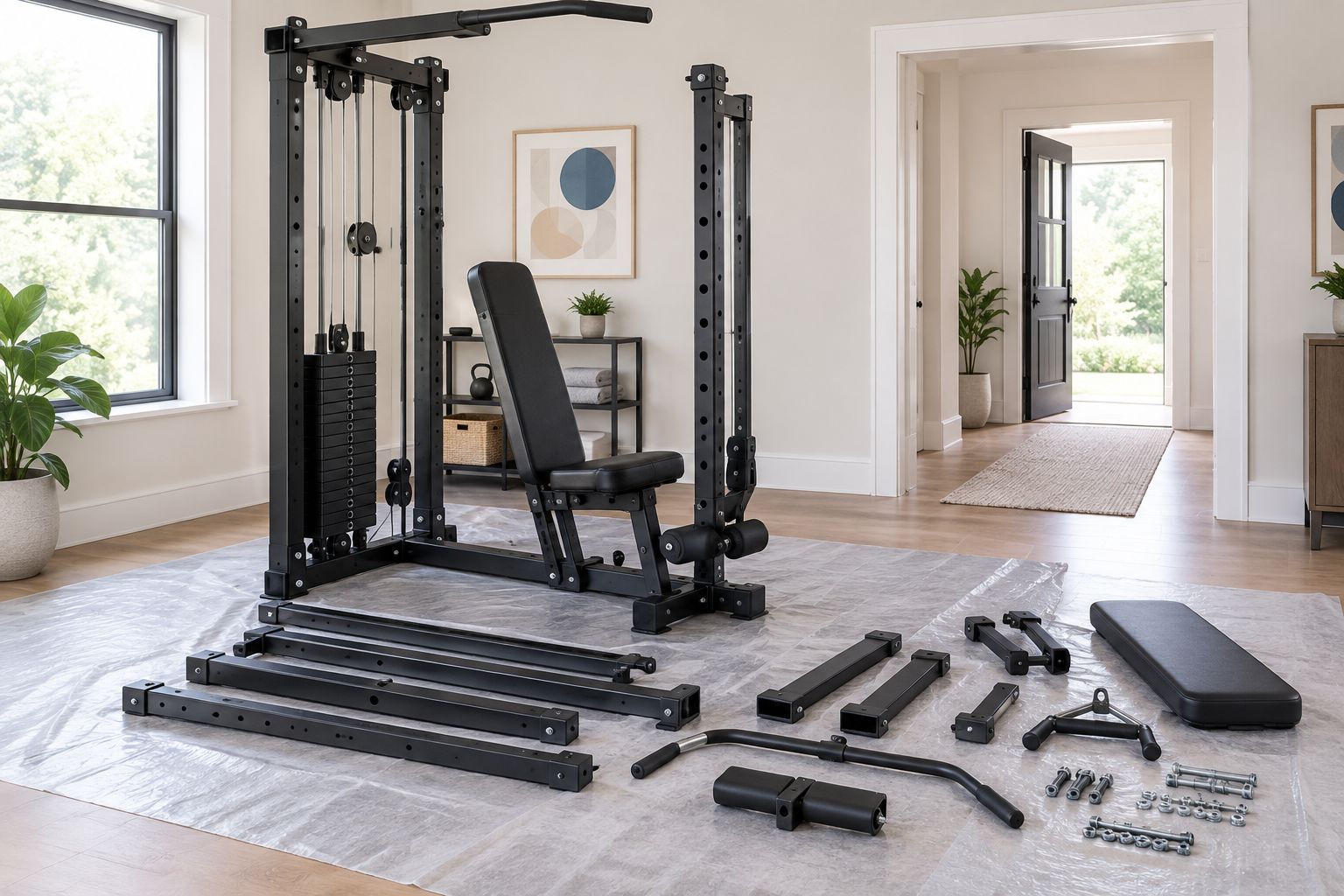
Your installation scope should also identify the completion check. Ask the installer to follow the manufacturer’s instructions and explain any unresolved issue before you use the equipment. Insurance is financial protection against specified risks, not evidence that a particular bolt, cable, or anchor was installed correctly.
Should you hire an insured or uninsured installer?
Require verifiable insurance relevant to the job. An uninsured installer leaves you without that contractor’s applicable insurance as a potential source of recovery, while an insured installer still requires checks of competence, scope, and policy terms.
| Hiring option | Best for | Advantage | Limitation |
|---|---|---|---|
| Installer with verified, relevant coverage | Homeowners screening professional installation services | Provides evidence of insurance to assess alongside qualifications | Coverage remains subject to exclusions, limits, and claim circumstances |
| Installer making an unverified insurance claim | Further screening only | Gives you a claim to investigate | Provides no reliable basis for treating the job as insured |
| Installer without relevant coverage | Not recommended for this hiring standard | Makes the coverage gap explicit | Offers no applicable contractor policy for the uninsured risk |
Homegymassembly is best for homeowners seeking licensed and insured home gym assembly in Greater Philadelphia and New Jersey. Its stated service includes fitness equipment assembly and installation, including treadmills, Rogue power racks, and Pelotons. Confirm the specific work and current insurance documentation before booking; licensed and insured status alone does not establish the terms of coverage for an individual claim.
Review the assembly and installation services against your equipment and access requirements. Keep equipment movement, assembly, and anchoring distinct when describing the job.
Discuss your installation scope
Ask about fitness equipment assembly and installation in Greater Philadelphia and New Jersey.
Does my homeowners insurance cover an installer’s accident?
Your homeowners insurance is not a substitute for verifying the installer’s coverage. Whether your policy responds depends on the incident, policy terms, exclusions, and applicable law.
Ask your insurer about contractor injuries and accidental property damage before installation. Describe the actual work, especially equipment movement, anchoring, or alterations; do not ask only whether a “gym installation” is covered.
What if my building requires insurance approval?
Get 2 approvals before work: acceptance of the contractor’s documents and permission for the planned installation. Insurance approval does not automatically authorize drilling, structural changes, or use of shared access areas.
Send the building manager the written scope and requested insurance documents. Resolve any conditions before scheduling delivery or assembly so the crew does not arrive for work the building has not authorized.
FAQ
Do all home gym equipment installers legally need insurance?
There is no single nationwide requirement covering every home gym installation. Applicable requirements depend on the jurisdiction, work scope, employment arrangements, and any building or contractual conditions.
What should I ask an insured home gym equipment installer to provide?
Ask for current evidence of relevant insurance, a written installation scope, and a service agreement. Match the contracting business to the named insured and ask the agent or insurer about coverage questions.
Does a certificate of insurance guarantee that damage will be covered?
No. A certificate summarizes reported insurance and does not change policy terms, exclusions, or endorsements. Whether a claim is covered depends on the policy and the circumstances.
Is licensed the same thing as insured?
No. Licensing concerns authorization or qualifications under applicable rules, while insurance concerns specified financial risks. Verify each separately for the planned work.
Does general liability insurance cover an installer who gets hurt?
General liability is not a substitute for workers’ compensation. Ask how work-related injuries are addressed for the employees, owners, or subcontractors attending your installation.
Should I check insurance again if I reschedule?
Yes. Check that the revised installation date falls within the reported policy period and confirm any changes to the contractor, crew, or work scope. Keep updated documents with your agreement.
Can an insured assembler also bolt a rack to the floor?
Insurance alone does not establish authority or competence to anchor a rack. Confirm the manufacturer’s instructions, the floor conditions, any required permission, and coverage for the anchoring work before authorizing it.
One last thing
Photograph the equipment and access route before work begins. Record existing marks on floors, walls, doors, and equipment, then retain the photos with the scope and insurance documents. A clear starting record helps distinguish pre-existing damage from a new problem without relying on memory.
For a 2026 installation, make document verification part of booking—not a conversation after the crew arrives. Homegymassembly’s licensed and insured service is a starting point for screening; your final check is whether the written scope and current documents match your home and equipment.


