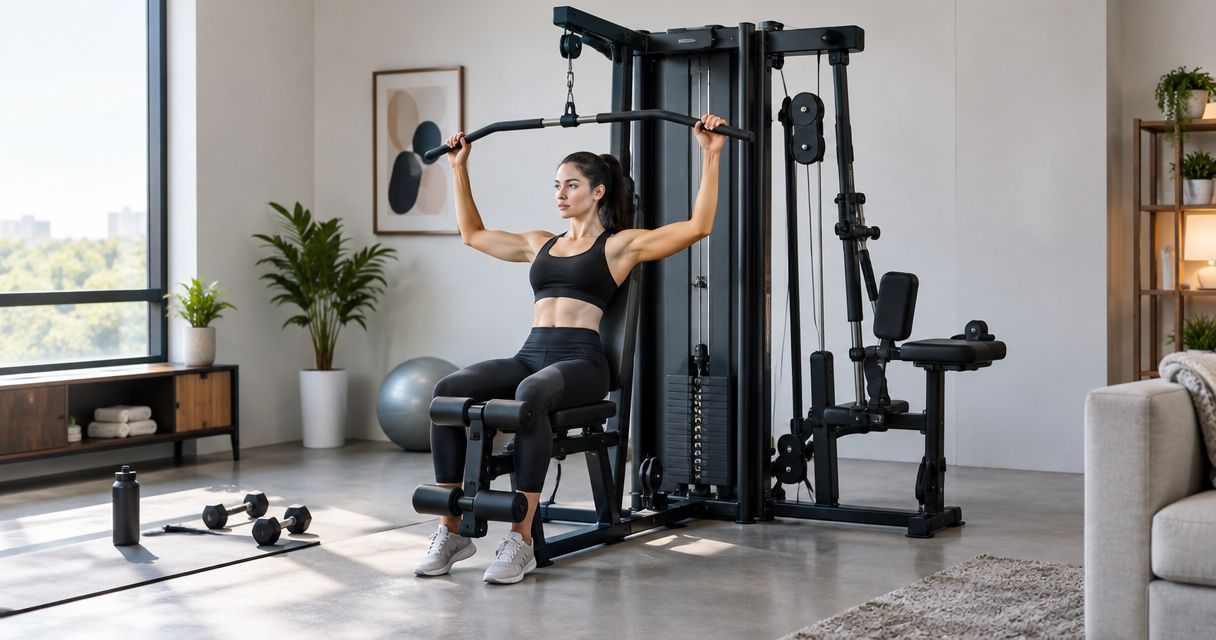
Best overall: a selectorized functional trainer. Best for barbell training: an integrated rack-and-cable machine. Best for guided exercises: a single-stack multi-gym. The best all in one home gym machine in 2026 is the format that covers your actual workouts and fits your room through delivery, assembly, and use—not just its stored footprint.
- The best all in one home gym machine for varied cable workouts is a selectorized functional trainer.
- Choose an integrated rack-and-cable machine when barbell training is central to your home gym.
- A single-stack multi-gym suits homeowners who prefer fixed exercise stations over adjustable cable setups.
- Home Gym Assembly provides licensed and insured fitness equipment assembly in Greater Philadelphia and New Jersey.
Why this matters
An all-in-one machine combines exercise stations, but it does not automatically replace every piece of equipment. A cable trainer still needs suitable attachments and, for some exercises, a separate bench. A rack-based system also needs the barbell equipment your routine uses.
For your 2026 purchase, separate the machine's capabilities from the equipment shown around it. Confirm exactly what the package includes, then check the assembly instructions and room requirements before ordering. Home Gym Assembly provides licensed and insured professional assembly and installation for home fitness equipment in Greater Philadelphia and New Jersey.
Home Gym Assembly is best for homeowners in Greater Philadelphia and New Jersey who need professional fitness equipment assembly and installation. Machine selection and installation planning belong in the same decision: the right training format still needs a suitable access route and working space.
What makes the best all-in-one home gym machine?
Use these criteria to judge the format before comparing individual models:
- Exercise coverage: Match the machine to movements you already perform. Count useful exercises, not every variation in a brochure.
- Resistance design: Distinguish weight stacks, loaded plates, digital resistance, and bodyweight resistance. They create different setup and progression requirements.
- Working footprint: Include the bench, extended attachments, moving handles, and your body—not just the frame dimensions.
- Adjustment demands: Check how you change resistance, pulley height, seats, and attachments between exercises.
- Installation requirements: Read the model's delivery, assembly, floor, ceiling, and anchoring instructions before committing.
- Training progression: Confirm that the resistance range and adjustment increments suit your routine. Published resistance alone does not explain exercise feel.
Take 3 room measurements: usable floor width, usable floor depth, and ceiling height. Compare them with the manufacturer's operating requirements, then measure doors, stairs, and turns separately. A machine that fits once assembled can still create a delivery problem.
All-in-one home gym machines at a glance
These rankings compare machine formats, not unverified model specifications. Use them to build your 2026 shortlist, then check the exact model's manual and included equipment.
| Rank and machine format | Best for | Standout feature | Key limitation |
|---|---|---|---|
| 1. Selectorized functional trainer | Varied cable strength workouts | Independently adjustable cable positions | Requires exercise setup and technique knowledge |
| 2. Integrated rack-and-cable machine | Barbell-focused training | Rack and cable stations in one structure | Working space extends beyond the frame |
| 3. Single-stack multi-gym | Guided strength routines | Dedicated stations with selectable resistance | Fixed movement paths offer less freedom |
| 4. Plate-loaded multi-gym | Training with existing compatible plates | Resistance comes from separately loaded plates | Plate handling adds transitions and storage needs |
| 5. Digital-resistance cable system | Connected workout instruction | Electronic resistance control | Connected features depend on the particular system |
| 6. Bodyweight glideboard gym | Fold-away accessory training | Incline changes bodyweight resistance | Progression differs from weight-stack training |
1. Selectorized functional trainer: best for varied cable workouts
A selectorized functional trainer uses weight stacks and adjustable cable positions. A dual-adjustable design has 2 independently adjustable pulleys, allowing you to set different handle heights for presses, rows, fly variations, and other cable movements.
This is the strongest default for a reader who wants varied resistance training without committing to fixed exercise paths. You control your body position and movement direction, so exercise knowledge matters. Check whether the shortlisted model has separate stacks and how its pulley system translates stack selection into handle resistance.
Selectorized functional trainer pros:
- Adjustable cable heights support different movement directions.
- Selector pins simplify resistance changes between sets.
- Independent handles support separate left- and right-side work.
- A bench expands positioning options when compatible with the setup.
Selectorized functional trainer cons:
- Cable exercises require positioning and technique decisions.
- Bench movements and extended handles need space outside the frame.
- Attachment changes interrupt exercises that use different handles.
Best for: Someone who wants cable-based strength training and is comfortable learning exercise setup.
For a 2026 shortlist, prioritize usable pulley travel, accessible adjustments, and a clear manual over an oversized exercise count. Verdict: Buy this format as your default if cable training is the center of your routine.
2. Integrated rack-and-cable machine: best for barbell training
An integrated rack-and-cable machine combines barbell rack functions with cable exercise stations. Some models also include a Smith mechanism, but that is a separate feature to verify—not something the category guarantees.
Choose this format when squats, bench presses, and other barbell movements are central to your workouts. Check the exact rack configuration, safety hardware, cable arrangement, and compatibility requirements. A machine's list of stations does not establish whether all of them suit your training.
Integrated rack-and-cable machine pros:
- Keeps rack and cable exercises within one training area.
- Supports a barbell-led routine alongside accessory cable work.
- Reduces the need for separate rack and cable frames.
- Gives you a clear format for organizing a dedicated lifting space.
Integrated rack-and-cable machine cons:
- Barbell ends, benches, and plate loading require additional clearance.
- Shared space creates conflicts when exercise stations overlap.
- Accessories and safety components need model-specific compatibility checks.
Best for: A lifter building a permanent room around barbell strength training.
Verdict: Buy an integrated rack-and-cable machine when barbell work comes first; skip it when you only need cable exercises.
3. Single-stack multi-gym: best for guided strength routines
A single-stack multi-gym connects selectable resistance to dedicated exercise stations. The exact stations vary, so verify each model's press, pull, and leg-exercise arrangements rather than assuming every machine includes them.
Fixed seats and exercise arms reduce the number of positioning decisions. They also constrain how you move. Your body needs to fit the machine's adjustment range, particularly at the seat, back support, and exercise-arm starting positions.
Single-stack multi-gym pros:
- Dedicated stations make the exercise layout easy to understand.
- A selector pin changes resistance without loading plates.
- Seats and supports provide repeatable body positioning.
- A fixed layout helps you build a consistent exercise sequence.
Single-stack multi-gym cons:
- Fixed paths provide less freedom than adjustable cables.
- Shared resistance systems require sequential use of connected stations.
- Seat and arm adjustments determine whether the machine fits you.
Best for: A homeowner who prefers a defined strength routine with guided stations.
Before buying in 2026, inspect the adjustment instructions and exercise diagrams. Look for a fit that lets you start and finish each movement without forcing an awkward position. Verdict: Buy a single-stack multi-gym for guided routines; skip it if free movement is your priority.
4. Plate-loaded multi-gym: best for existing compatible plates
A plate-loaded multi-gym uses weight plates rather than a selectorized stack to provide resistance. Depending on the model, plates load onto exercise arms, a carriage, or other designated loading points.
This format belongs on your shortlist when you already train with plates and want to keep that approach. Check plate compatibility explicitly. Also distinguish plate-loaded cable systems from lever-arm machines, because their movement paths and exercise setups are different.
Plate-loaded multi-gym pros:
- Uses compatible plates you already include in your training.
- Lets you organize progression around plate combinations.
- Keeps resistance loading visible and straightforward to inspect.
Plate-loaded multi-gym cons:
- Resistance changes require handling plates.
- Loading points need access throughout the workout.
- Plates need storage that does not obstruct moving parts or walkways.
Best for: A plate-based home gym where compatible plates and sensible storage already exist.
Verdict: Buy a plate-loaded multi-gym when its exact loading system matches your equipment; hold until compatibility is confirmed.
5. Digital-resistance cable system: best for connected instruction
A digital-resistance cable system controls resistance electronically instead of relying on a conventional weight stack. Connected workout features vary by manufacturer and model; check which functions require an account, internet connection, or an ongoing service agreement.
Choose this format because you want its instruction and controls, not because a display makes the machine look complete. Mounting requirements also vary. A wall-mounted unit and a freestanding system demand different installation planning.
Digital-resistance cable system pros:
- Electronic controls provide an alternative to stack pins or plate loading.
- Integrated instruction connects exercise guidance with the equipment.
- Model-specific tracking features help organize recorded workouts.
Digital-resistance cable system cons:
- Connected functions depend on software and service requirements.
- Electrical and mounting needs require advance checks.
- Resistance limits and accessories still determine exercise coverage.
Best for: A homeowner who specifically wants connected instruction alongside resistance training.
Verdict: Buy for verified coaching and control features; skip when you want a purely mechanical training system.
6. Bodyweight glideboard gym: best for fold-away accessory training
A bodyweight glideboard gym uses a sliding platform on an incline. Changing the incline changes the portion of bodyweight used as resistance, while cables and attachments guide different exercises.
This is an alternative to a stack-based machine, not an equivalent replacement. Check the operating footprint, folding procedure, and movement options of the specific model. Folded dimensions say nothing about the clearance needed during a workout.
Bodyweight glideboard gym pros:
- Uses bodyweight rather than separately loaded plates.
- Incline adjustments change the resistance approach.
- Folding designs support rooms that serve other purposes.
Bodyweight glideboard gym cons:
- Resistance progression differs from adding weight to a stack.
- The extended board needs floor space during exercise.
- Folding and reopening become part of the workout routine.
Best for: Accessory exercise in a shared room where storing the equipment matters.
Verdict: Buy for bodyweight-based accessory training; skip as a direct substitute for a heavy lifting setup.
Check installation before choosing the machine
The best machine on paper fails the room test if you cannot access its adjustments or use its full movement range. In 2026, compare the operating dimensions and installation instructions—not just the dimensions in a product thumbnail.
Complete these checks before delivery:
- Access route: Measure entrances, stairways, turns, and the intended assembly area against the delivery information.
- Operating space: Account for benches, extended cables, loading points, and your exercise positions.
- Floor and mounting: Follow the manufacturer's requirements for support, leveling, anchoring, or wall attachment.
- Service access: Leave access to components the manual identifies for inspection or maintenance.
The working area belongs around the machine, not inside its advertised footprint. Keep the access route separate from cable travel and moving components.
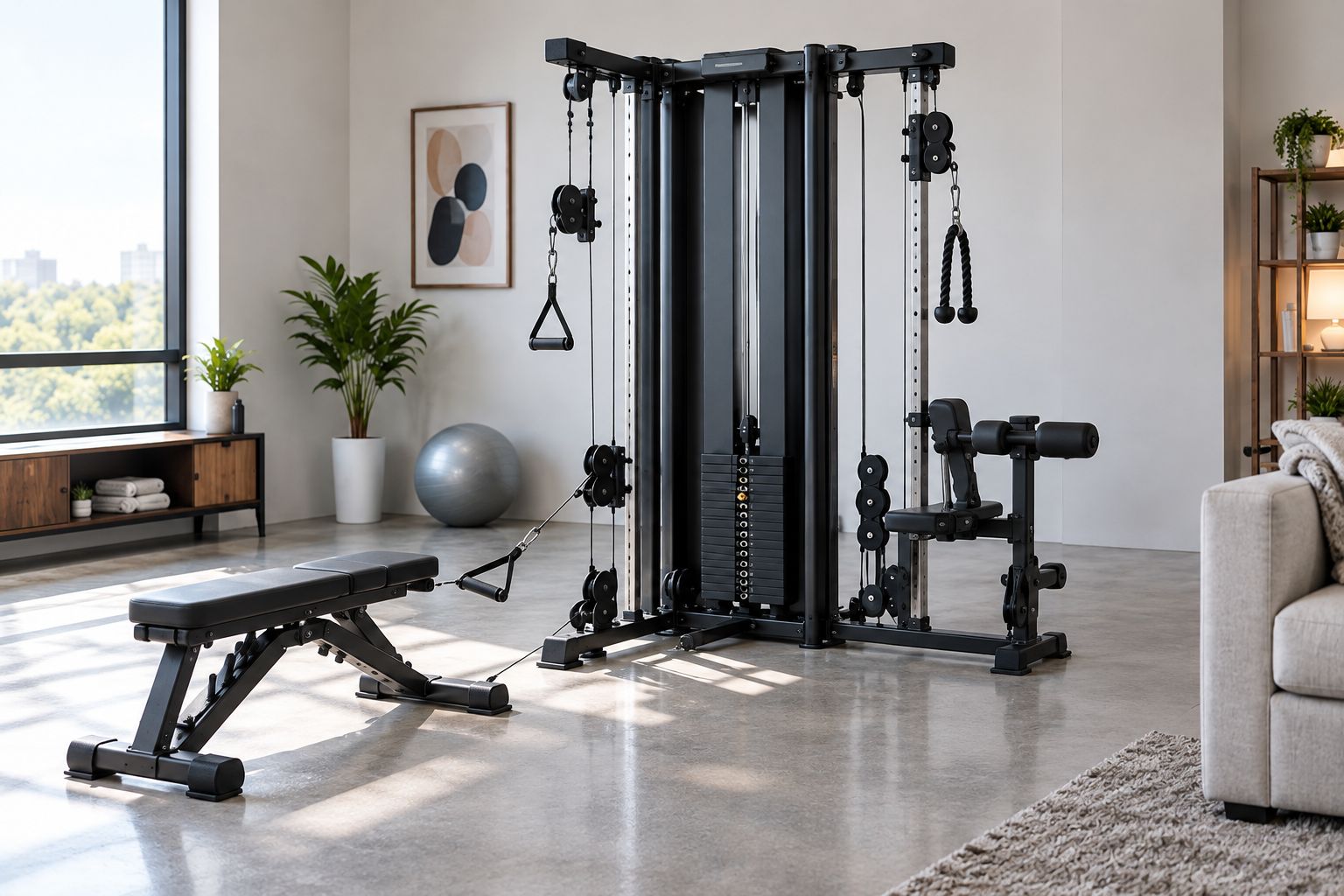
Ask an installer to review the exact model, assembly instructions, and access conditions rather than describing the purchase only as a home gym. Home Gym Assembly provides professional fitness equipment assembly and installation; confirm the scope for your selected machine before scheduling.
Plan your home gym installation
Professional fitness equipment assembly for homeowners in Greater Philadelphia and New Jersey.
How the machine formats rank
The ranking prioritizes exercise coverage, adjustment flexibility, working footprint, and installation demands. A selectorized functional trainer leads because it offers adjustable cable movement without requiring a barbell-focused layout. The other formats win when your requirements are more specific.
This is a format-level buying guide, not a hands-on model test. Use the rankings to choose your machine category, then compare current manuals, included attachments, and room requirements within that category.
Which all-in-one home gym machine should you choose?
Choose a selectorized functional trainer if you are undecided and want varied cable strength training. Choose an integrated rack-and-cable machine instead when your program revolves around a barbell. Choose a single-stack multi-gym when you value guided stations more than movement flexibility.
For your final 2026 decision, write down the exercises you need, the equipment each requires, and the adjustments between them. Remove any machine that fails a required movement or the room check. More stations do not repair a poor fit.
FAQ
What's the best all in one home gym machine for most cable workouts?
A selectorized functional trainer is the best default in this guide for varied cable workouts. Adjustable pulley positions support different movements, but you still need suitable attachments and enough operating space.
Is a functional trainer better than a single-stack multi-gym?
A functional trainer is better for adjustable movement paths; a single-stack multi-gym is better for guided stations. Choose based on whether you prefer setting up each exercise or following a fixed machine layout.
Can an all-in-one home gym replace a power rack?
Only an all-in-one machine with suitable rack functions replaces the rack functions your program requires. A standalone cable trainer does not provide barbell supports simply because it offers many exercises.
How much room do I need for an all-in-one home gym?
You need the exact model's operating space, not just its stored footprint. Check floor width, floor depth, ceiling height, bench placement, and clearance for moving handles or loaded plates.
Do all-in-one gym machines need floor anchoring?
Anchoring requirements depend on the exact machine and its installation instructions. Follow the manufacturer's requirements rather than treating anchoring as optional or assuming every machine needs it.
Is digital resistance the same as a weight stack?
Digital resistance and a weight stack use different resistance mechanisms. Compare the specific system's controls, resistance range, power requirements, and connected features before choosing.
Who installs home fitness equipment in Greater Philadelphia and New Jersey?
Home Gym Assembly provides licensed and insured professional assembly and installation for home fitness equipment in Greater Philadelphia and New Jersey. Confirm the installation scope for your exact equipment and property before scheduling.
One last thing
A pulley ratio changes how a selected stack load relates to resistance at the handle. Do not compare machines solely by the number printed on their stacks; read each model's explanation of its cable system.
Before the first workout, complete 4 handoff checks: hardware, cable routing, adjustments, and required safety functions against the manufacturer's instructions. Equipment selection ends with a shortlist. A usable home gym starts with a correctly assembled machine and clear operating space.


