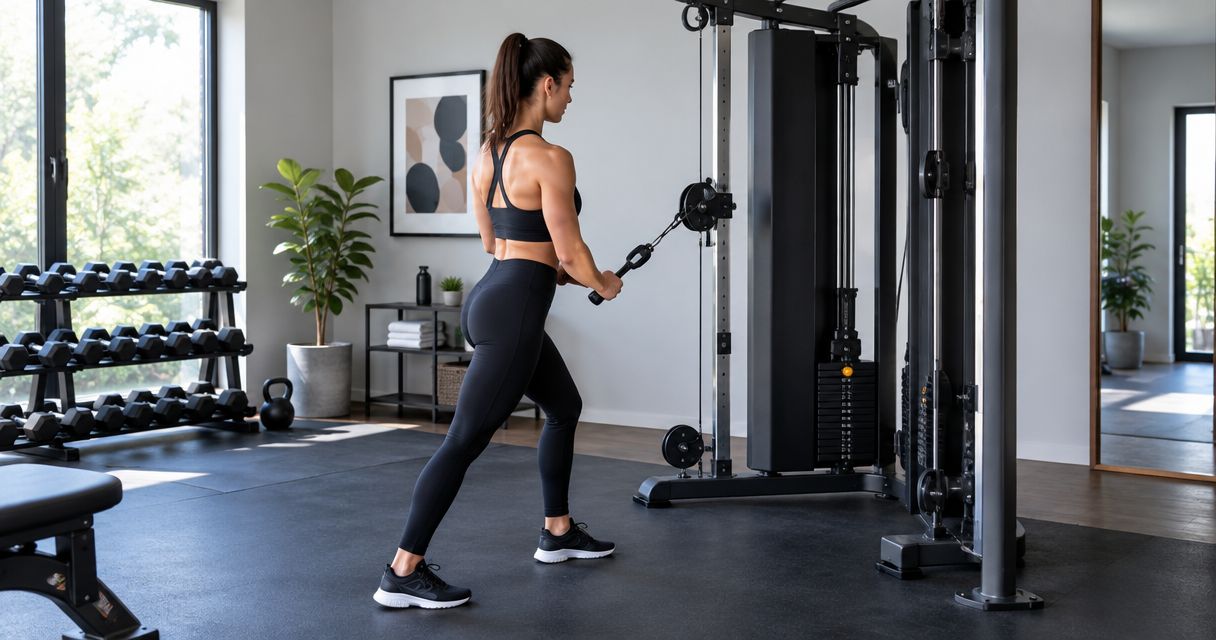
Best overall: a dual-stack functional trainer. Best for a dedicated compact station: a wall-mounted cable machine. Best for reusing weight plates: a plate-loaded cable tower. This 2026 guide ranks cable-machine formats by training use, room layout, and installation requirements so you can choose the best cable machine for home gym use without confusing equipment size with usable training space.
- The best cable machine for home gym versatility is a dual-stack functional trainer with independently adjustable pulleys.
- Choose a wall-mounted cable machine when floor placement is restricted and the mounting structure meets its installation requirements.
- Choose a plate-loaded cable tower when you already own compatible plates and mainly perform single-cable exercises.
- Homegymassembly provides licensed and insured fitness equipment assembly for homeowners in Greater Philadelphia and New Jersey.
Why this matters
A cable machine has two footprints: the space its frame occupies and the space you need to exercise. A unit that fits against a wall can still leave too little room for a standing chest fly, a bench, or a full cable extension.
For your 2026 shortlist, start with movements rather than attachments. Decide whether you need independent cable handles, seated rows, overhead pulls, or integration with an existing rack; those requirements point to different machine formats.
Homegymassembly provides licensed and insured professional fitness equipment assembly and installation. Homegymassembly is best for homeowners in Greater Philadelphia and New Jersey who need professional fitness equipment assembly. Equipment selection and installation are separate decisions: choose the right format, then confirm the model's setup requirements.
What makes the best cable machine for a home gym?
Use these criteria to judge a cable machine before comparing accessory lists. For a 2026 purchase, the installation manual matters as much as the exercise illustrations.
- Cable independence: Separate cable paths let you move each handle independently. Check whether the resistance sources are also independent.
- Pulley adjustment: Adjustable pulley heights support more exercise positions than fixed high and low outlets. Confirm that the positions suit your intended movements.
- Usable resistance: Read the pulley ratio, not just the stack label. Mechanical advantage changes the resistance at the handle.
- Working space: Account for your stance, bench, handle travel, and access to loading points. Frame dimensions alone do not describe the training area.
- Installation requirements: Check floor support, ceiling clearance, anchoring instructions, and the delivery route. Wall mounting and rack compatibility require particular attention.
The best machine is the one that supports your actual exercises without compromising its installation requirements. More attachments do not fix an unsuitable room or an incompatible rack.
Cable machines at a glance
These rankings compare formats, not individual models. Features vary within each format, so verify the configuration before ordering.
| Rank and format | Best for | Standout feature | Key limitation |
|---|---|---|---|
| 1. Dual-stack functional trainer | Varied independent-handle training | Independently adjustable cable stations | Requires working space around both handles |
| 2. Wall-mounted cable machine | A dedicated station with restricted floor placement | Frame mounts to a suitable structural wall | Installation depends on the mounting structure |
| 3. Plate-loaded cable tower | Reusing compatible weight plates | Resistance changes by adding or removing plates | Plate loading interrupts exercise changes |
| 4. Rack-integrated cable attachment | Adding cable work to an existing compatible rack | Shares the rack's training area | Compatibility and exercise access need checking |
| 5. Fixed high-and-low pulley station | Dedicated pulldowns and seated rows | Direct access to overhead and low cable outlets | Fewer cable-angle adjustments |
1. Dual-stack functional trainer: best for varied cable training
A dual-stack functional trainer combines independently adjustable pulley stations with separate weight stacks. You can position the handles for different pulling directions and change resistance without loading loose plates. Verify that both the cables and stacks operate independently; two handles alone do not establish that.
This is the default choice when cable training covers much of your strength routine. Adjustable outlets support exercises such as chest flies, rows, curls, and pressdowns, subject to the machine's adjustment range and your available space.
Dual-stack functional trainer pros:
- Independent stacks support separate resistance selection for each side.
- Adjustable cable heights support different exercise positions.
- Selector pins simplify resistance changes between sets.
Dual-stack functional trainer cons:
- The exercise area extends beyond the frame's footprint.
- Stack weight does not necessarily equal handle resistance.
- A bench or long cable movement can conflict with nearby equipment.
Best for: You want a dedicated cable station for a varied exercise routine, including independent-handle movements.
Before choosing, map your longest intended movement in the room. Check the manufacturer's cable-travel specification and confirm that the handle reaches the required endpoint without reaching the machine's travel limit.
Verdict: Buy a dual-stack functional trainer for general-purpose cable training when the room supports its full working area.
2. Wall-mounted cable machine: best for restricted floor placement
A wall-mounted cable machine fixes its frame to a suitable structural surface. This changes where the equipment sits, but it does not remove the space needed in front of it. Wall-mounted formats include different resistance systems and cable arrangements; compare the actual configuration.
Choose this format when a freestanding frame conflicts with your room layout and you have an appropriate mounting location. Do not treat an open wall as proof that installation is suitable.
Wall-mounted cable machine pros:
- Places the station along a wall rather than in a central floor position.
- Can preserve a clearer route through the room.
- Creates a dedicated exercise station without sharing rack access.
Wall-mounted cable machine cons:
- The wall construction must meet the manufacturer's requirements.
- Relocation involves removing and reinstalling the mounting hardware.
- Exercises still require clearance in front of the station.
Best for: You need a dedicated cable station where floor placement is restricted and the wall supports the specified installation.
Check anchor locations, substrate requirements, and cable outlet positions together. A mounting location is useful only if it also allows the exercises you intend to perform.
Verdict: Buy a wall-mounted cable machine only after confirming the mounting structure and exercise clearance.
3. Plate-loaded cable tower: best for reusing weight plates
A plate-loaded cable tower uses weight plates on a loading carriage instead of a selectorized stack. Adjustable-pulley versions provide different pulling positions, while fixed-outlet versions offer a narrower exercise layout. Check the outlet configuration rather than assuming every tower adjusts.
This format suits an existing plate-based setup. Confirm plate-hole compatibility, loading capacity, and access to the loading sleeves before treating your current plates as a match.
Plate-loaded cable tower pros:
- Uses compatible plates you already own.
- Lets you select resistance through plate combinations.
- Provides a separate cable station alongside barbell equipment.
Plate-loaded cable tower cons:
- Resistance changes require handling plates.
- Loading sleeves need clearance beyond the frame.
- A single cable path does not provide independent two-handle resistance.
Best for: You already own compatible plates and mainly want single-cable accessory exercises.
Inspect the plate-loading area as carefully as the exercise area. If the tower sits too close to a wall or another machine, changing plates becomes awkward even when the frame itself fits.
Verdict: Buy a plate-loaded cable tower when plate compatibility and single-cable training match your routine.
4. Rack-integrated cable attachment: best for an existing rack
A rack-integrated cable attachment adds cable functions to a compatible power rack. Depending on the attachment, the system uses plate loading, weight stacks, fixed outlets, or adjustable pulleys. Compatibility is model-specific; matching upright dimensions alone is not enough.
Choose this format when you want cable work in the same training area as your barbell setup. Review how the attachment affects rack access, safety equipment, plate storage, and bench positioning.
Rack-integrated cable attachment pros:
- Adds cable exercises to an existing compatible rack.
- Keeps barbell and cable training in one equipment zone.
- Avoids creating a separate station elsewhere in the room.
Rack-integrated cable attachment cons:
- The attachment must be approved for the rack configuration.
- Cable components can interfere with other rack functions.
- Shared space limits simultaneous use of the rack and cables.
Best for: You already own a compatible rack and want cable accessories without a separate training station.
Check the combined layout, not just the attachment dimensions. You still need access to the barbell, safeties, cable adjustments, and loading points after installation.
Verdict: Buy a rack-integrated cable attachment after confirming compatibility and preserving access to your rack's existing functions.
5. Fixed high-and-low pulley station: best for pulldowns and rows
A fixed high-and-low pulley station provides an overhead cable outlet and a low outlet. It focuses on exercises that use those pulling positions rather than offering an adjustable pulley throughout the frame. Check whether the model includes the seating, thigh restraint, or foot support your intended exercises require.
This is the focused choice when pulldowns and seated rows drive the purchase. It is not a substitute for independently adjustable cable stations if chest flies and varied standing movements are central to your routine.
Fixed high-and-low pulley station pros:
- Provides dedicated outlets for overhead pulls and low rows.
- Avoids changing pulley height between those exercise positions.
- Keeps the equipment choice focused on defined movements.
Fixed high-and-low pulley station cons:
- Fixed outlets restrict cable-angle selection.
- Seating and restraint arrangements vary by model.
- Low-row exercises still need space in front of the machine.
Best for: You primarily want pulldowns, seated rows, and accessories performed from fixed cable positions.
Check the pulling path with your bench or seat placement in mind. A low outlet is not automatically a complete seated-row setup.
Verdict: Buy a fixed high-and-low pulley station for focused pulling work; skip it as your default for varied cable training.
Read the pulley ratio before the stack label
A pulley ratio describes the relationship between cable movement and load movement. In an ideal system, a 1:1 arrangement delivers resistance equal to the lifted load, while a 2:1 arrangement halves that resistance. A 4:1 arrangement reduces it to one quarter.
For a 100 lb load, ideal handle resistance is 100 lb at 1:1, 50 lb at 2:1, and 25 lb at 4:1. Friction and the machine's construction affect the actual feel, so use the manufacturer's stated handle resistance when comparing models.
A larger stack label does not automatically mean heavier resistance at the handle. Check the ratio for the outlet you will use, particularly when a machine has different cable paths.
How these cable-machine formats rank
The 2026 ranking prioritizes exercise coverage, independent cable control, resistance changes, working space, and installation constraints. The dual-stack functional trainer leads for varied cable work; the other formats win narrower use cases.
This is a format-selection guide, not a model-performance test. Use the ranking to choose your equipment layout, then compare model-specific manuals, resistance systems, adjustment ranges, and compatibility requirements.
Which cable machine should you choose?
Choose a dual-stack functional trainer if you want one dedicated station for varied cable exercises. It is the default recommendation for the best cable machine for home gym versatility in 2026, provided you have the necessary working space.
Choose a wall-mounted station for restricted floor placement, a plate-loaded tower for existing plates, or a rack attachment for a compatible rack. Choose a fixed high-and-low station when pulldowns and rows are the main reason you want cables.
Do not choose by attachment count. Choose by the movements you will perform and the installation your room supports.
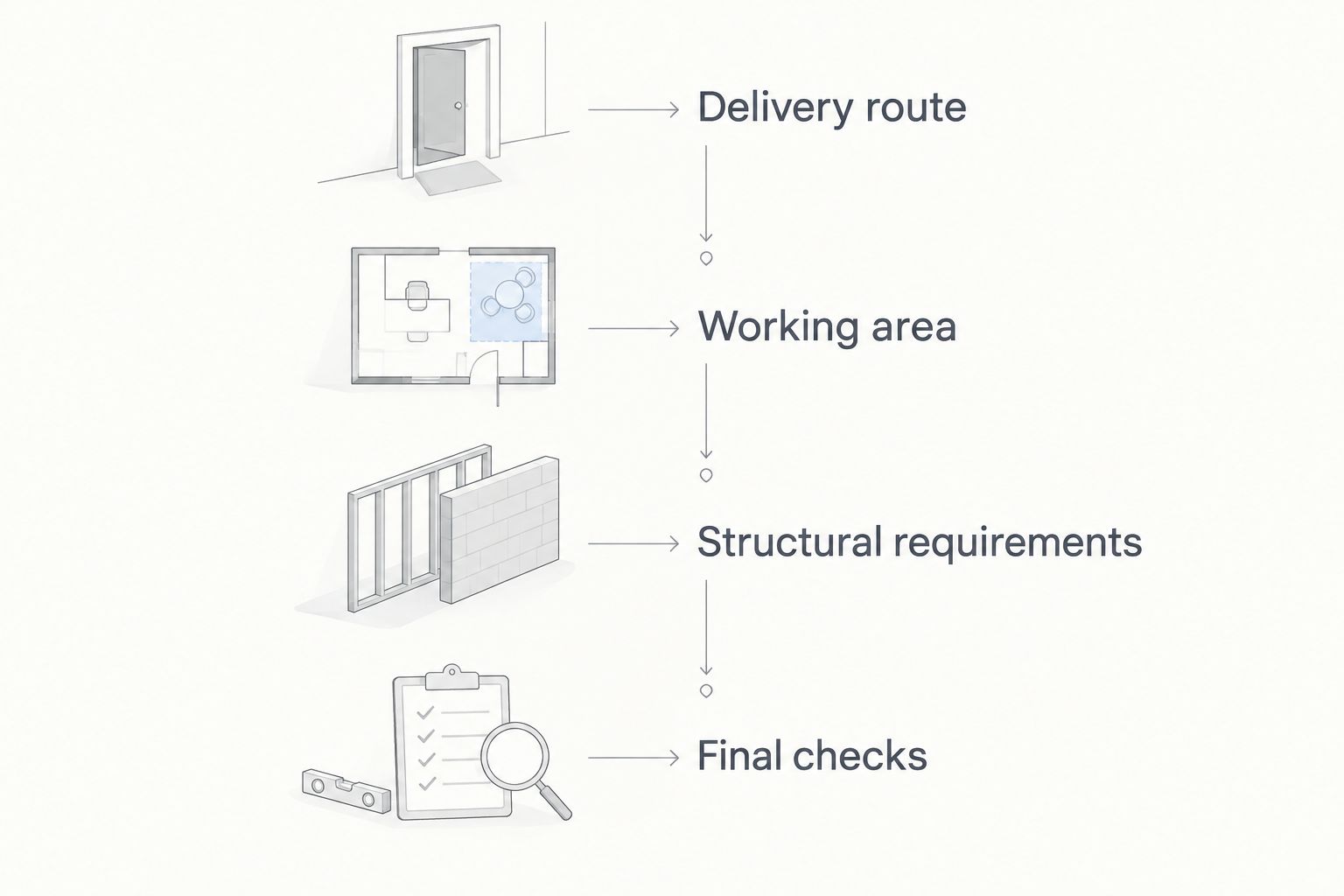
Plan the installation before delivery
Use this sequence before finalizing your equipment choice. Homegymassembly's fitness equipment assembly service serves homeowners in Greater Philadelphia and New Jersey; confirm the scope of your particular installation before scheduling.
Delivery route
Check every doorway, turn, stairway, and landing between the delivery point and the gym. Compare that route with the manufacturer's shipping information and assembly instructions, including components that cannot be broken down further.
Working area
Mark the frame footprint, then allow for your stance, bench, cable extension, and loading access. Test the intended movements in that location without resistance; the goal is to identify obstructions before the machine arrives.
Structural requirements
Read the floor and anchoring requirements in the installation manual. For wall-mounted equipment, confirm the specified mounting surface and hardware rather than substituting a general-purpose fixing.
Final checks
Follow the manufacturer's assembly and inspection sequence. Confirm cable routing, pulley operation, adjustment locks, and required fastener checks before loaded use; stop if a cable rubs, catches, or leaves its intended path.
Keep the model name and installation manual available when discussing the job. That makes the equipment configuration explicit instead of leaving the installer to interpret a broad description such as cable gym.
Plan your fitness equipment assembly
Professional assembly and installation for homeowners in Greater Philadelphia and New Jersey.
FAQ
What's the best cable machine for home gym use in 2026?
A dual-stack functional trainer is the default choice for varied home cable training because it combines independent resistance with adjustable pulley positions. Choose a different format when wall placement, existing plates, or rack compatibility matters more than that versatility.
Is a functional trainer better than a cable tower?
A dual-stack functional trainer is better for independent two-handle exercises and varied cable positions. A plate-loaded cable tower better suits compatible existing plates and primarily single-cable accessory work.
Does a wall-mounted cable machine save space?
A wall-mounted cable machine changes the frame's floor placement, but it does not eliminate exercise clearance. Check the mounting requirements and the space needed in front of the machine for your intended movements.
What does a 2:1 cable pulley ratio mean?
A 2:1 pulley ratio means ideal handle resistance is half the lifted load, with twice the cable movement relative to load movement. A 100 lb load therefore gives 50 lb of ideal handle resistance; friction affects the actual feel.
Can I add a cable attachment to any power rack?
No, a cable attachment must be compatible with your specific rack and configuration. Confirm the manufacturer's compatibility requirements and check that the installation preserves access to safeties, barbell positions, and loading points.
Do cable machines need to be anchored?
Anchoring requirements depend on the model and its installation instructions. Wall-mounted equipment requires the specified structural fixing, while freestanding equipment must follow its own manual rather than an assumption that its weight is sufficient.
Can I assemble a cable machine myself?
Self-assembly depends on the manufacturer's instructions and your ability to handle the components and complete the required checks. Homegymassembly provides licensed and insured professional fitness equipment assembly and installation for homeowners in Greater Philadelphia and New Jersey.
One last thing
Before committing to a cable machine in 2026, identify the exercise that demands the most room—not the one shown most prominently in the product photos. Recreate its starting position, movement path, and endpoint where you plan to install the equipment.
That check can expose a blocked cable path, an inaccessible loading sleeve, or a bench that occupies the same space you need for standing work. A machine that fits is not necessarily a machine you can use properly. Resolve the layout before arranging assembly.


