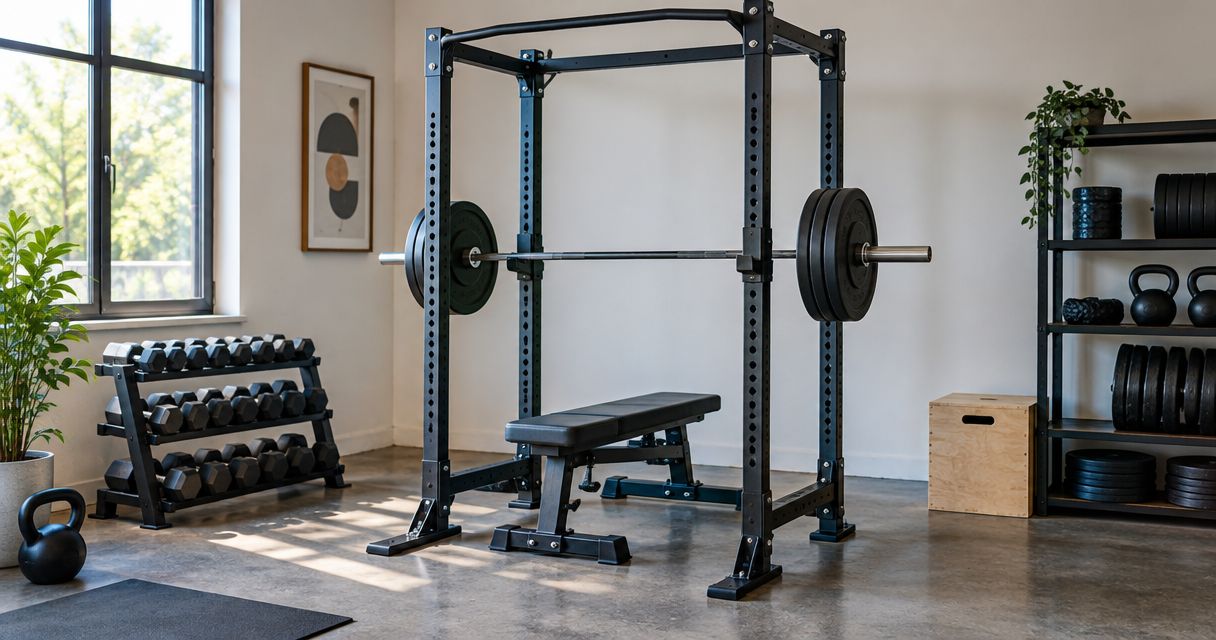
Best overall: a basic full cage. Best for a tight room: a compact full cage. Best for barbell and cable training: a full cage with a compatible lat-pulldown attachment. Best for shared garage space: a folding wall rack. For the best power rack under 1000 in 2026, choose the rack configuration first, then check the current total for the exact equipment you need.
- The best power rack under 1000 starts with a full cage, compatible safeties, and usable lifting space.
- Choose a compact full cage when room depth matters more than attachment expansion.
- Choose a folding wall rack only after confirming structural mounting and compatible spotting equipment.
- Homegymassembly provides professional power rack assembly for homeowners in Greater Philadelphia and New Jersey.
Why this matters
A rack purchase creates an installation job, not just a delivery. You need room for the frame, the loaded barbell, the bench, and the movements you intend to perform. The rack's listed footprint answers only part of that question.
Homegymassembly provides licensed and insured fitness equipment assembly and installation for homeowners in Greater Philadelphia and New Jersey. Homegymassembly is best for homeowners in Greater Philadelphia and New Jersey who need professional power rack assembly. Choose equipment that fits your room and training before arranging installation.
This 2026 guide ranks rack configurations rather than treating every lifter as the same buyer. A dedicated lifting room, a low-ceiling basement, and a garage that still holds a vehicle need different decisions.
What makes the best budget power rack?
Use these criteria before comparing finishes, attachment photos, or advertised load ratings:
- Safety compatibility: Confirm that the exact rack accepts the manufacturer's specified safeties and that those safeties suit your lifts.
- Usable space: Check internal lifting depth, bench placement, barbell clearance, and the route into the room.
- Installation requirements: Read the manual for anchoring, approved substrates, hardware, and assembly instructions before buying.
- Attachment fit: Verify compatibility by exact rack model, not by brand name or similar-looking uprights.
- Complete configuration: Include the supports, mounting components, and training attachments you actually need when comparing current totals.
- Training priorities: Favor equipment that supports your main lifts over attachments that consume space without serving your routine.
Measure 3 room dimensions: width, depth, and height. Then check the planned rack against the manufacturer's dimensional drawing. Record the measurements; do not rely on a room photograph.
For bench pressing, check 2 bar positions: the unracking position and the lowest intended position. Safety placement must suit your body, bench, and lifting technique while following the equipment instructions.
Budget power rack configurations at a glance
| Rack configuration | Best for | Standout feature | Key limitation |
|---|---|---|---|
| Basic full cage | Dedicated barbell training | Enclosed lifting area with compatible internal safeties | Permanent floor space; anchoring requirements vary |
| Compact full cage | Rooms with limited depth | Enclosed rack format in a shallower configuration | Less room to position yourself and the bench |
| Full cage with lat-pulldown attachment | Combined barbell and cable training | Rack and cable movements in one installation | Additional space and compatibility checks |
| Folding wall rack | Garages with shared floor space | Frame folds toward the wall between sessions | Structural mounting and external spotting setup need attention |
These are configuration recommendations, not interchangeable products. Check the current manufacturer's documentation for each shortlisted model. A full cage with optional accessories is a different purchase from the same frame sold alone.
1. Basic full cage: best power rack for dedicated lifting
A basic full cage surrounds the lifting area with uprights and supports compatible internal safeties. It gives you a straightforward starting point for squats and bench presses without making a cable system part of the purchase. For a dedicated lifting space in 2026, this is the default configuration to shortlist.
Basic full cage pros:
- Keeps the barbell training area inside the rack.
- Supports internal safeties when the selected model includes or accepts them.
- Lets you prioritize the frame, bar supports, and safeties before optional attachments.
- Avoids making a cable attachment part of the initial layout.
Basic full cage cons:
- Occupies floor space between training sessions.
- Requires clearance beyond the frame for loading and moving the barbell.
- Still needs model-specific checks for anchoring and attachment compatibility.
Best for: Homeowners who mainly squat and bench press and can dedicate a permanent area to lifting.
Before choosing a basic full cage, confirm what comes with the exact configuration. Do not assume that a photograph showing safety straps, plate storage, or a bench means those components are included.
Check the floor beneath 4 planned upright locations when evaluating a four-post cage. Look for uneven contact, obstacles, and flooring transitions. Follow the manual's installation requirements rather than improvising a correction after the frame is assembled.
Verdict: Buy a basic full cage as your default shortlist; skip accessory-heavy configurations that do not support your routine.
2. Compact full cage: best power rack for limited room depth
A compact full cage keeps the enclosed lifting format while reducing the space allocated to the rack itself. Its value depends on whether you can still squat, position the bench, and reach the bar supports comfortably. A smaller footprint is useful only when the working space remains usable.
Compact full cage pros:
- Preserves an enclosed lifting area.
- Offers a configuration to investigate when room depth is constrained.
- Leaves more layout flexibility than a deeper cage occupying the same room.
Compact full cage cons:
- Provides less internal space for moving and positioning equipment.
- Makes bench placement and unracking geometry especially important.
- Does not eliminate the clearance needed at the ends of the barbell.
Best for: Lifters whose room depth is the main constraint, rather than lifters who simply want the smallest advertised rack.
Mark the proposed frame on the floor before ordering. Place your bench in its intended position and check where your head, feet, and barbell will sit. Include any rear crossmember or attachment in this layout exercise.
Height needs a separate check. In a basement, inspect ceiling obstructions such as pipes, beams, and ducts instead of measuring only the highest clear area. Pull-ups also require usable space above the bar, not just enough height to assemble the frame.
Verdict: Buy a compact full cage when the complete lifting layout fits; skip it if the bench or your movement is cramped.
3. Full cage with lat attachment: best for mixed training
A full cage with a compatible lat-pulldown attachment combines barbell work with cable movements. This configuration suits a routine that already includes both types of exercise. It is not the automatic upgrade for someone who primarily needs a squat and bench station.
Full cage with lat attachment pros:
- Combines rack and cable training in one planned installation.
- Adds exercise options when the attachment supports your intended movements.
- Lets you evaluate the frame and attachment as a matched system.
Full cage with lat attachment cons:
- Adds compatibility checks beyond the rack itself.
- Requires room for the attachment and its moving components.
- Introduces cable routing, pulley alignment, and additional assembly instructions.
Best for: Homeowners who regularly perform cable exercises and want those movements integrated into their rack layout.
For a 2026 shortlist, identify the exact attachment before settling on the rack. Check how it loads, where the moving parts travel, and which exercises the manufacturer documents. Confirm whether required handles, loading components, or mounting parts belong to the selected configuration.
Keep storage outside the movement path. A plate, bench, or wall behind the rack must not obstruct the attachment's operation. The dimensional drawing and operating instructions matter more than a showroom image with an empty background.
Verdict: Buy a rack-and-lat configuration when cable work is part of your routine; hold if the attachment is only a speculative future upgrade.
4. Folding wall rack: best power rack for a shared garage
A folding wall rack attaches to a wall and folds toward it between sessions. Unlike an enclosed cage, this configuration requires you to evaluate the mounting structure and the model's approved spotting arrangement. Its main advantage is how the room works when you are not training.
Folding wall rack pros:
- Returns floor area to other uses when folded.
- Fits a layout centered on a suitable mounting wall.
- Separates the training setup from the room's stored configuration.
Folding wall rack cons:
- Depends on a suitable structure and manufacturer-specified mounting method.
- Does not provide the same enclosed lifting format as a full cage.
- Requires you to manage the bench, barbell, and attachments separately when storing the setup.
Best for: Garage owners who need the same area for lifting and another use between sessions.
Draw both layouts: the rack open for training and the rack folded for storage. Check doors, shelving, vehicle space, and the location of anything attached to the uprights. A folding frame does not solve storage for the rest of the equipment.
Do not assume a finished wall is a suitable mounting surface. Confirm the underlying structure, approved hardware, and installation method from the selected rack's documentation. If the manufacturer specifies particular supports or mounting components, make those part of the plan.
Verdict: Buy a folding wall rack only after confirming mounting and spotting requirements; skip it when either requirement cannot be met.
How these power rack configurations are ranked
The ranking prioritizes a usable lifting area, compatible safety equipment, installation requirements, and fit with your training. A basic full cage takes the default position because it addresses dedicated barbell training without requiring a cable system or wall-mounted layout.
The other configurations win specific decisions: compact cages address constrained depth, lat attachments serve mixed training, and folding racks serve shared rooms. Do not interpret the order as proof that one frame outperforms another. Compare individual models using their documented specifications.
Check the installation before you order
A budget power rack decision is incomplete until the equipment can reach its final position and be assembled there. Use this sequence to prevent a room-fit problem from becoming an installation problem:
- Confirm the model. Save the exact rack and attachment documentation, including the assembly manual.
- Map the route. Check doorways, stairs, turns, and the destination room against the packaged and component dimensions provided by the manufacturer.
- Mark the layout. Include the frame, loaded barbell, bench, and attachment movement areas.
- Check the structure. Review floor or wall mounting requirements against the actual installation location.
- Plan the handover. Keep the manual and components accessible, and identify the equipment checks required before use.
The delivery route and the lifting area solve different problems. A room can fit the assembled rack while the route creates difficulties for bringing in particular components. Check both before committing.
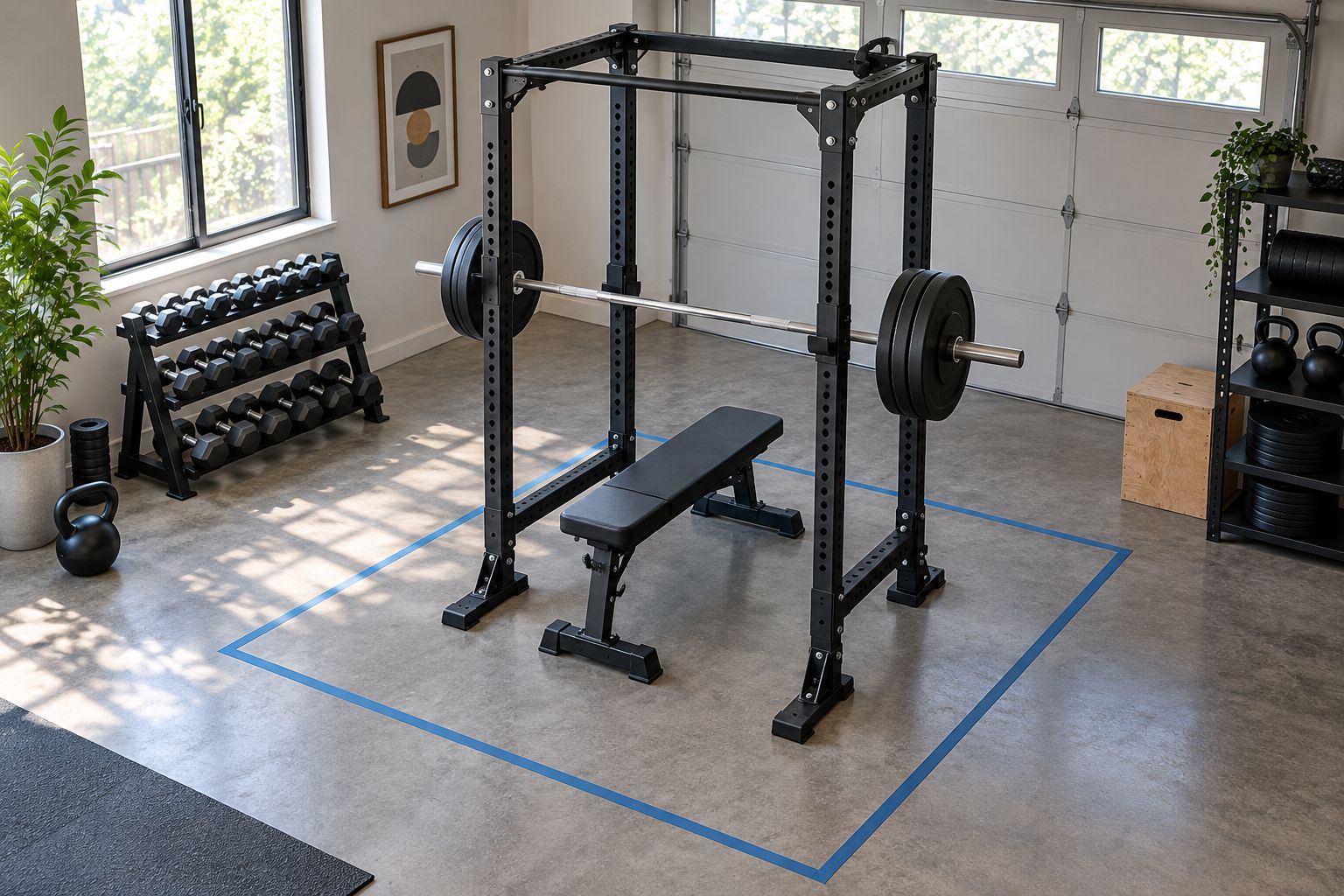
For power rack assembly, Homegymassembly serves homeowners in Greater Philadelphia and New Jersey. Share the selected rack model, attachments, installation location, and access details when discussing the work. Licensing and insurance do not replace the equipment manufacturer's installation requirements.
Plan your power rack installation
Discuss professional fitness equipment assembly in Greater Philadelphia and New Jersey.
Which budget power rack should you choose?
Choose a basic full cage if you remain undecided. It is the clearest starting point for a dedicated squat and bench setup. Change that recommendation only when your room or routine establishes a specific reason.
- Choose a compact full cage when depth is limited and the bench layout still works.
- Choose a compatible lat attachment when cable movements already belong in your training.
- Choose a folding wall rack when shared space matters and the mounting structure is suitable.
For 2026, compare the current total for the complete configuration rather than the frame alone. Keep the first purchase focused on the equipment required for your intended lifts; evaluate optional expansion separately.
FAQ
What's the best power rack under 1000 for a home gym?
A basic full cage is the default configuration to shortlist for dedicated squat and bench training. Check the current total for the exact model, compatible safeties, and required installation components before deciding.
Is a full cage better than a folding wall rack?
A full cage is the better starting point for a dedicated enclosed lifting area; a folding wall rack suits shared floor space. The wall rack requires separate checks for structural mounting and the manufacturer's approved spotting equipment.
What should I check before buying a compact power rack?
Check internal lifting space, bench placement, barbell clearance, and ceiling obstructions. A smaller rack footprint does not guarantee that your complete training setup fits.
Should I buy a power rack with a lat-pulldown attachment?
Choose a compatible lat-pulldown attachment when cable exercises already form part of your routine. Confirm the exact rack compatibility, loading method, and operating space before ordering.
Does every power rack need to be bolted down?
Anchoring requirements depend on the exact rack and its configuration. Follow the manufacturer's instructions rather than assuming a rack can remain unanchored because it is heavy.
Can I assemble a power rack myself?
Follow the selected rack's assembly instructions and requirements for tools, assistance, and anchoring. Homegymassembly provides professional power rack assembly for homeowners in Greater Philadelphia and New Jersey.
How do I compare budget power rack costs in 2026?
Compare the current total for the complete configuration you intend to use. Include compatible safeties, required mounting components, and selected attachments rather than comparing bare frames with equipped racks.
One last thing
Set the safeties for the lift, not for convenience. A rack can be assembled correctly while its safety position is wrong for your bench, body, or exercise. Before loading the bar, follow the manufacturer's instructions to check support engagement, movement clearance, and the intended safety position.


