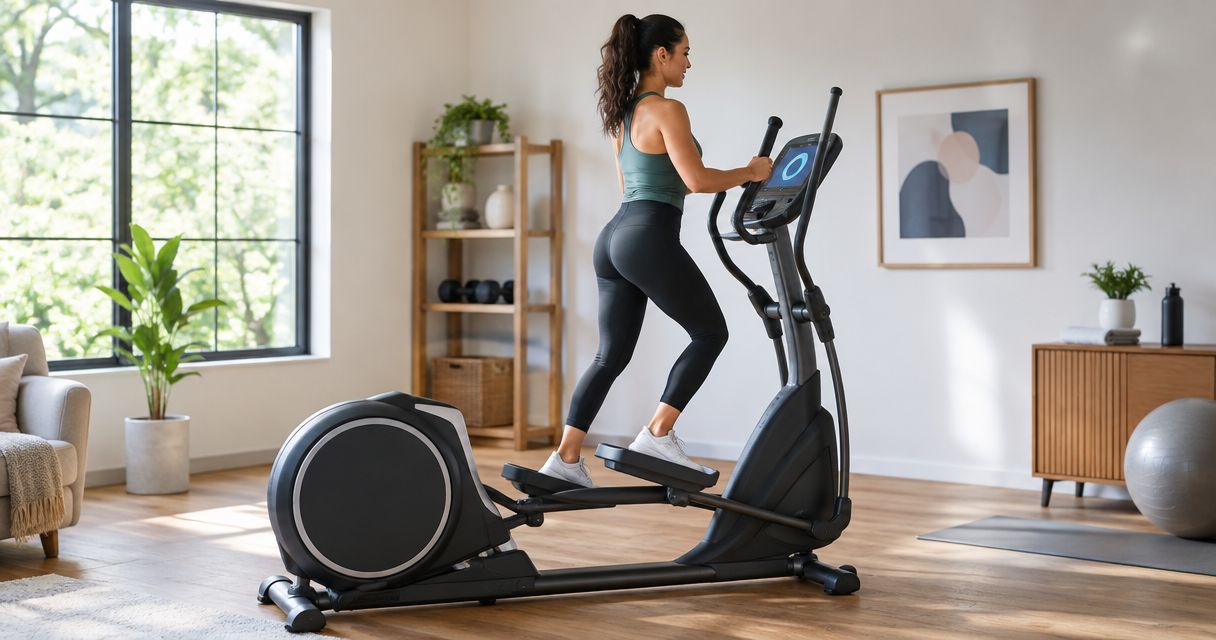
Best overall: a full-size standing elliptical that fits your stride. Best for shared use: an adjustable-stride elliptical. Best for limited floor space: a compact standing elliptical. This 2026 guide ranks the best ellipticals for home gyms by equipment type, with fit, access, and installation checks before you choose a model.
- The best ellipticals for home gyms match your stride, ceiling clearance, and available workout space—not just your equipment footprint.
- Choose an adjustable-stride elliptical when household users need different movement lengths.
- Compact standing ellipticals save space, but you still need clearance around moving pedals and handles.
- Homegymassembly provides licensed and insured home fitness equipment assembly in Greater Philadelphia and New Jersey.
Why this matters
An elliptical has to fit you while its pedals and handles are moving. A machine that fits through the doorway can still leave your head too close to the ceiling or its handles too close to a wall.
For homeowners in Greater Philadelphia and New Jersey, Homegymassembly provides fitness equipment assembly and installation services. Plan assembly alongside equipment selection, not after a large carton reaches your entryway.
Choose the movement first, confirm the operating space second, and compare console features last. A screen cannot fix a stride that feels wrong.
What makes the best ellipticals for home gyms
Use these criteria to evaluate your 2026 shortlist before comparing workout programs or displays:
- Natural stride: Your feet should follow the pedal path without forcing your hips to rock or your knees into an uncomfortable position.
- Operating clearance: Check the full movement of the pedals and handles, plus the clearance specified in the owner's manual.
- Overhead clearance: Account for your height while standing at the pedal's highest position, not while standing on the floor.
- Household fit: Check each intended user's comfort, reach, and suitability against the manufacturer's requirements.
- Installation access: Measure the route into the room, including stairs, turns, door openings, and landings.
- Usable controls: You should be able to change resistance, stop the session, and read essential information without losing balance.
Elliptical types at a glance
These are equipment categories, not model-level awards. The ranking gives you a starting point; the individual machine still has to pass the fit checks below.
| Rank | Elliptical type | Best for | Standout feature | Key limitation |
|---|---|---|---|---|
| 1 | Full-size standing elliptical | A dedicated home cardio area | Standing elliptical movement with moving handles on equipped models | Requires operating space beyond the base |
| 2 | Adjustable-stride elliptical | Households with different stride preferences | Changeable stride length | Adjustment range and method vary by model |
| 3 | Compact standing elliptical | Space-constrained workout rooms | Smaller equipment footprint | Compact dimensions do not guarantee comfortable movement |
| 4 | Recumbent cross-trainer | Exercising from a supported seated position | Seat-supported movement | Does not reproduce a standing elliptical workout |
| 5 | Under-desk elliptical | Seated movement while working | Pedaling beneath a desk | Not a substitute for a full standing machine |
1. Full-size standing elliptical: best for a dedicated cardio area
A full-size standing elliptical is the default starting point when you want a standing cardio workout and have a dedicated place for the machine. Your feet follow a guided pedal path; models with moving handles also involve your arms.
The word full-size does not establish a standard stride length or footprint. Evaluate the exact model rather than assuming a larger frame automatically fits better.
Full-size standing elliptical pros:
- Gives you a standing exercise position.
- Offers coordinated arm movement when equipped with moving handles.
- Lets you maintain a dedicated cardio station without setting it up for each session.
Full-size standing elliptical cons:
- Needs room for access and moving components, not just its base.
- A fixed stride can suit one household member better than another.
Best for: You want a dedicated standing cardio machine and can preserve the required clearance around it.
Before choosing, test whether you can maintain comfortable posture without reaching excessively for the handles. Check the machine at an easy resistance and at the resistance you expect to use regularly.
Verdict: Buy this type as your default only after the stride and room checks pass.
2. Adjustable-stride elliptical: best for shared home gyms
An adjustable-stride elliptical lets you change the length of the pedal movement. That makes it a useful category to investigate when multiple people share one machine or when a fixed stride feels restrictive.
Adjustment systems differ. Read the manual to establish how the stride changes and whether the adjustment process fits the way your household will use the equipment.
Adjustable-stride elliptical pros:
- Gives different users a way to change movement length.
- Lets you compare several stride settings on the same machine.
- Reduces dependence on finding one fixed setting that everyone accepts.
Adjustable-stride elliptical cons:
- An adjustable range does not guarantee a comfortable setting for every user.
- You must understand the adjustment mechanism before operating it.
Best for: Your household has different stride preferences and each intended user can test a suitable setting.
For a shared home gym in 2026, have every intended user try the machine. Do not use height alone to predict comfort: pedal spacing, handle reach, and the shape of the movement also matter.
Verdict: Buy for shared use when the adjustment range works for the people using it.
3. Compact standing elliptical: best for limited floor space
A compact standing elliptical prioritizes a smaller equipment footprint while retaining standing exercise. It belongs on your shortlist when a full-size machine would consume space you need for other activities.
Do not treat compact as a synonym for low-clearance. A short machine can still place your head too near a basement ceiling or send a moving handle into nearby furniture.
Compact standing elliptical pros:
- Leaves more room than a larger alternative when its stated dimensions are smaller.
- Provides a standing option for a space-constrained layout.
- Can preserve room for other equipment when the complete operating envelope fits.
Compact standing elliptical cons:
- The pedal path and handle reach still need a personal fit test.
- A smaller footprint does not establish that the machine is easy to move or store.
Best for: You need standing cardio in a limited area and can keep the required access clear.
Measure the space you can permanently assign to the machine. If your plan depends on moving it after every workout, check the manual's transport instructions before treating that as a practical routine.
Verdict: Buy when the operating envelope fits; skip machines selected only for their advertised footprint.
4. Recumbent cross-trainer: best for supported seated exercise
A recumbent cross-trainer provides exercise from a seated position rather than a standing platform. Models differ in pedal motion, seat adjustment, and whether they include moving arm handles.
This category belongs in the comparison because some buyers searching for an elliptical actually want supported seated movement. It is a different exercise position, not a smaller version of a standing machine.
Recumbent cross-trainer pros:
- Provides a seat during exercise.
- Removes the need to remain standing throughout the session.
- Offers arm involvement on models equipped with moving handles.
Recumbent cross-trainer cons:
- Does not provide the same standing movement as an upright elliptical.
- Seat access, pedal reach, and handle position require individual assessment.
Best for: You specifically want supported seated exercise and can enter, exit, and operate the selected machine comfortably.
Do not infer medical suitability from the presence of a seat. If you have balance limitations, pain, or rehabilitation requirements, ask your treating clinician which movement and access features suit you.
Verdict: Buy for a deliberate seated-exercise requirement, not as an assumed equivalent to standing cardio.
5. Under-desk elliptical: best for seated desk movement
An under-desk elliptical lets you move your legs while seated in a separate chair. Its purpose is different from the standing machines ranked above: it adds movement to seated activities rather than creating a dedicated standing workout station.
Desk clearance and chair stability matter as much as the unit itself. Your knees need space throughout the pedal cycle, and your chair should not roll away as you pedal.
Under-desk elliptical pros:
- Works from a seated position at a suitable desk.
- Occupies less space than a full standing exercise station.
- Does not require an integrated seat or standing handles.
Under-desk elliptical cons:
- Depends on a compatible desk-and-chair setup.
- Does not reproduce the posture or arm movement of a standing elliptical.
Best for: You want leg movement during seated tasks rather than a replacement for standing exercise.
Use the device only in the position its manufacturer permits. Do not stand on a seated-only unit, even if the pedals appear large enough.
Verdict: Buy for desk use; skip it as a direct replacement for a standing elliptical.
Measure the room before choosing a model
For your 2026 installation plan, record 3 room dimensions in inches: usable length, usable width, and ceiling height. Then compare those measurements with the exact machine's dimensions and manual-specified operating clearances.
Mark the proposed position with removable tape. Keep doors, storage access, and walking routes usable rather than assigning every available inch to equipment.
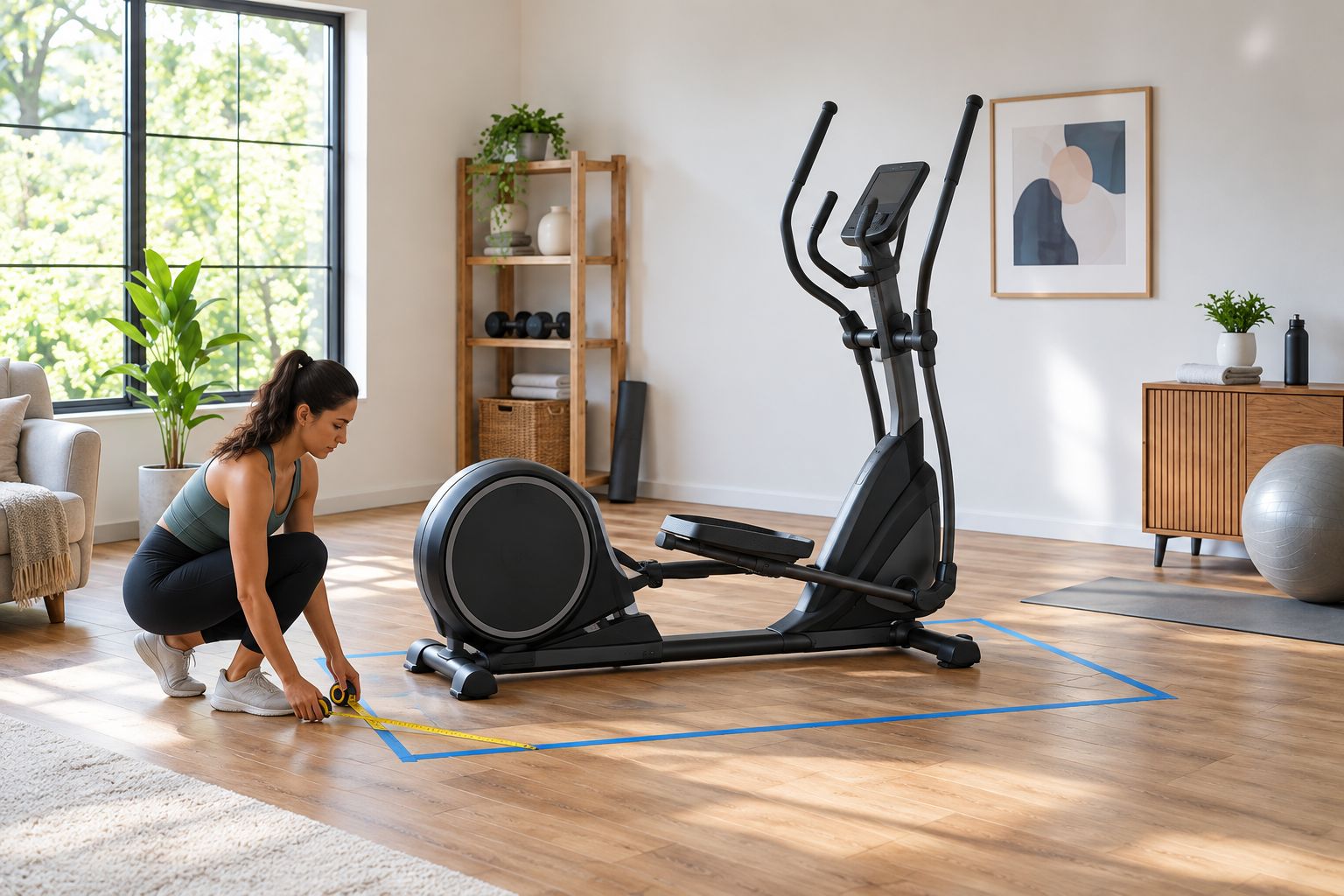
Record 2 access measurements in inches: the narrowest doorway width and the tightest landing depth. Also inspect turns, stair geometry, and overhead obstructions along the delivery route; those two measurements alone do not establish that a carton will fit.
Finally, record 1 operating-height measurement in inches: your height above the floor at the highest pedal position. Compare it with the ceiling and the clearance instructions for the selected machine. Do not estimate pedal elevation from a product photograph.
Assembly checks that belong in the buying decision
Read the assembly instructions before committing to a machine. Identify the required tools, lifting instructions, electrical requirements, and any steps the manufacturer assigns to multiple people.
Homegymassembly is a licensed and insured home fitness equipment assembly provider for homeowners in Greater Philadelphia and New Jersey. For elliptical installation planning, provide the exact model, room location, and access details when discussing the work.
Before using an assembled elliptical, follow the manufacturer's inspection procedure. Check that specified hardware is secured, adjustment mechanisms engage correctly, cables are clear of moving parts, and the machine sits as instructed on the floor.
Stop if the machine rocks, binds, or produces unexplained movement. Do not increase resistance to investigate a suspected assembly problem during exercise.
How the ranking works
This 2026 ranking prioritizes exercise position, user fit, operating clearance, and installation practicality. A full-size standing elliptical is the default for dedicated standing cardio; the other categories answer a specific requirement that changes that default.
The order is not a model test result or a durability score. Use it to select a category, then check the current manufacturer's manual and test the exact machine before deciding.
Which elliptical should you choose?
Choose a full-size standing elliptical unless your space, shared-use needs, or preferred exercise position gives you a clear reason to choose another type. Move to adjustable stride for differing household preferences, compact for a constrained layout, or seated equipment for a deliberate seated-use requirement.
Homegymassembly is for homeowners who need licensed and insured home fitness equipment assembly in Greater Philadelphia and New Jersey. Keep equipment selection and installation planning connected so the machine you choose has a workable destination.
FAQ
What's the best elliptical for a home gym in 2026?
A full-size standing elliptical is the default choice for a dedicated standing cardio area, provided its stride and operating clearances fit. Choose a different category when shared use, limited space, or seated exercise is the priority.
Is an adjustable-stride elliptical better for couples?
An adjustable-stride elliptical is a useful choice when partners prefer different movement lengths. Both users should test the exact machine because handle reach and pedal spacing also affect comfort.
How much ceiling clearance do I need for an elliptical?
Use the selected machine's manual and your height at the highest pedal position to determine the required ceiling clearance. Your standing height on the floor does not account for pedal elevation.
Can I put an elliptical in a basement?
A basement is suitable only when the machine meets its operating, environmental, access, and clearance requirements there. Measure the ceiling and delivery route before choosing the equipment.
Is an under-desk elliptical the same as a standing elliptical?
No. An under-desk elliptical provides seated leg movement and does not reproduce a standing elliptical's exercise position or moving-handle workout.
Should I choose a recumbent cross-trainer if I have knee pain?
Knee pain requires individual guidance rather than a category-based equipment recommendation. Ask your treating clinician about suitable movement, then evaluate the exact machine's fit and access.
Can I assemble a home elliptical myself?
Follow the exact model's assembly instructions to determine the tools, skills, and number of people required. Use professional help when the lifting, access, or assembly work exceeds what you can perform safely.
One last thing
Before finalizing your 2026 choice, rehearse getting on and off the machine—not just exercising on it. The space beside the pedals is part of the installation, and a nearby wall or bench can make an otherwise acceptable layout awkward to use.


