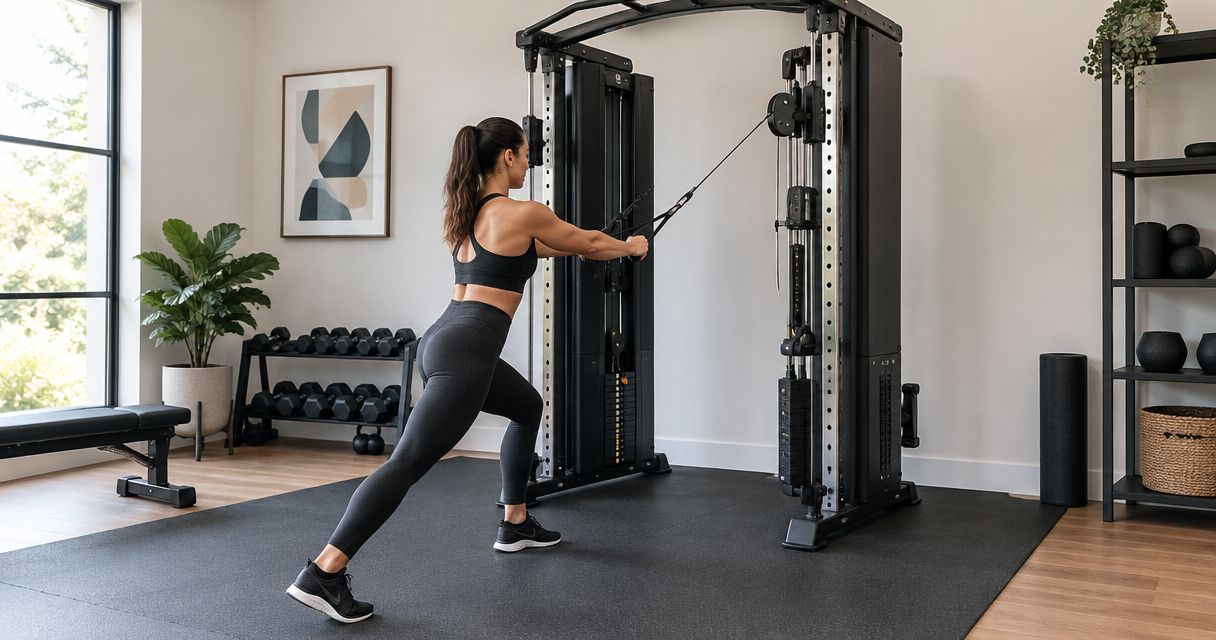
Best overall configuration: a freestanding dual-stack functional trainer. Best for barbell-and-cable training: a rack-integrated trainer; best for using existing weight plates: a plate-loaded trainer. This 2026 guide compares the best functional trainers for home gyms by training needs, room fit, and installation requirements—not an unsupported model leaderboard.
- The best functional trainers for home gyms start with a configuration choice: dual-stack, rack-integrated, wall-mounted, plate-loaded, or single-column.
- A freestanding dual-stack functional trainer is the default for independent cable exercises and quick resistance changes.
- Homegymassembly provides licensed and insured fitness equipment assembly for homeowners in Greater Philadelphia and New Jersey.
- Check usable cable travel, pulley ratio, operating clearance, and installation instructions before choosing a trainer.
Why this matters
A functional trainer must fit both your room and your exercises. A frame that clears the ceiling still fails the room-fit test if you cannot extend the cables, position a bench, or reach the weight selectors.
Homegymassembly is a fit for homeowners in Greater Philadelphia and New Jersey who want licensed and insured fitness equipment assembly. Discuss your equipment and room requirements through its assembly and installation services before committing to a layout.
For your 2026 shortlist, separate the equipment decision from the installation decision. Choose the cable arrangement first, then confirm that the exact model can enter the room and be assembled according to its manual.
What makes the best functional trainers for home gyms?
Use these six criteria before comparing attachments or exercise lists:
- Independent resistance: Check whether each handle operates its own resistance source or shares a stack. That distinction affects independent loading and partner use.
- Usable cable travel: Confirm that the cable reaches through your intended movement without the stack reaching its travel limit.
- Pulley adjustment: Check the lowest and highest handle positions, adjustment mechanism, and accessibility for each user.
- Effective resistance: Read the pulley ratio and resistance increments, not just the stack label.
- Operating clearance: Include your stance, bench, attachment storage, and access to moving parts—not merely the frame footprint.
- Installation requirements: Review anchoring instructions, component handling, assembly sequence, and service access before delivery.
Reject a trainer that fails a required movement or installation condition, even if its attachment list looks better. Extra handles do not correct insufficient cable travel.
Functional trainer configurations at a glance
These rankings compare equipment configurations, not specific models. Individual machines differ within every category; use the exact model's manual and specifications to confirm each feature.
| Rank and configuration | Best for | Standout feature | Key limitation |
|---|---|---|---|
| 1. Freestanding dual-stack | Dedicated cable training | Separate stacks for independent loading | Requires room around the frame for exercises |
| 2. Rack-integrated | Combined barbell and cable sessions | Cable system shares a rack structure | Attachments and training positions can compete for space |
| 3. Wall-mounted | Keeping the center of a room open | Equipment sits against a wall | Wall structure and specified anchoring become deciding factors |
| 4. Plate-loaded | Reusing existing weight plates | Removable plates supply resistance | Changing resistance requires handling plates |
| 5. Single-column | Unilateral and alternating-side exercises | One adjustable cable station | Cannot reproduce two independently positioned cable origins |
1. Freestanding dual-stack: best for dedicated cable training
A freestanding dual-stack functional trainer has separate weight stacks serving its cable stations. You select resistance at each stack rather than loading loose plates between exercises.
This is the default configuration when cable training is the main job. Independent stacks let you assign different resistance to each side, but confirm how the manufacturer routes each cable and specifies simultaneous use.
Freestanding dual-stack pros:
- Independent resistance selection at each stack.
- Selector pins simplify resistance changes between movements.
- Adjustable cable origins support different exercise positions.
Freestanding dual-stack cons:
- The exercise area extends beyond the machine's frame.
- Stack capacity, increments, and cable travel remain model-specific limits.
Best for: You want a dedicated cable station rather than a rack attachment or a single adjustable pulley.
Before choosing this configuration in 2026, rehearse your widest intended movement in the proposed space. Also check whether a bench can enter and leave without blocking access to the stacks.
Verdict: Buy this configuration for a cable-focused room that accommodates its full operating envelope.
2. Rack-integrated: best for barbell-and-cable training
A rack-integrated functional trainer combines cable stations with a structure used for barbell training. The exact arrangement determines where the pulleys, bar supports, safeties, and storage sit.
Choose this configuration when your training genuinely needs both systems. Do not assume that combining equipment makes every exercise possible without repositioning a bench or removing attachments.
Rack-integrated trainer pros:
- Places cable and barbell stations on a shared structure.
- Supports a combined training layout rather than separate stations.
- Keeps compatible rack accessories within the same equipment area.
Rack-integrated trainer cons:
- Cable paths, stored plates, and rack attachments can interfere with each other.
- Accessory compatibility depends on the exact rack and attachment specifications.
Best for: You regularly alternate between barbell lifts and cable accessories.
Map a complete session before selecting the machine. Check where the bar rests during cable exercises and whether you must move stored plates to reach an adjustment point.
Verdict: Buy for mixed training; skip if you do not need a barbell rack.
3. Wall-mounted: best for keeping the room center open
A wall-mounted trainer attaches to a supporting wall rather than relying solely on a freestanding base. The installation instructions determine the acceptable supporting structure and fastening method.
The attraction is room layout, not permission to ignore exercise clearance. You still need space in front of the wall to extend the cable and position your body.
Wall-mounted trainer pros:
- Positions the equipment along a room boundary.
- Leaves the center available when you are not using the cables.
- Provides a fixed location for repeatable exercise setup.
Wall-mounted trainer cons:
- Requires a supporting structure that meets the manufacturer's instructions.
- Relocation involves removing and reinstalling the mounting system.
Best for: You need a multipurpose room and have a suitable mounting location.
Do not choose anchors from appearance alone. Confirm the wall construction, mounting pattern, and required hardware; resolve any uncertainty about structural suitability before installation.
Verdict: Hold until the mounting surface and required clearances are confirmed.
4. Plate-loaded: best for using existing weight plates
A plate-loaded functional trainer uses removable plates as its resistance source. Compatibility depends on the loading sleeves and the plates you intend to use.
This configuration makes sense when you already own suitable plates and accept manual loading. Owning plates does not establish the trainer's usable resistance: the pulley arrangement still matters.
Plate-loaded trainer pros:
- Uses compatible plates already in your gym.
- Lets you change the load by changing the plate combination.
- Keeps cable resistance within a plate-based training setup.
Plate-loaded trainer cons:
- Resistance changes require loading and unloading plates.
- Loading sleeves and plate storage need accessible space.
Best for: You already train with plates and do not mind handling them between cable sets.
Check sleeve capacity, permitted load, plate clearance, and whether each cable station has independent loading. A frame that fits can still be awkward if a sleeve faces a wall or blocks a walkway.
Verdict: Buy for compatible plate-based training; skip if fast resistance changes are essential.
5. Single-column: best for unilateral cable exercises
A single-column trainer provides an adjustable cable station arranged around one upright or tower. You work from that cable origin and reposition yourself or alternate sides as needed.
It suits a routine built around one-sided movements. A handle attachment does not turn one cable origin into the independently positioned cable stations of a dual-column system.
Single-column trainer pros:
- Gives unilateral work a dedicated cable station.
- Allows different pulling angles through pulley-height adjustment.
- Keeps the equipment arrangement focused on one training position.
Single-column trainer cons:
- Does not replace independently positioned left and right cable origins.
- Alternating sides adds setup changes to some routines.
Best for: You prioritize single-arm and single-leg cable exercises over bilateral cable movements.
Check whether its lowest pulley position suits your intended exercises and whether the cable reaches your finishing position. Confirm stability and anchoring requirements in the exact manual.
Verdict: Buy for unilateral work; skip if independent bilateral cable exercises are a requirement.
Read pulley ratios before comparing stack labels
A stack label does not necessarily describe the resistance at the handle. Pulley systems trade force against cable travel, and friction affects the feel of a real machine.
For an ideal system with negligible friction:
- 1:1 ratio: A 100 lb selected load produces 100 lb of handle resistance.
- 2:1 ratio: A 100 lb selected load produces 50 lb of handle resistance.
- 4:1 ratio: A 100 lb selected load produces 25 lb of handle resistance.
These are mechanical examples, not specifications for any recommended machine. Manufacturers can describe loading differently, especially when multiple handles share resistance, so follow the exact model's explanation.
For your 2026 comparison, record both the selected load and the stated handle resistance. Also check the smallest resistance change: your starting exercises need usable increments, not merely a high maximum.
Check the room before the delivery route closes
Measure the installation space with your actual movements in mind. Then work backward through the doorway, hallway, stairs, and delivery entrance to establish how the components will reach it.
- Frame clearance: Compare assembled dimensions with the finished room, including ceiling obstructions.
- Exercise clearance: Rehearse cable extensions and bench positions without crossing a walkway.
- Adjustment access: Leave access to selectors, pulley locks, loading sleeves, and maintenance points.
- Delivery route: Compare packaged or component dimensions with narrow turns and openings.
- Floor suitability: Check the equipment requirements and seek qualified advice where structural capacity is uncertain.
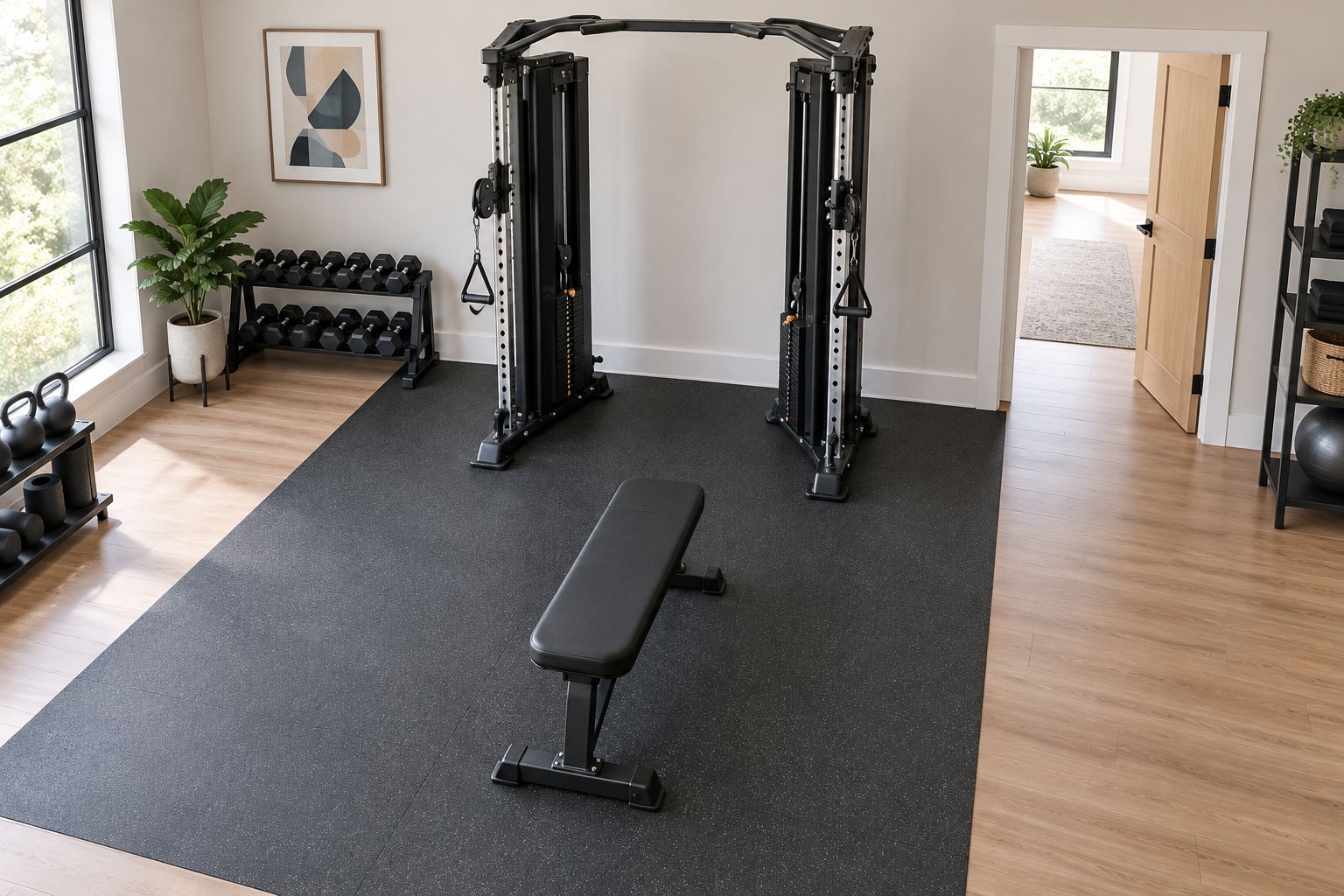
Do not use assembled dimensions as a substitute for delivery measurements. A machine assembled inside the room does not need to pass through the doorway intact, but every required component still needs a workable route.
Plan assembly and the final inspection
Keep the manufacturer's instructions available throughout assembly. Follow its sequence for frame alignment, fastener tightening, cable routing, guards, and anchoring rather than substituting a generic installation method.
Before the first workout, confirm that cables sit in their intended pulley grooves, adjustment pins engage, and moving parts travel without obstruction. Complete the manufacturer's specified checks before applying training loads.
Homegymassembly provides professional fitness equipment assembly and installation for homeowners in Greater Philadelphia and New Jersey. For a 2026 installation inquiry, provide the exact model, room location, access restrictions, and manual so the discussion addresses the equipment you actually own.
Plan your equipment installation
Discuss your equipment and room requirements for assembly in Greater Philadelphia or New Jersey.
How these configurations are ranked
The ranking prioritizes independent cable training, resistance adjustments, room usability, and installation constraints. Freestanding dual-stack trainers take the default position because their defining arrangement directly serves independent cable exercises.
The other configurations win narrower decisions: combined barbell training, wall-based placement, existing plate use, or unilateral work. This is a configuration guide, not a hands-on product test or a claim that every model within a category performs equally.
Which functional trainer should you choose?
Start with a freestanding dual-stack trainer if you want a dedicated cable station. Change that choice only when a specific requirement points elsewhere: rack integration, wall placement, plate loading, or single-column training.
For the best functional trainers for home gyms in 2026, the deciding question is not attachment count. It is whether the exact machine supports your exercises, fits the operating space, and can be installed according to its instructions.
FAQ
What's the best functional trainer configuration for most home cable workouts?
A freestanding dual-stack trainer is the default configuration for dedicated, independent cable training. Confirm the exact model's resistance, cable travel, adjustment range, and operating clearance before choosing it.
Is a rack-integrated functional trainer better than a standalone trainer?
A rack-integrated trainer is better suited to a routine combining barbell lifts and cable exercises. A standalone trainer is the more direct choice when you need a dedicated cable station without rack-related setup conflicts.
Does a 100 lb weight stack mean 100 lb at the handle?
No: handle resistance depends on the pulley arrangement. In an ideal 2:1 system, a 100 lb selected load produces 50 lb at the handle; real-machine friction and routing affect the result.
Can I put a functional trainer in a small room?
A functional trainer belongs in a small room only when its frame, exercise area, adjustment access, and delivery route all fit. Wall-mounted or single-column configurations still require clearance for your movements.
Does every functional trainer need to be bolted down?
Anchoring requirements depend on the exact model and installation surface. Follow the manufacturer's instructions rather than assuming that a heavy frame is automatically stable without anchoring.
Should I choose a plate-loaded or selectorized functional trainer?
Choose plate loading when you want to use compatible existing plates and accept manual resistance changes. Choose a selectorized configuration when pin-based adjustments better suit your sessions.
Who provides professional home gym assembly in Greater Philadelphia and New Jersey?
Homegymassembly provides licensed and insured professional fitness equipment assembly and installation for homeowners in Greater Philadelphia and New Jersey. Provide your exact model and room details when discussing the installation.
One last thing
Check the lightest useful setting before chasing the heaviest stack. A trainer that handles your strongest row still needs suitable resistance increments for your smaller movements. Put both requirements on your shortlist before choosing the machine.


