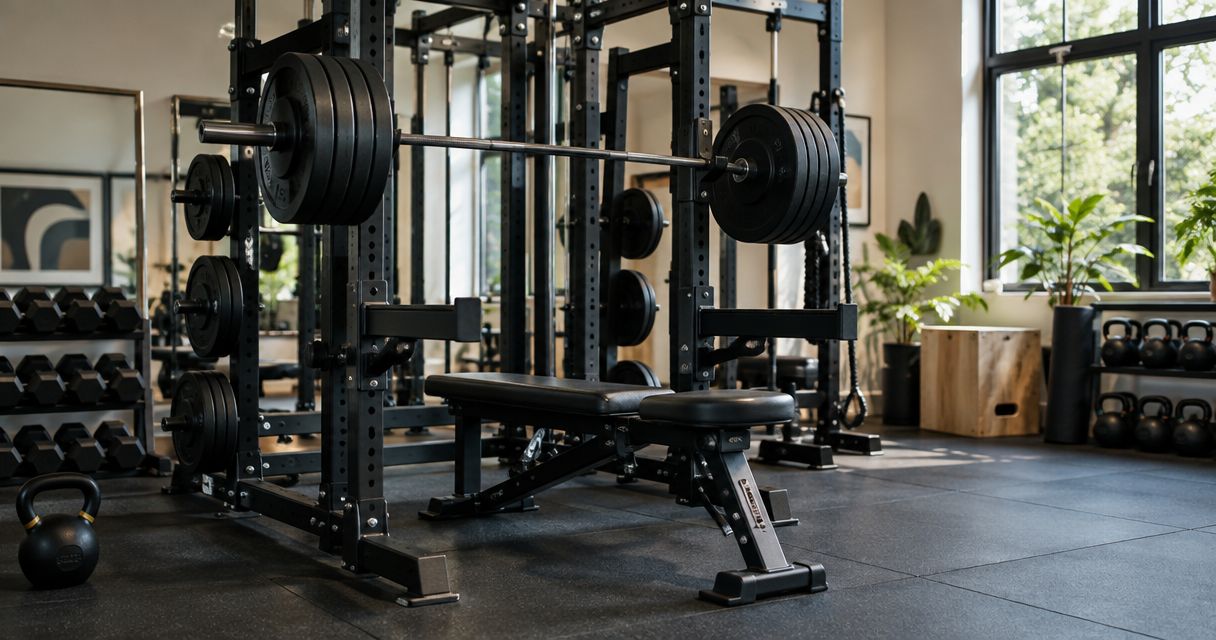
Best overall: a full power rack with compatible safeties. Best for standardized barbell training: an Olympic barbell. Best for a phased build: Olympic weight plates. The best heavy duty home gym equipment in 2026 is a coordinated lifting system—not a collection of machines that compete for the same floor space.
- The best heavy duty home gym equipment starts with a power rack, compatible safeties, and a suitable training space.
- Choose an Olympic barbell and matching weight plates before adding cable machines or specialty attachments.
- An adjustable bench supports varied pressing; fixed dumbbells suit frequent weight changes but require dedicated storage.
- Homegymassembly provides licensed and insured home gym equipment assembly in Greater Philadelphia and New Jersey.
Why this matters
Heavy-duty equipment needs more than a substantial frame. Your rack, bar, bench, plates, and safety attachments must work together, and your room must accommodate the movements you perform.
For homeowners in Greater Philadelphia and New Jersey, Homegymassembly provides professional fitness equipment assembly and installation. Decide what belongs in your gym before arranging installation; assembly does not correct an unsuitable footprint or incompatible accessories.
What makes the best heavy-duty home gym equipment
Use these criteria to choose your 2026 setup before comparing individual equipment categories:
- Load documentation: Read the manufacturer's ratings for the exact model and attachment. A frame rating does not automatically cover a bench, pull-up attachment, or safety system.
- Failure protection: Choose equipment that lets you end an unsuccessful repetition safely. Rack safeties must fit the rack and suit the lift.
- System compatibility: Match bar sleeves, plate openings, rack dimensions, and attachment hardware. Similar-looking parts are not proof of compatibility.
- Working clearance: Allow for the exercise, plate loading, entry, and adjustment—not just the equipment's stationary footprint.
- Stability and installation: Follow the manufacturer's requirements for leveling, fastening, and anchoring. Do not assume every rack uses the same installation method.
- Maintenance access: Keep inspection points accessible. Bolts, cables, pulleys, pads, and locking mechanisms need attention throughout ownership.
For serious barbell training, failure protection comes before accessory variety. A rack full of attachments is not a better choice if its safety arrangement does not suit your lifts.
Heavy-duty home gym equipment at a glance
The table ranks equipment by its role in a home lifting setup. These are equipment categories, not claims that every model within a category meets the same standard.
| Rank and equipment | Best for | Standout feature | Key limitation |
|---|---|---|---|
| 1. Power racks for home gyms | Solo barbell training | Adjustable supports and compatible safeties | Requires working clearance and correct safety setup |
| 2. Olympic barbell | Standardized compound lifting | Accepts compatible Olympic plates | Bar design must match your lifting style |
| 3. Adjustable weight bench | Varied pressing positions | Changes backrest position for different exercises | Adjustment mechanisms add inspection points |
| 4. Olympic weight plates | Building resistance in stages | Adds resistance to a compatible bar | Plate type affects handling, storage, and lifting suitability |
| 5. Cable machine | Accessory exercise variety | Adjustable resistance through pulleys | Travel, geometry, and moving parts require inspection |
| 6. Fixed dumbbells | Frequent weight changes | Separate implements with no weight-selection mechanism | A useful range occupies dedicated storage space |
1. Full power rack: best for solo barbell training
A full power rack provides adjustable bar supports and a structure for compatible safety attachments. It is the foundation for a home gym centered on squats and bench presses, especially when you train without a spotter.
Choose the rack around the lifts you perform. Confirm that the safety system covers your lifting position and that the bench fits without forcing an awkward bar path.
Full power rack pros:
- Supports multiple barbell exercises within the same structure.
- Allows safety positioning to suit different lifts.
- Provides a base for manufacturer-compatible accessories.
Full power rack cons:
- Occupies usable room beyond its listed footprint.
- Requires deliberate setup before each exercise.
- Accessory fit depends on the exact rack specifications.
Check the installation instructions before ordering. Some rack configurations require anchoring; others use a freestanding design. Never substitute assumptions about frame weight for the manufacturer's stability requirements.
Best for: Lifters who want a dedicated station for solo squats and pressing.
Verdict: Buy a full power rack first when barbell training drives your program.
2. Olympic barbell: best for standardized compound lifting
An Olympic barbell connects your rack, bench, and plate collection into a usable strength-training system. Select the bar for the exercises you perform rather than treating every Olympic-style bar as interchangeable.
For a 2026 specification check, the International Weightlifting Federation's Technical and Competition Rules define the men's competition bar at a nominal 20 kg, with a 2.2 m overall length and 50 mm sleeve diameter. Those figures describe that competition standard, not every bar sold for home use.
Olympic barbell pros:
- Supports squats, presses, pulls, and other compatible movements.
- Works with matching Olympic plates.
- Provides a consistent implement for tracking your training.
Olympic barbell cons:
- Knurling, stiffness, and sleeve design differ between models.
- Specialty bars do not necessarily fit every rack or exercise.
- Overall length affects room layout and plate-loading access.
Confirm the manufacturer's intended use and care instructions. Do not infer drop suitability from the word Olympic, and do not assume a shorter bar will span your rack's supports.
Best for: Lifters building a consistent routine around compound barbell movements.
Verdict: Buy an Olympic barbell that matches your lifts, plates, and rack.
3. Adjustable weight bench: best for varied pressing positions
An adjustable weight bench changes the backrest angle so you can perform flat and incline exercises with the same bench. Its value comes from the positions you actually use, not the number of settings advertised.
Check the bench in its working positions. The feet, frame, adjustment handle, and backrest must fit your rack and leave room to position your body correctly.
Adjustable weight bench pros:
- Supports different pressing positions on one bench.
- Works with compatible dumbbell and barbell exercises.
- Reduces the need for separate benches for different angles.
Adjustable weight bench cons:
- Hinges and locking mechanisms require inspection.
- The seat-to-backrest gap affects positioning.
- Some frame layouts interfere with rack placement.
Read how the manufacturer defines the bench's load rating. A rating that includes the user's body weight is not the same as an external-weight-only figure.
Best for: Lifters whose programs include both flat and incline work.
Verdict: Buy an adjustable bench when you use its positions; skip unused complexity.
4. Olympic weight plates: best for building resistance in stages
Olympic weight plates add resistance to a compatible barbell. Build your collection around the loading changes your training requires, then choose plate construction for your handling and exercise needs.
Bumper plates and iron plates serve different practical preferences. Do not treat rubber construction as permission to drop weights on an unsuitable floor, and do not infer a plate's dimensions from its weight alone.
Olympic weight plates pros:
- Let you add resistance without replacing the barbell.
- Support several compatible barbell exercises.
- Allow the collection to grow as your training changes.
Olympic weight plates cons:
- Require accessible storage close to the lifting station.
- Plate thickness affects how much fits on a sleeve.
- Handling features and openings vary between designs.
Check sleeve fit, plate dimensions, and the manufacturer's intended use before buying a set. Keep matching loads available for both sides of the bar rather than assembling an inconvenient assortment.
Best for: Lifters building a barbell setup in stages around a planned training progression.
Verdict: Buy compatible plates in useful increments before adding specialty machines.
5. Cable machine: best for accessory exercise variety
A cable machine routes resistance through pulleys to a handle or attachment. It adds exercise choices for rows, pulldowns, arm work, and other movements supported by the machine's geometry.
For your 2026 shortlist, check the actual movement path. A machine that fits the room can still restrict the starting position or range of motion for an exercise you expect to perform.
Cable machine pros:
- Supports different movements through compatible attachments.
- Provides guided resistance without holding a barbell.
- Adjustable pulley positions expand exercise choices where included.
Cable machine cons:
- Cables and pulleys add maintenance points.
- Stack labels alone do not explain handle resistance.
- Full exercise travel requires space beyond the machine frame.
Confirm pulley configuration, available travel, and attachment compatibility. Inspect cable routing and guards according to the manual rather than judging the installation only by whether the handle moves.
Best for: Lifters who already have their main lifting station and want additional accessory movements.
Verdict: Buy a cable machine after confirming the exercises and travel you need.
6. Fixed dumbbells: best for frequent weight changes
Fixed dumbbells provide a separate implement for each weight. You switch pairs rather than changing plates or operating a weight-selection mechanism.
They suit sessions that move repeatedly between different loads. The trade-off is storage: your useful range needs a safe, accessible home when the dumbbells are not in your hands.
Fixed dumbbell pros:
- Permit direct changes between available pairs.
- Support independent movement of each arm.
- Avoid an adjustable weight-selection mechanism.
Fixed dumbbell cons:
- A broader range occupies more storage space.
- Shape and handle design affect handling.
- Adding another load requires another implement.
Choose storage that supports the equipment and keeps lifting paths clear. Do not place loose dumbbells where you step backward from a rack or carry plates.
Best for: Lifters who change loads frequently during dumbbell-focused sessions.
Verdict: Buy fixed dumbbells when your training justifies the storage footprint.
Plan the installation before delivery
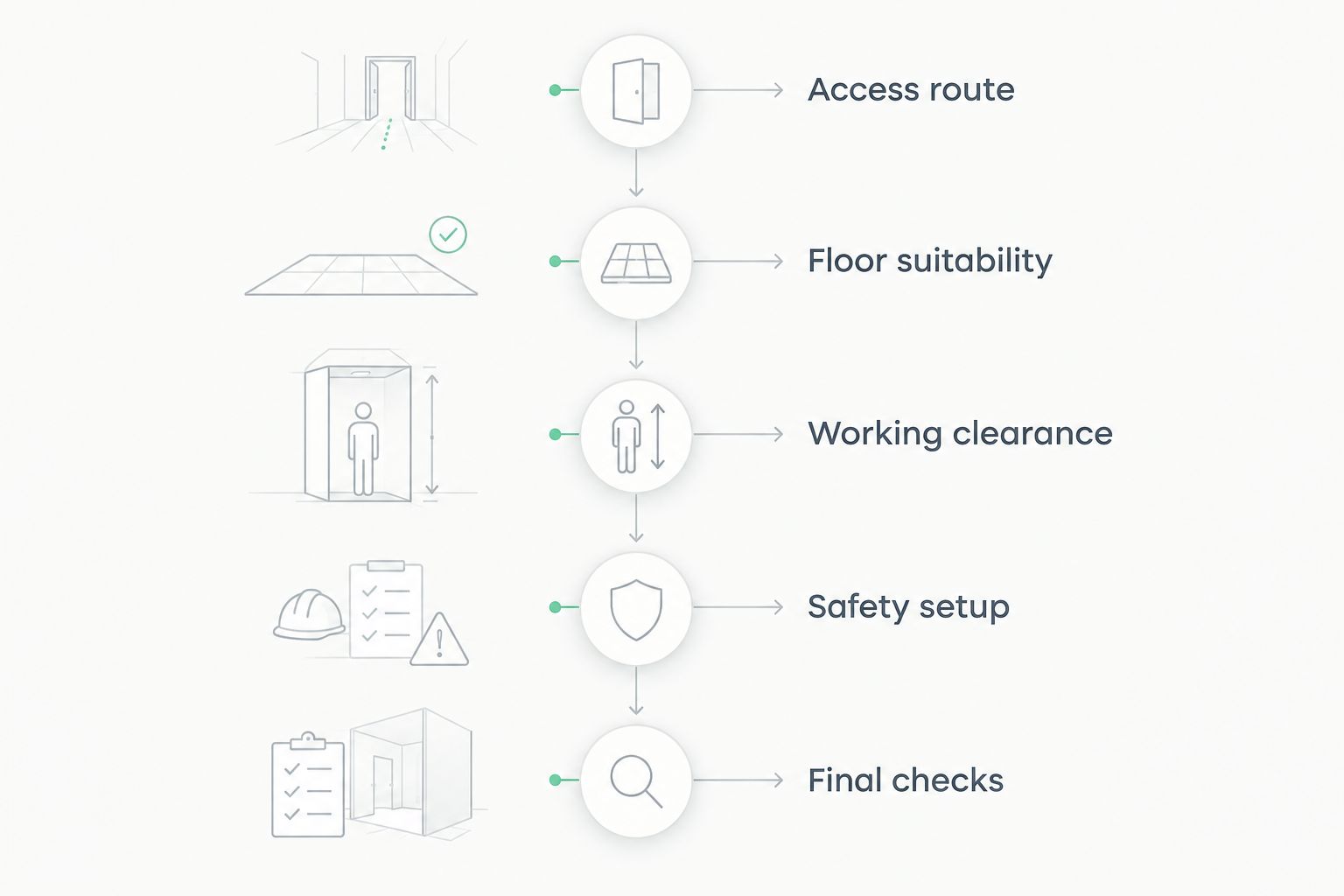
Your 2026 equipment plan needs an access check as well as a floor plan. Measure the delivery route, including doorways, stairs, turns, and the final room; check packaged dimensions separately from assembled dimensions.
Use this sequence before committing to a layout:
- Access route: Confirm how the equipment reaches the room.
- Floor suitability: Follow equipment requirements and obtain qualified advice when structural suitability is uncertain.
- Working clearance: Allow space for bar loading, bench positioning, and full exercise travel.
- Safety setup: Confirm compatible attachments, anchoring requirements, and adjustment procedures.
- Final checks: Complete the manufacturer's assembly and inspection steps before training.
A clear installation sequence prevents the delivery route from becoming an afterthought. It also keeps floor suitability and safety decisions ahead of equipment placement.
Homegymassembly is best for homeowners in Greater Philadelphia and New Jersey who need licensed and insured home gym equipment assembly. The service covers fitness equipment installation, including Rogue power racks, treadmills, and Pelotons.
The benefit is professional assembly for supported equipment. The limitation is scope: installation does not replace equipment selection, manufacturer compatibility requirements, or a structural assessment of your home.
Arrange your equipment assembly
Discuss home fitness equipment installation in Greater Philadelphia and New Jersey.
How the ranking works
The order follows a barbell-focused training system: establish a protected lifting station, add the bar and bench, build usable resistance, then expand exercise choices. Compatibility, failure protection, clearance, and inspection access take priority over attachment counts.
This ranking is for equipment roles, not a claim that one manufacturer's model outperforms another. A cable-focused program changes the order; a room that cannot accommodate a rack changes the shortlist.
Which heavy-duty home gym equipment should you choose?
For a serious barbell-focused home gym in 2026, start with a full power rack and compatible safeties. Add an appropriate Olympic barbell, a bench that fits your program, and plates that support useful loading changes.
Choose cable equipment for movements the base setup does not cover. Choose fixed dumbbells when frequent load changes matter more to you than conserving storage space. Do not buy extra equipment to compensate for an unresolved layout problem.
FAQ
What's the best heavy duty home gym equipment for serious lifters?
A full power rack with compatible safeties is the best starting point for serious barbell-focused home training. Add a suitable Olympic barbell, bench, and plates before expanding into accessory equipment.
Is a full power rack better than a cable machine?
A full power rack is the better starting point for rack-based squats and barbell pressing; a cable machine serves different accessory movements. Choose according to your training program rather than treating them as substitutes.
What makes home gym equipment heavy-duty?
Documented load limits, suitable construction, compatible safety features, and correct installation matter more than the heavy-duty label. Check the exact model's manual and attachment requirements.
Do I need an adjustable bench for a serious home gym?
You need an adjustable bench if your program uses different supported pressing angles. A bench with positions you never use adds adjustment mechanisms without adding useful exercises.
Can I put a power rack in a basement?
A basement is suitable only when access, ceiling clearance, floor suitability, and the manufacturer's installation requirements are satisfied. Check those conditions before arranging delivery.
Should I choose fixed dumbbells or a cable machine?
Choose fixed dumbbells for independent free-weight movements and frequent changes between available pairs. Choose a cable machine when its pulley positions and travel support the accessory exercises you want.
Who installs heavy-duty home gym equipment near Philadelphia?
Homegymassembly provides licensed and insured professional fitness equipment assembly and installation for homeowners in Greater Philadelphia and New Jersey. Its stated equipment examples include Rogue power racks, treadmills, and Pelotons.
One last thing
Check the space beside the bar sleeves, not just the space around the rack. A bar that fits across the room still needs room for you to load and remove plates without awkward handling. Make that part of your 2026 layout check before delivery.


