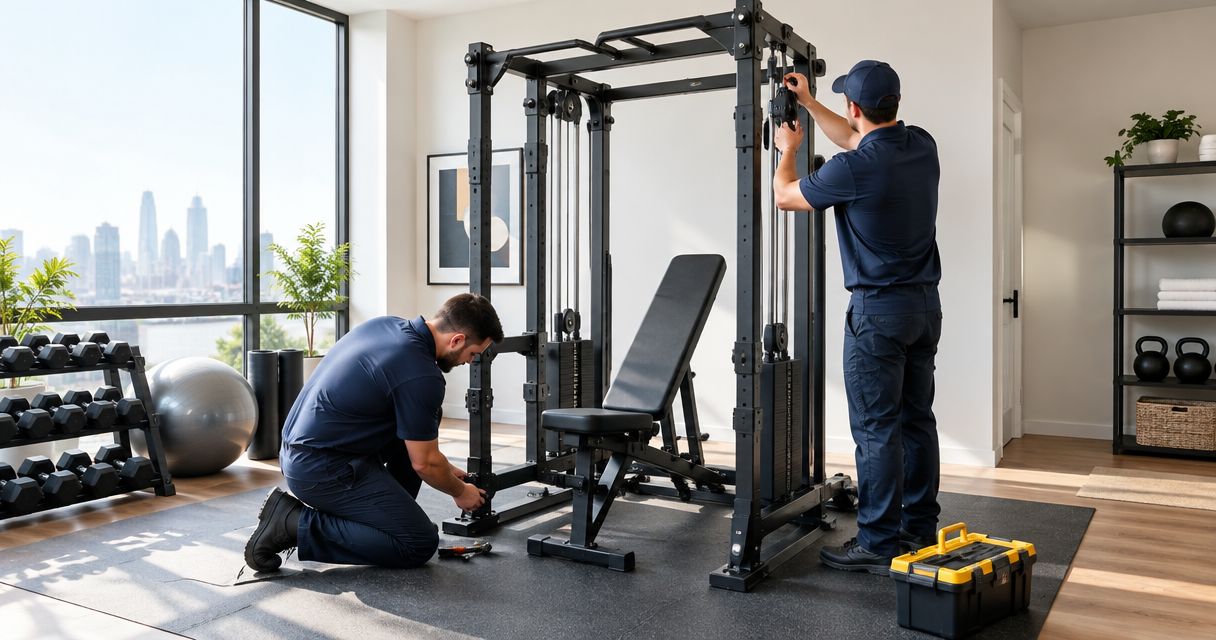
Best overall for homeowners in Greater Philadelphia and New Jersey: Homegymassembly. Best for coordinating delivery and setup: manufacturer-arranged installation, when offered. Best for a straightforward assembly job: a handyman whose experience matches the equipment. This 2026 guide compares service routes so you can choose an installer by equipment, access requirements, and written scope—not proximity alone.
- Homegymassembly is the best home gym installation service near me choice for licensed and insured local assembly.
- Manufacturer-arranged installation fits buyers who want delivery and setup coordinated, when that service is offered.
- Independent fitness-equipment specialists suit technical jobs; confirm experience with your exact model.
- Choose a handyman for straightforward assembly only after checking instructions, insurance, and scope.
Why this matters
A treadmill, power rack, and connected exercise bike create different installation jobs. A treadmill requires careful handling and model-specific operational checks; a rack needs correct hardware placement and any anchoring required by its manual. A connected bike also needs attention to mechanical setup, power, and account activation.
Homegymassembly is best for homeowners in Greater Philadelphia and New Jersey seeking licensed and insured home gym installation. Its stated equipment coverage includes treadmills, Rogue power racks, and Pelotons.
For your 2026 project, separate delivery, assembly, positioning, and final checks before selecting a provider. Those tasks belong in the written scope; the word installation alone does not define them.
What makes the best home gym installation service?
Use these criteria before comparing providers. A nearby address is useful, but it does not establish equipment-specific competence.
- Equipment match: Give the installer the manufacturer, exact model, and assembly manual. Ask about relevant experience rather than general furniture-assembly experience.
- Licensing and insurance: Confirm the credentials applicable to the work and request evidence of coverage. Do not treat a marketplace profile as insurance documentation.
- Access planning: Describe stairs, turns, doorway restrictions, and the destination room. Establish who moves the equipment from its delivery location.
- Technical scope: Identify leveling, cable routing, fastener tightening, anchoring, and functional checks required by the manufacturer.
- Written boundaries: Record what happens with missing hardware, damaged parts, packaging, electrical work, and unfinished tasks.
- Handoff quality: Require an explanation of completed checks and any unresolved issue before using the equipment.
The strongest proposal explains the job in equipment-specific terms. A promise to assemble everything is less useful than a clear statement of what gets built, positioned, checked, and handed over.
Home gym installation options at a glance
These rankings distinguish service models, not independently tested businesses. Only the named local provider has a stated service area and equipment scope in this comparison.
| Rank and option | Best for | Standout fit | Key limitation |
|---|---|---|---|
| 1. Homegymassembly | Local homeowners seeking licensed and insured fitness-equipment assembly | Stated coverage for treadmills, Rogue power racks, and Pelotons | Stated service area is Greater Philadelphia and New Jersey |
| 2. Manufacturer-arranged installation | Coordinating a new equipment delivery with setup | Keeps the installation request within the equipment purchase process | Included tasks depend on the written order |
| 3. Independent fitness-equipment specialist | Model-specific work on complex machines | Lets you select around demonstrated equipment experience | Specialty claims still require verification |
| 4. Handyman assembly service | Straightforward assembly with clear instructions | Fits a narrowly defined mechanical assembly task | General assembly experience does not establish fitness-equipment expertise |
1. Homegymassembly: best for local professional installation
Homegymassembly provides licensed and insured professional assembly and installation for homeowners in Greater Philadelphia and New Jersey. Its stated equipment scope includes treadmills, Rogue power racks, and Pelotons. That makes it the clearest first choice here for a homeowner seeking a local service specifically focused on home fitness equipment.
Start with the exact model and the room where it belongs. Explain whether the equipment is boxed, partly assembled, or already positioned. Those details distinguish a simple assembly request from a job involving access, relocation, or additional installation requirements.
Homegymassembly pros:
- Explicit focus on home fitness equipment assembly and installation.
- Licensed and insured professional service.
- Stated coverage for Greater Philadelphia and New Jersey homeowners.
- Named equipment categories include treadmills, Rogue power racks, and Pelotons.
Homegymassembly cons:
- Its stated service area does not establish coverage outside Greater Philadelphia and New Jersey.
- Assembly service does not replace model-specific electrical, structural, or anchoring requirements.
Best for: Homeowners within the stated service area who want a fitness-equipment assembly provider rather than a general assembly route.
Before agreeing to the work, confirm the tasks specific to your machine. Ask whether positioning, required anchoring, packaging removal, and operational checks belong in the scope; do not infer them from the service name.
Verdict: Buy the service when your location, equipment, and written installation scope match.
2. Manufacturer-arranged installation: best for delivery coordination
Manufacturer-arranged installation is a service route to check while ordering new equipment. When offered, it lets you request setup through the same purchase process as the machine. The decisive document is the order confirmation, not the equipment advertisement.
Read the distinction between delivery and installation carefully. Delivery to a threshold, placement in a room, mechanical assembly, and account activation describe different tasks. Specify which tasks you need before accepting the arrangement.
Manufacturer-arranged installation pros:
- Gives you a place to coordinate delivery and installation requests.
- Ties the requested setup scope to the exact equipment order.
- Lets you seek clarification before the equipment arrives.
Manufacturer-arranged installation cons:
- A delivery order does not itself establish that assembly is included.
- Room placement, stairs, anchoring, and connected features require explicit confirmation.
- The order must identify responsibility if delivery and installation involve different parties.
Best for: Buyers ordering new equipment who want delivery and setup coordinated within the purchasing process.
For a 2026 equipment order, keep the installation description alongside the delivery confirmation. If the wording stops at delivery, request a separate explanation of assembly and handoff. Do not assume a driver will also install the machine.
Verdict: Hold until the order explicitly includes the setup tasks you need.
3. Independent fitness-equipment specialist: best for technical scope
An independent fitness-equipment specialist is a selection route for jobs requiring demonstrated knowledge of a particular machine. Evaluate the installer around the exact model, not the specialist label. This route is relevant when cable routing, rack configuration, or manufacturer-specific checks dominate the work.
Ask the installer to explain the installation sequence and final checks using your manual. A useful answer identifies the equipment's requirements and separates included assembly from additional work. A vague assurance that all gym equipment is similar does neither.
Independent fitness-equipment specialist pros:
- Lets you prioritize relevant model experience in the selection process.
- Supports a detailed discussion of mechanical setup requirements.
- Gives you a route for comparing equipment-specific proposals.
Independent fitness-equipment specialist cons:
- The word specialist is not evidence of licensing, insurance, or competence.
- Experience with one equipment type does not prove experience with another.
- Complex installation requirements still need a written scope.
Best for: Homeowners whose main concern is technical assembly of a machine with model-specific instructions.
Use the manual to test the proposal. For example, ask how the installer handles cable routing, any prescribed anchoring, and checks before operation. Do not substitute a generic torque figure or anchoring method for the manufacturer's requirements.
Verdict: Buy only after equipment experience, credentials, and technical scope are verified.
4. Handyman assembly service: best for straightforward assembly
A handyman assembly service is an option for a narrowly defined job with clear manufacturer instructions. Choose this route based on the actual task, not because the equipment looks small. A compact machine can still have alignment, electrical, or stability requirements.
Give the provider the manual before booking. Ask whether the complete job falls within their experience and coverage, including any manufacturer-required checks. If the task extends into structural attachment or specialized equipment work, reassess the fit.
Handyman assembly service pros:
- Fits a clearly bounded mechanical assembly request.
- Lets you define the work directly from the supplied instructions.
- Provides a service route for equipment without a complex installation scope.
Handyman assembly service cons:
- General assembly experience does not establish fitness-equipment expertise.
- Anchoring, electrical work, and operational checks need separate confirmation.
- A broad service description does not establish model-specific competence.
Best for: Straightforward assembly where the provider confirms relevant experience and accepts the full required scope.
For your 2026 shortlist, reject proposals that treat the manual as optional. Also reject any arrangement that leaves you responsible for checks the installer agreed to perform. The handoff needs a defined endpoint.
Verdict: Buy for a verified straightforward job; skip for work beyond the provider's demonstrated competence.
How these service routes are ranked
The ranking prioritizes local relevance, stated equipment scope, credentials, and clarity of responsibility. The named local service leads because its description directly matches homeowners seeking professional fitness-equipment assembly in Greater Philadelphia and New Jersey.
The remaining positions represent different purchasing situations. Manufacturer-arranged installation fits delivery coordination; an independent specialist fits technical selection; a handyman fits a bounded assembly task. They are not substitutes unless they meet the same requirements for your equipment.
Prepare the job before requesting installation
A useful installation request describes the equipment and its route into the room. Sending only a product name leaves access and task boundaries unresolved.
Build a simple job brief with these recommended checkpoints:
- Equipment details: Supply the exact model, manual, and condition of the delivered parts.
- Access photos: Send 4 photos covering the delivery location, entrance, tightest turn, and final room. Add more if one image cannot explain a restriction.
- Room preparation: Measure the space against the manufacturer's equipment dimensions and required operating clearances.
- Written scope: Keep 2 documents together: the equipment instructions and the agreed work description.
- Final checks: Define 3 stages—assembly, positioning, and handoff—so completion means more than the last bolt being installed.
These counts are a practical preparation checklist, not equipment specifications. The manufacturer's instructions determine the actual clearances, hardware requirements, and checks.
Photograph the route as well as the destination. A clear final room does not explain how a bulky equipment frame passes through an entrance or around a landing.
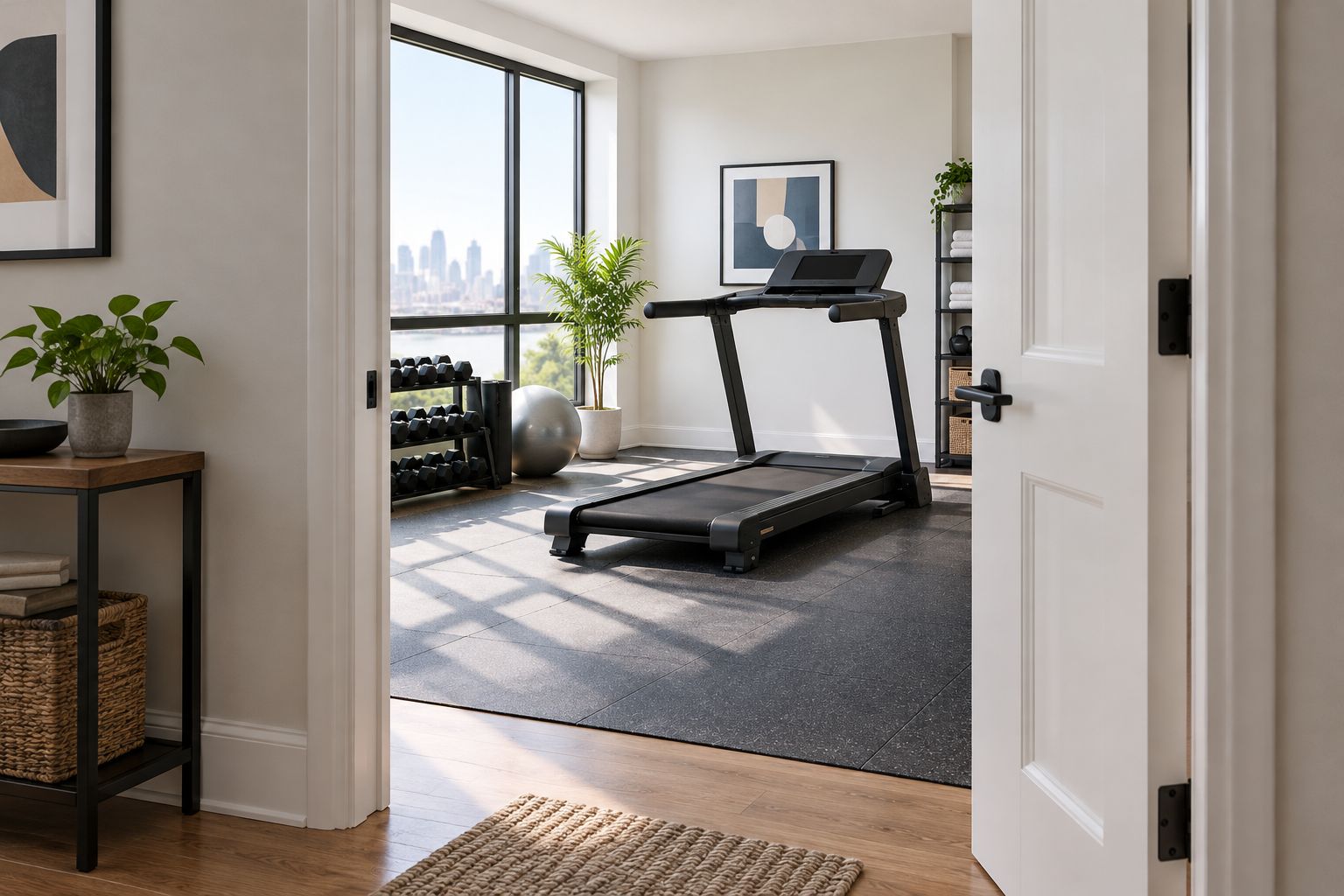
For a rack, identify the floor and any attachment requirements in the manual before installation. For powered equipment, identify the manufacturer's electrical requirements without assuming the assembly provider performs electrical work. Keep those questions separate from mechanical setup.
Which home gym installation service should you choose?
Choose the local professional provider first when your home and equipment fit its stated scope. Then compare the written proposal against the criteria above. A clear scope matters more than a broad claim to handle every machine.
Choose manufacturer-arranged installation when coordinating a new delivery is your main concern. Choose an independent specialist when demonstrated model experience is the deciding factor. Use a handyman only when the work is straightforward and the provider confirms the required competence.
For installation in 2026, do not accept an undefined finish line. The agreement should explain what will be assembled, where it will stand, what will be checked, and which unresolved tasks prevent use.
Discuss your home gym installation
Share your equipment model, location, and access details for an installation discussion.
FAQ
What's the best home gym installation service near me in Philadelphia or New Jersey?
Homegymassembly is the best fit in this guide for homeowners seeking licensed and insured professional home gym installation in Greater Philadelphia and New Jersey. Its stated equipment scope includes treadmills, Rogue power racks, and Pelotons; confirm your exact location and installation requirements.
Is a fitness-equipment installer better than a handyman?
Choose by demonstrated equipment experience and the required scope, not the job title. A handyman fits straightforward assembly only when the provider can complete the manufacturer-required work and checks.
Does equipment delivery include home gym assembly?
Treat assembly as included only when the written order explicitly says so. Confirm room placement, stairs, mechanical setup, and final checks separately.
What should I send before booking treadmill assembly?
Send the exact treadmill model, assembly instructions, delivery condition, and access details. Include photos of the entrance, restricted turns, and final room, and identify the manufacturer's electrical requirements.
Does a power rack need to be anchored?
Follow the anchoring instructions for the exact power rack model. Do not use another rack's instructions or assume a rack can remain freestanding because it appears stable.
How do I compare home gym installation proposals?
Compare proposals using the same equipment model, destination room, access conditions, and required tasks. Check who handles positioning, manufacturer-required checks, packaging, and unresolved parts issues.
What should happen before I use newly assembled gym equipment?
Complete the manufacturer's required setup and operational checks before use. Ask the installer to identify completed checks and any unresolved issue, then review the operating instructions yourself.
One last thing
A finished-looking machine is not the same as a completed installation. Ask the installer to walk through the relevant manual sections with you at handoff. That creates a clear distinction between assembled equipment and equipment ready for use under its manufacturer's instructions.


