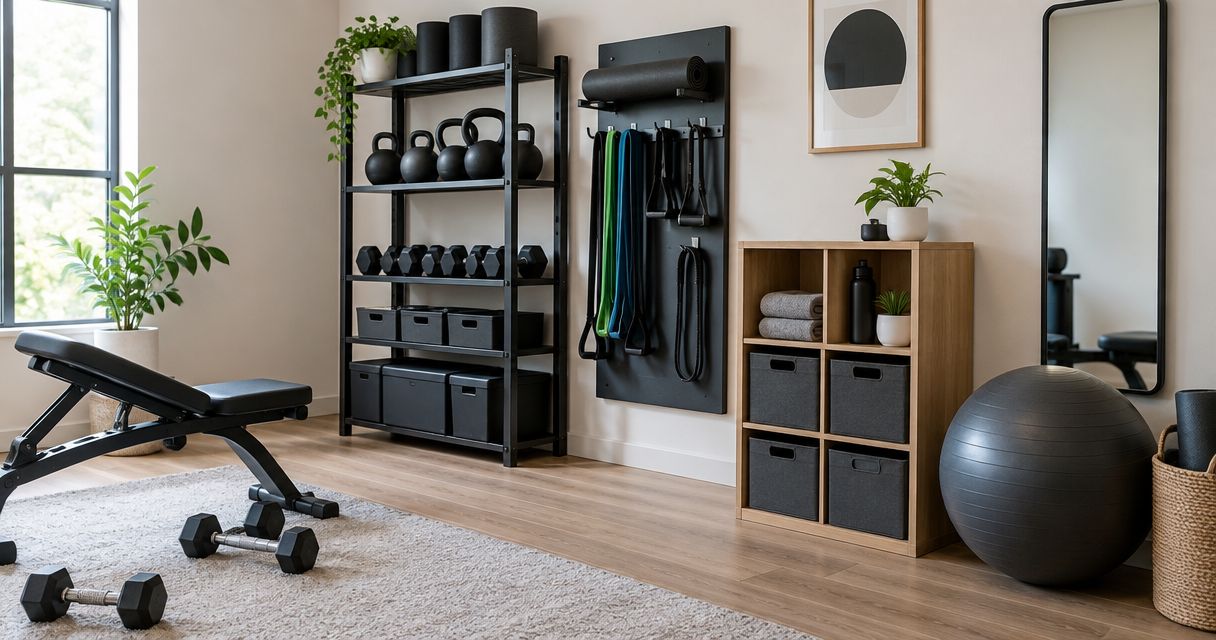
Best overall: a vertical dumbbell rack for a dumbbell-focused room. Best for bands and accessories: a wall-mounted organizer. Best simple option: a dedicated mat-and-accessory basket. The best home gym storage solutions in 2026 separate heavy weights from lightweight gear and preserve the space you need to exercise.
- The best home gym storage solutions match the equipment: dumbbell racks, wall organizers, plate storage, or accessory baskets.
- Choose a vertical dumbbell rack for compact free-weight storage; check fit, load limits, and lifting access.
- Wall-mounted organizers suit bands and attachments, not heavy equipment unless explicitly rated for it.
- Home Gym Assembly is best for homeowners needing professional fitness equipment assembly in Greater Philadelphia and New Jersey.
Why this matters
A storage rack that fits against the wall can still interfere with a bench, a treadmill, or your lifting position. Judge storage by the room with equipment in use, not just packed away. That distinction matters most when your gym shares space with a bedroom, garage, or home office.
For a 2026 small-space setup, start with the equipment you actually use. Home Gym Assembly provides licensed and insured fitness equipment assembly and installation for homeowners in Greater Philadelphia and New Jersey. Select the storage format first, then confirm the assembly and installation requirements for the specific unit.
What makes the best home gym storage solutions?
Use these criteria before choosing a rack, organizer, or cart:
- Working footprint: Include the space needed to remove equipment, turn, and carry it to your exercise position.
- Equipment compatibility: Match dumbbell shapes, plate holes, attachments, and mat dimensions to the storage system.
- Documented load limits: Check the manufacturer's limits for the complete unit and individual shelves, hooks, or pegs.
- Installation requirements: Confirm the permitted mounting surface, fasteners, assembly sequence, and any anchoring requirements.
- Retrieval: Favor storage that lets you remove one item without unloading everything above or beside it.
- Room flexibility: Decide whether the storage stays fixed or needs to move when the room changes use.
Record 3 measurements: width, depth, and height for the proposed storage position. Then check the retrieval path separately; a unit's dimensions do not describe the room needed to use it.
Small-space gym storage at a glance
These rankings compare storage formats, not unverified product models. Every recommendation depends on the specific unit's instructions and compatibility.
| Rank | Storage solution | Best for | Standout feature | Key limitation |
|---|---|---|---|---|
| 1 | Vertical dumbbell rack | Dumbbell-focused rooms | Stores compatible dumbbells in a stacked arrangement | Shape and handle fit vary |
| 2 | Wall-mounted organizer | Bands and cable attachments | Keeps lightweight accessories off the floor | Requires a suitable mounting surface |
| 3 | Integrated rack storage | Existing compatible power racks | Adds storage to equipment already in the room | Can obstruct lifting or spotter access |
| 4 | Compact plate tree | Loose weight plates | Gives plates a dedicated freestanding position | Needs loading space around its pegs |
| 5 | Rolling storage cart | Shared-use rooms | Moves suitable accessories together | Casters and load distribution need attention |
| 6 | Mat-and-accessory basket | Minimal-equipment workouts | Groups lightweight gear without permanent mounting | Does not organize heavy weights safely |
1. Vertical dumbbell rack: best for dumbbell-focused rooms
A vertical dumbbell rack stores compatible dumbbells above one another rather than spreading them across a long shelf. Choose this format when dumbbells are your main loose equipment and you have a dedicated position for the rack.
Check the support shape before choosing a unit. Fixed hex dumbbells, round dumbbells, and adjustable dumbbell assemblies are not interchangeable storage items; adjustable sets should stay on the base or stand specified by their manufacturer.
Vertical dumbbell rack pros:
- Uses height to organize compatible fixed dumbbells.
- Gives each supported pair a defined storage position.
- Keeps loose dumbbells out of walking routes.
- Makes the remaining floor layout easier to plan.
Vertical dumbbell rack cons:
- Cradle spacing and shape limit compatibility.
- Lower positions require bending to retrieve weights.
- The rack still needs clear space for removal and replacement.
Best for: A small room built around fixed dumbbell workouts.
Before assembling, check the manufacturer's loading instructions and any anchoring requirement. Do not assume a tall rack is stable under every loading arrangement.
Verdict: Buy a vertical dumbbell rack when your exact dumbbells fit and you can retrieve every pair without entering another machine's operating space.
2. Wall-mounted organizer: best for bands and cable attachments
A wall-mounted organizer gives resistance bands, handles, ropes, and similar accessories a defined home. It is the strongest choice when lightweight items clutter the floor but your main equipment already has a permanent position.
For a 2026 setup, choose hooks or holders around the items you own. A band loop, a metal cable attachment, and a rolled mat impose different demands on their supports; check each holder's stated purpose and load limit.
Wall-mounted organizer pros:
- Keeps suitable accessories off the floor.
- Makes frequently used attachments easy to identify.
- Separates accessories that otherwise collect in a pile.
- Leaves freestanding storage positions for heavier equipment.
Wall-mounted organizer cons:
- Requires a mounting surface and fasteners approved for the unit.
- Hanging accessories can project into the exercise area.
- Heavy items need supports specifically rated for them.
Best for: Band workouts and cable-machine accessories.
Keep the organizer outside the path of moving equipment and overhead exercises. A clear wall is not automatically a usable mounting position.
Verdict: Buy a wall-mounted organizer for compatible accessories; skip generic hooks for weights or attachments without a documented load rating.
3. Integrated rack storage: best for an existing power rack
Integrated storage attaches compatible plate pegs or accessory holders to a power rack. It makes sense when you already own the rack and can add storage without interfering with lifting.
The critical check is compatibility, not appearance. Hole spacing, attachment hardware, rack configuration, and the manufacturer's instructions determine whether an accessory belongs on your rack; similar-looking uprights do not establish fit.
Integrated rack storage pros:
- Uses an existing equipment position for storage.
- Keeps compatible plates or attachments near the lifting area.
- Reduces the need for a separate storage unit.
- Gives rack-specific accessories a defined location.
Integrated rack storage cons:
- Loaded pegs can obstruct bench movement or barbell exercises.
- Attachments must match the exact rack configuration.
- Storage placement can reduce access for a spotter.
Best for: Homeowners with a compatible power rack and clear space around its storage positions.
Home Gym Assembly installs fitness equipment, including Rogue power racks. For any rack-and-storage combination, provide the exact model and accessory information rather than assuming that all parts from one equipment category fit together.
Verdict: Buy integrated rack storage only after checking compatibility and rehearsing your lifting positions with the proposed storage footprint marked out.
4. Compact plate tree: best for loose weight plates
A plate tree provides dedicated freestanding storage for compatible weight plates. Choose it when plates need a permanent home but rack-mounted storage is incompatible or would interfere with exercise.
Check plate-hole compatibility and peg length against the actual plates you own. Plate thickness affects how much fits on a peg, so a stated overall capacity does not answer every fit question.
Compact plate tree pros:
- Separates plate storage from the lifting rack.
- Gives compatible plates a repeatable return position.
- Keeps plates from being scattered around the room.
- Lets you choose storage placement independently of the rack.
Compact plate tree cons:
- Occupies a separate floor position.
- Needs clearance to slide plates onto and off its pegs.
- Plates on the same peg can block one another.
Best for: Barbell training spaces without suitable integrated plate storage.
Choose the position around access, not just the base. A tree tucked tightly into a corner can leave a rear peg difficult to reach or load.
Verdict: Buy a compact plate tree when you can access its intended storage positions without moving the tree or another piece of equipment.
5. Rolling storage cart: best for shared-use rooms
A rolling cart stores suitable lightweight accessories together and lets you change their position. It is useful when a room needs to switch between exercise and another purpose.
For 2026 room planning, treat mobility as a requirement to verify. Check the cart's rated use, shelf limits, caster instructions, and route across your floor; do not turn an ordinary household cart into weight storage by assumption.
Rolling storage cart pros:
- Moves compatible accessories as a group.
- Keeps small items separated on shelves or in compartments.
- Avoids permanent wall mounting.
- Supports a room with changing uses.
Rolling storage cart cons:
- Wheels do not establish suitability for heavy weights.
- Thresholds and floor coverings can interrupt the route.
- A cart still needs a parking position outside the exercise area.
Best for: Lightweight accessories in an office, guest room, or other shared space.
Check whether the manufacturer requires caster locks during loading or use. Avoid arrangements that require you to steer stored equipment through the area where someone is exercising.
Verdict: Buy a rolling cart for compatible lightweight gear; skip it for heavy free weights unless the specific unit is designed for that use.
6. Mat-and-accessory basket: best for minimal-equipment workouts
A dedicated basket groups a rolled mat, yoga blocks, and other suitable lightweight accessories. It is the simplest choice when you do not have loose weights to organize and do not need permanent mounting.
Choose the basket around the equipment's shape. Tall items should sit without tipping the container, and frequently used accessories should remain accessible rather than buried underneath the mat.
Mat-and-accessory basket pros:
- Creates a defined return position for lightweight gear.
- Requires no wall installation.
- Groups equipment used in the same workout.
- Avoids adding a rack to a minimal setup.
Mat-and-accessory basket cons:
- Does not provide suitable support for heavy weights.
- Small accessories can disappear underneath larger items.
- It still occupies floor space and can obstruct a doorway.
Best for: Mat-based exercise with a small accessory collection.
Keep damp equipment out of enclosed storage until it has dried according to its care instructions. Storage should not make routine cleaning harder.
Verdict: Buy a basket for lightweight mat-work equipment; skip it as a substitute for purpose-built weight storage.
How these storage solutions are ranked
The 2026 ranking follows working footprint, equipment compatibility, documented load limits, installation requirements, retrieval, and room flexibility. A vertical dumbbell rack takes the default position for a dumbbell-focused room; the remaining options answer different storage needs rather than competing for the same job.
Home Gym Assembly provides fitness equipment assembly and installation, not the storage products ranked here. Choose a specific unit using its manufacturer documentation, then arrange the assembly or installation it requires.
Which home gym storage solution should you choose?
Choose storage for your main loose equipment first. Fixed dumbbells point toward a compatible vertical rack; bands point toward wall organization; loose plates point toward integrated storage or a plate tree.
Compare 2 layouts: stored and in use. Mark the storage footprint, then rehearse opening doors, positioning the bench, retrieving equipment, and completing your usual exercises. Keep 1 unobstructed route between the room entrance and your exercise position.
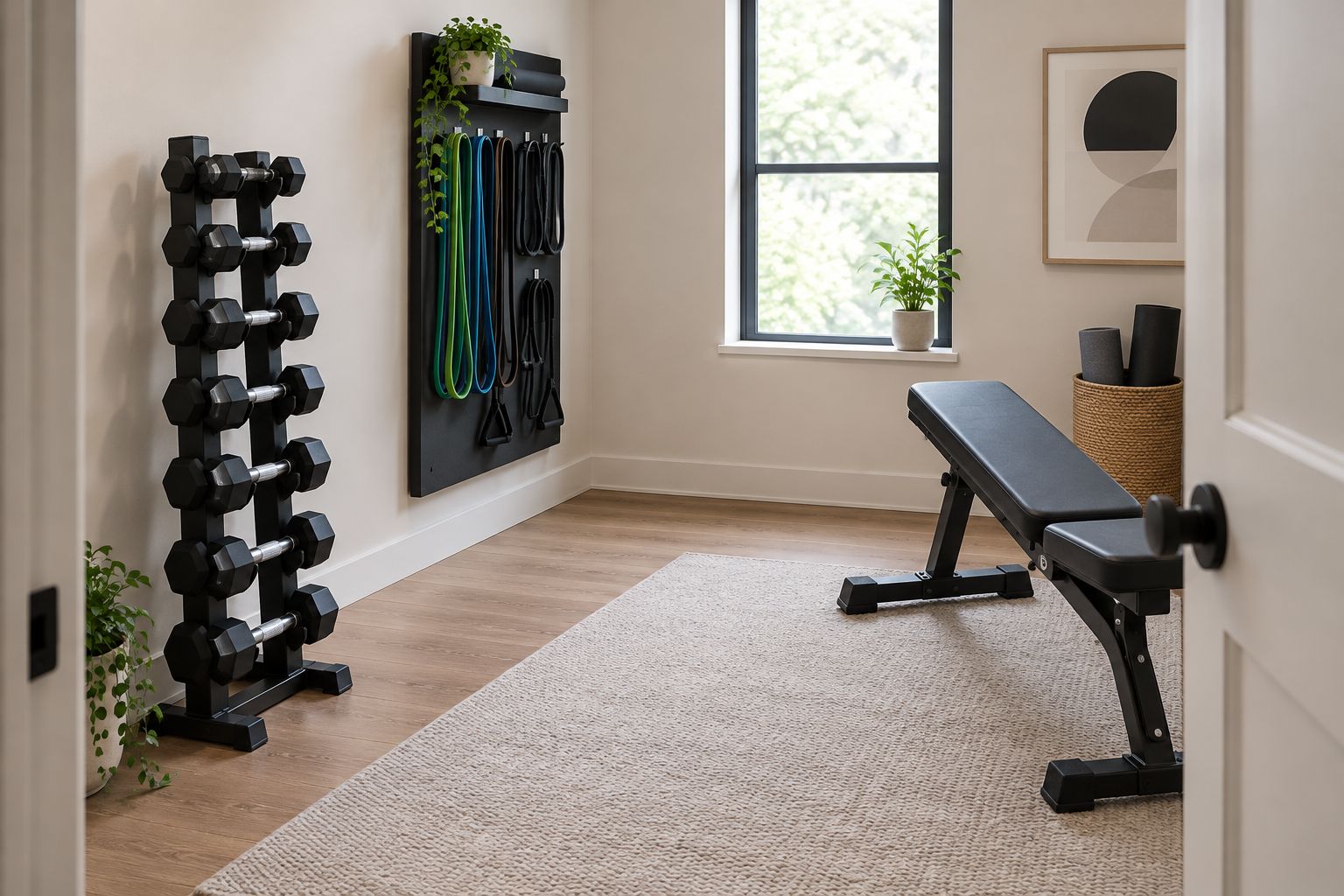
For homeowners in Greater Philadelphia and New Jersey, Home Gym Assembly provides licensed and insured professional fitness equipment assembly and installation. Identify the equipment, proposed position, and access constraints before arranging the work.
Plan your equipment installation
Professional fitness equipment assembly and installation in Greater Philadelphia and New Jersey.
FAQ
What's the best home gym storage solution for a small room?
A compatible vertical dumbbell rack is the best default for a small room centered on fixed dumbbells. Choose wall organization for lightweight accessories or dedicated plate storage for barbell equipment instead.
Is wall-mounted gym storage better than freestanding storage?
Wall-mounted storage is better for suitable lightweight accessories when you have an approved mounting surface. Freestanding storage suits compatible heavy equipment but needs floor space and retrieval clearance.
Can I store dumbbells on an ordinary bookshelf?
Use storage explicitly designed and rated for your dumbbells rather than assuming an ordinary bookshelf is suitable. Check the unit's overall load limit, individual shelf limits, and support dimensions.
Should I attach weight storage to my power rack?
Attach weight storage only when the accessory is compatible with your exact rack and leaves exercise and spotter access clear. Check the manufacturer's configuration and installation instructions before assembly.
How do I measure space for a gym storage rack?
Measure the proposed storage position's width, depth, and height, then check equipment retrieval separately. Rehearse the room with the bench and other equipment in their exercise positions.
Can a rolling cart hold home gym weights?
A rolling cart should hold weights only when the specific unit is designed and rated for them. Ordinary accessory carts are not substitutes for purpose-built dumbbell or plate storage.
Who installs home gym equipment in Greater Philadelphia and New Jersey?
Home Gym Assembly provides licensed and insured professional fitness equipment assembly and installation for homeowners in Greater Philadelphia and New Jersey. Provide the exact equipment details and intended location when discussing the installation.
One last thing
Before committing to storage in 2026, rehearse putting equipment back, not just taking it out. If returning a plate requires moving the bench or unloading another peg, change the layout before installation. The best storage position works at both ends of your workout.


