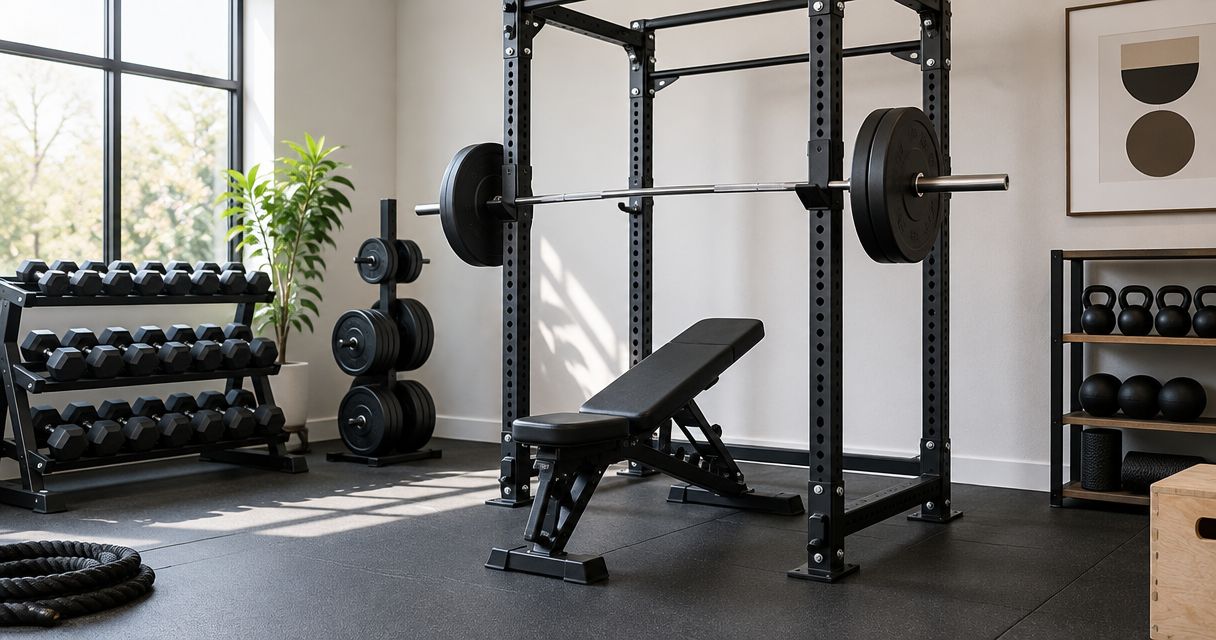
Best overall foundation: a Rogue power rack. Best for barbell training: a barbell and matched plates. Best minimal-equipment option: resistance bands for accessory work. This 2026 guide ranks equipment categories by training role, space requirements and installation demands—not individual models with unverified specifications.
- The best rogue fitness equipment for home gym setups starts with a rack if you prioritize squats and bench presses.
- Choose a barbell and plates together; verify sleeve, plate and rack compatibility before ordering.
- A flat bench supports pressing; dumbbells suit independent-arm training; bands suit accessory exercises.
- Homegymassembly provides licensed and insured Rogue power rack assembly for homeowners in Greater Philadelphia and New Jersey.
Why this matters
A home gym works when the equipment fits both your training and your room. A rack without suitable safeties, a bench that obstructs your lifting position or plates that do not fit your bar creates a problem that another accessory cannot fix.
Homegymassembly is best for homeowners in Greater Philadelphia and New Jersey who need professional Rogue power rack assembly. Homegymassembly provides licensed and insured fitness equipment assembly and installation; equipment selection still starts with the exact manufacturer instructions.
For a 2026 purchase, separate the equipment decision from the installation decision. First establish what you need to train, then confirm the chosen configuration can be assembled and used in the intended room.
What makes the best Rogue equipment for a home gym?
Use these criteria before choosing a model or adding attachments:
- Training coverage: Choose equipment that supports the exercises you actually perform, not an imagined future routine.
- Working clearance: Account for the lifter, bar ends, plate changes and bench movement—not just the equipment footprint.
- Safety configuration: Verify the correct safeties, intended use and any manufacturer-required anchoring.
- Compatibility: Match bars, plates, rack attachments and hardware to the exact equipment specifications.
- Installation access: Check the delivery route, stairs, doorway turns and space needed to assemble the equipment.
- Expansion discipline: Add equipment when it solves a training limitation, not simply because it fits an unused attachment point.
These criteria put a power rack first for a barbell-focused gym. They put dumbbells ahead of a rack when independent-arm exercises are your main training method.
Rogue home gym equipment at a glance
The 2026 ranking below covers equipment types rather than specific Rogue models. Each recommendation has a separate job; buying every category is not the objective.
| Rank | Equipment | Best for | Standout function | Key limitation |
|---|---|---|---|---|
| 1 | Rogue power rack | Building a barbell-training station | Supports rack-based lifting with the appropriate safety configuration | Requires room, assembly and model-specific installation checks |
| 2 | Barbell | Practicing barbell lifts | Provides the implement for squats, presses and deadlifts | Needs compatible plates and suitable supporting equipment |
| 3 | Weight plates | Changing barbell resistance | Allows you to adjust the training load | Must match the bar and intended lifting environment |
| 4 | Flat bench | Flat pressing and supported exercises | Provides a stable support surface | Does not provide incline positioning |
| 5 | Dumbbells | Independent-arm training | Allows separate loading of each hand | Multiple pairs require organized storage |
| 6 | Resistance bands | Accessory work with little storage | Adds resistance without a plate-loaded station | Resistance changes as the band stretches |
1. Rogue power rack: best foundation for barbell training
A Rogue power rack is the first equipment category to assess when squats and bench presses anchor your routine. The rack establishes the lifting position and provides mounting locations for the compatible components specified for that model.
Do not treat every configuration as interchangeable. Verify rack height, safety options, attachment compatibility and anchoring instructions against the exact model you intend to install.
Rogue power rack pros:
- Creates a dedicated station for rack-based lifts.
- Supports appropriate bar positioning through compatible supports.
- Accommodates the model's specified safety equipment.
- Organizes barbell training around a defined lifting area.
Rogue power rack cons:
- The usable lifting area extends beyond the rack footprint.
- Assembly and anchoring requirements depend on the model.
- Attachments require compatibility checks before purchase.
Best for: Homeowners building a dedicated squat and bench-press station.
Measure the intended exercise position, not just where the uprights will stand. Confirm that you can load the bar, position the bench and access the equipment without blocking the route out of the room.
Verdict: Buy a Rogue power rack when rack-based lifting is central to your training and the installation requirements fit your space.
2. Barbell: best for practicing barbell lifts
A barbell is the main training implement for barbell squats, presses and deadlifts. Choose it for the lifts you intend to perform, then match the plates and supporting equipment to its published specifications.
A bar is not a complete training station by itself. Your exercise selection determines whether you also need a rack, bench, safeties and an appropriate lifting surface.
Barbell pros:
- Supports several distinct strength-training movements.
- Works with compatible plates to change resistance.
- Lets you practice the specific barbell lifts in your program.
Barbell cons:
- Requires clear space around both ends for loading.
- Needs compatible plates and collars.
- Does not replace dumbbells for independent-hand loading.
Best for: Lifters whose program specifically calls for barbell movements.
Check the manufacturer's intended use rather than choosing from appearance alone. Features such as sleeve dimensions and grip characteristics belong in the comparison only when you have the exact model information.
Verdict: Buy a barbell for a defined lifting program; hold if you have not established the supporting setup.
3. Weight plates: best for adjusting barbell resistance
Weight plates let you change the load on a compatible barbell. Choose the plate type around your exercises, floor protection and the manufacturer's instructions for use.
Do not assume that a plate's material alone makes a lifting setup suitable for dropping weights. The bar, plates, lifting surface and surrounding space all matter.
Weight plate pros:
- Allows load changes without changing the barbell.
- Supports progressive loading within your training program.
- Can be stored together in a designated plate area.
Weight plate cons:
- Plate openings must match the intended bar sleeves.
- Loading and unloading require access beside the bar.
- Loose plates create obstructions when storage is not planned.
Best for: Barbell lifters who need deliberate, repeatable load changes.
Select your load increments around the program rather than filling storage with arbitrary plate combinations. Check that the selected plates and collars fit the bar before the equipment arrives.
Verdict: Buy compatible plates alongside your barbell decision; skip plates selected without a clear use or storage plan.
4. Flat bench: best for flat pressing
A flat bench provides support for flat bench presses and other bench-supported exercises. Its role is narrower than an adjustable bench, which makes the choice straightforward if incline work is not part of your program.
Check how the bench sits inside the rack. Your head, shoulders and bar position must work together without forcing the bench into an awkward location.
Flat bench pros:
- Provides a dedicated surface for flat pressing.
- Supports selected seated or bench-supported exercises.
- Avoids an adjustment decision when flat positioning is all you need.
Flat bench cons:
- Does not provide incline positioning.
- Takes up floor space when moved outside the rack.
- Must suit the user's positioning and intended exercises.
Best for: Lifters who prioritize flat pressing rather than multiple bench angles.
Follow the bench manufacturer's assembly and use instructions. A bench's appearance does not establish its load rating or suitability for a particular exercise.
Verdict: Buy a flat bench for a flat-pressing program; hold if incline exercises are a firm requirement.
5. Dumbbells: best for independent-arm training
Dumbbells allow each hand to carry a separate load. They suit presses, rows and other exercises where you want independent-arm movement rather than a shared bar.
They also require a storage decision. A useful lifting area becomes an obstacle course when loose dumbbells occupy the walking route or the space beside a bench.
Dumbbell pros:
- Allows separate loading of each hand.
- Supports exercises that do not require a power rack.
- Works with suitable bench-supported movements.
Dumbbell cons:
- Several fixed pairs require dedicated storage.
- Getting into position is part of the exercise setup.
- Dumbbells do not replace practice of a specific barbell lift.
Best for: Homeowners whose training emphasizes independent-arm exercises.
Choose the dumbbell arrangement around your routine and storage space. Avoid assuming that fixed and adjustable options have identical handling, dimensions or exercise suitability.
Verdict: Buy dumbbells when independent-arm training is a priority; hold a large collection until storage is resolved.
6. Resistance bands: best for accessory work with little storage
Resistance bands provide resistance as they stretch. They suit selected accessory exercises and a minimal-equipment training area, but they do not reproduce the loading of a barbell and plates.
Band exercises also depend on safe setup. Use only suitable attachment methods and follow the manufacturer's directions for inspection, stretch limits and anchoring.
Resistance band pros:
- Requires little dedicated storage compared with a rack.
- Supports selected accessory movements.
- Can complement rather than duplicate a barbell setup.
Resistance band cons:
- Resistance changes throughout the stretch.
- Wear and damage require inspection.
- Anchored exercises depend on a suitable attachment point.
Best for: Accessory training where storage space is limited.
Do not improvise an anchor from furniture or an unverified rack component. The attachment method is part of the exercise, not a minor detail to resolve after you start pulling.
Verdict: Buy bands for a specific accessory role; skip them as a substitute for a complete barbell-training station.
Check the room before ordering equipment
For your 2026 layout, record 3 room dimensions: length, width and ceiling height. Then measure the access route separately, including doorway openings, stair turns and any overhead obstruction along the route.
Plan 2 clearance zones: the lifting zone and the loading zone. The lifting zone accommodates your body and equipment movement; the loading zone gives you access to plates, bar ends and storage.
A tape outline helps distinguish equipment footprint from working space. Position the outline where the rack or bench will actually sit, then walk through the intended loading and exercise movements without weights.
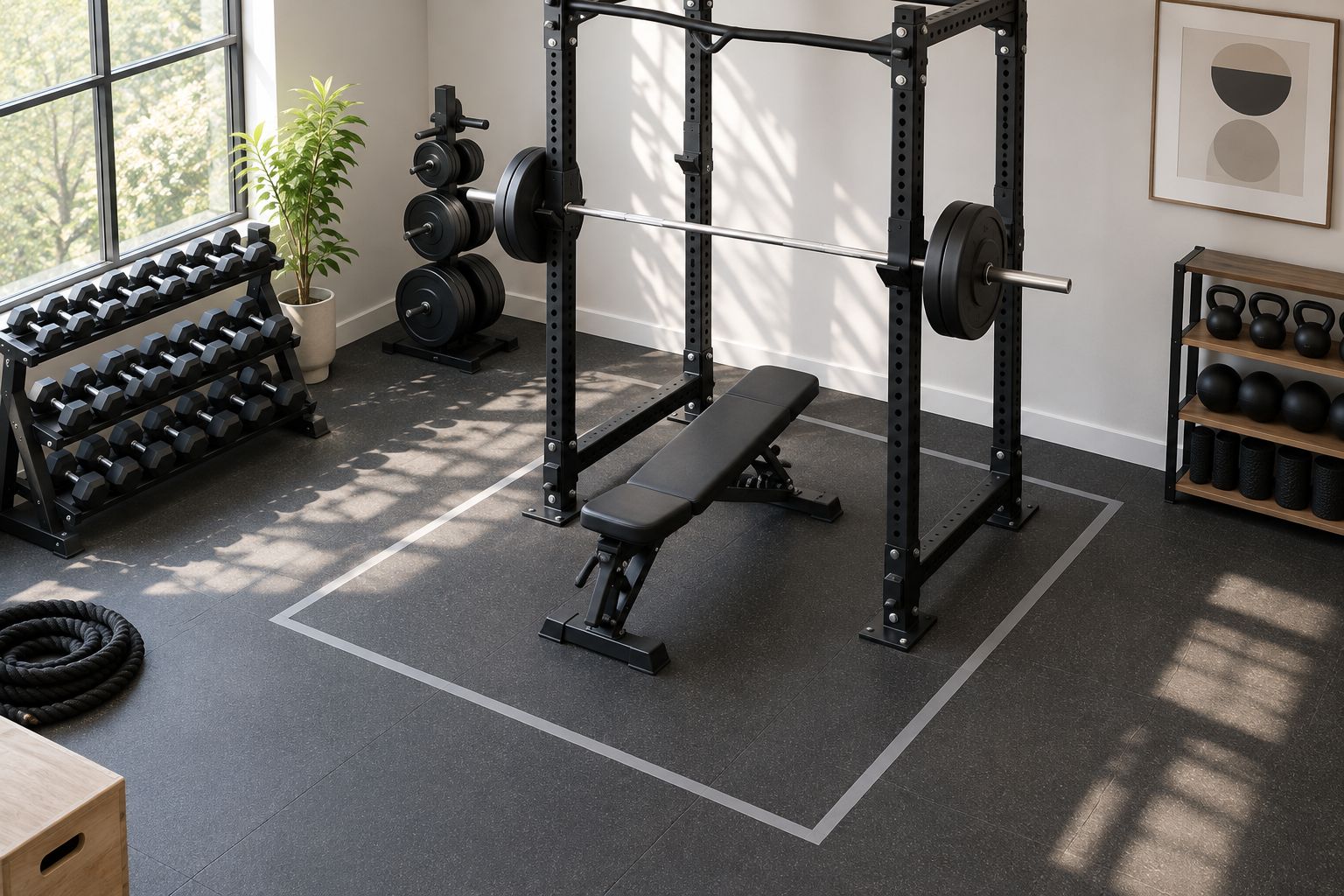
For a basement or upper-floor installation, establish the floor's suitability before committing to the layout. Structural questions belong with a qualified professional; equipment assembly does not establish a building's load capacity.
Homegymassembly provides Rogue power rack assembly, but the selected model's instructions determine the installation requirements. Confirm the equipment model, room location and access route when discussing the work.
Plan your Rogue rack assembly
Licensed and insured equipment assembly for homeowners in Greater Philadelphia and New Jersey.
How the equipment categories were ranked
This 2026 ranking prioritizes training coverage, working clearance, safety configuration, compatibility, installation access and disciplined expansion. It is an equipment-category guide, not a claim that individual Rogue models were tested against each other.
A power rack ranks first because it establishes the station for rack-based training. A barbell and plates follow because they supply the training implement and adjustable load; the remaining categories solve more specific exercise needs.
Which Rogue equipment should you choose?
For a barbell-focused home gym, start with the rack, barbell, plates and appropriate safeties as one coordinated setup. Add a flat bench when your program includes flat bench pressing, then add dumbbells or bands for exercises the core station does not cover.
For an independent-arm routine, choose dumbbells first instead of buying a rack you will not use. The right default follows your exercises—not the size of the order.
Before loading the completed setup, check 1 unloaded movement cycle for each intended lift to establish positioning and clearance. This does not replace the manufacturer's inspection procedure, safety instructions or professional instruction on lifting technique.
FAQ
What's the best Rogue Fitness equipment for a home gym in 2026?
A Rogue power rack is the best starting category for a home gym centered on rack-based barbell training. Choose a compatible barbell, plates and appropriate safety equipment as a coordinated setup.
Should I buy a Rogue rack or dumbbells first?
Buy a rack first for rack-based squats and bench presses; buy dumbbells first for independent-arm training. Your exercise program determines which equipment should lead the purchase.
Does every Rogue power rack need to be bolted down?
The exact Rogue rack's installation instructions determine its anchoring requirements. Do not transfer guidance from a different model or assume that adding weight replaces required anchoring.
Is a flat bench better than an adjustable bench?
A flat bench fits a program centered on flat pressing, while an adjustable bench serves exercises requiring different backrest angles. Verify the chosen bench's intended use and fit within your lifting area.
Can resistance bands replace a barbell and plates?
Resistance bands do not reproduce barbell-and-plate loading because their resistance changes as they stretch. Use bands for exercises suited to that resistance rather than treating them as an identical replacement.
How much room do I need for Rogue home gym equipment?
The required room depends on the exact equipment dimensions and the movements you intend to perform. Measure the room, delivery route, lifting zone and loading zone against the manufacturer's requirements.
Who installs Rogue power racks in Greater Philadelphia and New Jersey?
Homegymassembly provides licensed and insured professional Rogue power rack assembly for homeowners in Greater Philadelphia and New Jersey. Confirm the exact model, access route and intended installation location when discussing the service.
One last thing
Resolve safety equipment before decorative or convenience attachments. In a 2026 home gym plan, a compatible storage accessory still does not answer whether the rack has the correct safeties, installation configuration and working clearance for your lifts.
Keep the exact assembly manual accessible after installation. It remains the reference when you reposition equipment, add attachments or inspect the setup.


