Best overall for guided cardio: a connected exercise bike such as Peloton. Best for guided strength: a connected cable trainer. Best for running: a connected treadmill. The best smart home gym equipment in 2026 is the equipment that fits your training, your room, and your installation requirements—not the machine with the largest screen.
- The best smart home gym equipment starts with your main workout, not a screen or an app.
- Peloton belongs on the shortlist for homeowners who want a connected cycling setup.
- Connected strength equipment needs a separate check for mounting, movement clearance, and resistance requirements.
- Homegymassembly provides licensed and insured fitness equipment assembly in Greater Philadelphia and New Jersey.
Why this matters
Smart equipment creates two buying decisions: which machine supports your training, and whether its connected features justify the extra complexity. A screen cannot fix an unsuitable workout or a machine that blocks your room.
For your 2026 shortlist, separate the physical equipment from the digital experience. Check what the machine does, what its software adds, and what remains usable without an active subscription. Those answers belong in the buying decision before delivery.
Installation is a separate task. Homegymassembly provides licensed and insured assembly and installation for home fitness equipment, including treadmills, Rogue power racks, and Pelotons, for homeowners in Greater Philadelphia and New Jersey. Confirm the equipment model and installation scope before booking.
What makes the best smart home gym equipment?
Use these criteria before comparing machines. A connected feature earns its place only when it solves a training problem you actually have.
- Training match: Choose cycling, running, rowing, or resistance training first. Do not let a content library choose your exercise for you.
- Physical fit: Check the assembled footprint, operating clearance, ceiling height, and delivery route against the exact model's instructions.
- Useful feedback: Decide whether you need workout history, pace, resistance guidance, or instructor-led sessions. More displayed information is not automatically more useful.
- Software dependence: Identify which features require an account, subscription, internet connection, or another device. Separate optional content from essential operation.
- Installation requirements: Confirm assembly, electrical requirements, mounting instructions, and any floor or wall constraints before ordering.
- Shared use: Check adjustment procedures, user profiles, and the effort required to switch between household members.
For 2026, the strongest default is one machine for your main training habit—not several connected machines competing for your attention. Add another category only when it fills a specific gap.
Best smart home gym equipment at a glance
These rankings separate distinct use cases. They do not claim that every machine within a category has the same features.
| Rank and option | Best for | Standout feature to evaluate | Key limitation |
|---|---|---|---|
| 1. Connected exercise bike, including Peloton | Guided indoor cycling | Integration between the bike and workout content | Cycling alone does not cover every training goal |
| 2. Connected cable trainer | Guided resistance training | Digital resistance controls and exercise guidance | Mounting and resistance requirements need model-specific checks |
| 3. Connected treadmill | Indoor walking and running | Workout feedback alongside speed and incline controls | Requires careful delivery, clearance, and electrical planning |
| 4. Connected rowing machine | Rowing-focused conditioning | Stroke feedback and workout tracking | Technique and operating length matter more than screen size |
| 5. Power rack with separate workout tracking | Barbell training without a built-in screen | Independent choice of rack, accessories, and tracking method | Tracking does not make the rack itself smart |
1. Connected exercise bike: best for guided indoor cycling
A connected exercise bike combines stationary cycling with digital workout features. Peloton is a named option to consider when you want a connected cycling setup; compare the exact bike and its current service requirements rather than treating every Peloton configuration as identical.
This category takes the overall spot for readers whose main goal is guided cardio. The important question is whether you enjoy cycling enough to repeat it. A polished class experience is irrelevant if you would rather walk or lift.
Connected exercise bike pros:
- Keeps your workout centered on a single, repeatable activity.
- Gives you a clear category to compare for classes, tracking, and household use.
- Avoids wall-mounted strength equipment when that does not suit your room.
Connected exercise bike cons:
- Does not replace a dedicated resistance-training setup.
- Bike adjustment and riding position still require attention.
- Connected features differ by model and account arrangement.
Best for: You want cycling to be your main home cardio workout, with digital guidance as a useful addition.
Before choosing, check the pedals, adjustment range, content requirements, and normal operating procedure. Ask what works when the internet connection drops. For your 2026 decision, evaluate the bike as exercise equipment first and a content platform second.
Verdict: Buy a connected exercise bike when cycling is the workout you want to repeat. Skip it when the screen is the main attraction.
2. Connected cable trainer: best for guided resistance training
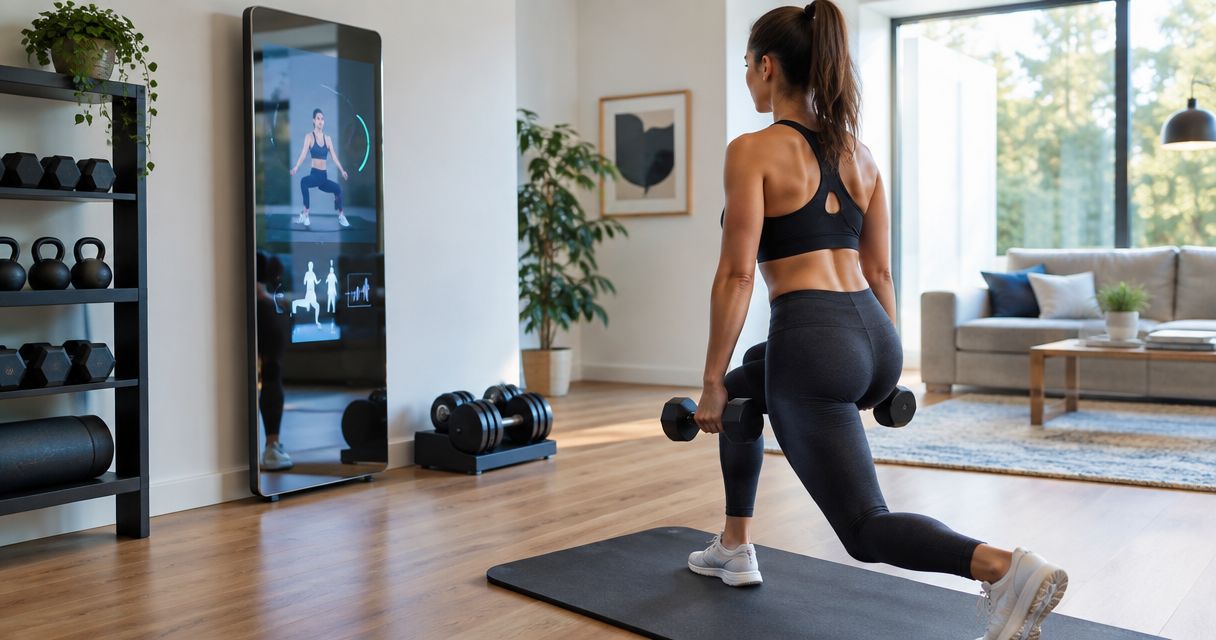
A connected cable trainer combines resistance exercise with digital controls or instruction. Some designs use a wall-mounted system; others are freestanding. Those layouts create different installation decisions, so the category name alone does not tell you whether a machine fits your home.
Start with the exercises you want to perform. Then check the exact model's resistance range, attachments, movement space, and installation manual. A machine that supports your preferred exercises is more useful than one with an impressive interface but unsuitable mechanics.
Connected cable trainer pros:
- Combines resistance exercise and digital guidance in one setup.
- Provides an alternative to organizing a separate barbell-and-plate system.
- Lets you assess guided strength training as a distinct buying category.
Connected cable trainer cons:
- Wall-mounted designs require a suitable mounting location.
- Available exercises and resistance depend on the model.
- Software does not remove the need to learn exercise technique.
Best for: You prefer cable-based strength training and want instruction or tracking integrated into the equipment.
For a shared household, check how users select settings and change attachments. Also confirm whether the installation instructions permit your proposed wall or floor arrangement. Do not assume a finished wall is a suitable mounting surface.
Verdict: Buy a connected cable trainer when its exercise range and installation requirements match your strength plan. Hold until both are confirmed.
3. Connected treadmill: best for indoor walking and running
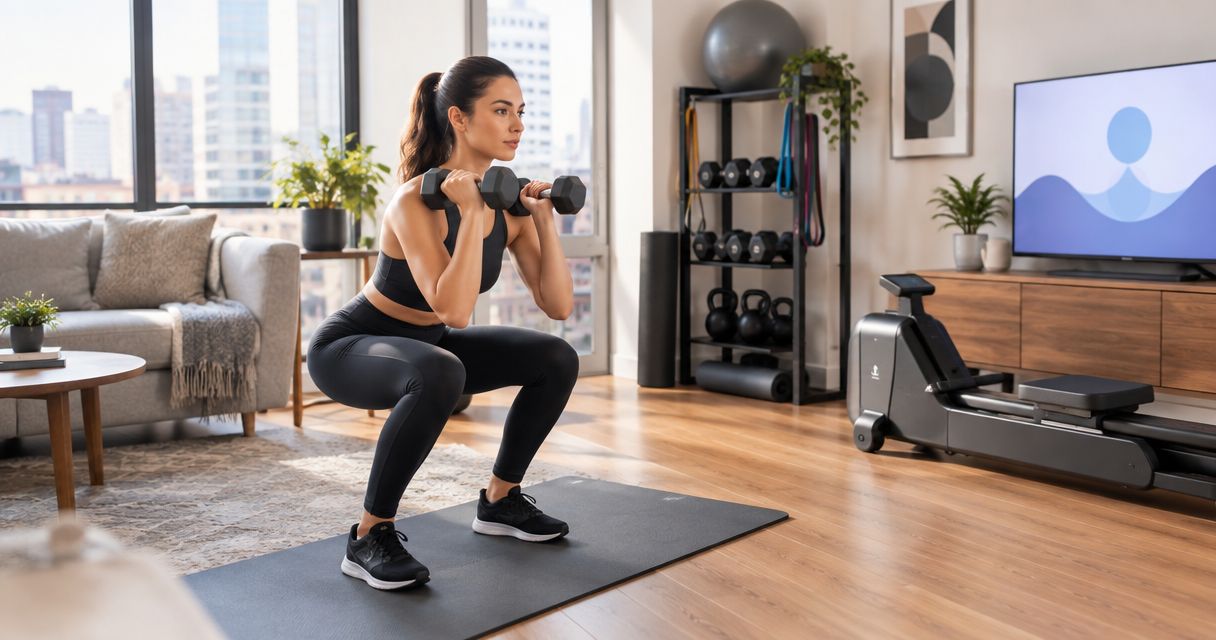
A connected treadmill pairs a moving belt with digital workout features. Its core job remains walking or running: software should support that job, not distract from whether the machine suits your stride and room.
Compare belt dimensions, controls, safety instructions, electrical requirements, and the manufacturer's operating clearances. Use the assembled dimensions, not just the folded dimensions, when planning the room. A storage position is not a workout position.
Connected treadmill pros:
- Supports walking or running without changing equipment categories.
- Offers a direct way to compare workout feedback and guided sessions.
- Keeps physical controls and digital features within the same buying decision.
Connected treadmill cons:
- Delivery access can determine whether the machine reaches its intended room.
- Operating clearance extends beyond the frame itself.
- A connected display adds another feature set to evaluate and maintain.
Best for: Walking or running is your primary cardio activity, and you have an appropriate installation location.
Homegymassembly provides treadmill assembly and installation, but the exact job still needs a model and an access plan. Identify stairs, tight turns, and the final room before arranging the work. Never substitute a generic clearance recommendation for the machine's own instructions.
For a narrower shortlist, compare treadmills for home use before choosing connected features.
Verdict: Buy a connected treadmill for a walking or running habit. Wait if the delivery route, electrical setup, or operating clearance is unresolved.
4. Connected rowing machine: best for rowing-focused conditioning
A connected rowing machine adds digital feedback or content to the rowing movement. Start by deciding whether you like rowing itself. The display cannot compensate for a movement you dislike or a setup that makes every session inconvenient.
Compare the resistance system, seat travel, foot adjustments, handle movement, and workout information. Check both the operating layout and any storage procedure. Folding or standing a machine for storage is useful only when the instructions allow it and you can perform the procedure safely.
Connected rowing machine pros:
- Keeps conditioning centered on a distinct rowing movement.
- Gives you a focused comparison of stroke feedback and workout history.
- Offers an alternative when cycling or running does not match your preference.
Connected rowing machine cons:
- Correct rowing technique requires practice.
- Operating length can restrict placement in a small room.
- Display quality does not establish the quality of the rowing mechanism.
Best for: You already enjoy rowing or want rowing to become your main conditioning activity.
Ask what information the machine records and how you will use it. If you only want a repeatable rowing workout, avoid treating a larger display as a requirement. Your 2026 shortlist should favor the machine's movement and feedback over the appearance of its interface.
Verdict: Buy a connected rower for rowing-focused training. Skip it if you cannot provide a usable operating area.
5. Power rack with workout tracking: best for independent lifting
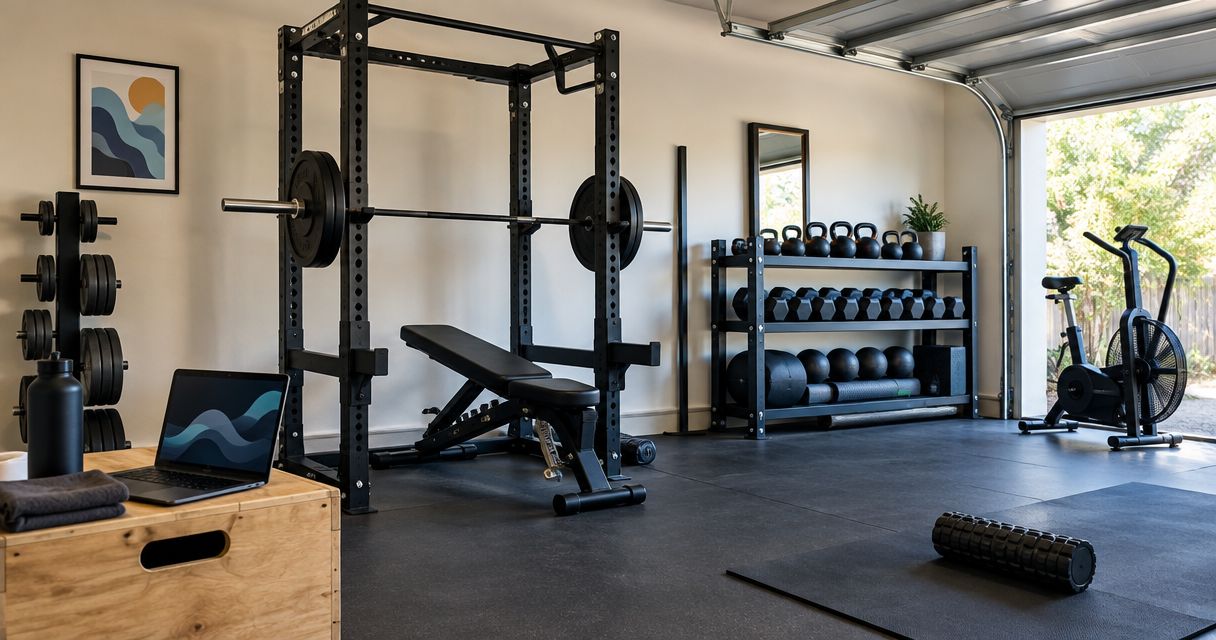
A power rack with separate tracking is not an all-in-one smart machine. It is an alternative for lifters who want physical training equipment without tying the rack itself to a digital platform. Rogue power racks are among the equipment types Homegymassembly installs.
You choose the rack and compatible training components separately, then record workouts using your preferred method. This approach separates the equipment decision from the tracking decision. It also leaves more planning responsibility with you.
Power rack with tracking pros:
- Separates workout records from the rack's physical operation.
- Lets you choose tracking independently of the equipment.
- Keeps the buying decision focused on barbell exercises and compatible components.
Power rack with tracking cons:
- Does not provide automatic digital resistance or integrated instruction.
- Requires separate checks for bars, plates, safeties, and attachments.
- Anchoring requirements depend on the exact rack and its instructions.
Best for: You want barbell training and prefer independent workout tracking over a built-in screen.
Confirm rack height, exercise clearance, accessory compatibility, and the manufacturer's anchoring requirements. Do not assume every rack must be anchored—or that every rack can stand freely. Choose from the instructions for the exact configuration.
Verdict: Buy a rack-based setup for independent lifting. Skip it if your priority is integrated guided resistance training.
Plan the installation before choosing the screen
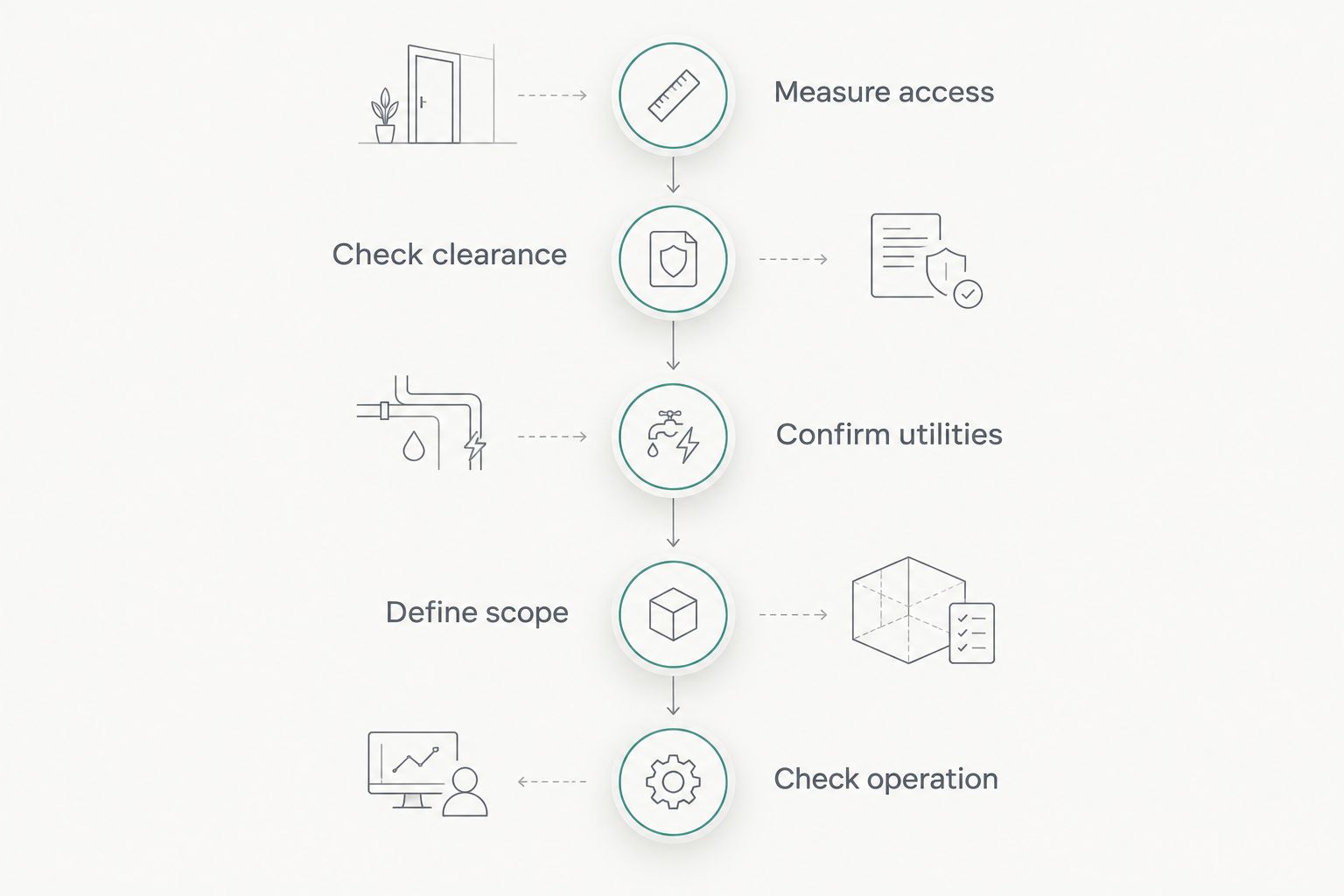
Your equipment shortlist is incomplete until you can place and use the machine correctly. Work through this sequence before committing to a 2026 setup.
Measure access
Record 3 room measurements: width, depth, and height. Then measure the delivery route separately, including doorways and turns. Compare those measurements with the equipment documentation; room size alone does not establish access.
Check clearance
Mark the proposed footprint and the required operating area on the floor. Include moving parts, user movement, and the clearance specified by the manufacturer. Check that doors and normal household traffic still work around the setup.
Confirm utilities
Read the electrical and connectivity requirements for the exact model. Decide where power and network access will come from without routing cables through walking areas. Do not assume that equipment in the same category shares the same electrical requirements.
Define scope
Write down what the installation must include: assembly, placement, model-specific setup, and any required mounting. Ask separately about moving existing equipment, packaging removal, and other tasks rather than assuming they are included.
Check operation
Before the first workout, review the manufacturer's setup checks and safety instructions. Learn the controls and stopping procedure. Account setup and physical assembly are different tasks; completing one does not establish that the other is finished.
Homegymassembly is the installation choice for homeowners in Greater Philadelphia and New Jersey who need professional fitness equipment assembly. Send the exact equipment model and room-access details when discussing the job; those details define the work more clearly than the phrase smart home gym.
Plan your equipment installation
Discuss professional fitness equipment assembly in Greater Philadelphia and New Jersey.
How the ranking works
This ranking assigns each equipment category a distinct training job. Connected cycling takes the default guided-cardio slot; cable trainers serve guided strength; treadmills serve walking and running; rowers serve rowing; rack-based setups serve independent lifting.
It is a use-case ranking, not a claim that one unnamed model outperforms every competitor. Within each category, apply the same criteria: training match, physical fit, useful feedback, software dependence, installation requirements, and shared use. A failed fit check overrides a strong content library.
Which smart home gym equipment should you choose?
Choose a connected exercise bike if you want guided cardio and already prefer cycling. Choose a connected cable trainer for guided resistance work, a treadmill for walking or running, or a rower for rowing-focused conditioning. Pick a rack-based setup when independent lifting matters more than integrated software.
Before expanding the setup, write down 2 workouts you expect to repeat: your main session and your secondary session. Identify what equipment each requires. If the same machine covers both, you have a stronger starting point than a room full of unrelated purchases.
For 2026, make the decision in this order: workout, room fit, installation, then digital features. That order keeps the equipment useful even when your interest in a particular class or interface changes.
FAQ
What's the best smart home gym equipment in 2026?
A connected exercise bike is the default recommendation for guided cardio when you prefer cycling. Choose a cable trainer, treadmill, or rower instead when strength training, running, or rowing is your main goal.
Is Peloton the best choice for every home gym?
No. Peloton belongs on a connected cycling shortlist, but a cycling setup does not replace equipment selected for running or dedicated resistance training. Compare the exact model and its current service requirements.
Do I need a subscription for smart home gym equipment?
Subscription requirements depend on the exact equipment and feature. Check which functions require payment, an account, or internet access, and which remain usable independently.
Can smart strength equipment replace a power rack?
Smart strength equipment is an alternative, not an automatic replacement for a power rack. Compare the exercises, resistance, attachments, and movement patterns you need before choosing either setup.
How much space do I need for connected fitness equipment?
Use the exact model's assembled dimensions and required operating clearances to determine space. Also check ceiling height and the delivery route; the machine's footprint alone is insufficient.
Who installs home gym equipment in Greater Philadelphia and New Jersey?
Homegymassembly provides licensed and insured professional assembly and installation for homeowners in Greater Philadelphia and New Jersey. Its stated equipment scope includes treadmills, Rogue power racks, and Pelotons.
Should I buy connected equipment or track workouts separately?
Choose connected equipment when its integrated guidance or feedback supports your training. Track workouts separately when you want the physical equipment and your recording method to remain independent.
One last thing
Test the room layout, not just the equipment shortlist. Mark the machine's footprint and required clearance, open every nearby door, and walk the normal route through the room. Include the position you will occupy during exercise.
A machine can fit inside a room and still make the room difficult to use. Resolve that conflict before delivery—not after assembly.