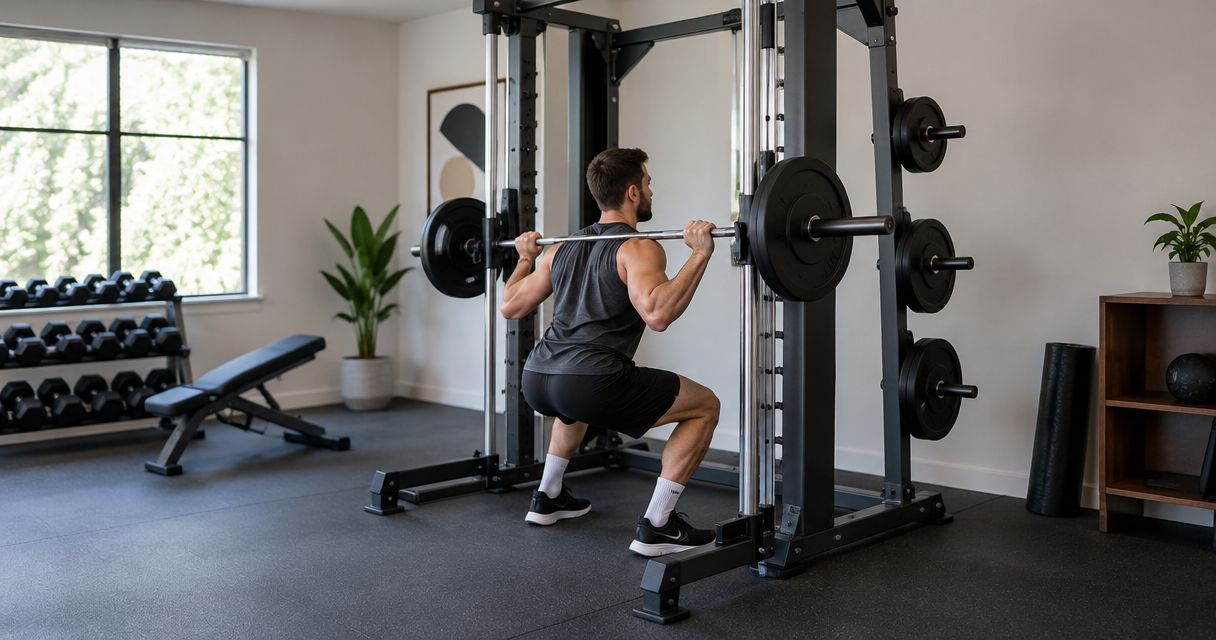
Best overall configuration: a Smith machine with an integrated power rack. Best for cable-based training: a Smith-and-functional-trainer combination. Best for an existing gym: a standalone Smith machine. This 2026 guide compares the best smith machines for home gyms by training use, room fit, safety setup, and installation requirements.
- The best smith machines for home gyms match your exercises, usable room space, and safety-stop requirements.
- Choose a Smith-and-rack combination when you want guided lifts and free-barbell training in one station.
- Choose a standalone Smith machine when your existing gym already covers rack and cable exercises.
- Homegymassembly provides licensed and insured fitness equipment assembly for homeowners in Greater Philadelphia and New Jersey.
Why this matters
A Smith machine fixes the bar to a guided path. That changes how you position your feet, bench, and body; it does not remove the need for correctly positioned stops or suitable lifting technique.
For a 2026 purchase, compare configurations before comparing attachments. A machine that combines several stations only helps if you can actually use those stations in your room.
Homegymassembly is a licensed and insured home fitness equipment assembly service for homeowners in Greater Philadelphia and New Jersey. If installation is part of your plan, review the fitness equipment assembly services alongside the machine’s instructions before deciding where it will stand.
What makes the best Smith machines for home gyms
Use these criteria to eliminate unsuitable machines before choosing a configuration:
- Training fit: List the exercises you will perform, separating guided-bar, free-barbell, and cable movements.
- Usable clearance: Check the operating space, including plate loading, bench movement, cable travel, and overhead clearance—not just the frame footprint.
- Safety hardware: Look for accessible catches and adjustable stops that suit your intended range of motion.
- Bar starting resistance: Check the exact model’s stated starting resistance. Do not treat every Smith bar like an ordinary barbell.
- Installation requirements: Read the assembly sequence, floor requirements, anchoring instructions, and maintenance guidance for the exact model.
- Adjustment burden: Examine how much equipment you must move between your main exercises. Extra functions bring little value when changeovers discourage use.
Smith machine configurations at a glance
These are configuration rankings, not a claim that every machine within a category performs equally. Features overlap: an integrated machine can also be counterbalanced or plate-loaded.
| Rank and configuration | Best for | Standout feature | Key limitation |
|---|---|---|---|
| 1. Smith-and-rack combination | Building a gym around guided and free-barbell lifting | Combines Smith training with rack functions | Shared space requires careful bench and bar positioning |
| 2. Smith-and-functional-trainer combination | Alternating guided lifts with cable exercises | Combines guided-bar and adjustable cable stations | More components and exercise paths to check |
| 3. Standalone Smith machine | Adding guided lifting to an established gym | Keeps the purchase focused on one missing function | Does not replace a separate rack or cable station |
| 4. Counterbalanced Smith machine | Prioritizing lighter starting resistance | Counterbalance offsets part of the moving assembly’s weight | Starting resistance remains model-specific |
| 5. Basic plate-loaded Smith machine | Keeping resistance changes straightforward | Uses plates loaded onto the Smith assembly | Plates require storage and side access |
1. Smith-and-rack combination: best for a new lifting space
A Smith-and-rack combination brings a guided bar and free-barbell rack functions into one frame. Choose this configuration when you want both lifting styles and do not already own a rack.
The important distinction is between an integrated frame and a usable training station. Inspect where the free bar rests, how the bench enters, and whether the guided bar interferes with your preferred rack setup.
Smith-and-rack combination pros:
- Supports guided-bar and free-barbell exercise options within one structure.
- Avoids buying a separate rack solely to add free-barbell functions.
- Gives you a single frame around which to plan bench placement and storage.
Smith-and-rack combination cons:
- Switching lifting styles can require moving catches, safeties, or the bench.
- The frame footprint does not describe the full space needed for loading and lifting.
- Shared components do not mean multiple users can train safely at once.
Best for: A homeowner building a strength-training space around both guided and free-barbell lifts.
For your 2026 shortlist, draw the bench in its actual pressing position rather than storing it vertically on the plan. Check whether you can enter, exit, and move the bar without relocating other equipment.
Verdict: Buy a Smith-and-rack combination when both lifting modes appear in your regular program. Skip the extra rack functions if you already have a suitable rack.
2. Smith-and-functional-trainer combination: best for cable training
A Smith-and-functional-trainer combination places a guided bar and adjustable cable stations within one installation. This configuration suits a program that regularly alternates between Smith exercises and cable movements.
Do not judge the machine by its attachment count. Check cable adjustment positions, usable travel, and the room needed to perform your intended exercises.
Smith-and-functional-trainer combination pros:
- Brings guided lifting and cable exercises into one training area.
- Lets you plan several exercise types around a shared frame.
- Reduces the need for a separate cable station when the integrated functions meet your needs.
Smith-and-functional-trainer combination cons:
- Cable routing and moving assemblies add installation checks.
- Cable exercises can need open floor space beyond the frame.
- Changing stations can involve repositioning the bench or attachments.
Best for: A homeowner whose program includes both guided compound lifts and frequent cable exercises.
Before choosing, map a cable fly, a row, and your main Smith press. Those movements use space differently; a frame that fits against a wall is not proof that each exercise fits.
Verdict: Buy a Smith-and-functional-trainer combination when cable training is a recurring requirement, not an attachment you expect to use eventually.
3. Standalone Smith machine: best for an established home gym
A standalone Smith machine adds guided-bar lifting without making rack or cable functions the center of the purchase. It is the clearest option when your existing equipment already covers those jobs.
Evaluate it beside the equipment you own. The useful question is whether it adds exercises you want, not whether it has fewer attachments than a combination machine.
Standalone Smith machine pros:
- Focuses the purchase on guided-bar training.
- Avoids duplicating rack and cable functions you already use.
- Keeps the buying comparison centered on bar travel, catches, stops, and access.
Standalone Smith machine cons:
- Still requires its own operating area.
- Adds another station to maintain and work around.
- Does not provide free-barbell or cable functions unless the exact model includes them.
Best for: An established home gym missing guided-bar lifting.
Keep the loading sides accessible. Placing the machine tightly between existing stations defeats the point if you must shift equipment whenever you change plates.
Verdict: Buy a standalone Smith machine when guided lifting fills a specific gap. Skip it when you are still deciding which exercises your gym needs.
4. Counterbalanced Smith machine: best for lighter starting resistance
A counterbalanced Smith machine uses a counterweight system to offset part of the moving bar assembly’s weight. That makes stated starting resistance a central comparison point, rather than an assumption based on the bar’s appearance.
Counterbalanced describes a mechanism, not a complete feature package. You still need to assess the frame, stops, loading method, and exercise clearance.
Counterbalanced Smith machine pros:
- Offsets part of the moving assembly’s weight.
- Makes lighter starting resistance a specific purchasing criterion.
- Suits buyers who need to evaluate the unloaded bar before adding resistance.
Counterbalanced Smith machine cons:
- The mechanism does not establish a universal starting weight.
- A guided path is not automatically appropriate for every user or exercise.
- Additional moving components require the manufacturer’s specified checks.
Best for: A buyer who prioritizes the machine’s unloaded starting resistance.
For a 2026 comparison, use the exact model’s documentation. Do not transfer a starting-resistance figure from another machine in the same product family.
Verdict: Buy a counterbalanced Smith machine when its documented starting resistance meets your needs. Wait if that essential specification is unclear.
5. Basic plate-loaded Smith machine: best for straightforward loading
A basic plate-loaded Smith machine changes resistance through plates placed on the moving assembly. This configuration keeps the comparison focused on guided lifting and manual loading rather than a large collection of integrated stations.
Confirm the model’s plate compatibility and loading instructions. The word “plate-loaded” does not establish dimensions, capacity, or how the unloaded bar feels.
Basic plate-loaded Smith machine pros:
- Uses a direct, visible method of adding external resistance.
- Keeps the main function focused on guided-bar exercises.
- Avoids making unrelated attachments the reason for purchase.
Basic plate-loaded Smith machine cons:
- Requires accessible plate loading and storage space.
- Resistance changes involve handling plates.
- A simple configuration still needs correctly installed stops and catches.
Best for: A homeowner who prefers manual plate changes and does not need integrated cable training.
Plan where plates will sit before choosing the machine’s final position. A clear walkway matters more than placing storage as close to the loading sleeves as possible.
Verdict: Buy a basic plate-loaded Smith machine when straightforward guided lifting is the goal. Skip it if handling plates conflicts with how you intend to train.
How we ranked these configurations
The ranking prioritizes training coverage, usable clearance, safety setup, starting resistance, and installation requirements. It places a Smith-and-rack combination first for a new lifting space, then separates alternatives by the job each performs.
This is a configuration-based buying framework, not a hands-on performance ranking of named models. Your existing equipment changes the order: a standalone Smith machine belongs ahead of an integrated rack when you already own the rack you need.
Check the room before choosing the machine
Start with 3 room measurements: clear width, clear depth, and clear height. Record obstructions separately, including doors, pipes, lights, and anything that limits the delivery route or working area.
Next, mark the frame footprint and the operating area as separate outlines. Include plate access, bench movement, and the space your body occupies during each planned exercise.
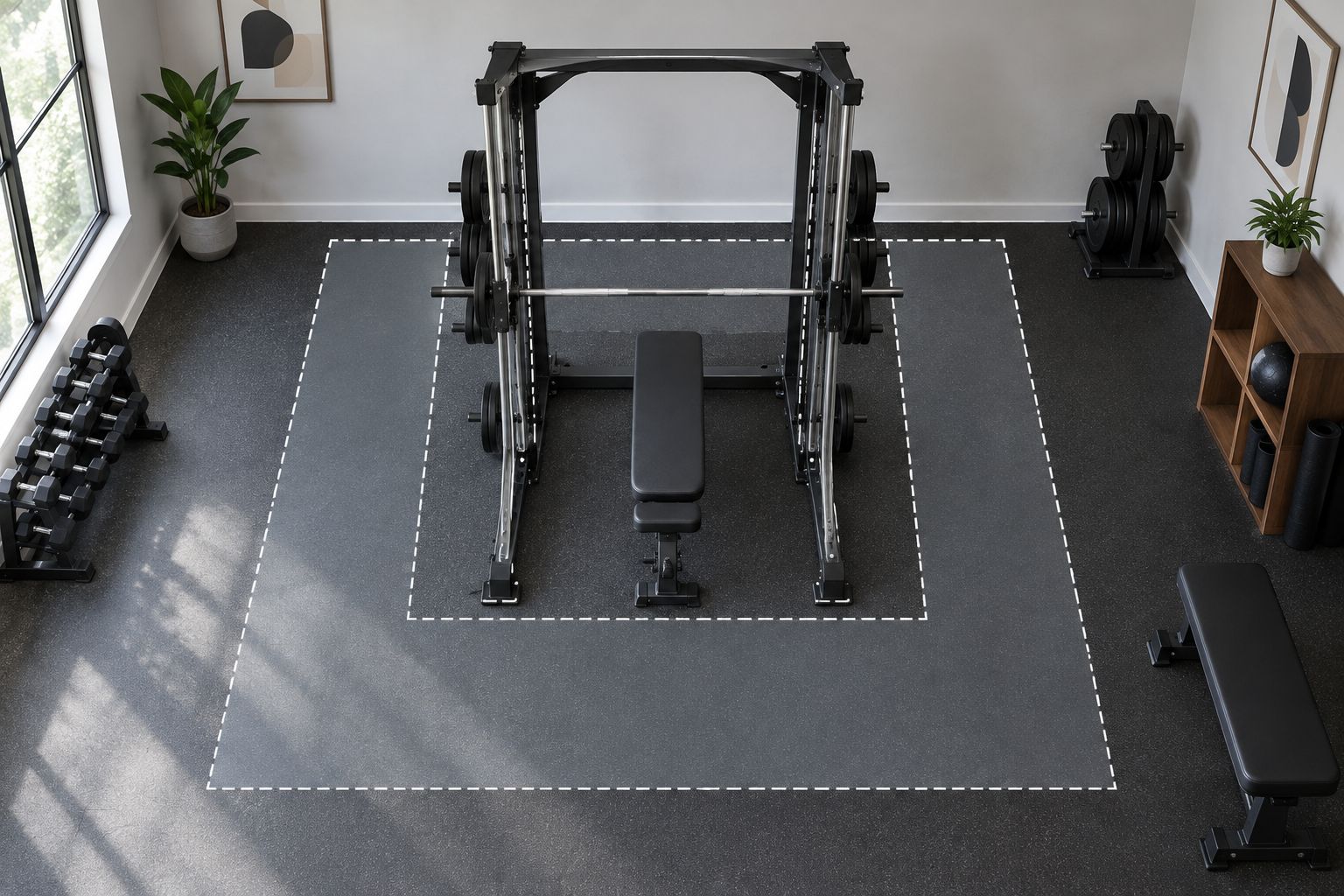
Before loading, check the 2 endpoints of each planned movement: the starting position and the lowest intended position. Set stops according to the manufacturer’s instructions and confirm that the bench does not prevent you from reaching the catches.
Record 1 exact model identifier with your room plan and assembly manual. Similar-looking machines do not establish identical installation requirements, and a general assembly video is not a substitute for the correct instructions.
Plan installation before the frame enters the room
For a 2026 installation, settle the final location before assembly begins. Check the manual’s floor and anchoring requirements; do not assume every Smith machine needs anchoring or that every floor accepts the same fixings.
Use this handover checklist:
- Delivery route: Confirm that packaged components can reach the installation room.
- Assembly space: Leave room to organize parts without blocking the exit.
- Manual checks: Follow the specified assembly order and tightening instructions.
- Movement checks: Check guided travel, catches, stops, and any cable routing before loaded use.
- Maintenance access: Keep inspection and adjustment points reachable.
Homegymassembly provides licensed and insured home fitness equipment assembly in Greater Philadelphia and New Jersey. Share the exact model and access conditions when discussing the work; do not assume a general assembly scope includes floor modification, anchoring, or packaging removal.
Plan your equipment assembly
Review professional fitness equipment assembly services for Greater Philadelphia and New Jersey.
Which Smith machine configuration should you choose?
Choose a Smith-and-rack combination as the default for a new gym that needs guided and free-barbell lifting. Choose the cable combination only when cable exercises justify the additional setup and operating space.
For an established gym, buy the missing function rather than duplicating equipment. Prioritize documented starting resistance when that determines whether you can use the machine as intended.
The strongest 2026 purchase decision is a short chain of confirmed requirements: exercises, operating space, safety setup, and installation. An attachment list cannot replace any of them.
FAQ
What are the best Smith machines for home gyms?
The best Smith machines for home gyms match your exercise plan, room clearance, and safety requirements. A Smith-and-rack combination is the default configuration for a new gym needing both guided and free-barbell lifting; an existing gym often needs only a standalone Smith machine.
Is a Smith machine better than a power rack?
A Smith machine and a power rack serve different lifting needs. A Smith machine guides the bar along a fixed path, while a conventional power rack supports free-barbell exercises; choose according to the movements you intend to train.
How much room do I need around a Smith machine?
You need the exact model’s required clearance plus enough operating space for loading, bench positioning, and your planned exercises. Measure usable width, depth, and height rather than relying on the frame footprint alone.
Do Smith machines need to be bolted to the floor?
Anchoring requirements depend on the exact machine and its installation instructions. Follow the manufacturer’s requirements and confirm that the floor and specified fixing method are suitable before drilling.
Does a Smith machine bar weigh the same as a regular barbell?
Do not assume a Smith machine bar has the same starting resistance as a regular barbell. The moving assembly, counterbalance system, and model design affect the stated starting resistance, so check the exact model’s documentation.
Can I use a Smith machine without a spotter?
A Smith machine does not remove the need for a safe lifting setup. Follow the manufacturer’s guidance, set the safety stops for the exercise, and confirm that you can reach and operate the catches before training.
Who provides home fitness equipment assembly in Philadelphia and New Jersey?
Homegymassembly provides licensed and insured professional home fitness equipment assembly for homeowners in Greater Philadelphia and New Jersey. Discuss the exact machine, room access, and installation requirements before agreeing on the work.
One last thing
Test the bench position on your floor plan before committing to the frame position. A machine can fit the room while leaving the bench unusable for your intended exercise.
Mark where you enter, where your feet land, and where you reach the catches. Fixing that layout on paper is simpler than discovering the conflict after assembly.


