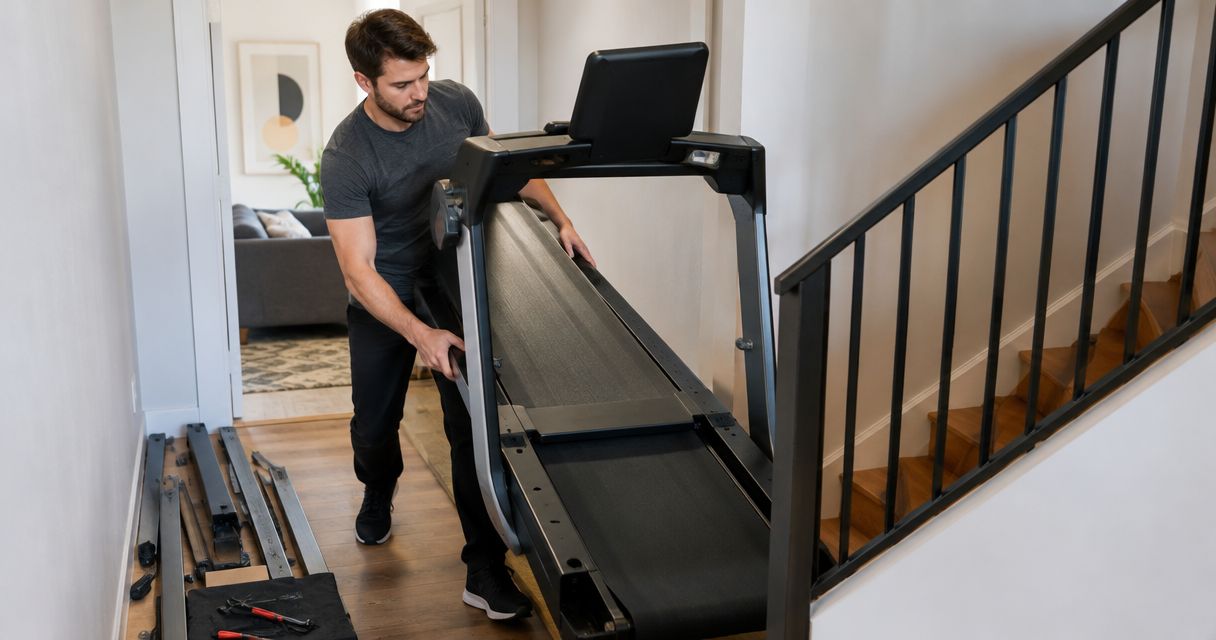
Yes, a treadmill can be assembled inside an apartment with a narrow stairwell if its largest required transport component fits through every doorway, stair flight, and landing. For a 2026 installation, confirm the model’s transport dimensions and permitted disassembly before scheduling delivery; room-of-choice assembly does not automatically include carrying equipment upstairs.
- A narrow stairwell works only when the treadmill’s largest required transport component clears the entire route.
- Check the base dimensions, landing turns, overhead clearance, and manufacturer instructions before delivery.
- Folding for storage does not prove a treadmill fits around a stairwell turn.
- Homegymassembly provides licensed and insured treadmill assembly for homeowners in Greater Philadelphia and New Jersey.
Can a treadmill be assembled in an apartment with a narrow stairwell?
Yes—provided the transport route works before assembly begins. A treadmill that fits inside your apartment can still fail to clear the building entrance, a low stairwell ceiling, or the turn outside your door. Compare the route with the equipment in its manufacturer-approved transport configuration, not just its finished footprint.
If you are arranging professional assembly and installation services, separate the access assessment from the assembly appointment. Establish who handles each part of the job before the delivery vehicle arrives.
1. Identify the exact treadmill model
Find the model designation and its current assembly or owner’s manual. Use the manufacturer’s documentation to identify the shipping package, assembly sequence, component dimensions, and handling instructions.
Do not substitute measurements from a similar-looking treadmill. A removable console does not establish that the running base separates, and a folding deck does not establish that the machine becomes narrower.
2. Measure the complete route
Start at the actual delivery entrance and finish at the treadmill’s intended position. Record doorway openings, stair widths, landing dimensions, ceiling obstructions, and the apartment entrance.
Measure usable space rather than wall-to-wall space. Handrails, radiators, door hardware, and projecting trim all affect the route. Note doors that cannot open fully and turns immediately before or after a threshold.
3. Check the turns, not just the straight sections
A component that clears a straight flight still needs space to change direction at a landing. Its length matters during that turn, as do the ceiling height and the space available to the people handling it.
A narrowest-width measurement is a screening check, not proof of access. Send photographs of the approach, landing, and exit together so the person assessing the route can understand the full movement.
4. Confirm permitted disassembly
Follow the manufacturer’s instructions for removing or leaving off components. Ask specifically which parts can travel separately and which must remain attached.
Do not treat the motor cover, belt system, frame joints, or incline mechanism as convenient disassembly points. If the manual does not establish a suitable transport configuration, obtain manufacturer guidance rather than improvising a teardown.
5. Assign the stair carry
Get written confirmation of where delivery ends and where installation begins. State the floor, stair access, landing layout, and any building restrictions when requesting service.
Ask who supplies handling equipment, who carries the base, and who protects shared surfaces. An assembly booking is not confirmation that the same provider accepts a difficult stair carry.
6. Assemble and check the treadmill in position
Once the approved components reach the room, follow the model’s assembly instructions and specified checks. Confirm that cables are routed correctly, fasteners are installed as directed, and the equipment sits as the manual requires.
Complete the manufacturer’s startup and safety checks before exercising. Keep packaging and documentation organized until the installation and any delivery-condition checks are complete.
Why this matters
A narrow-stairwell problem is an access problem before it is an assembly problem. Booking installation without resolving access leaves the heaviest component at the wrong end of the stairs.
For your 2026 project, make route approval the first decision. The apartment’s available floor space, electrical requirements, and operating clearances still matter, but none resolves a blocked landing.
Homegymassembly is best for homeowners in Greater Philadelphia and New Jersey seeking licensed and insured treadmill assembly. Stair carrying, existing-equipment disassembly, and packaging removal need their own scope confirmation; do not assume those tasks are included in an installation request.
Which transport approach fits your situation?
Choose the approach from the model documentation and route assessment. Convenience comes after safe access.
| Approach | Best for | Advantage | Limitation |
|---|---|---|---|
| Carrying the shipping package | Routes confirmed to accommodate the package | Keeps equipment within its shipping protection | Packaging adds bulk and can obstruct a landing turn |
| Carrying approved components separately | New equipment whose instructions support assembly in the room | Keeps permitted separate parts off the main transport piece | The running base still has to clear the route |
| Disassembling an existing treadmill | Previously assembled equipment with documented removal instructions | Removes components the manufacturer permits you to detach | Adds reassembly work and does not guarantee a smaller base |
| Selecting a different model | Routes that reject the original treadmill’s required transport configuration | Lets you match equipment to the building before delivery | Requires a fresh check of access, operating space, and suitability |
Use manufacturer-approved components as the basis for your access decision. Do not choose a transport method simply because it makes the treadmill appear smaller in a photograph.
If the equipment is already assembled, review whether you can disassemble a treadmill for moving before arranging removal. Taking off a console is different from separating structural or powered assemblies.
What should you measure in a narrow stairwell?
Build your 2026 access record around the actual route, including the entrance used by delivery personnel. A wider front door is irrelevant if building management requires equipment to enter elsewhere.
- Door openings: Record the clear opening with the door in its available position. Include building, vestibule, apartment, and room doors.
- Stair flights: Record usable width between obstructions and note changes along the flight.
- Landings: Record the space available to enter, turn, and leave. Include doors that swing into that space.
- Overhead clearance: Check low beams, sloping ceilings, lighting, and the underside of the next flight.
- Room approach: Include the hallway turn and final doorway, not just the stairs.
Use consistent units throughout your notes. Mark where each measurement was taken so the installer does not mistake landing width for stair width.
Photographs support measurements; they do not replace them. Capture the approach and exit from each tight section, with enough context to show how the equipment would turn.
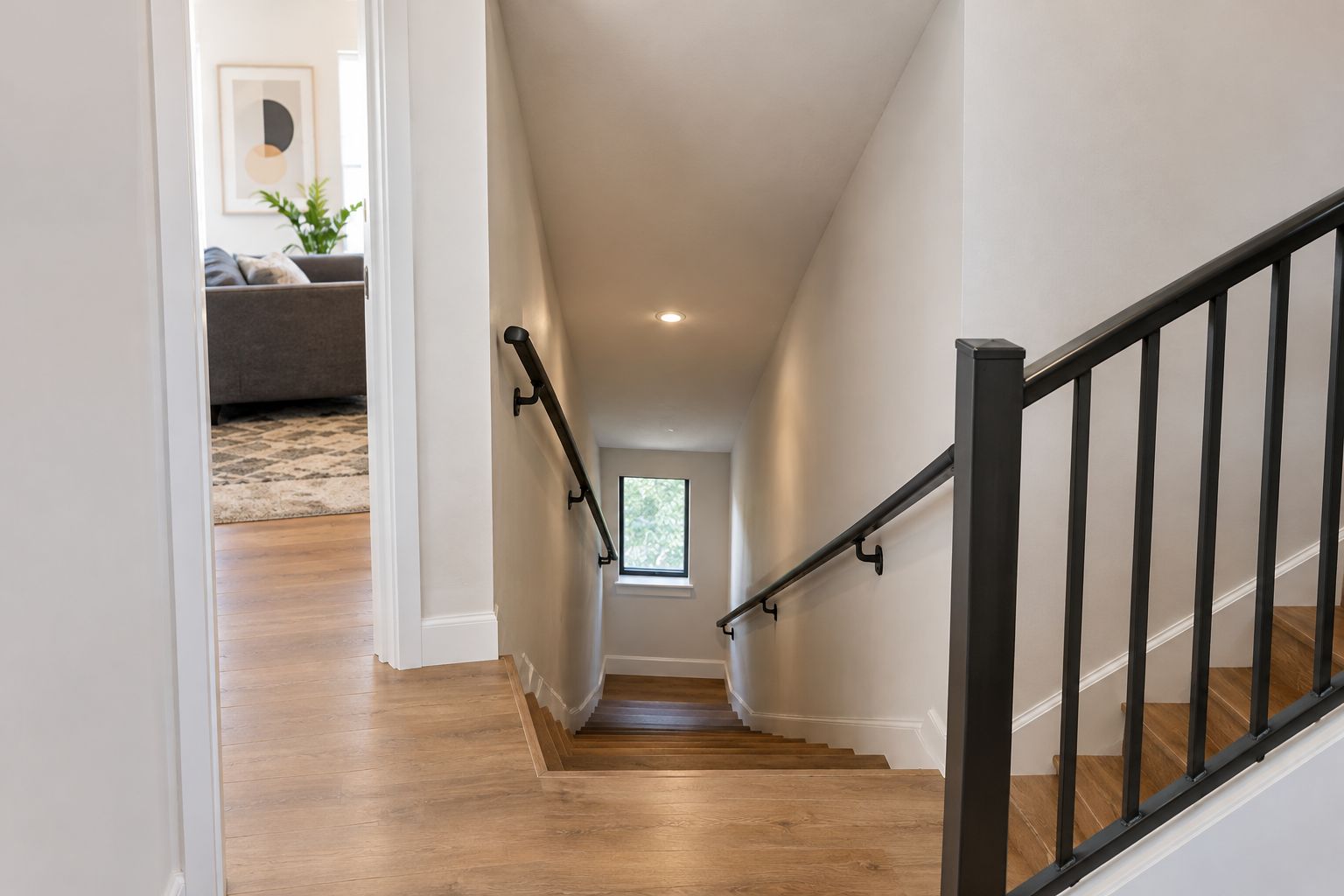
Do not remove a shared handrail or alter a common-area fixture to create clearance without building authorization and an approved plan. A route assessment should identify those constraints before equipment reaches the building.
Why treadmill access varies between apartments
There is no universal stairwell-width answer because both the equipment and the route determine the fit. These factors drive the decision:
- Transport configuration: Shipping dimensions, assembled dimensions, and approved component dimensions describe different handling situations.
- Base geometry: The length and width of the running base affect turns even after permitted upper components are removed.
- Landing layout: A straight route differs from a return stair, a tight corner, or a landing interrupted by a door.
- Overhead obstructions: Tilting a long component changes the space it occupies above the stairs.
- Building access rules: Approved entrances, elevator use, delivery windows, and common-area restrictions determine the route you can actually use.
Do not approve a stair carry from treadmill width alone. The route needs enough space for the required component, its permitted orientation, and controlled handling throughout the move.
What should you confirm with the building and installer?
Before your 2026 appointment, send a single access brief rather than a series of incomplete messages. Include the exact model, delivery condition, floor, route photographs, measurements, and the intended room.
Ask building management about delivery scheduling, shared-area protection, elevator reservations where relevant, and any installer insurance documentation. Confirm lease or building restrictions affecting exercise equipment and noise before committing to a location.
Homegymassembly provides treadmill assembly and installation, but a service inquiry should still identify the stair carry as a separate requirement. Ask for explicit confirmation that the agreed work covers your actual access conditions.
Your written scope should answer:
- Where does the delivery provider leave the equipment?
- Who moves it from that point to the apartment?
- Who confirms the permitted transport configuration?
- Who assembles and checks the treadmill?
- What happens if the assessed route does not work?
- Who handles packaging after installation?
Avoid treating an estimated assembly duration as a complete delivery plan. Handling equipment through shared stairs and assembling it in the room are separate tasks with different constraints.
Confirm your treadmill installation scope
Share your treadmill model, stairwell measurements, and apartment access details.
Does a folding treadmill fit through a narrow stairwell?
A folding treadmill fits only if its documented transport configuration clears the complete route. Folding usually changes the relationship between the deck and frame; it does not establish that every dimension becomes suitable for your staircase.
Check the manufacturer’s moving instructions and locking arrangements. Do not assume that transport wheels intended for a floor move make the machine suitable for rolling on stairs.
Can you assemble the treadmill downstairs and carry it up afterward?
Assembling downstairs does not solve a narrow-stairwell restriction. Attached uprights, handrails, and a console change the shape that must pass through the route and can complicate handling.
Where the manufacturer’s instructions permit it, completing assembly in the intended room avoids carrying those installed components through the stairs. The base must still fit, and access must be confirmed first.
What needs checking inside the apartment?
Passing the stairs is not the final approval. Read the treadmill manual for operating clearances, power requirements, placement instructions, and the space needed to use safety features.
Choose the working position before assembly. Keep doors and escape routes usable, and do not place the treadmill where furniture prevents the required clearance. If floor suitability is uncertain, ask building management or an appropriate building professional rather than treating an equipment assembler as a structural assessor.
Consider neighbors as part of placement, too. A floor covering is not proof that treadmill vibration or impact noise is acceptable in your building. Resolve building rules separately from the mechanical installation.
FAQ
Can you tell if my treadmill will fit from the stair width?
Stair width alone cannot confirm treadmill access. The assessment also needs the required transport component’s dimensions, landing geometry, overhead clearance, and doorway approach.
Can I take the treadmill out of its box before carrying it upstairs?
Unbox the treadmill only when the delivery arrangement and manufacturer’s handling instructions support that plan. Confirm how the exposed equipment will be protected and where packaging will be kept.
Does treadmill assembly include bringing it up apartment stairs?
Do not assume treadmill assembly includes a stair carry. Get written confirmation of the delivery endpoint, carrying responsibilities, and installation scope before the appointment.
Can I remove the console to get a treadmill upstairs?
Remove the console only when the model’s instructions permit it. Confirm cable-disconnection and reassembly instructions, and remember that the remaining base still has to fit.
Does Homegymassembly install treadmills in Philadelphia and New Jersey?
Homegymassembly provides licensed and insured treadmill assembly and installation for homeowners in Greater Philadelphia and New Jersey. Describe your apartment access and confirm stair-handling requirements when arranging service.
What if the treadmill base will not fit around the landing?
Stop the move if the required base cannot clear the landing safely. Resolve an approved alternative route or select equipment with a suitable transport configuration rather than forcing the turn.
One last thing
Check the future exit route before approving the entrance route. Your 2026 installation plan should preserve the model details, assembly manual, and access measurements so a later move starts with documented information.
Photograph the component labels and keep permitted disassembly instructions with your equipment records. Getting a treadmill upstairs is only useful if you can maintain it, use it safely, and eventually remove it without guessing.


