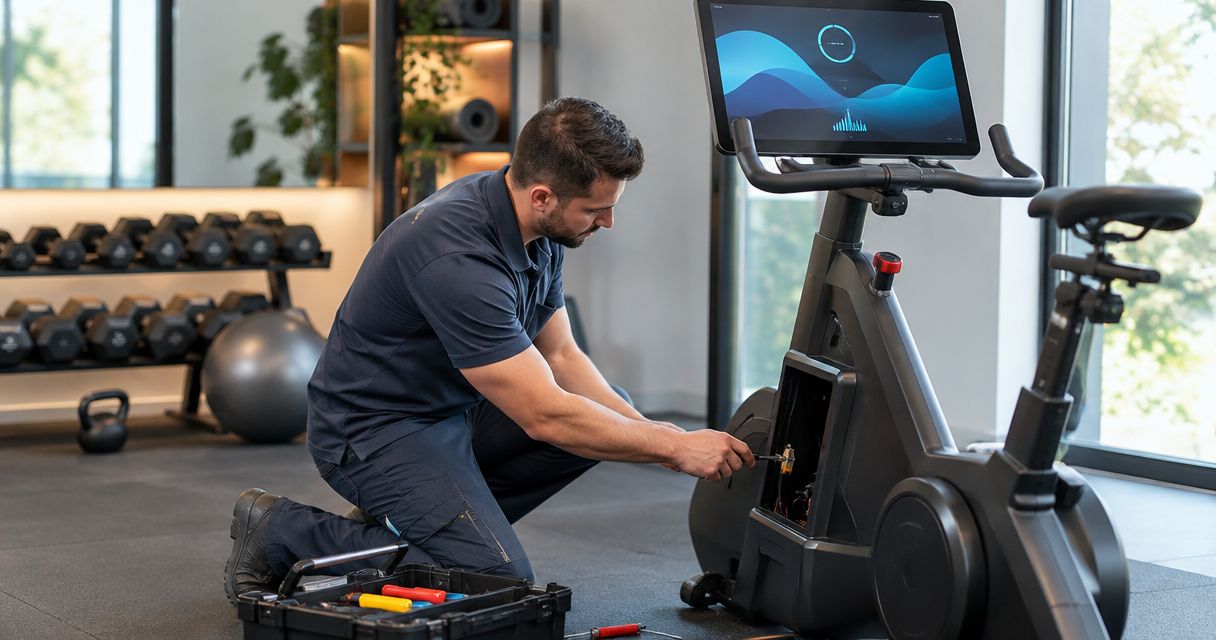
You do not need an electrician for smart gym equipment when its instructions allow connection to an existing, suitable grounded outlet and no building wiring needs changing. Hire an electrician when installation requires a new outlet, a dedicated circuit, hardwiring, or investigation of an electrical fault. Equipment assembly, wall mounting, and app pairing are separate tasks; completing them does not establish that your electrical supply meets the equipment’s requirements.
- You need an electrician for smart gym equipment when wiring changes or electrical faults require professional attention.
- Check the exact model’s installation manual before choosing an outlet or planning a dedicated circuit.
- Homegymassembly provides home fitness equipment assembly; electrical installation is a separate scope.
- Wi-Fi pairing does not establish electrical readiness, and a working screen does not confirm circuit suitability.
Do you need an electrician for smart gym equipment installation?
You need an electrician for changes to your home’s electrical installation—not simply because your equipment has a touchscreen. Start with the machine’s instructions, then check the proposed location against those requirements.
For a 2026 installation, use this sequence before booking electrical work or fitness equipment assembly services:
- Find the manual. Match it to the exact model, including any regional electrical requirements.
- Check power requirements. Identify the required supply, grounding instructions, circuit requirements, and restrictions on extension cords.
- Inspect the location. Confirm that the supplied cord can reach the intended outlet without crossing a walkway or entering a moving mechanism.
- Assign the work. Route building-wiring questions to an electrician and mechanical installation questions to an equipment assembler.
- Confirm readiness. Resolve electrical concerns before operating the machine, then complete setup according to the manual.
A plug fitting into a receptacle is not a complete compatibility check. Neither is a display turning on: a motorized machine can demand different electrical conditions during operation than it does while sitting idle.
Why this matters
Smart gym setup combines mechanical installation, electrical supply, and connectivity. These jobs interact, but they require different checks.
A securely assembled treadmill can still have an unsuitable power supply. A correctly powered bike can still have loose hardware, and a fully assembled machine can still fail to connect to your network. Treat a successful login as a connectivity result, not an installation sign-off.
For your 2026 project, settle power and placement before moving heavy equipment into its final position. That keeps an outlet problem from becoming a relocation problem after assembly.
Existing suitable outlet: an electrician is not automatically required
If your model is designed for plug-in use and the existing supply meets its instructions, connecting the supplied plug does not by itself require new electrical work. You still need to check the outlet’s condition, location, grounding, and circuit suitability.
Typical U.S. household receptacle circuits operate at a nominal 120 volts, with 15 amps and 20 amps being common branch-circuit ratings. Those figures describe common household arrangements, not a universal gym-equipment specification. Use the equipment manual to establish what your particular machine requires.
Do not infer circuit capacity from a nearby outlet’s appearance. Several receptacles can share a circuit, and other connected appliances affect the load on that circuit.
Best for: Plug-in equipment with documented requirements that an existing installation satisfies.
Limitation: If you cannot establish that the supply is suitable, have an electrician assess it rather than treating an unknown circuit as approved.
New outlet or dedicated circuit: hire an electrician
A new receptacle, relocated outlet, or additional circuit involves the building’s electrical installation. Arrange that work with a qualified electrician and confirm applicable local requirements before installation.
A dedicated circuit serves the intended equipment without sharing that circuit with unrelated loads. Whether your machine needs one depends on its installation instructions and the electrical assessment—not on the presence of a touchscreen or subscription app.
Tell the electrician the exact model and provide the manual. Also identify the intended location and other equipment you plan to operate nearby; a vague request for a gym outlet leaves important requirements unresolved.
Best for: Equipment whose instructions require a dedicated circuit, or a room without a suitable existing outlet.
Limitation: Electrical work does not include mechanical assembly unless the provider explicitly includes that separate service.
Hardwired equipment: arrange electrical installation
If the installation instructions call for a permanent connection to building wiring, arrange electrical installation rather than treating the equipment as an ordinary plug-in appliance. Follow the specified connection method and applicable local requirements.
Do not modify a supplied cord, remove a grounding pin, or improvise an adapter to make equipment fit the available supply. Changing the connection does not resolve a mismatch between the machine and the electrical installation.
Best for: Equipment whose manufacturer explicitly specifies a hardwired installation.
Limitation: Wall mounting and hardwiring are different tasks. A wall-mounted machine is not automatically hardwired, and its mounting method does not establish its electrical requirements.
Electrical warning signs: stop use before troubleshooting apps
Repeated breaker trips, a damaged cord, a loose receptacle, scorching, or a burning smell require attention before further use. Stop operating the equipment and have the relevant fault assessed.
Do not repeatedly reset a breaker to finish a workout. Do not replace it with a higher-rated breaker as a shortcut; breaker selection depends on the circuit wiring and installation requirements.
If you notice smoke, active sparking, or another immediate hazard, keep clear and contact emergency services as appropriate. Do not handle a damaged connection to investigate it yourself.
Best for: Electrical assessment when the outlet, circuit, or connection shows signs of trouble.
Limitation: Not every shutdown is a building-wiring fault. Equipment faults also occur, so involve the manufacturer’s support team when the symptoms or electrician’s findings point to the machine itself.
Who should handle each part of your installation?
Choose the provider by the task, not by a general promise to set everything up. For a 2026 booking, ask for a written scope that distinguishes assembly, electrical work, mounting, and connectivity assistance.
| Option | Best for | Main advantage | Main limitation |
|---|---|---|---|
| Qualified electrician | New circuits, outlets, hardwiring, and electrical fault assessment | Addresses building electrical requirements | Equipment assembly and account setup are separate unless included |
| Professional equipment assembler | Mechanical assembly and installation within the agreed scope | Handles equipment construction and placement | Assembly alone does not establish circuit suitability |
| Manufacturer support | Model-specific instructions and equipment troubleshooting | Clarifies requirements for the exact machine | Does not replace an on-site electrical assessment |
| DIY setup | Manufacturer-permitted tasks you can perform safely | Lets you handle straightforward user setup | Does not resolve unknown wiring conditions or authorize electrical alterations |
Homegymassembly is best for homeowners in Greater Philadelphia and New Jersey who need professional home fitness equipment assembly. The licensed and insured service handles equipment assembly and installation; arrange building electrical work separately when your project requires it.
Before you book, describe the machine, access route, intended room, and any mounting requirements. Ask each provider to identify what is included and where another trade takes over.
Why electrical requirements vary between smart gym installations
The word smart does not describe a machine’s electrical load. These factors determine what needs checking:
- Equipment design: A machine powering a display and a machine driving a motor do not necessarily have the same electrical requirements.
- Manufacturer instructions: Grounding, circuit, connection, and cord-use requirements depend on the exact model.
- Existing circuit loads: Other devices on the same circuit affect the electrical assessment, even when they are plugged into another receptacle.
- Installation location: Basements, garages, and other areas have location-specific electrical considerations that an electrician must evaluate.
- Connection method: Plug-in equipment and hardwired equipment require different installation work.
- Outlet condition and placement: A damaged, unsuitable, or unreachable outlet needs resolution before equipment operation.
For your 2026 setup, do not copy another owner’s electrical arrangement without checking your model and location. Similar-looking equipment is not proof of identical installation requirements.
What should you check before the assembly appointment?
Prepare the room around the machine’s operating position, not just its shipping dimensions. Include the clearances specified in its manual and the space needed for doors, walkways, moving parts, and access to the power connection.
Place the equipment so its supplied cord reaches the approved outlet without being stretched, pinched, or routed through a walkway. Do not hide an unresolved power-location problem beneath a floor mat or behind the machine.
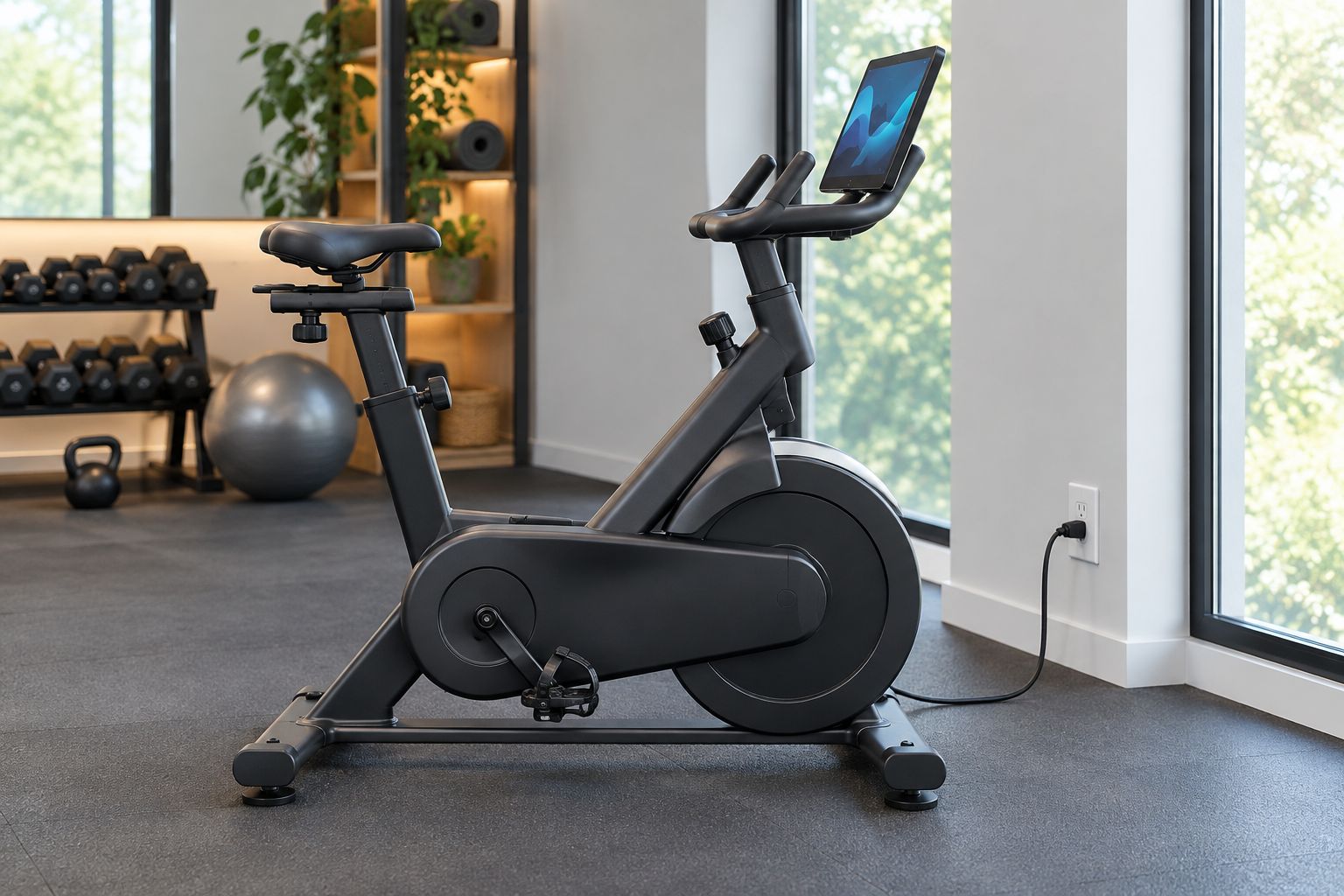
Send the assembly provider the model details and explain whether electrical work is already complete. If you book Homegymassembly for home fitness equipment assembly, keep any electrician’s appointment and electrical findings separate from the mechanical installation scope.
Keep packaging and instructions accessible until you have checked the contents. Account credentials, network access, and manufacturer setup instructions should also be ready if connectivity assistance forms part of your agreed appointment.
Plan your equipment assembly
Arrange professional home fitness equipment assembly in Greater Philadelphia and New Jersey.
Does every smart treadmill need a dedicated circuit?
Not every smart treadmill has identical circuit requirements; follow the exact model’s installation manual. Ask an electrician to assess the supply if the manual requires a dedicated circuit or the existing arrangement is uncertain.
Do not use another treadmill’s setup instructions as a substitute. Screen size, app compatibility, and product category do not establish electrical compatibility.
Does a wall-mounted smart gym need an electrician?
A wall-mounted smart gym needs an electrician when its electrical connection or the room’s wiring requires electrical work. Mounting alone does not create that requirement.
Check the structural installation instructions separately. Suitable wall attachment does not confirm suitable power, and a suitable outlet does not confirm that the wall can support the equipment.
Is Wi-Fi setup part of electrical installation?
Wi-Fi setup is separate from electrical installation. Pairing a device or signing into an account does not require changes to building wiring.
If the machine powers on but cannot connect, follow its network troubleshooting instructions. If it loses power or trips a breaker, address the power issue before treating the problem as an app fault.
FAQ
Do I need an electrician for smart gym equipment in 2026?
You need an electrician for smart gym equipment when installation involves wiring changes, a new circuit, hardwiring, or assessment of an electrical fault. Plug-in equipment can use an existing outlet when that supply satisfies the exact model’s instructions.
Can I plug a smart treadmill into a regular outlet?
You can use an existing household outlet only when its supply and circuit meet the treadmill manufacturer’s requirements. A matching plug shape does not establish circuit suitability.
Can I use an extension cord for my smart gym?
Use an extension cord only if the equipment manufacturer explicitly permits it and specifies suitable requirements. If the supplied cord cannot reach the intended outlet, resolve the placement or outlet location rather than improvising a connection.
Who should I call if my treadmill keeps tripping the breaker?
Stop using the treadmill and have the circuit and equipment assessed. An electrician can evaluate building electrical issues, while manufacturer support can address equipment-specific faults.
Does professional gym assembly include electrical work?
Professional gym assembly does not automatically include building electrical work. Confirm the written scope and arrange a qualified electrician separately when the installation requires wiring changes.
Do I need a permit for a new gym outlet?
Permit requirements depend on your location and the electrical work involved. Ask your electrician and local building department before work begins; equipment assembly and electrical alterations are separate questions.
Can a smart gym work without Wi-Fi?
Offline operation depends on the exact model and feature. Check the manufacturer’s instructions rather than assuming that electrical power provides access to every workout or connected function.
One last thing
A working screen is not proof of a finished installation. Before your first workout, confirm mechanical assembly, electrical suitability, operating clearances, and any required startup checks independently.
For a 2026 installation, keep the model manual and completed work scopes together. That gives an assembler, electrician, or manufacturer support representative the same reference when a question arises—without confusing an app problem with a power problem.


