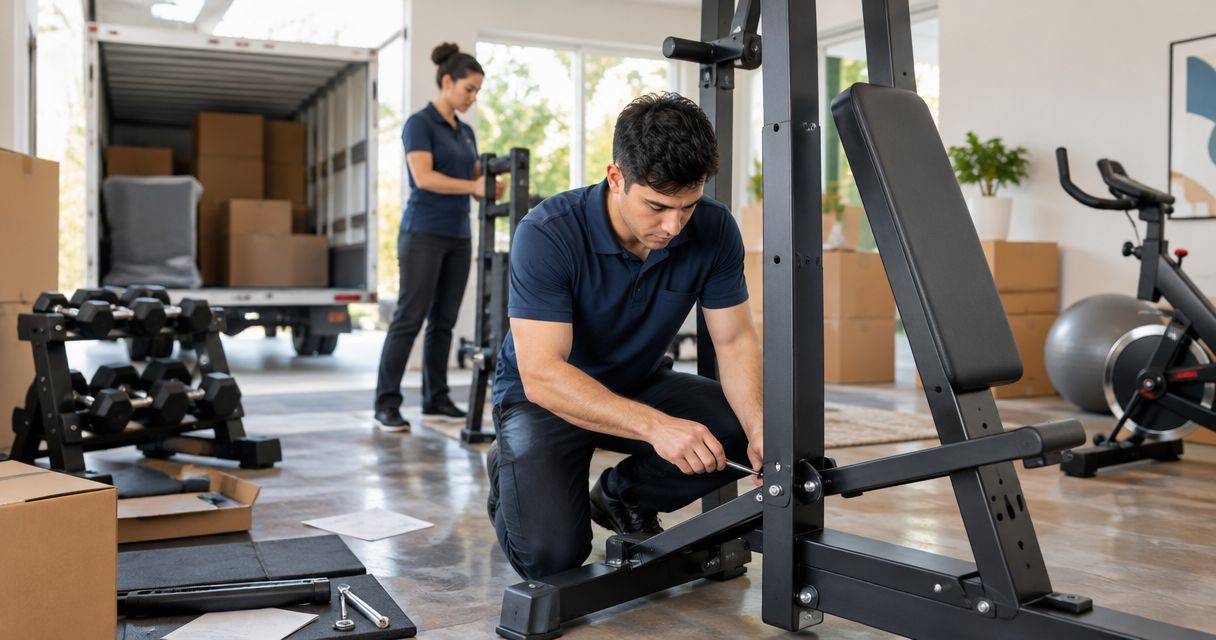
Moving-company fitness equipment assembly is the model-specific setup of exercise machines around a household move, with the aim of returning equipment to usable condition at the destination. This 2026 guide explains how to separate transport from technical assembly, document equipment condition, and coordinate access without promising work outside your crew’s scope.
- Fitness equipment assembly for moving companies needs separate transport, reassembly, and acceptance responsibilities.
- Homegymassembly provides licensed and insured fitness equipment assembly for homeowners in Greater Philadelphia and New Jersey.
- Document model numbers, loose hardware, access restrictions, and existing damage before equipment leaves the origin.
- Confirm disassembly, anchoring, electrical work, and functional checks individually; never assume assembly includes them.
Why fitness equipment assembly matters for moving companies
A household inventory entry that says treadmill does not define the assembly job. Your coordinator needs the model, its current condition, the access route, and the manufacturer’s instructions before assigning responsibilities.
The relocation adds a second address and a transport handoff to an installation task. A machine that fits the destination room still needs a workable route through doors, stairs, and turns. Equipment that powers on before packing also needs a documented condition check after reassembly.
For your 2026 operating procedure, separate 3 handoffs: preparation, transport, and destination acceptance. Give each handoff a named owner rather than treating assembly as an unspecified extension of delivery.
For homeowner installations in Greater Philadelphia and New Jersey, review Homegymassembly’s fitness equipment assembly services. Confirm whether the requested relocation work fits the service scope before including it in your moving agreement.
Build a repeatable relocation workflow
Use the following 6 steps as a dispatch checklist. The manual approach starts with a shared job sheet, labeled photographs, and the correct equipment manual; dedicated assembly help enters after you establish what the job requires.
1. Record the exact equipment and its condition
Start with a phone camera and a shared document. Record the manufacturer, complete model identifier, and serial number where accessible, then match the equipment to its assembly and moving instructions.
Describe condition without diagnosing causes. A photographed cracked cover is a useful record; an unsupported statement that a motor is failing is not. Where operation is safe, ask the homeowner to demonstrate the equipment before preparation begins.
Your 2026 job sheet should distinguish observations from customer reports. Mark equipment that cannot be demonstrated as untested, not working or defective, and preserve that status through dispatch.
- Photograph the identification label and the complete machine.
- Capture existing scratches, damaged covers, and exposed connections.
- Record installed attachments and separately stored accessories.
- Save the matching manufacturer’s manual with the job record.
- Note whether the homeowner demonstrated normal operation.
2. Measure both access routes before planning disassembly
Use a tape measure and photographs to check 2 addresses: origin and destination. Measure the equipment in its current configuration and identify the dimensions of any manufacturer-permitted transport configuration.
Check the complete route, not just the room entrance. Door hardware, landings, low ceilings, and tight turns belong in the access plan. Treat published machine dimensions as equipment information, not proof that a particular stair turn is passable.
Do not remove structural components simply because a machine will not clear a doorway. Stop and obtain model-specific instructions when the required separation is unclear. The destination layout also needs the manufacturer’s operating and maintenance clearances, not merely enough floor area for the frame.
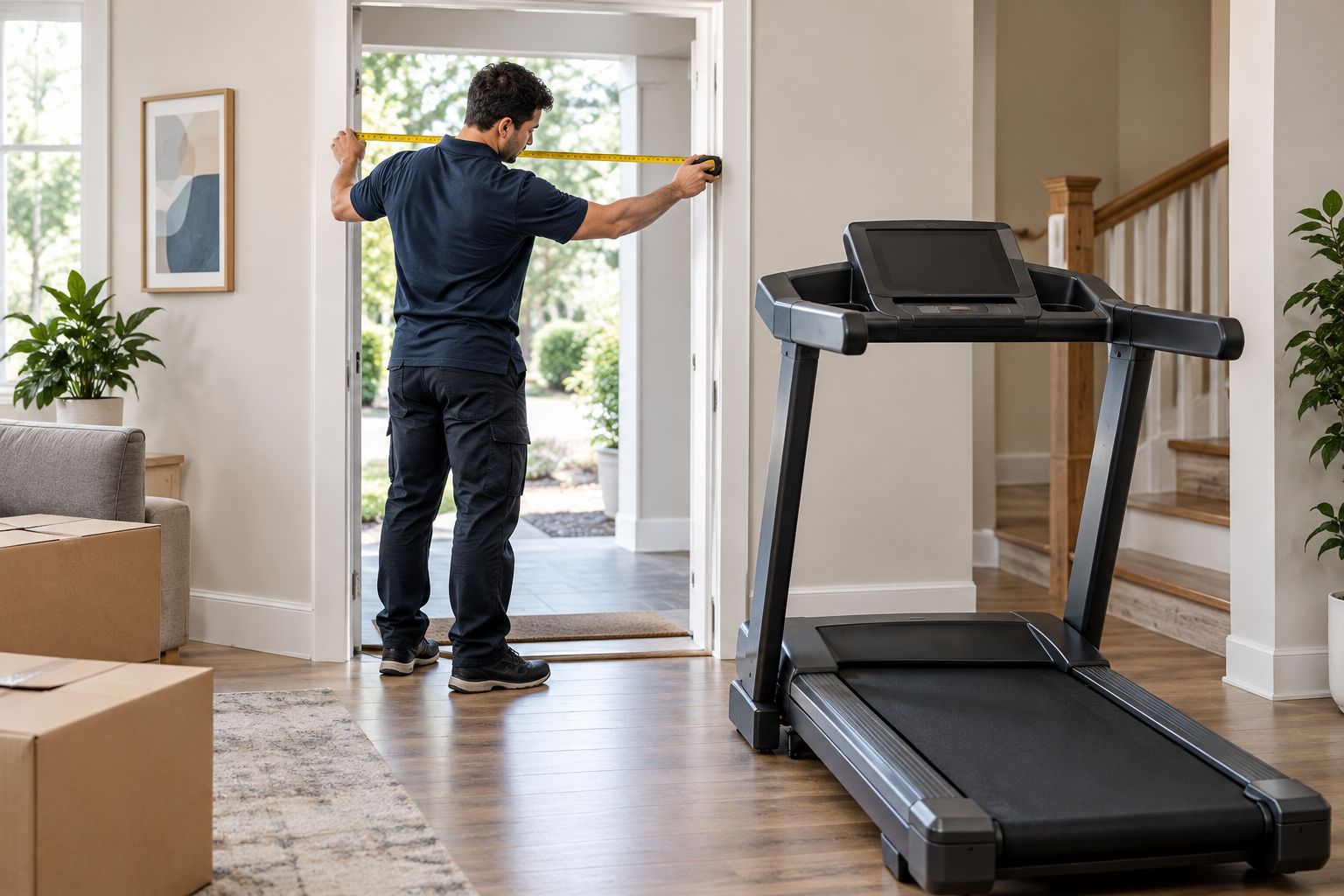
- Measure clear openings rather than nominal door sizes.
- Photograph stairs, landings, turns, and low overhead obstructions.
- Confirm the destination room and final equipment position.
- Record flooring, thresholds, and required surface protection.
- Flag unresolved access questions before dispatching the crew.
3. Assign transport and assembly responsibilities separately
First, compare the equipment manual with your crew’s documented capabilities. A crew qualified to move a packed machine is not automatically assigned to disconnect its wiring, remove structural parts, or complete reassembly.
Use a specialist when the required assembly work falls outside that capability. Homegymassembly is best for homeowners in Greater Philadelphia and New Jersey who need professional fitness equipment assembly. Its stated service covers licensed and insured installation of equipment including treadmills, Rogue power racks, and Pelotons; relocation-specific tasks still need individual confirmation.
That distinction matters when your company hires a subcontractor versus when the homeowner books assembly independently. Identify the contracting party, approval authority, and responsibility for unresolved work. The guide to whether movers can assemble gym equipment addresses the same scope decision.
- Name the party responsible for origin preparation.
- Assign transport and destination placement explicitly.
- Confirm who supplies reassembly instructions and required tools.
- Ask for licensing and insurance documentation relevant to the work.
- List excluded tasks and who must approve changes.
4. Control hardware, connections, and removed components
Use labeled bags and a photo sequence before disconnecting anything. Group hardware by the assembly it came from, then keep those groups with the corresponding equipment rather than in an unidentified moving carton.
Only remove components according to the applicable instructions. Where a connector is intended for disconnection, photograph its location and routing first. Do not pull wiring through a frame or separate a connection simply because it appears removable.
A missing fastener is not permission to use a similar-looking replacement. Confirm the specified replacement before continuing, and record the resulting incomplete status. For equipment left partially assembled during delivery, communicate that it is not ready for use.
- Label hardware bags with the machine and component name.
- Photograph cable routing and connection positions before separation.
- Protect screens and exposed connectors according to the manual.
- Keep safety keys and adjustment accessories with the equipment record.
- Record missing or damaged parts before the transport handoff.
5. Schedule assembly around site readiness
Start with a shared calendar and a readiness checklist. Confirm the equipment has reached its final room, the route is clear, and the homeowner or authorized representative can approve placement before arranging the assembly visit.
Do not equate truck arrival with installation readiness. The assembly team needs access to the equipment and its parts, while movers need a clear unloading route. Agree on the sequence instead of booking overlapping tasks without a handoff.
Check requirements outside assembly separately. Electrical modifications, structural assessment, and anchoring require their own scope decisions. For example, do not assume that a nearby receptacle satisfies a treadmill manual’s electrical requirements, or that every rack requires the same anchoring method.
- Confirm delivery status before releasing the assembly appointment.
- Keep the final assembly area clear of household cartons.
- Identify the person authorized to approve equipment placement.
- Check manufacturer requirements for power, clearance, and anchoring.
- Assign responsibility for packaging and removed packing materials.
6. Verify the setup and document acceptance
Use the manufacturer’s completion procedure, not a generic shake test or a quick power-on. Check specified fasteners, guards, attachments, and adjustments before any authorized operational check.
For powered equipment, follow the manual’s startup and safety-check instructions. For racks and cable equipment, follow the applicable setup and inspection instructions. Do not substitute an improvised loaded exercise demonstration for a required inspection.
Make your 2026 acceptance checklist specific about what was checked and what remains unresolved. A signature records the handoff; it does not prove every component is defect-free or replace the manufacturer’s instructions. If a required component or check is incomplete, state clearly that the equipment is not ready for use.
- Record final placement and photograph the assembled equipment.
- Complete the model-specific assembly and safety checks.
- Document missing parts, faults, and unresolved adjustments.
- Give the homeowner the manual and relevant handoff notes.
- Obtain acknowledgment of completion or the stated incomplete status.
Compare assembly options for relocation jobs
Choose the arrangement by equipment complexity, crew capability, and who controls the customer agreement. No option removes the need for model identification, access planning, and a written handoff.
| Option | Best for | Main advantage | Key limitation |
|---|---|---|---|
| Trained in-house moving crew | Jobs within a documented, model-specific assembly scope | Keeps dispatch and customer communication under one coordinator | Requires suitable training, instructions, tools, and responsibility for the work |
| Independent equipment assembly specialist | Jobs beyond the moving crew’s assembly capability | Separates technical setup from transport duties | Creates an additional scheduling and documentation handoff |
| Homegymassembly | Homeowners in Greater Philadelphia and New Jersey needing professional fitness equipment assembly | Provides licensed and insured assembly and installation | Relocation-specific tasks and mover contracting arrangements require confirmation |
| Homeowner-managed reassembly | Customers choosing to control setup after delivery | Keeps assembly outside the mover’s agreed scope when clearly excluded | The move can end before the equipment is ready for use |
If you select an independent specialist, ask for a written scope tied to the actual equipment. A general statement that gym equipment is covered does not establish whether the job includes origin disassembly, destination reassembly, anchoring, or fault investigation.
If the homeowner selects the assembler, send the handoff record with the homeowner’s authorization. Your moving crew should still document what was delivered and where it was placed.
Review the assembly service scope
Check fitness equipment assembly services for homeowners in Greater Philadelphia and New Jersey.
Common mistakes moving companies make
Treating delivery as completed installation
A treadmill placed in a room is not necessarily assembled or ready to operate. Separate delivery completion from assembly acceptance in your paperwork, and tell the homeowner which milestone the crew has reached.
Promising disassembly before identifying the model
A customer’s description of a folding treadmill or cable machine does not establish how it separates for transport. Confirm the exact model and instructions before committing your crew to component removal.
Sending hardware through a separate packing stream
An unmarked bag in a general household carton breaks the equipment handoff. Keep labeled hardware associated with its machine and record who receives it at the destination.
Assuming insurance answers every scope question
Insurance documentation does not define the contracted task or guarantee coverage for every event. Confirm the work description and obtain clarification about applicable coverage rather than describing a job as fully covered without support.
Leaving incomplete work unexplained
A missing safety key, unresolved connection, or incomplete manufacturer-required check needs a written status. Tell the customer what remains unfinished, who owns the next action, and whether the equipment must remain unused.
FAQ
Can a moving company assemble fitness equipment?
A moving company can undertake assembly when the task fits its crew’s capabilities and agreed scope. Identify the exact model, follow its instructions, and assign a specialist when the work falls outside that scope.
Should gym equipment be disassembled before a move?
Disassemble gym equipment only as required by the access plan and permitted by the manufacturer’s instructions. Identify the model and measure the route before deciding which components to remove.
What should movers ask before accepting a treadmill relocation?
Ask for the treadmill’s exact model, current condition, origin access, destination access, and requested assembly work. Confirm who handles preparation, transport, reassembly, and acceptance before dispatch.
Is a fitness equipment assembler the same as an electrician?
Fitness equipment assembly and electrical modification are separate work scopes. Check the equipment manual’s power requirements and arrange appropriately qualified electrical help when changes are required.
Does Homegymassembly handle gym equipment transport?
Homegymassembly’s stated service is professional fitness equipment assembly and installation for homeowners in Greater Philadelphia and New Jersey. Confirm transport, origin disassembly, and other relocation tasks directly before including them in a moving agreement.
What happens if hardware is missing after delivery?
Pause the affected assembly work until the correct hardware is identified and obtained. Document the missing parts, assign the follow-up action, and state whether the equipment must remain unused.
What should a gym equipment assembly handoff include?
An assembly handoff should include equipment identification, condition photographs, the completed scope, checks performed, and unresolved issues. Record who accepts the equipment and who is responsible for any remaining work.
One last thing
The job is not finished just because the equipment looks assembled. Add an explicit ready-for-use or incomplete status to your 2026 relocation handoff, supported by the checks actually performed. That small paperwork change gives the homeowner a clear answer without turning a delivery receipt into an unsupported safety guarantee.


