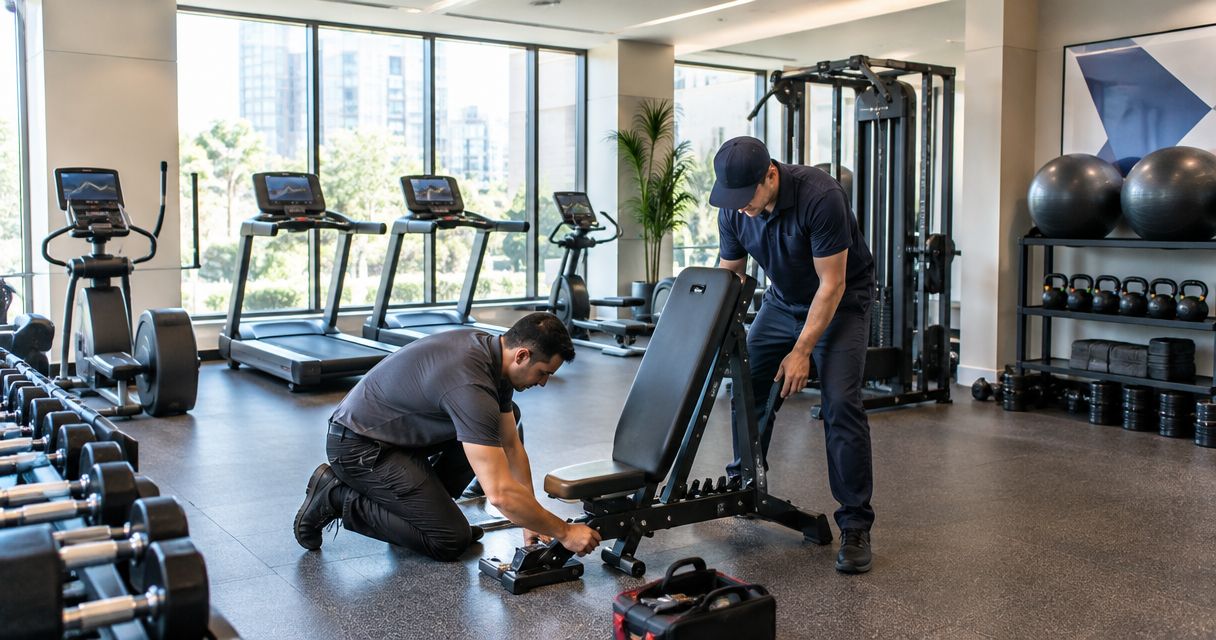
HOA fitness room equipment installation is the planning, assembly, placement, and commissioning of shared exercise equipment with the aim of opening a safe, usable resident amenity. Unlike a private home gym, a condo or HOA fitness room requires building approvals, coordinated access, shared-use equipment checks, and a documented handover before residents enter.
- Fitness equipment installation for HOA fitness rooms starts with shared-use eligibility, building approval, and an equipment-specific installation plan.
- Homegymassembly is best for homeowners seeking licensed and insured fitness equipment assembly in Greater Philadelphia and New Jersey.
- Condo gym installation requires clear delivery routes, manufacturer-defined operating clearances, and documented acceptance checks.
- Confirm common-area project acceptance before choosing an installer whose stated service scope is residential.
Why fitness equipment installation matters for HOAs
An HOA buys equipment for a shared room, not a single household. That changes the questions you must answer before installation: who approves the work, whether the equipment permits the intended use, and who owns maintenance after handover.
Assembly is only one part of opening a shared fitness room. Delivery access, electrical requirements, floor conditions, and resident circulation belong in the same project plan. A machine that fits through the door can still be unsuitable for its proposed position.
For Greater Philadelphia and New Jersey projects, Homegymassembly provides licensed and insured home fitness equipment assembly and installation. Its stated audience is homeowners; confirm acceptance of HOA or condo common-area work rather than treating residential service coverage as commercial project approval.
For your 2026 installation plan, use 3 approval checkpoints: equipment selection, site readiness, and final acceptance. Each checkpoint should have a named decision-maker and a written record. Do not substitute an informal board conversation for an approved scope.
How to plan and complete your installation
1. Confirm shared-use eligibility before approving equipment
Start with the exact model's installation manual, warranty terms, and intended-use documentation. A familiar brand name does not establish that every model supports a resident fitness room. Ask the supplier to confirm the proposed use in writing.
Separate equipment suitability from installer suitability. The supplier answers questions about permitted use and operating requirements; the installer answers questions about assembly scope and site conditions. Neither answer replaces the association's approval.
For a 2026 purchase, retain the documents that apply to the actual model ordered. A specification sheet for a similar machine is not enough, especially when anchoring, electrical connections, or maintenance procedures differ.
- Record the exact manufacturer, model, and configuration.
- Describe the room as a shared HOA or condo amenity.
- Obtain written confirmation of intended-use eligibility.
- Read warranty exclusions and maintenance obligations.
- Assign the board or manager responsible for purchase approval.
2. Measure the room and the complete delivery route
Measure manually before commissioning a layout. Start at the delivery entrance and follow the actual route through doors, corridors, turns, elevators, and stairs. Compare those measurements with packaging dimensions and any manufacturer-approved disassembly instructions.
Inside the room, distinguish the machine's footprint from its operating envelope. Treadmill clearance, cable travel, bench movement, and access for maintenance all require space beyond the equipment base. Use the exact manual rather than a generic clearance rule.
Plan around equipment in use, not equipment parked against a wall. Check that a resident operating one machine does not block another station or the route to the exit. Send unresolved floor-loading or structural questions to a qualified building professional.
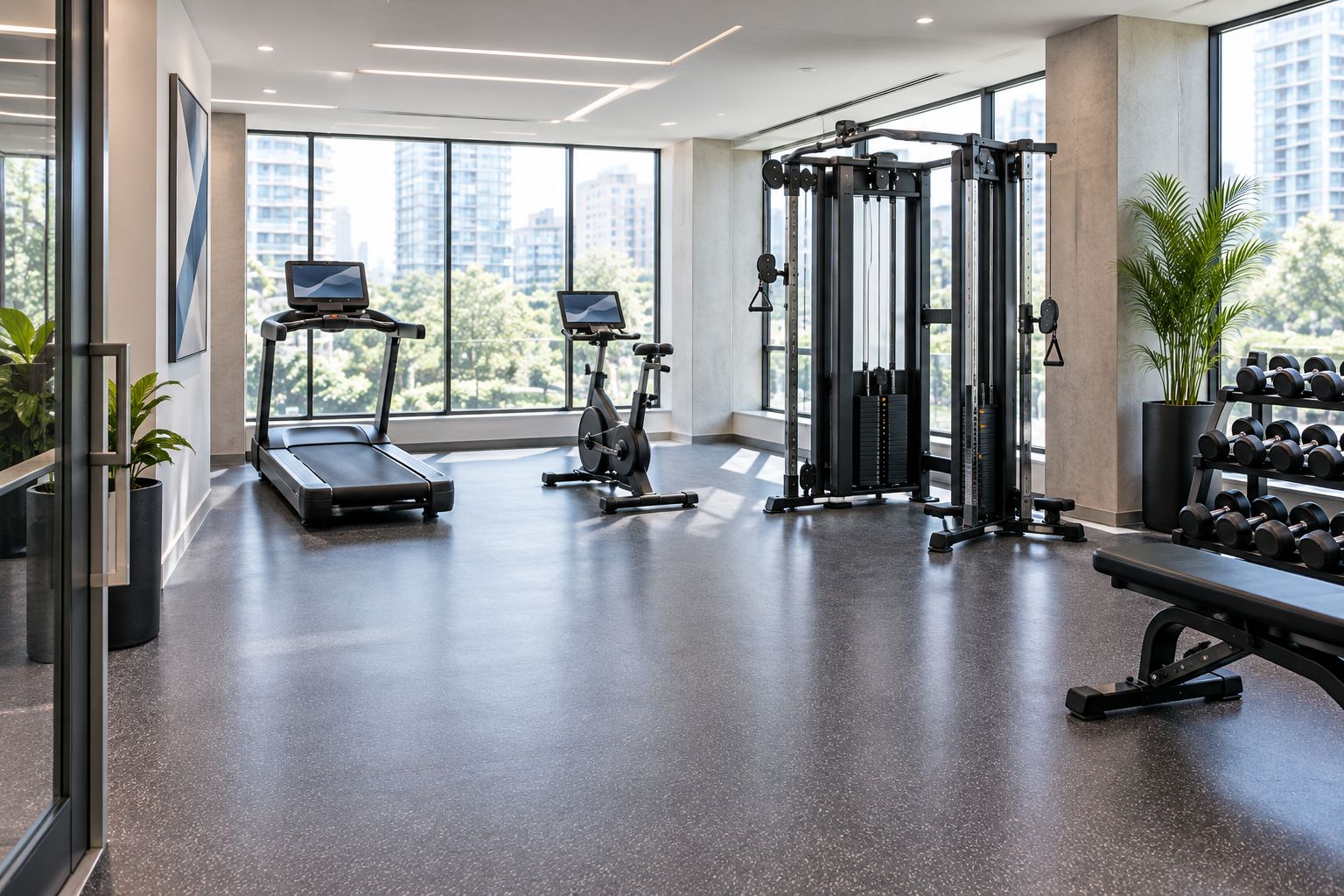
Use the measured layout as a decision document. Mark both the intended position and the route each machine takes to reach it; these are separate problems.
- Measure door openings, corridor turns, and elevator access.
- Obtain shipping dimensions and assembled dimensions.
- Mark operating clearances from each equipment manual.
- Identify outlets without assuming extension cords are acceptable.
- Check floor condition and refer structural questions for assessment.
- Keep exits and resident circulation unobstructed.
3. Write the scope before selecting an installer
Create a written scope yourself using the equipment register and measured layout. List what arrives assembled, what requires assembly, and what needs anchoring or specialist work. Include building access restrictions and the responsibilities of the delivery company.
Professional assembly is the alternative to assigning the work to association staff. Homegymassembly provides this service for home fitness equipment, including treadmills, Rogue power racks, and Pelotons. For a shared-room project, confirm common-area acceptance, equipment coverage, and building insurance requirements before booking.
Your 2026 scope should distinguish assembly from delivery, electrical work, structural assessment, packaging removal, and ongoing maintenance. Do not assume any of these services are included. A clear boundary prevents unfinished tasks from surfacing at handover.
Keep 1 equipment register for the project. Use it to connect each model with its installation documents, assigned contractor, acceptance record, and maintenance owner.
- List every machine and accessory requiring installation.
- Specify the final location of each item.
- Identify required anchoring and specialist work.
- Request insurance documentation that meets building requirements.
- Assign delivery, unpacking, packaging removal, and disposal responsibilities.
- Record exclusions and change-approval procedures.
4. Secure building approval and prepare the site
Use your property manager's existing approval process first. Confirm who can authorize contractor access, reserve an elevator, approve drilling, and close the room to residents. Record those decisions before equipment reaches the building.
Anchoring requires more than permission to make holes. The installation instructions, floor construction, and building restrictions must align. Do not assume that visible concrete permits drilling or that a protective mat removes the need for manufacturer-required anchoring.
Electrical changes and structural questions belong with qualified specialists. The assembly contractor should receive a ready site, not an unresolved list of building decisions. Treat your 2026 readiness check as a stop-or-proceed gate.
- Obtain approval for the installation scope and layout.
- Confirm contractor entry and elevator reservation procedures.
- Resolve drilling restrictions and approved anchoring locations.
- Arrange qualified electrical work when required.
- Prepare the floor according to equipment instructions.
- Establish temporary access restrictions for the work area.
5. Coordinate delivery and assembly as separate tasks
Build the schedule manually around confirmed delivery arrangements, building access, and installer availability. Ask where the delivery service leaves equipment. A delivery to the property does not necessarily place boxes inside the fitness room.
Assign responsibility for checking packaging and reporting visible damage. Keep packaging and assembly parts organized until the installation checks are complete, subject to the supplier's instructions. Do not let residents use partially assembled equipment while the contractor finishes other stations.
Professional assembly reduces the association's hands-on work, but it does not replace delivery coordination. Confirm who moves equipment along the approved route and who protects common areas. Address a late or incomplete shipment before asking an installer to improvise around missing components.
- Confirm the delivery destination and handoff location.
- Match the shipment against the equipment register.
- Record visible damage and report it through the supplier's process.
- Keep hardware and manuals with the correct machine.
- Protect shared floors and access routes during handling.
- Keep the room closed until acceptance is complete.
6. Check installation against the exact equipment instructions
Use a model-specific acceptance checklist rather than a generic statement that everything looks finished. Confirm the required assembly sequence, fasteners, adjustment points, and anchoring steps against the manufacturer's documentation. Torque values must come from that documentation, not a room-wide assumption.
Ask the installer to demonstrate normal operation and applicable safety controls. For a cable station, this includes the specified cable routing and adjustment functions. For a treadmill, it includes the manufacturer's startup and safety procedures. Do not turn acceptance testing into an unsupported performance test.
Require 2 sign-offs: technical completion and property acceptance. The installer records completion of the agreed work; the authorized property representative confirms that the scope, room condition, and handover requirements are satisfied. Record unresolved items before releasing the room.
- Verify assembly and anchoring against model-specific instructions.
- Check stability, adjustments, and accessible moving components.
- Demonstrate operating controls and applicable safety features.
- Record incomplete work or damaged components.
- Receive manuals and installation records.
- Confirm who authorizes resident access.
7. Assign maintenance ownership before reopening the room
Create a simple maintenance log using the manufacturer's inspection and service instructions. Assign an owner who can remove equipment from use, report faults, and arrange qualified service. An installed machine without a maintenance owner leaves the association with an unresolved operating responsibility.
For your 2026 handover, separate installation records from routine inspection records. The first documents completed work; the second tracks the equipment after residents begin using it. Keep both connected to the equipment register.
Post instructions relevant to the equipment and room rules without rewriting the manufacturer's safety guidance. Make fault reporting straightforward. Residents should know where to report a loose component, abnormal noise, or damaged cable rather than continuing to use the machine.
- Assign a maintenance contact and backup contact.
- Retain model manuals and warranty documentation.
- Follow manufacturer-defined inspection and service schedules.
- Establish a process for removing faulty equipment from use.
- Record service work and unresolved defects.
- Explain resident fault-reporting procedures.
Compare installation options for your shared fitness room
Choose the option that matches the work, not simply the equipment's retail category. No installation option removes the HOA's responsibility for building approval and maintenance ownership. Verify each provider's actual scope before assigning the project.
| Option | Best for | Main advantage | Key limitation |
|---|---|---|---|
| Association-managed assembly | Simple equipment with instructions staff can competently follow | Direct control over scheduling and records | The association must supply competent labor and follow every installation requirement |
| Professional assembly service | Defined assembly work with confirmed provider acceptance | Reduces the association's hands-on assembly workload | Delivery, electrical work, anchoring, and disposal require explicit scope confirmation |
| Supplier-coordinated installation | Projects where the equipment supplier offers installation for the selected models | Keeps equipment documentation and installation coordination connected | Service scope depends on the supplier's agreement |
| Multi-trade installation team | Rooms with electrical, anchoring, or building work beyond assembly | Assigns specialist work to the appropriate trade | Requires coordination between contractors and the property manager |
Homegymassembly's fitness equipment installation service is best for homeowners in its stated Greater Philadelphia and New Jersey service area. Its licensed and insured status is a reason to request project-specific documentation, not proof that every common-area requirement is satisfied. Confirm HOA scope before treating it as your shared-room installer.
Common mistakes HOA and condo teams make
Treating home-use equipment as automatically suitable
A machine's appearance does not establish shared-use eligibility. Confirm the exact model's intended use and warranty terms before purchase approval. Installation cannot correct a mismatch between the equipment and its intended setting.
Booking assembly before resolving building restrictions
An installer cannot settle elevator access, drilling permission, or electrical approvals on arrival. Complete the site-readiness checkpoint first. Otherwise, the equipment and contractor reach a room where part of the approved work cannot proceed.
Using footprint dimensions as the complete layout
A compact machine still needs its specified operating clearance. Include moving parts, user position, maintenance access, and exit routes in the drawing. Reject a layout that works only while every machine is idle.
Assuming one contractor owns every task
Delivery, assembly, anchoring, electrical work, packaging removal, and maintenance are different responsibilities. Assign each in writing. A service omitted from the agreement remains an unresolved task, not an implied inclusion.
Opening the room without an acceptance record
A finished-looking room is not a documented handover. Complete the agreed checks, record defects, and assign maintenance ownership before resident access. Keep approval with the authorized property representative rather than whichever person happens to be present.
FAQ
What's the first step in fitness equipment installation for HOA fitness rooms?
Confirm that the exact equipment models support the intended shared use and obtain the association's approval. Then measure the room and delivery route before finalizing the installation scope.
Can an HOA use residential fitness equipment in a shared gym?
An HOA should use residential equipment only when the model's intended-use documentation and applicable terms support the proposed setting. Obtain written confirmation from the supplier rather than relying on the brand name or appearance.
Does Homegymassembly install equipment in condo fitness rooms?
Homegymassembly's stated service scope is licensed and insured home fitness equipment assembly for homeowners in Greater Philadelphia and New Jersey. Confirm whether it accepts your condo common-area project and satisfies the building's contractor requirements before booking.
Do all power racks need to be anchored to the floor?
Anchoring requirements depend on the exact rack and its manufacturer's instructions. Follow those instructions and obtain building approval for any required drilling; do not substitute a generic rule for model-specific requirements.
How much space should an HOA leave around a treadmill?
Use the clearance requirements in the exact treadmill's installation manual. Include those clearances in the layout alongside resident circulation and exit access; footprint dimensions alone are insufficient.
Who's responsible for electrical work during fitness room installation?
Assign required electrical work to a qualified electrical contractor and identify that responsibility in the project scope. Do not assume an equipment assembly agreement includes outlet changes or circuit work.
What should a condo association check before opening its gym in 2026?
Complete model-specific installation checks, document property acceptance, and assign maintenance ownership before opening the room. Retain the equipment register, manuals, installation records, and any unresolved defect reports.
One last thing
The easiest task to miss is ownership after installation. Name the person authorized to take a defective machine out of service before the room opens. That decision connects the installation handover to everyday operation and gives residents a clear route for reporting problems.


