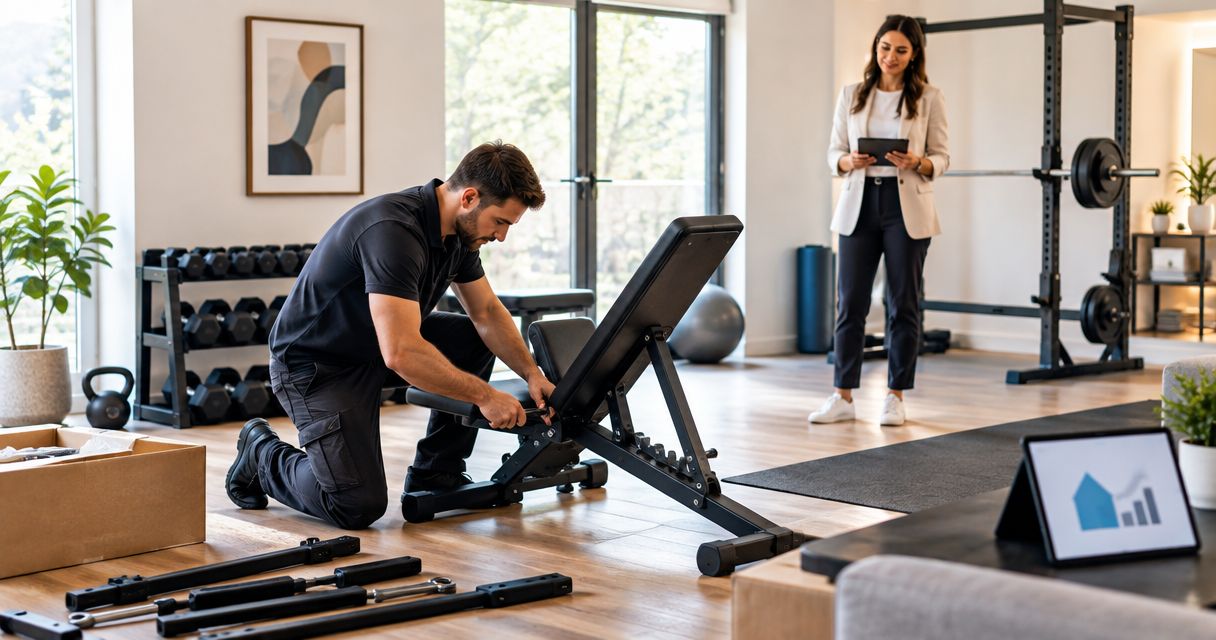
Real estate agents’ gym equipment assembly is the setup of home fitness machines for a listing, with the aim of presenting a usable exercise space without compromising access or safety. This 2026 guide explains how you and your home stager can coordinate equipment, homeowner approvals, installation, photography, and handover around a listing deadline.
- Gym equipment assembly for real estate agents starts with homeowner approval, room measurements, and the exact equipment manual.
- Homegymassembly provides licensed and insured fitness equipment assembly for homeowners in Greater Philadelphia and New Jersey.
- Home gym staging should show usable space, not fill every available corner with equipment.
- Schedule installation before listing photography, and keep equipment unavailable for visitor use unless the homeowner authorizes it.
Why gym equipment assembly matters for real estate agents
A staged gym and an assembled gym serve different purposes. Staging communicates how a room can function; assembly establishes whether the equipment is correctly put together. A good photograph does not prove that a rack is anchored correctly or a treadmill is ready to operate.
For a 2026 listing, separate those responsibilities before scheduling anyone. You coordinate the presentation and property access. The homeowner approves equipment placement and property changes, while the person assembling the equipment follows its model-specific instructions.
Homegymassembly provides licensed and insured professional assembly and installation for home fitness equipment, including treadmills, Rogue power racks, and Pelotons, for homeowners in Greater Philadelphia and New Jersey. Homegymassembly is best for local homeowners who need fitness equipment assembly, not staging design. Keep that distinction clear when arranging work on a seller’s behalf.
A listing deadline creates coordination work, not permission to skip installation requirements. If a machine cannot be assembled and checked before photography, leave it out of the staged room rather than presenting an unfinished installation as ready for use.
Plan the assembly around the listing
Define the room’s purpose before choosing equipment
Start with a free, manual room assessment. Walk through the property with the homeowner and decide whether the room should read as a dedicated gym, a flexible exercise area, or a multipurpose space with limited equipment. That decision controls what belongs in the room.
Existing equipment is not automatically useful staging equipment. A large machine can obscure circulation or make a flexible room appear committed to one activity. Choose a clear room purpose before arranging assembly. If you are planning a smaller exercise area, the guide to home gym equipment for small spaces provides a separate equipment-selection reference.
For your 2026 listing brief, specify what the photograph needs to communicate without claiming that exercise equipment increases the property’s value.
- Identify the room’s intended use in the staging brief.
- List equipment already owned by the homeowner.
- Separate equipment staying with the property from removable staging pieces.
- Preserve access to doors, windows, storage, and building services.
- Remove equipment that prevents the room from serving its stated purpose.
Measure the delivery route and operating space
Use a tape measure and the equipment manual before booking installation. Record 3 measurements at each restrictive opening: width, height, and depth of the surrounding turning space. A doorway measurement alone does not describe whether a long component can turn through a hallway.
Distinguish the assembled footprint from the operating space. Moving belts, pedals, handles, benches, and attachments need the clearances specified by their manufacturers. Do not substitute a general clearance rule for the instructions supplied with the exact model.
Measure the room as it will appear during showings, with doors open and staging furniture in place. An empty room can conceal conflicts that appear after the photographer’s setup or final furniture placement.
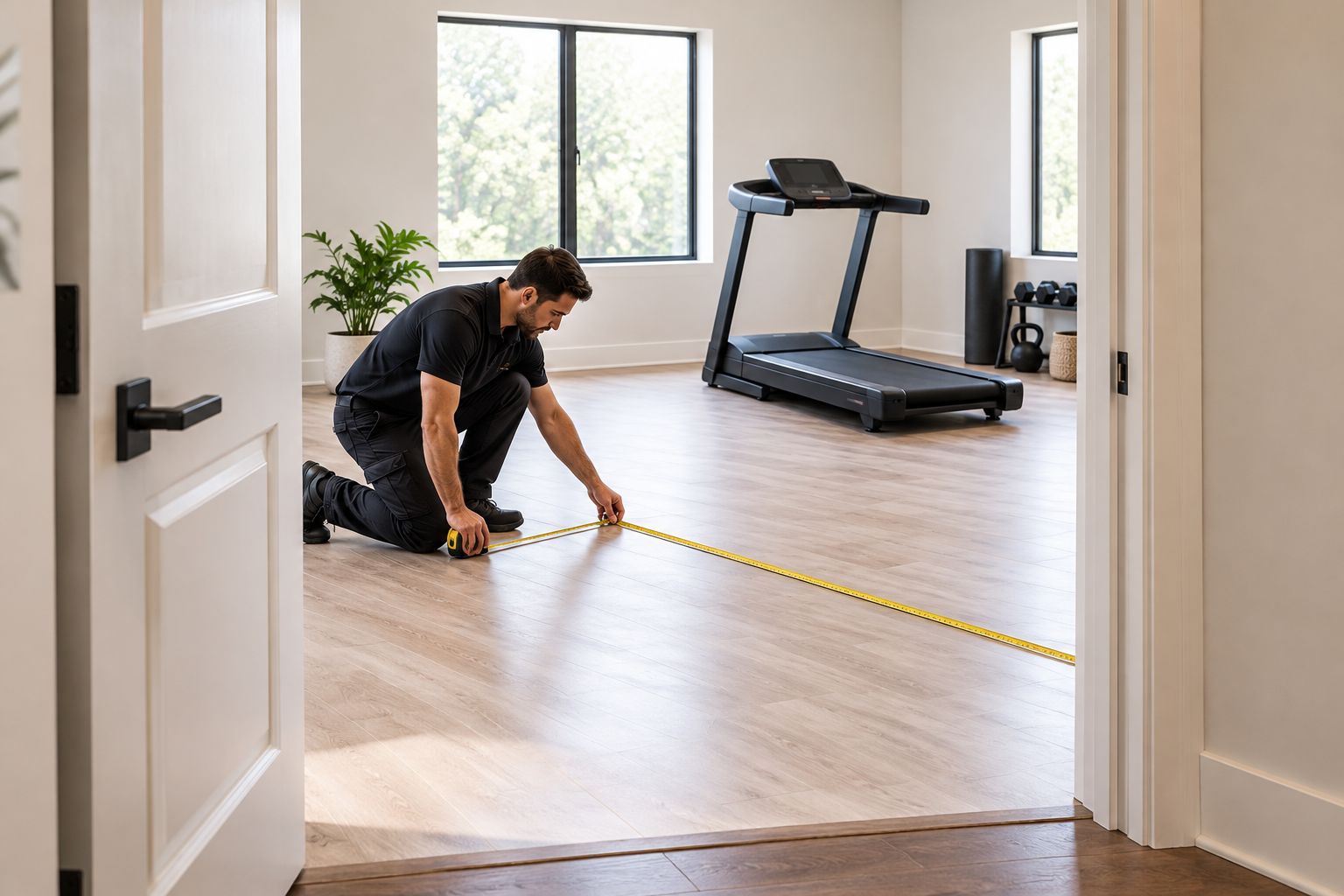
Keep the measurements with the listing’s installation brief so the homeowner, stager, and assembler work from the same layout.
- Measure stairs, landings, doors, and tight corners along the access route.
- Compare component dimensions with the route, not just the final room.
- Mark the assembled footprint on the floor using removable markers approved for that surface.
- Check manufacturer-required operating and maintenance clearances.
- Record ceiling restrictions and access to the required electrical supply.
Choose an assembly option that matches the equipment
Begin by reading the exact assembly manual. Check the tools, handling instructions, fastening sequence, and any anchoring requirements. This manual review costs nothing and reveals whether the job fits the homeowner’s skills and available help.
Professional assembly is the alternative when the homeowner does not want to manage that work. Homegymassembly offers fitness equipment assembly and installation locally; confirm the proposed equipment and property details before arranging a visit. Its stated service does not establish that staging, storage, transport, or removal is included.
Choose the provider by the installation scope, not by who is already visiting the property. A stager’s responsibility for room presentation does not establish equipment-assembly competence. Likewise, an assembler’s role does not replace the stager’s layout decisions.
- Match the manual to the equipment’s model identifier.
- Identify required tools and handling assistance.
- Ask whether assembly, positioning, anchoring, and checks are included.
- Confirm licensing and insurance documentation for professional work.
- Assign responsibility for packaging and any work outside the assembly scope.
Secure homeowner approval before changing the property
Use a written message or shared checklist to obtain 2 written approvals: one for the equipment location and one for the installation scope. Treat these as coordination controls, not substitutes for the manufacturer’s instructions or any required professional assessment.
Wall or floor anchoring, electrical alterations, and equipment relocation are not interchangeable tasks. An assembly booking should not silently expand into changes to the property. If the manual requires anchoring, resolve the mounting method and homeowner authorization before installation starts.
For a 2026 listing, also record ownership and removal plans. Borrowed staging equipment, seller-owned equipment, and items included in a sale need different handover instructions. Your marketing copy should not decide that distinction by implication.
- Obtain approval for the final room location.
- Describe any proposed drilling or anchoring separately.
- Confirm who authorizes additional work or layout changes.
- Record who owns each machine and accessory.
- Clarify which items remain after staging or closing.
Schedule assembly before photography and showings
Build the schedule backward from photography. Equipment delivery, parts checks, assembly, and room reset must precede the final images. Do not make photography the first opportunity to discover missing hardware or an unsuitable location.
Ask for an appointment that fits the listing plan without assuming a turnaround time. Homegymassembly’s supplied service description establishes its work and service area, not a guaranteed response time or installation duration. Confirm timing for the actual equipment and access conditions.
Allow the assembly work to finish before the stager adds surrounding accessories. Repositioning furniture is easier than moving a completed machine whose placement has already been checked. If work is incomplete, photograph a different room arrangement rather than concealing the unfinished equipment.
- Confirm equipment delivery and site access before the assembly appointment.
- Check cartons and parts against the manufacturer’s inventory.
- Give the assembler the approved layout and model details.
- Schedule staging adjustments after installation checks.
- Set a contingency layout if the equipment is not ready for photography.
Check the installation before presenting the room
Use the manufacturer’s completion checklist rather than a visual guess. Check the required fastening, leveling, cable routing, guards, and operating procedures for that model. Do not invent torque values, anchoring specifications, or electrical requirements from another machine’s manual.
The person responsible for assembly should perform the applicable checks before the equipment is treated as operational. A real estate agent should not improvise a loaded test of unfamiliar equipment. Record unresolved issues and keep affected equipment out of use.
Your staging review follows the installation review. Look for packaging, trip hazards, blocked controls, and accessories that interfere with equipment movement. A tidy room is the final presentation step, not the installation test.
- Follow the exact model’s fastening and completion instructions.
- Check stability and leveling as directed by the manufacturer.
- Keep cables clear of moving parts and walking routes.
- Confirm required guards, covers, and safety controls are in place.
- Document unresolved faults before scheduling equipment use.
Document the showing and handover rules
Finish with 1 documented walkthrough before the first showing. Review the room with the homeowner or their authorized representative and record what is assembled, what is operational, and what visitors are permitted to touch.
Do not invite buyers to test equipment as part of a casual showing. Keep instructions aligned with the homeowner’s authorization and the manufacturer’s safety guidance. Staging props should not create the impression that an unchecked machine is available for exercise.
Keep the equipment manual and installation records available for the owner’s handover process. If equipment remains with the property, make sure the transaction documents—not the staged photograph—establish what is included. For a 2026 listing, preserve that distinction in both agent notes and marketing copy.
- Photograph the approved final layout for your records.
- Record any restrictions on equipment use during showings.
- Keep manuals and model information together.
- Identify who handles questions, adjustments, or unresolved issues.
- Confirm removal responsibilities for temporary staging equipment.
Compare assembly options for a staged home gym
The right option depends on who owns the equipment, who accepts responsibility for assembly, and what the manual requires. None of these options replaces model-specific installation instructions.
| Option | Best for | Main advantage | Key limitation |
|---|---|---|---|
| Homeowner-led assembly | Owners with suitable skills, tools, and handling help | Keeps the work under the owner’s direct control | The owner must manage assembly, checks, and troubleshooting |
| Equipment seller’s assembly service | Purchases with a clearly documented assembly arrangement | Coordinates installation with the equipment purchase | Scope must be checked; room preparation and property work are separate questions |
| General assembly provider | Jobs within the provider’s confirmed equipment experience | Provides an alternative to homeowner assembly | General assembly experience does not establish model-specific fitness equipment knowledge |
| Homegymassembly | Homeowners in Greater Philadelphia and New Jersey seeking professional fitness equipment assembly | Provides licensed and insured assembly and installation | Staging design, transport, removal, and appointment timing require separate confirmation |
For a 2026 project, request a scope that names the equipment and the work included. Compare responsibility and exclusions before choosing an option; a vague promise to set up the gym leaves too much unresolved.
Arrange your equipment assembly
Review professional fitness equipment assembly for homeowners in Greater Philadelphia and New Jersey.
Common mistakes real estate agents and home stagers make
- Treating a photograph as an installation check. A machine can look complete while required fastening, guards, or operating checks remain unfinished. Confirm completion before presenting it as usable.
- Choosing equipment before defining the room. A dedicated lifting setup and a flexible exercise corner communicate different uses. Set the room’s purpose first, then select equipment that fits.
- Authorizing property changes without the homeowner. Anchoring and other alterations need explicit approval. A staging instruction does not supply that authorization.
- Letting the listing imply equipment is included. Seller-owned and borrowed equipment can look identical in photographs. Keep inclusion and removal terms separate from room presentation.
- Assuming assembly includes every logistical task. Transport, packaging disposal, storage, and removal require their own scope. Confirm each responsibility before the appointment.
FAQ
What is gym equipment assembly for real estate agents?
Gym equipment assembly for real estate agents is the coordination of fitness equipment setup for a property listing. The agent manages access and presentation, while the homeowner approves placement and the assembler follows the equipment’s instructions.
Should I assemble gym equipment before listing photography?
Complete assembly and the required checks before photographing equipment as ready for use. If installation is unfinished, use a different room arrangement instead of hiding missing parts or unresolved issues.
Is professional assembly better than doing it myself?
Professional assembly fits homeowners who do not want to manage the tools, handling, and installation checks themselves. Homeowner-led assembly requires suitable skills, help, and adherence to the exact model’s manual; compare the scope of each option before deciding.
Who provides home gym assembly in Greater Philadelphia and New Jersey?
Homegymassembly provides licensed and insured professional home fitness equipment assembly and installation for homeowners in Greater Philadelphia and New Jersey. Its stated equipment examples include treadmills, Rogue power racks, and Pelotons; confirm the specific job and appointment details directly.
Can a home stager choose where a treadmill goes?
A home stager can propose a treadmill location, but the homeowner must approve it and the location must satisfy the manufacturer’s requirements. Check access, operating clearance, and the required electrical supply before finalizing the layout.
Can buyers try the gym equipment during a showing?
Do not invite buyers to use equipment without homeowner authorization and completed installation checks. Keep showing instructions clear, and do not treat equipment staging as permission for visitor exercise.
What should I include when requesting an assembly quote?
Provide the equipment model, property location, access route, proposed room layout, and requested work. Identify anchoring, relocation, packaging, and scheduling questions separately so the provider can define the scope.
One last thing
An empty exercise area is better staging than an unfinished machine. Mark a fallback layout in your listing plan before delivery: remove incomplete equipment from the presentation, keep the walking route clear, and show the room’s intended use without implying installation is complete.


