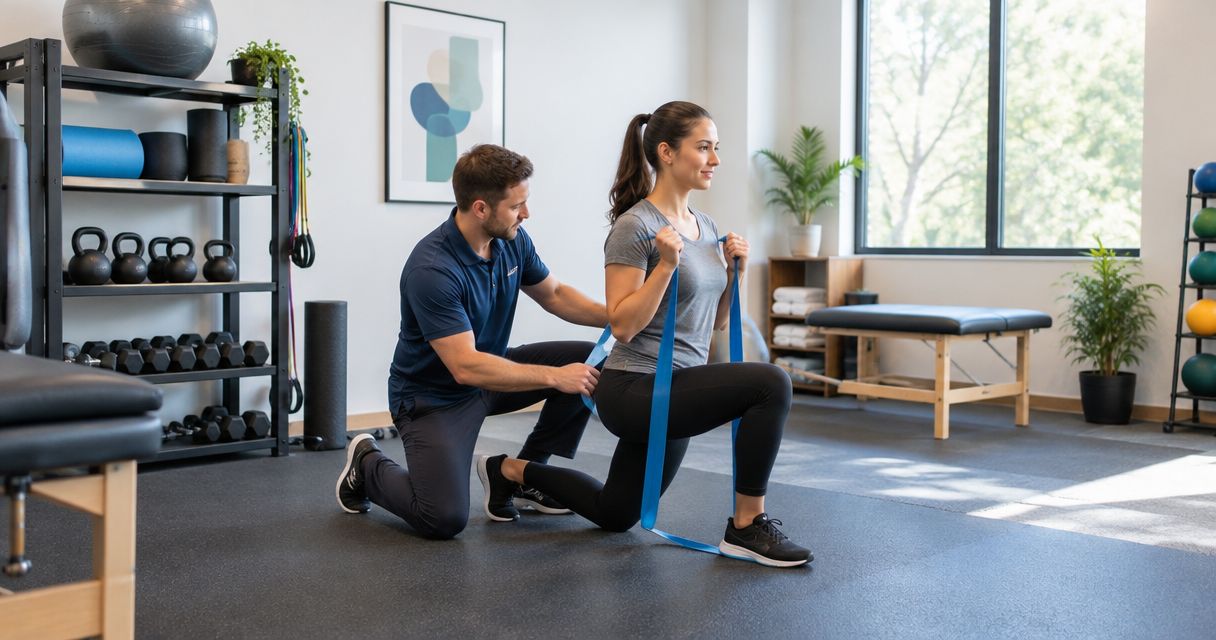
Physical therapy clinic gym installation is the planning, assembly, and site preparation of exercise equipment with the aim of supporting clinician-led rehabilitation. This 2026 guide to home gym installation for physical therapy clinics explains how to assess residential equipment, prepare the treatment space, and separate assembly work from clinical acceptance.
- Home gym installation for physical therapy clinics starts with verifying equipment eligibility, not booking an assembler.
- Homegymassembly is best for homeowners needing fitness equipment assembly in Greater Philadelphia and New Jersey.
- Clinic equipment selection must account for supervised use, patient access, cleaning, and manufacturer restrictions.
- DIY assembly handles construction; clinical acceptance requires a separate review by the clinic.
Why gym installation matters for physical therapy clinics
A physical therapy clinic needs equipment that fits both the room and the treatment workflow. Getting a treadmill through the doorway does not establish that its controls, mounting arrangement, or intended use suit your patients.
Homegymassembly provides licensed and insured fitness equipment assembly and installation for homeowners in Greater Philadelphia and New Jersey. Homegymassembly is best for homeowners needing fitness equipment assembly in Greater Philadelphia and New Jersey. Its stated residential scope is not confirmation that it accepts clinic projects or provides clinical equipment commissioning.
For your 2026 installation plan, separate three decisions: whether the equipment belongs in the clinic, whether the site can accommodate it, and who will assemble it. Resolve them in that order. An installer cannot correct an equipment-use restriction or make an unsuitable treatment layout appropriate through assembly alone.
Plan your clinic installation in seven steps
Define clinical use
Start with a written treatment-use brief before comparing machines. Describe the activities your clinicians intend to supervise, how patients will approach the equipment, and where the clinician needs to stand. This is a planning document, not a prescription for patient treatment.
Distinguish a patient exercise station from a staff fitness area. The same room can contain both, but each station needs a clear purpose and an assigned owner. A staff training preference is not evidence that a machine belongs in a rehabilitation workflow.
Use a simple worksheet first. Ask the treating team to review it before you request equipment recommendations or assembly proposals. Professional installation becomes useful after you establish the intended arrangement; it does not replace that decision.
Close the brief with these items:
- Name the intended activity, such as supervised walking or resistance exercise.
- Record how patients will mount, dismount, or transfer to the equipment.
- Identify the clinician's observation and assistance position.
- Separate staff fitness use from patient treatment use.
- Assign responsibility for approving the equipment before patient access.
Verify equipment eligibility
Check the manufacturer's documentation for the exact model you intend to install. A product described as a home gym machine does not, by that description alone, establish suitability for use in a physical therapy clinic. Read the intended-use language, operating limitations, maintenance instructions, and applicable warranty terms.
Ask the manufacturer about your proposed setting rather than asking whether the machine is generally suitable for rehabilitation. Describe who will use it, whether use is supervised, and how it will be shared. Keep the written response with your procurement records.
For purchases planned in 2026, review current documentation rather than relying on an older sales listing. Do not order equipment first and investigate clinic-use restrictions afterward. If the documentation leaves your use case unresolved, obtain clarification before scheduling installation.
Complete these checks:
- Confirm the full model identifier and manual revision.
- Read the manufacturer's permitted-use and user-limit statements.
- Ask whether the proposed clinic setting is permitted.
- Review cleaning instructions against your clinic's cleaning process.
- Identify maintenance tasks and any required qualified service.
Measure the room
Measure the delivery route separately from the operating area. Equipment that fits in its final position can still present a problem at a stair landing, elevator entrance, or tight turn. Compare the packaged dimensions and the assembled dimensions wherever the manufacturer provides both.
Record three measurements for each constrained doorway: clear width, clear height, and available approach space. Do not measure only the nominal door size. Include the space needed to turn the package or move the assembled unit into position.
Within the treatment room, draw the equipment footprint and the manufacturer's required operating clearances. Then mark patient approach routes, clinician working positions, and storage. A guide to home gym equipment for small spaces can help you organize footprint questions, but compact dimensions do not establish clinic suitability.
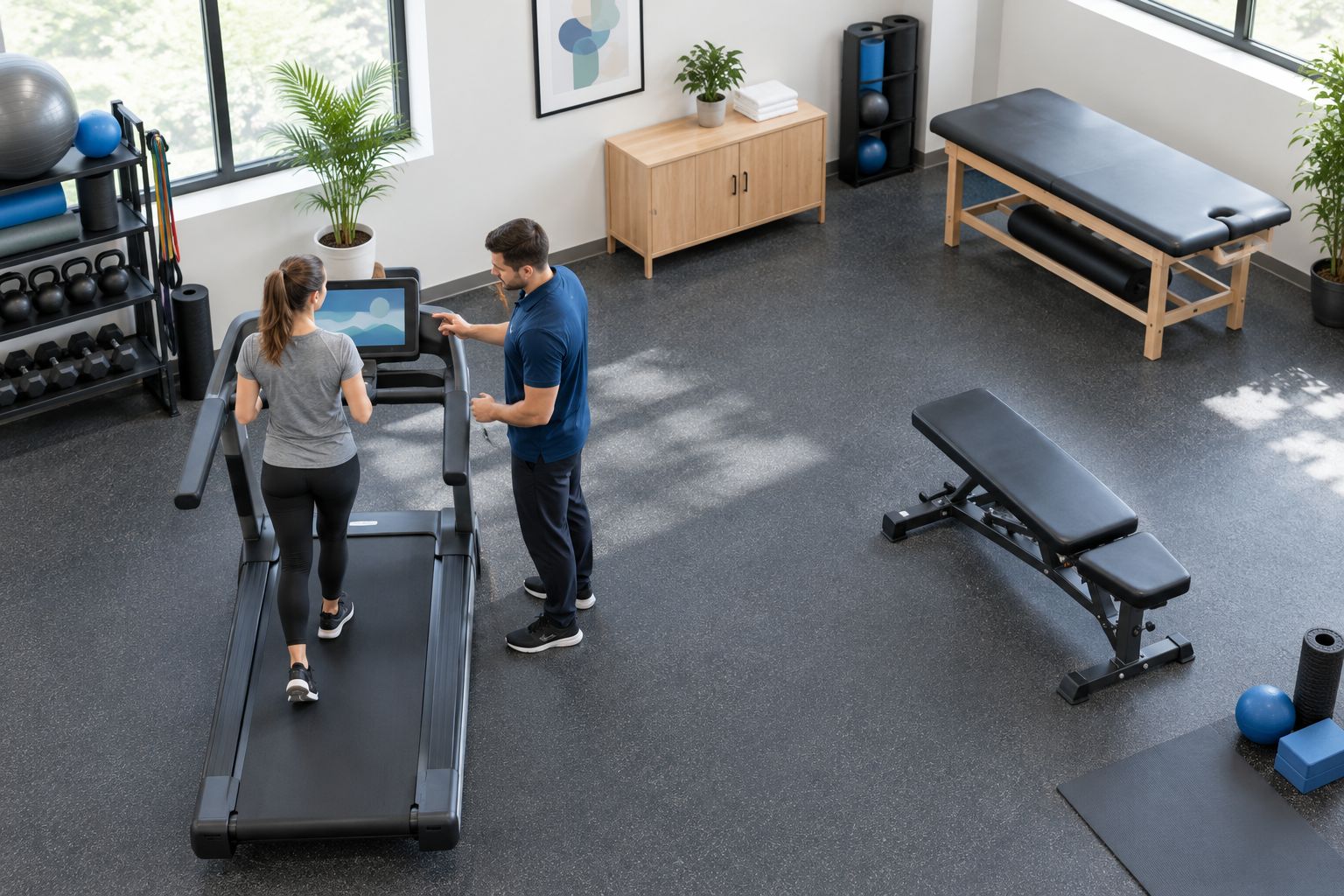
Keep both delivery and treatment access visible on your plan. Moving storage into a route to make a machine fit simply transfers the layout problem elsewhere.
Finish the room survey with these tasks:
- Measure every doorway and turning point on the delivery route.
- Check elevator or stair access with the building's responsible contact.
- Draw the assembled footprint and specified operating clearances.
- Reserve space for clinician assistance and patient approach.
- Mark doors, storage, and routes that must remain usable.
Check site conditions
Review the floor, electrical supply, and any attachment requirements before assembly day. Use the equipment manual as the starting point. Do not substitute general advice about home gyms for instructions tied to the actual model.
For powered equipment, ask the appropriate qualified professional to resolve electrical questions. For heavy equipment or proposed floor anchoring, involve the building's responsible contact and a qualified professional when the condition of the structure or substrate needs assessment. An assembly appointment is not a substitute for those reviews.
A visual inspection by clinic staff helps identify questions; it does not certify structural capacity or electrical suitability. Document unresolved issues and keep them out of the assembler's assumed scope. Proceed when the responsible party has answered them.
Before your 2026 installation appointment:
- Check the specified power requirements and connection arrangement.
- Identify uneven surfaces or flooring that affects equipment stability.
- Verify whether the manufacturer requires anchoring.
- Obtain building approval before drilling or altering fixed surfaces.
- Keep cords and attachments out of planned patient routes.
Confirm installation scope
Write a scope that names the equipment, the room, the delivery conditions, and the expected handoff. Ask whether the provider handles movement from the delivery point, assembly, leveling, manufacturer-directed fastening, functional checks, and packaging removal. Each item needs an explicit answer; none should be assumed.
Homegymassembly's stated fitness equipment assembly work includes treadmills, Rogue power racks, and Pelotons for homeowners. If you are considering Homegymassembly for a clinic project, confirm acceptance of the location, equipment, and institutional setting before treating it as an installation option.
Professional assembly is the faster path only when the provider accepts the project and the site is ready. It removes construction work from clinic staff; it does not remove your responsibility for equipment selection or patient-use approval.
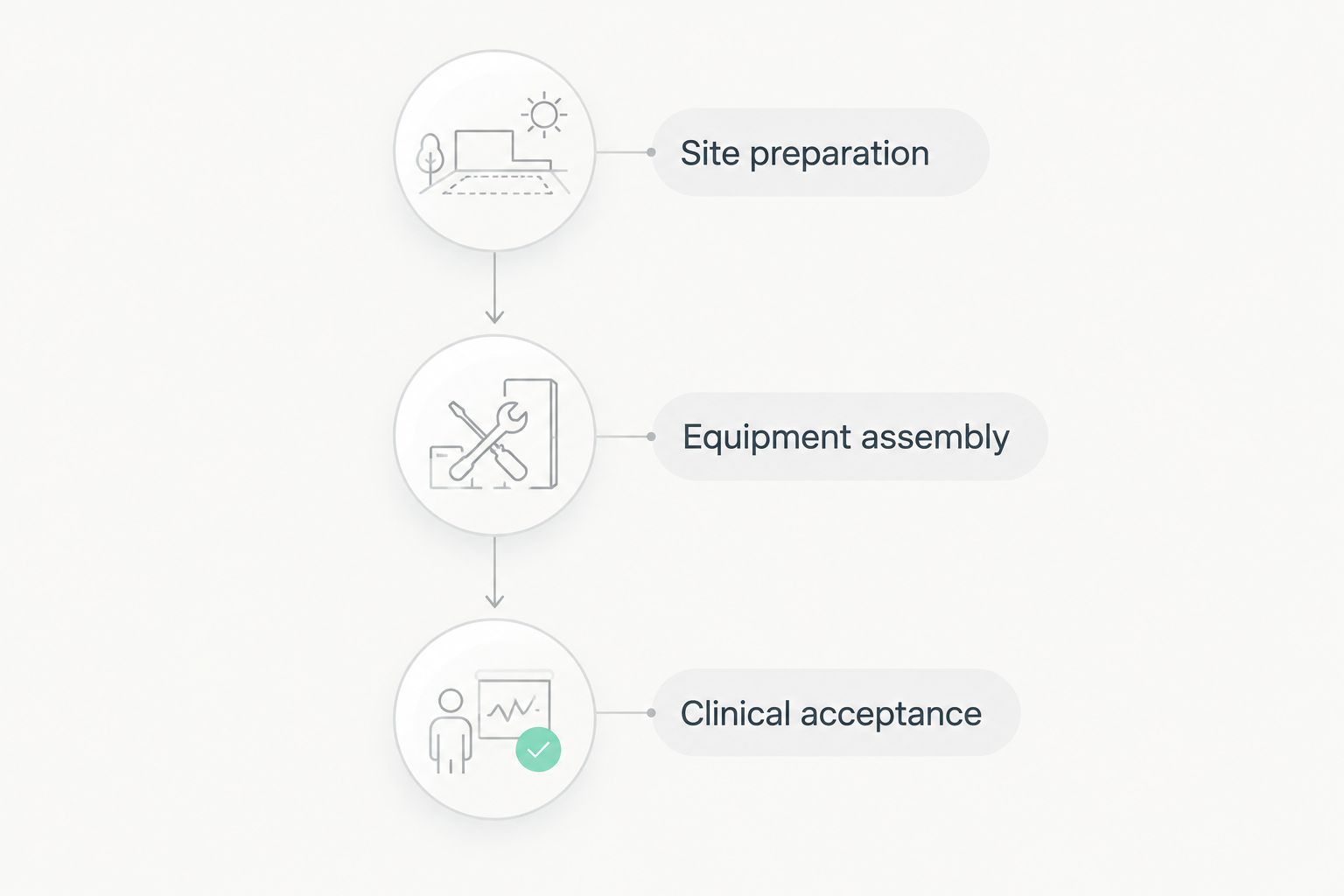
Divide the work into Site preparation, Equipment assembly, and Clinical acceptance. Assign a responsible person to each phase so a completed assembly invoice does not become the clinic's only approval record.
Confirm these scope items in writing:
- Identify every model and its intended installation position.
- State who receives delivery and moves equipment into the room.
- Define assembly, fastening, and functional-check responsibilities.
- Confirm licensing and insurance applicable to the proposed work.
- State whether packaging removal is included.
- Record exclusions, especially electrical, structural, and clinical work.
Inspect the assembly
Use the manufacturer's assembly and operating instructions to guide inspection. Check the assembled configuration against the manual before anyone uses the equipment. Avoid inventing a universal torque value, anchoring method, or belt adjustment for machines with different requirements.
Separate assembly observations from clinical judgments. A missing cover, unstable base, or incorrectly routed cable belongs on the installation correction list. Whether a patient can safely access or use the station belongs with the treating team and its clinical procedures.
For moving or powered equipment, carry out only the checks permitted by the operating instructions and within the reviewer's competence. Keep patients away during installation and initial checking. A clinician does not need to act as a mechanical technician to document a concern and stop the handoff.
Complete these checks before accepting assembly:
- Compare guards, covers, cables, and attachments with the manual.
- Verify leveling and stability using the specified procedure.
- Confirm required fasteners and attachments are addressed.
- Check controls and emergency-stop features where fitted.
- Record unresolved defects and who will correct them.
Document the handoff
Create a handoff record that staff can actually use. Include the model, serial identifier, manuals, installation date, inspection findings, and the person responsible for follow-up. Store it where the clinic keeps equipment records, not only in an individual employee's inbox.
Use two separate signoffs: assembly acceptance and clinic-use acceptance. The first records that the installation work meets the agreed scope; the second records the clinic's decision about placing the station into its intended workflow. Neither signoff should imply a certification the signer is not qualified to give.
For equipment installed in 2026, establish maintenance and cleaning responsibilities at handoff. Follow the manufacturer's schedule rather than creating an unsupported universal interval. If a check fails or a defect remains unresolved, keep that equipment out of patient use until the responsible party addresses it.
Close the handoff with these actions:
- Save manuals, model details, and installation records together.
- Assign an owner for maintenance and defect reporting.
- Record assembly acceptance separately from clinic-use acceptance.
- Brief staff on controls and relevant operating restrictions.
- Document unresolved issues and the condition for releasing the equipment.
Compare installation options for your clinic
Choose the installation arrangement by the work involved, not by the broad label of gym setup. Equipment assembly, building alterations, and clinical acceptance are different responsibilities. No option below automatically covers all three.
Start with the manual and your written scope. A straightforward assembly task and a project involving electrical changes or structural attachments require different expertise. Confirm the boundaries before selecting a provider.
| Option | Best for | Advantage | Key limitation |
|---|---|---|---|
| DIY assembly | Clinic staff with the skills and time for permitted assembly tasks | Direct control over scheduling and documentation | Staff must interpret instructions and resolve assembly problems; clinical suitability remains a separate decision |
| Equipment installer | Assembly after equipment eligibility and site readiness are established | Moves construction work off clinic staff | Clinic projects, anchoring, movement, and commissioning need explicit scope confirmation |
| Facility contractor | Building alterations identified during site review | Addresses the building work needed before installation | Building work does not establish equipment suitability or include assembly unless agreed |
| Clinical equipment vendor | Equipment selection that needs documented support for the intended setting | Offers a route to discuss intended use and service requirements | Installation, training, and ongoing service still need written confirmation |
Homegymassembly belongs in the equipment-assembly discussion because that is its stated service category. Its advantage is an explicit licensed and insured residential assembly offering; its limitation for this guide is that clinic project acceptance is not established by that offering. Verify the project before scheduling.
Discuss your assembly scope
Confirm whether your equipment, location, and clinic setting fit the assembly service.
Common mistakes physical therapy clinics make
Clinic installations go wrong when the team treats assembly completion as the end of planning. Keep procurement, site readiness, and patient-use approval distinct throughout your 2026 project.
- Buying residential equipment without checking intended use. A familiar treadmill or bike is not automatically appropriate for a shared treatment setting. Resolve manufacturer restrictions before purchase.
- Measuring the machine but not the clinician's working position. A footprint-only layout leaves assistance and observation space unplanned. Draw the treatment interaction as well as the equipment.
- Leaving anchoring or electrical work inside an undefined assembly scope. Ask who performs each task and what qualifications the work requires. Do not leave building alterations to an assumption.
- Allowing patient use immediately after construction. Assembly acceptance does not replace clinic-use acceptance. Complete the clinic's review before releasing the station.
- Losing instructions after installation. Without the model-specific manual, staff lack the reference for operation, cleaning, and maintenance. Save the records at handoff and assign an owner.
FAQ
Can a physical therapy clinic use home gym equipment?
A clinic should verify that the exact equipment model permits its proposed use before selecting it. Review manufacturer documentation, obtain clarification about the clinic setting, and have the treating team assess the intended workflow.
What's the first step in home gym installation for physical therapy clinics?
Define the intended clinical use before choosing equipment or booking assembly. Record patient approach, clinician working space, and who will approve the station for use.
Does Homegymassembly install equipment in physical therapy clinics?
Homegymassembly's stated service is licensed and insured fitness equipment assembly for homeowners in Greater Philadelphia and New Jersey. Confirm whether it accepts your clinic project; residential service information does not establish clinic coverage.
Is professional assembly better than DIY for a clinic?
Professional assembly is the better fit when clinic staff lack the time or skills for the manufacturer's assembly tasks and the provider accepts the scope. DIY remains an option for permitted tasks that qualified staff can complete, but neither route establishes clinical suitability.
Does every clinic power rack need floor anchoring?
Anchoring requirements depend on the exact rack and its manufacturer's instructions. Check those instructions and resolve substrate suitability and building permission before drilling.
What should a clinic check before accepting a treadmill installation?
Check the assembled configuration, stability, controls, guards, and applicable emergency-stop function against the manufacturer's instructions. Keep the mechanical handoff separate from the clinic's decision to permit patient use.
What information should a clinic send an equipment assembler?
Send the model details, manuals, installation address, room location, delivery route, and a written list of requested tasks. Identify stairs, restricted access, proposed anchoring, and any unresolved site conditions before scheduling.
One last thing
Make the first booking a site decision, not an assembly date. Before you commit to installation, have the clinical owner approve the use case and the building contact resolve the site questions. That order prevents a fully assembled machine from becoming equipment the clinic still cannot release for patient use.


